Two years. That’s a long time to write a book. But it’s nothing when the book in question is so very, very important.
Of all the books I’ve written (many), this is my most important. I’m a life-long gamer and a devoted thinker, and this book is the culmination of a life spent writing about video games both as essays & blog posts and as hundreds of visual essays, editorials, and comedy videos on YouTube. With Suddenly I was a Shark!: My Time with What Remains of Edith Finch, I feel like I’ve finally made a valid contribution to this world of video games that I love so much.
About Suddenly I was a Shark! My Time with What Remains of Edith Finch.
What Remains of Edith Finch was released in 2017 amid a gaming public that had largely already dismissed the game’s genre. A walking simulator game exchanges the traditional ‘shoot, jump, run’ mechanics of most popular video games for a passive ‘walk, investigate a thing, walk some more’ set of mechanics. With no points, no combat, no puzzles, and no goal other than narrative progression, What Remains of Edith Finch’s success came as a surprise to most. But for those few who appreciated the power of a combat-less, story-driven video game, What Remains of Edith Finch would become a beacon for an emerging trend of games that aim to change the gamer themself. Jimmy Fallon, Saturday Night Live alumnus and host of The Tonight Show with Jimmy Fallon, says of the game, “it’s one of my favorite things… it’s gonna change your life.”
In Suddenly I was a Shark!: My Time with What Remains of Edith Finch, author, and lifelong video game enthusiast, Caleb J. Ross explores the life-changing impact of this unassuming video game about a young woman’s attempt to understand a curse that has killed every member of her family. By mixing developer interviews, personal stories, and examinations of the game’s many literary inspirations, Caleb delivers a powerful story of personal change via one of the most important walking simulator video games ever made.
Humans can’t live without AI. Our brains won’t let that happen.
Recently Insomniac revealed that their next game (presumedly Marvel’s Spider-Man 2) will feature “very cool” new dialogue technology. Insomniac didn’t provide any further details, so my brain immediately went in a direction toward generative Artificial Intelligence (AI) because of course anything “new” and “very cool” must be commandeered by our future robot overlords. A few days later, head of Sony’s Independent Developer Initiative Shuhei Yoshida offered a few thoughts to GamesIndustry.biz about generative AI, saying “Those AI tools will be used in the future, not just for creating assets, but for animations, AI behaviour and even doing debug.”
AI prompt: Shuhei Yoshida as a robot
To be frank, when I measure the possible good against the probable bad, I tend to fear what generative AI will bring to video games. AI has been part of games for a while, but mostly as a background design tool (texture generation, for example. Though texture generation is technically “procedural generation,” not AI. It’s a sliding scale: “procedural generation doesn’t typically use AI.”). We haven’t yet seen AI as a marquee feature. We don’t yet know how AI will influence the foreground parts of games like character movement, quest generation, or dialog.
I won’t pretend to know how designers will leverage AI for game design. I’m not that smart. But follow me as I allow my ignorance to breed fear for a moment.
Beyond the standard fears with AI—the loss of jobs for humans, mostly—I fear the loss of community.
Right now, in our human-curated gaming world, one of the great side effects of games is that multiple people are able to congregate around a shared experience. But when that experience is fractured into many (hundreds? millions?) of different experiences, how can a group of people gather ‘round the water cooler/campfire to discuss a single experience? Will the live event become the de facto experience? …
Live streaming will be the only way to share a game experience.
One possible output of using generative AI for the foreground parts of video games is that Twitch-style game live streaming will become an even greater component of video games than it is already (which is hard to imagine, I know).
Streaming will no longer be a way to share an experience between the streamer and other viewers but will become the only way to experience, with a group, a particular version of a game. If that streamer gets a side quest or a dialog option that nobody else will ever see, then the only way to become absorbed into the zeitgeist of a game is to be present during the micro-zeitgeist of a Tuesday evening streaming session.
I’m worried about this future. I’m busy on Tuesday evenings.
Whoa, Caleb! I think you are forgetting that generative AI isn’t necessarily something game designers will use as a real-time mechanic…
Generative AI creates the end product; it isn’t the end product.
Generative AI isn’t necessarily something that would be used during gameplay. In fact, much more likely (to Yoshida’s point), AI would be used during the development phase to create the assets that would then go into the final singular experience.
AI could be applicable during pre-production to ideate upon concept art. In fact, I’m guilty of using the AI tool MidJourney to help jumpstart my own creative solo brainstorm[1]A small brainstorm…maybe, a brain microburst? when designing the cover of my newest book Suddenly I was a Shark!: My Time with What Remains of Edith Finch (which releases June 12, 2023). Ultimately, I created a cover that was not informed at all by the MidJourney output, but my mind was still opened up to the possibilities of using generative AI to get the brain juices flowing.
For anyone who has ever been part of a brainstorming process, you know that kickstarting the process can be hard. Maybe we let AI kickstart it for us.
Whoa again, Caleb! I think you are also forgetting that most video games never offer a truly universal experience…
Games have rarely promised a single experience.
Games have always been procedural engines that rarely output a singular experience. The most well-known procedural generation type is the Roguelike genre which is entirely dependent upon randomly generated scenarios.
And beyond procedural generation as a genre mechanic, sometimes games—no matter the genre—have random enemy spawns and random enemy pathing that are based on the player character’s behavior which is, of course, subject to the whims of the (relatively randomly motivated) player.
There’s also a thing called RNG (random number generation) which is a stand-in term for how games randomize everything from loot drops to attack rates. Such things are technically random experiences.[2]Though practically speaking, they still mostly honor the plot points that inform the community conversation that I so cherish. In fact, under a powerful enough microscope, there is no singular experience.
In a video (featuring a much younger, baby-Caleb) titled “Are You Always Cheating in Video Games?” I argue that any deviation from a game designer’s intended mode is cheating, yet, paradoxically, it’s impossible for a game designer to insist upon a single mode. Therefore: no single experience.
Regarding the player’s adjustment of a difficulty setting, for example, I said: “…if the argument is that the normal, default mode is the correct, non-cheating mode, then playing either the easy mode or the hard mode is cheating [as either is a deviation from the intended play mode, despite one being more difficult].” Furthermore:
“By that logic, [players and critics] have a lot to demand from developers in order to agree on what is the default mode. You’ve got to look outside the game—not just difficulty settings, brightness level, effects volume, controller input map—but also how big your tv is, the comfort of your chair, the controller you are using, what food you’ve eaten…”
It’s impossible to build a critique around a single experience because a truly single experience is impossible. So, fearing a future of bespoke experiences is, maybe, possibly, just a little bit, okay(ish).
Whoa for the third time, Caleb! I think you just convinced yourself that generative AI has a place in video games that doesn’t need to be met with fear…
A bright side for those of us who sometimes appreciate a curious human over the human curiosity.
When I imagine a future in which plot-critical elements of a game are unique per player, then I see a less interesting world where fans of gaming, and fans of gaming conversation, are less served than they are now. The conversation about a game becomes impossible when there is no shared view of what the game is. This possibility is scary. I can’t be convinced otherwise.
Buuuuut, if I dismiss both the benefits that generative AI could bring to the ideation phase of game development, and the potential for a water-coolerless world, I do still see one more, small, yet highly speculative, benefit.[3]Though possibly just as a curiosity rather than as a practical win. And for what it’s worth, I believe curiosity is a net positive in and of itself. What happens, I wonder, when Death of the Author is fully realized, forcing criticism to abandon authorial intent?
What happens when a group of humans (gamers, museum-goers, concert audience members, etc) collectively discuss a piece of art, as art, that has no practical human source?
Let’s imagine generations of distance between the input and the output where the human context has been completely phased out of art’s creation. What happens then?
Does the audience become hyper-focused on aesthetics to the detriment of the art’s intellectual implications?
Is a “human seed” necessary to have an intellectual argument or can (must?) non-human art still be coerced into an intellectual argument? I mean, humans are the ones having this imagined argument, and so humans must adapt to any situation per the tools we have available, so what’s left but to accept that a human with a brain will see every nail as a subject to our brain-hammer?
Technology isn’t scary to those raised by technology.
I understand that I’m likely being very reductive. Nuance is hard to parse when the event horizon isn’t even visible. On a smaller scale, my paranoia is the same paranoia that drives every aging person ever. To fear the unknown is natural. So, I must constantly remind myself of a conversation I had years ago with author Stephen Graham Jones about the ebook’s (at that time impending) encroachment of paper books. I feared a generation that wouldn’t know the pleasures of physical books, a generation of people not knowing a paper book’s smell, of not knowing the feel of the paper at your fingertips when turning pages, of not looking down to the top of the book to see a bookmark marking your progress. Stephen argued that a new generation of readers will not lose those connections to books. Those connections will simply take on different forms. They will cherish the heat of an e-reader against their palms, the glow of its screen under covers, and the few seconds lag between touching the screen and seeing the next page flash into existence.
In other words, a future generation of gamers will love generative AI art for reasons we in the current generation cannot fathom.
The human is an incredibly adaptable creature. Our brains won’t let us live without intellectual and emotional attachments to art. With that in mind, I embrace my curiosity about what generative AI will bring to video games. Yes, despite how likely it might be that AI will drain the office water cooler, I’m curious about how the big-brained human will refill that cooler, because the human cannot exist without a full office cooler.
Today is an exciting day. Today, I reveal the cover of my newest book, a book about my favorite video game of all time, What Remains of Edith Finch!
I’ve worked on this book for the last two years. Of all the books I’ve written (many), this is my most important. I’m a life-long gamer and a devoted thinker, and this book is the culmination of a life spent writing about video games both as essays & blog posts and as hundreds of visual essays, editorials, and comedy videos on YouTube. With Suddenly I was a Shark!: My Time with What Remains of Edith Finch, I feel like I’ve finally made a valid contribution to this world of video games that I love so much.
(The paperback version will be available closer to the release date)
Paid subscribers here on Substack will get the .epub version of Suddenly I was a Shark!: My Time with What Remains of Edith Finch as part of their subscription. Upgrade to a paid subscription now.
Now, without further ado, here is the book cover…
…
…
Keep scrolling.
…
…
…
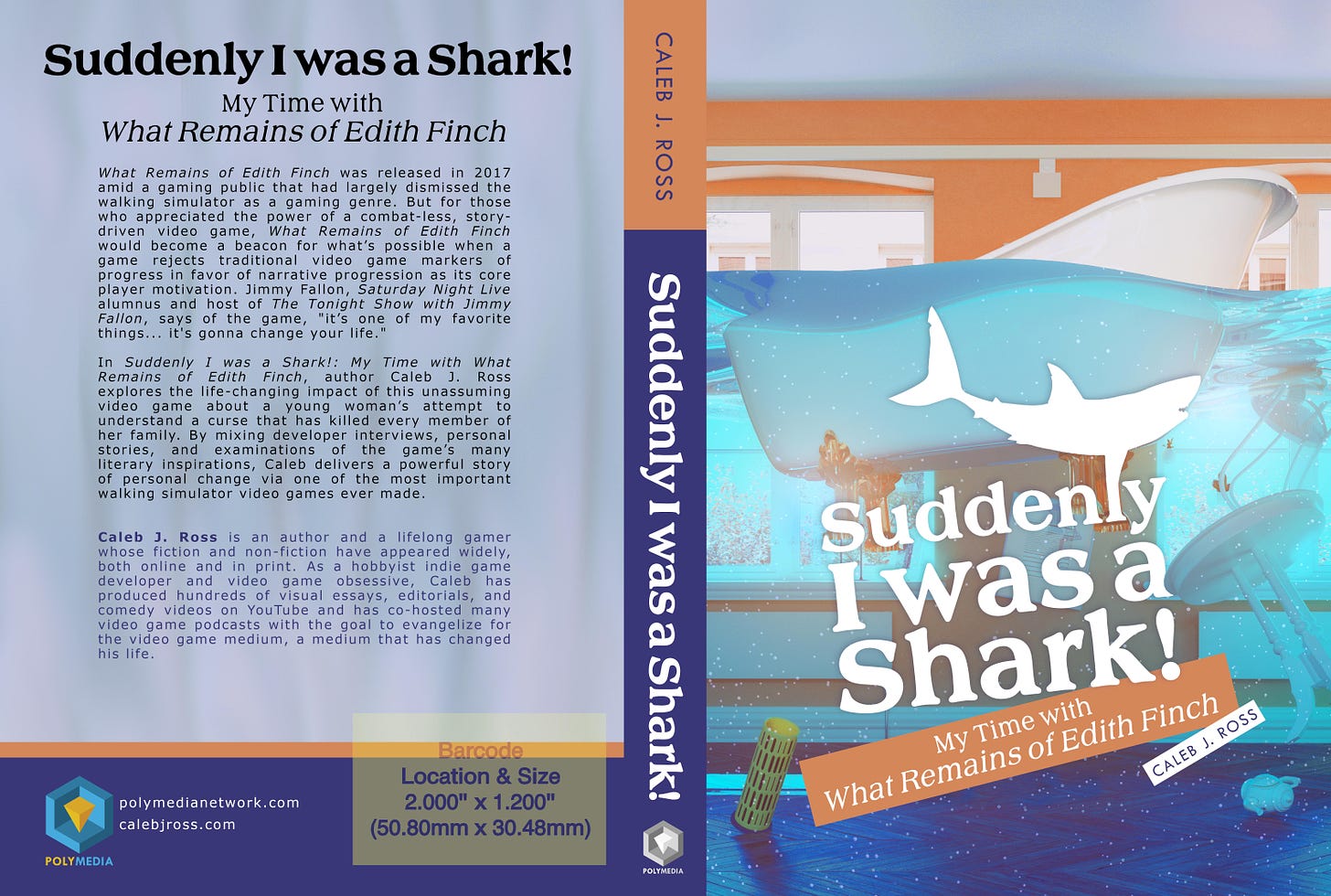
Front and back cover of Suddenly I was a Shark!: My Time with What Remains of Edith Finch by Caleb J. Ross
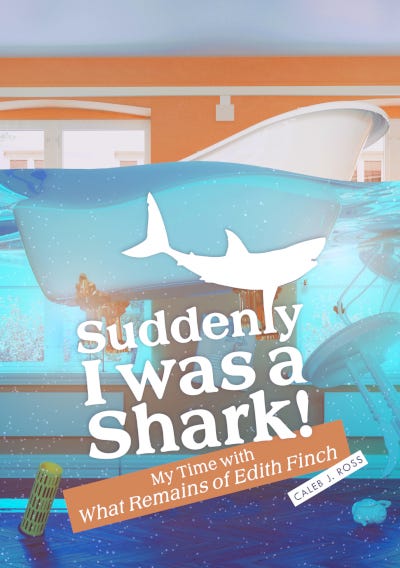
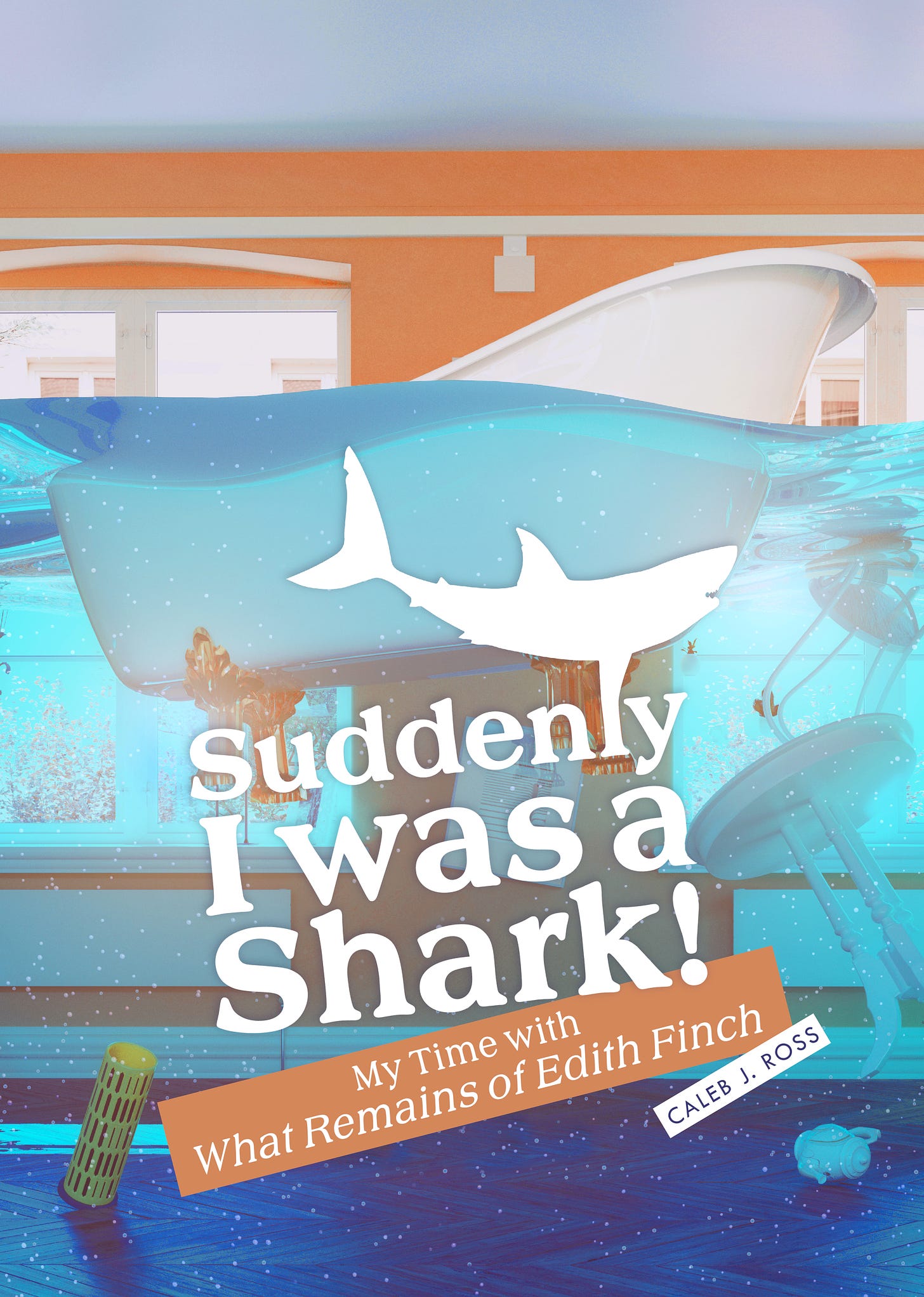
Front cover of Suddenly I was a Shark!: My Time with What Remains of Edith Finch by Caleb J. Ross
About the cover design
Much like Creative Director Ian Dallas wanted to evoke feelings of the sublime with What Remains of Edith Finch, I wanted the cover of Suddenly I was a Shark!: My Time with What Remains of Edith Finch to do the same. The bathtub floating within its own impossible overflow is surreal, awe-inspiring, and definitely sublime.
Additionally, the flooded bathtub might remind some readers of a specific scene in the game, but I won’t ruin your day with that absolutely heartbreaking event. Play the game. Read the book. You’ll know.
The oversaturated colors give off a dream-like quality that compliments the dreaminess of the image’s subject. This cover is a window into the impossible.
The title text is angled to highlight the buoyancy of objects within the flooded bathroom. Much as the table, the chair, and the bathtub itself are powerless to escape the flood’s lift, so too are the title’s letters.
My favorite little detail is the way the table juts out in front of the “a” which forces the title to become part of the scene, rather than just a layer on top of it. But, then the shark shape, a flattened, very non-real portrayal of the animal, which is attached to the letter “l,” stands defiantly in contrast to the realness of the world that the overlayed table tries to pull the text back into. I love this conflict of surreal dreaminess and iconographic stability. I have to say, though, it seems the dream is winning this battle.
(The paperback version will be available closer to the release date)
About Suddenly I Was a Shark!: My Time with What Remains of Edith Finch
What Remains of Edith Finch was released in 2017 amid a gaming public that had largely already dismissed the game’s genre. A walking simulator game exchanges the traditional ‘shoot, jump, run’ mechanics of most popular video games for a passive ‘walk, investigate a thing, walk some more’ set of mechanics. With no points, no combat, no puzzles, and no goal other than narrative progression, What Remains of Edith Finch’s success came as a surprise to most. But for those few who appreciated the power of a combat-less, story-driven video game, What Remains of Edith Finch would become a beacon for an emerging trend of games that aim to change the gamer themself. Jimmy Fallon, Saturday Night Live alumnus and host of The Tonight Show with Jimmy Fallon, says of the game, “it’s one of my favorite things… it’s gonna change your life.”
In Suddenly I was a Shark!: My Time with What Remains of Edith Finch, author, and lifelong video game enthusiast, Caleb J. Ross explores the life-changing impact of this unassuming video game about a young woman’s attempt to understand a curse that has killed every member of her family. By mixing developer interviews, personal stories, and examinations of the game’s many literary inspirations, Caleb delivers a powerful story of personal change via one of the most important walking simulator video games ever made.
(The paperback version will be available closer to the release date)
Tell the world!
Do you know someone who loves What Remains of Edith Finch? Do you know someone who loves reading about video games? Share this post with them or consider buying a copy of Suddenly I was a Shark!: My Time with What Remains of Edith Finch for them. They will love you forever…probably.
Video games are a power fantasy, but I only recently realized what that might actually mean. I’ve long assumed that the “power” part of the fantasy refers to a game’s ability to give players focused agency: shoot what you want, how you want, and when you want. A fantastical power. Or, maybe not just “power,” as in firepower, but also narrative power: talk to who you want, when you want, and about what you want. Or, puzzle power: move the blocks you want, when you want, and how you want.[1]All this power must be within the confines of the game’s design, of course. Otherwise, the fantasy isn’t a fantasy. It’s just blank paper and some crayons. Freedom equals power.
But I recently realized a different form of power fantasy that video games allow: the power not just to make a decision but to be confident about that decision. See, my life is filled with assumptions (at work, I assume what that pie chart means; at home, I assume that my kids and I agree on what “clean” means). Video games provide feedback (ie, answers to questions) that instill confidence.
But I recently realized a different form of power fantasy that video games allow: the power not just to make a decision but to be confident about that decision.
Eradicate assumptions…most of the time
I have a mantra at my day job: eradicate assumptions. Basically, I ask enough questions until a situation has exposed all of its variables so that I can make a good decision. Eradicating assumptions has been an incredibly positive practice in my daily life. I ask what a pie chart means, even if it seems obvious. I review action items following every meeting because it’s dangerous to assume that everyone knows what they need to do and equally dangerous to assume that I know what they need to do. Maintaining such assumptions forces me to reserve space in my “head RAM” for this unknown data. That’s not fair to me or to the person who is unwittingly being charged with my own assumptions.[2]Dear Google Calendar, please remove the option for an event guest to select “maybe” as an option for attendance. “Yes” and “no” are all we need. Thank you. Eradicate assumptions.
Playing and developing video games over the years have allowed me to live in a glorious utopia of eradicated assumptions. I don’t worry about “what if” because the “whats” are all there for me to parse. My health bar is always visible when I’m put in situations where health can be impacted. My character’s heavy breathing indicates critically low stamina. A well-designed game gives players access to the information they need to make a decision when that decision needs to be made. Well-designed games eradicate all assumptions. Well-designed games avoid paralysis by assumption.
Well-designed games eradicate all assumptions. Well-designed games avoid paralysis by assumption.
But while video games can always be distilled down to binary decision trees, people are generally pretty complicated. This reality has led me to a default state of apology when outside my warm, comfortable world of gameplay feedback.
Most of the words that come out of my mouth during interactions with living (ie, non-video game) people are forms of an apology. I think this habit boils down to a lack of interest in competition, conflict, and even coercion. I accept life as it is, rarely fighting for myself. This isn’t a noble stance; don’t be confused. It’s almost certainly more of a lazy stance.[3]Some might take this immediate categorization of my act as “lazy” as just an example of my anti-conflict nature. Those people are probably right…again, I automatically say the other person is … Continue reading People can be so nuanced, so idiosyncratic, that no number of questions can eradicate every assumption. So, I operate under a universal assumption to blanket all unknown assumptions: I assume I am always in the wrong. This is my safety blanket assumption, a failsafe for human interaction.
Inside my safety blank of assumed fault
I’m so non-confrontational that I approach every interaction as an assumed competition that I’ve already lost. In this way, my competitor no longer has any reason to fight. We can move on to more important things (like assumptions that can be confidently eradicated). When interviewing subjects for my What Remains of Edith Finch book, my interview pre-amble often tripped aimlessly amid caveats to shield against assumed animosity. This book will be a love letter of sorts, it’s NOT a hit piece…I know you maybe never thought it was a hit piece, but you know, just in case you did, you shouldn’t think that…not that you’re wrong to have thought that. I mean, there are always vultures circling, right? But I’m not a vulture, unless you like vultures, then let’s talk about vultures. Let’s forget this interview entirely; this should be about you, not me. What’s your favorite vulture fact?
At work, part of my job involves teaching people how to use software. For every wrong click my student makes I apologize. I should have guided better. I give them no room to defend their actions. Instead, I apologize. Let’s try again. This time, I’ll do better.
When I pass strangers in the grocery store, close but not touching, I do so with a “pardon me” hanging from my lip. Always. The fear of collision, of confrontation, is enough to prime an admission of my own guilt even when, rationally, no guilt is necessary.
I’d like to think that my always-assume-I’m-wrong stance on life has led to strong relationships and a better understanding of the people around me. My rationale is that if I show the other person how much I respect them (by pre-conceding to any of their truths) then the other person doesn’t see me as a threat and is more likely to be open and honest with me. Surely, though, this has backfired; can people see through this, lose faith in my humility, find me not worth their time? Probably.
My rationale is that if I show the other person how much I respect them then the other person doesn’t see me as a threat and is more likely to be open and honest with me.
Even my movements, wordless, are gestures of apology. I tend to sit cross-legged, one leg crossed over the other, meeting the lifted leg’s ankle against the grounded leg’s knee. When sitting this way anywhere in public where the chairs crowd a walking route—waiting rooms in doctor offices, airport terminals, the DMV—my hanging foot searches for a stranger walking like a dog’s snout hunting smells from a car window. Upon sensing stranger movement, I flex my ankle open, like a salon door, to let a stranger pass, for concern that they just might, despite their distance, be forced to carve a path around my foot. Would the extra few inches I offer even matter to a stranger already given in to the labor of foot travel? No. Certainly not. I know this, but I move my foot anyway.
Team Quiet versus Team Loud
Even my lack of movement is an apology. At my favorite writing spot (a local cigar lounge; maybe a topic for a future post), there’s a tension that sometimes suffocates the room. A divide exists between those of us who want quiet—who want focus, who want to work or read or simply enjoy the silence in a way that life otherwise prohibits—and those who see the three 70” wall-mounted TVs and assume that those TVs are meant to be used (assume rightly, I concede). Unfortunately, their use comes with a kingly control over the TV volume, a power too many on Team Loud wield haphazardly. It doesn’t help my side, Team Quiet, that the chairs along the half-perimeter facing the TVs are large and soft enough to camp in and their collective shape (tiny crescents) encourages conversation. The room isn’t built for Team Quiet. In the battle of Form v. Function, where one must precede the other, Team Loud takes the Form victory at the cigar lounge.
In the battle of Form v. Function, where one must precede the other, Team Loud takes the Form victory.
A few days ago, I arrived early to the cigar lounge. Early arrival is the only way to stake claim to Lounge Land for Team Quiet. Even a soldier from Team Loud, upon entering a silent room already occupied by Team Quiet, sometimes questions their own alignment, unwilling to interrupt a stranger’s focus by turning on the TVs. My presence is enough for them to question their own presence. I respect these wartime sympathizers.
That day, I managed to hold the territory for a full two hours. Just me, my computer, and three powered-down TVs. It was a glorious day.
Two hours is about as long as I can write in a single stretch. So, satisfied with my output, I remove my Team Quiet armor—two foam earplugs— and prepare my exit.[4]My preferred brand of earplugs come in both a light tan color (the color of my white-guy skin) and bright blue. I use the blue model, because what’s the point of flesh-colored ear plugs? I want … Continue reading But then, like an assassin in the night, a Team Loud soldier arrives. He plops down in a chair directly opposite the center of the three TVs and powers on the center screen to a basketball game, mashing the volume-up button before the sound even has a chance to escape from the speakers, before he even has a chance to measure the need for his volume raid. This guy is a pro, a Capitan. A Lieutenant, at least.
I freeze. I had already decided to leave, but now I have to consider my options. But—and here’s where my lack of wartime commitment reveals itself—my options are not in service to this outward battle of Loud versus Quiet. Rather, my options are in service to my inward battle of optics: if I leave now, this TV guy will think I’m leaving because of his arrival, because I don’t like him, or because I’m mad at his mere existence, because, I mean, nothing else has changed. His arrival is the only variable. My leaving is the only result. The assumed conflict paralyzes me. My own Lieutenant would be very disappointed in me.
Of course, I say seated. In lieu of my exit, I re-read what I had just finished writing, pretending to do an edit pass, but thinking “how long is long enough so that this TV guy doesn’t mistake my exit for a frustrated, huffing-and-puffing, angry exit?” The real answer, the logical, rational, actual answer: no amount of time is long enough, because the very conceit upon which my “problem” is built is dumb. Caleb, just stand up and leave! That guy is already yelling at the screen because some guy failed to put a ball in a hoop. He doesn’t even know you are there.
…the very conceit upon which my “problem” is built is dumb.
Even should I frame this tension through the lens of my Loud versus Quiet battle, staying seated only communicates to my rival that the interruption is okay. Team Loud doesn’t learn anything if I stay. There’s legitimately no reason to not leave. I’m both a paranoid human AND a bad soldier.
I speak only in apology. I move according to apology. I remain unmoving according to apology.
While maintaining a safety blanket assumption of fault eliminates the need to eradicate so many other assumptions, video games offer a respite even from that one blanket assumption. When playing video games (and when programming video games), I get to live a life without any assumptions. It’s delightfully freeing.
When playing video games, I get to live a life without any assumptions.
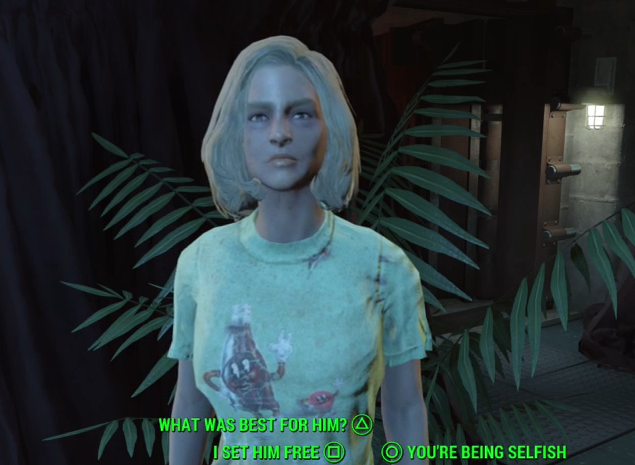
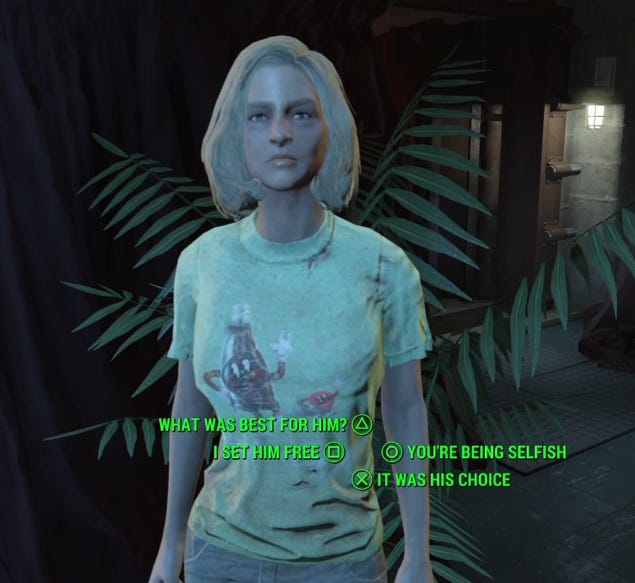
In my forthcoming video game essay, “There are No Kidney Stones in the Commonwealth: How Fallout 4 Saved My Life,” I poke fun at Fallout 4’s dialog system (Pre-order the essay on Amazon or become a paid subscriber to read it here on Substack and to receive a .epub version of the essay when the essay is released). Each dialog tree offers only four responses to any statement. These choices are not only limited in number but they are also limited in the nuance that so many other RPGs have accepted as necessary convention. But upon writing that essay I was reminded about the comfort such definitive, and limited, choice can bring. I re-fell in love with a video game’s commitment to exposed variables, to a world without assumptions.
Yes. Dear, sweet, limited choice options.
Maybe I should try my hand at confrontation in real life. Maybe I don’t have to rely so heavily on my safety blanket assumption of fault. Maybe I can actually tell a stranger they are wrong.
Will I, though? Will I ever confront a stranger? Probably not. I fear I won’t just be paralyzed by assumptions but might also get paralyzed by fists.
All this power must be within the confines of the game’s design, of course. Otherwise, the fantasy isn’t a fantasy. It’s just blank paper and some crayons.
Dear Google Calendar, please remove the option for an event guest to select “maybe” as an option for attendance. “Yes” and “no” are all we need. Thank you.
Some might take this immediate categorization of my act as “lazy” as just an example of my anti-conflict nature. Those people are probably right…again, I automatically say the other person is the correct person. Ugh. This trap of mine!
My preferred brand of earplugs come in both a light tan color (the color of my white-guy skin) and bright blue. I use the blue model, because what’s the point of flesh-colored ear plugs? I want people to know, from dozens of feet away, that I want nothing to do with them.
I’m currently in the final stages of editing my upcoming book about What Remains of Edith Finch! The book is called Suddenly, I was a Shark: My Time with What Remains of Edith Finch. I’ve never been so excited about a writing project before.
I’m a life-long gamer and a devoted thinker, and this book is the culmination of a life spent writing about video games both as essays & blog posts and as hundreds of visual essays, editorials, and comedy videos on YouTube. With Suddenly, I was a Shark: My Time with What Remains of Edith Finch, I feel like I’ve finally made a valid contribution to this world of video games that I love so much.
Please enjoy this sneak peek from an early chapter in the upcoming book. And please subscribe using the button below to stay informed on the book’s progress, an upcoming cover reveal, and a publication date (I’m shooting for June 2023). Paid Subscribers will receive a .epub version of the book as part of the subscription (in addition to .epub versions of ALL of my current books and essays).
“As a child, the house made me uncomfortable in a way I couldn’t put into words…” -Edith Finch
Edith stands on the estate side of a padlocked gate. The fence’s top rail behind her has bent to the weight of her body where she had heaved herself over. Surmounting this shaky fence could not have been easy.
I face down a winding asphalt path toward the home that Edith and her mother escaped from seven years ago. The asphalt is buckled and broken; the world below has refused to settle during those empty years. Tree roots have rippled the ground. Ivy reclaims the wooden barrier lining the path like it’s trying to rip down this safety measure, to make any intruder’s journey a dangerous one. But Edith would not have returned if danger worried her.
Edith is the lone surviving member of the Finch family, following 11 deaths beginning with her great-great grandfather, Odin. She’s returned here to her childhood home, following her own mother’s recent passing, to learn the truth of these strange deaths, to learn if what her great grandmother Edie claimed is true: the Finch family is cursed.
This asphalt path she’s on leads to many things. For the Giant Sparrow development team, this path at the start of their game What Remains of Edith Finch leads to a 2018 BAFTA Award for Best Game, a NAVGTR Award for Best Original Adventure Game, a SXSW Gaming Awards award for Excellence in Narrative, a 2017 The Game Awards award for Best narrative, and a slew of nominations. For gamers it leads to either the epitome of an underappreciated gaming genre or it leads to further evidence of an over-appreciated one. For me—an author of several books of fiction—it changes my entire understanding of the power of story. And it will change you, too, as it has so many players. Saturday Night Live alumnus and host of The Tonight Show with Jimmy Fallon, says of the game, “it’s one of my favorite things… it’s gonna change your life.”
But for 17 year-old Edith Finch the path leads to her childhood home tucked away within the sublime forests along the coasts of America’s Pacific Northwest. This is a world of vagabonds and misfits. This is a world of hope and death. This is a world where trees and cliffs meet, each offering opposing options for escape. A tree points optimistically upward into open sky while a cliff offers escape downward into the sea. The Finch home itself, then, is a limbo trapped between exits.
There are no shops out here. No schools. No neighbors. Only one restaurant, a Chinese takeout, delivers this far outside proper civilization. But the woods, though they are forever patient, are unquestionably alive. “The woods around the house have always been uncomfortably silent,” Edith says as I walk the path from the padlocked gate to Edith’s empty childhood home. “As though they are about to say something but never do.”
Breathtaking, you could call it; Edith’s world is one that threatens to take your breath just as it has taken the breath of Edith’s family.
What Remains of Edith Finch is set in a house framed by trees that are themselves framed by the Pacific Northwest’s cruel geography. This region’s reputation for awe is in full force here, guiding me forward despite persistent unease.
Creative Director, Ian Dallas, wanted What Remains of Edith Finch to give the player a feeling of the sublime, of being stricken by beauty and simultaneously fearful of it. The game’s setting certainly primes the story for the sublime. Its geography and citizenry clash and compliment to create a uniquely alluring world. Portland, Oregon author Katherine Dunn once identified the Pacific Northwest as a place of misfits, reasoning that those who want to escape their hometowns for a better life travel west then migrate north for its cheap cost of living. Speaking to Chuck Palahniuk, a fellow Portland author, she said “we just accumulate more and more strange people. All we are are the fugitives and refugees.”
Parts of the Pacific Northwest still today maintain a reputation for a vagabond culture that proudly rejects homogeneity while proclaiming acceptance.[1]I want to be careful not to conflate all of the Pacific Northwest with just Portland, Oregon, as the city is uniquely weird (rivaled in notoriety perhaps only by Seattle, Washington, just 170 miles … Continue reading This is a land where mainstream narratives are met with suspicion. Pacific Northwest native Kurt Cobain, of the band Nirvana which popularized Seattle grunge music for the world in the early 1990s, famously rejected the rockstar flamboyance narrative of preceding generations. “There is nothing in the world I like more than pure underground music,” Cobain told Sassy in April of 1992. “Pure” and “underground” are anathema to the then-popular adornments of mainstream success: big hair, pyrotechnic stage shows, and machismo. That same year Nirvana’s song “Smells Like Teen Spirit” won an MTV Video Music Award, one of the highest honors given by the once dominant television channel and arbiter of popular music. The song title etched into the award placard misspells “Teen” as “Team.” This error surely didn’t change Cobain’s opinion of the mainstream.
As an angsty teenager I loved what Nirvana embodied despite Cobain dying and the group having disbanded before I reached those teenage years. I felt trapped in my small town in Kansas, and I looked to the Pacific Northwest as a land of compatible souls. But even when I graduated high school and applied to universities, I never considered an actual move to the West. I felt comfortable keeping that world at arm’s length. I was shaped by the lyrics of a dead man, but I was unwilling to tempt the world that had shaped him. In that way, Edith is much braver than I am. The world she’s returning to is armed and eager to shape her, and she’s ready for it.
From the padlocked gate, I look toward the path’s end. At the top of this hill in the center of the forest, cropped at the center of the player’s screen, a cathedral-like spire juts from the horizon. It’s rejected by the surrounding world. An expunged poison. Pus from a popped zit. This is my destination. This misshapen, confusing, and obviously unsafe structure—obvious even from this distance of several hundred feet—was Edith’s home just seven years ago.
From this distance the construction could be the product of a weary believer driven by an impatient god to hastily construct an idol. Or it could equally be the purposeful work of a craftsman inspired by the fantastical logic of a Rube Goldberg machine. After numerous playthroughs, I’m still not sure which is more accurate.
One thing is for sure: the impossible house is intoxicating. So, I do the only thing the game allows me to do at this point. I walk toward the house. Slowly. The world slumbers as I shift along the path before me. Slowing down, as it turns out, is a great way to change me, to turn the world itself into an epiphany.
I want to be careful not to conflate all of the Pacific Northwest with just Portland, Oregon, as the city is uniquely weird (rivaled in notoriety perhaps only by Seattle, Washington, just 170 miles north, which is itself 100 miles of coastal and ferryboat travel south of Orcas Island, the proper setting of the game), but this focus is necessary in order to understand the Finches. Their home is a lone beacon of mystery secluded amid dense forests and bays in the very Northwest corner of the Northwest region. The home is a soup cracker of strange within a bowl of weird amidst a full table of adequately normal.
Imagine inventing a word that’s used by millions of people every day. Would you fight for recognition? Would you use the term daily, forcing its square frame into every conversation’s round hole? You’re like a small business owner whose every article of clothing frames a logo, no matter the occasion. “I’m sorry about your loss,” you say to a grieving daughter at her mother’s funeral. “Your loss of all that empty space in your apartment after you come on down to Phil’s House of Phurniture, off I-35 and Santa Fe!”
Imagine inventing a word that’s used by millions of people every day.
Or do you remain quiet? Maybe not out of humility or even not as an aversion to Phurniture Phil’s obnoxious lack of social tact, but instead in service to the weight you’ve unwittingly placed upon yourself? Imposter syndrome stemming from a single, early success. Do you pigeonhole yourself, never moving far from your trademark word for fear that you’ll be untethered from it and so have your legacy drown out by so much subsequent comparative banality? The only way to stay relevant is to stay quiet. You ride your initial fame, like a one-hit wonder, but unlike most such wonders, you gracefully retreat from the stage.
Sure, maybe you aren’t satisfied with your single-waypointed legacy, but you respect the shadow it has cast. Where some word artists may follow up their surprise hit “cacophony” with a sophomore attempt like “blastical” or “favrincol” to an uninterested audience that has already moved on to sold-out shows featuring “riposte” and “serendipity,” you instead relax into silent acceptance. “Cacophony” alone was good enough for you.
Besides, how would you even prove that you are the inventor of the universally praised “verisimilitude?” Would you record your voice and depend upon the file meta-data’s creation date as enough evidence for the U.S. Copyright Office? Or do you photograph the shape of your mouth making the word? Maybe even apply a sepia filter to give the impression of age, of gravitas, of proof in the way early photographic documentation can.
This is my great-great grandfather inventing the word “mervelt.”
I’ve been on the lookout for great words my entire life. I scout them. I’m like a talent agent, looking for words to represent. This hasn’t always worked out for me. Early in my agent career I scouted an entire phrase, having not yet even proven myself capable of single words.
Years ago, the late 1990s, a commercial for Sprite featured three streetball-playing men pushing the soda onto viewers with all of the bravado and forced intimidation that came to represent that time period. Suddenly, the director of the commercial yells “cut!” and these three men soften to a stereotypical representation of effeminate males who are more aligned to classical stage theater than to the basketball court. It’s a hard commercial to watch in 2023. Enjoy:
That commercial taught me…well, showed me, the phrase “what’s my motivation.” I was, at that time, part of a high school play called “You Can’t Take It with You,” and as my small-town school with limited resources would imply none of the student actors came up as “theater kids.” At our school, the only options for personality alignment were sports and other sports. Oh, some kids were farmers, but in such a small town, farming was essentially a sport.
I understood the concept of motivation, of course, but when presented in the context of an artistic production I imparted a unique meaning upon it. Like how “break a leg” doesn’t really mean break a leg. “What’s my motivation” must have meant “what is the key to this scene,” I rationalized. So, in the middle of my English/Theater teacher giving direction to a separate group of unguided high school students/linebackers/farmers, I asked “what’s my motivation?” She stopped mid-sentence, obviously confused by my audacious interruption, but surely equally confused by the sudden appearance of this phrase that she had never taught to us.[1]Even she must have known that teaching us theater theory isn’t worth her time given the lack of general support at the school for a theater personality. Her simple response: “Your grade.”
Hindsight would show me what a perfectly concise and piercing burn that was, made especially so because it came from a teacher who trafficked more in the “hippy, free-spirit” method of acting than in the “no-nonsense, tough-love” method that might have better served her insult. But at the time, I didn’t know. I accepted the direction as though it were sincere, focusing on what “your grade” meant to my character. I never found that meaning.
Years later, my own sons would unintentionally manifest interesting words. Their creations generally arose from their young vocabularies devoid of existing suitable words. For example, my oldest, at the age of six, coined the term “knee armpits” to refer to the back of the knee. The layman would say simply, “kneepits,” but I loved the window into his mind, his understanding that words can be broken down and melded together. That same son, earlier in his life, at the age of four, once yelled out to his mother and I that he had an itch on his “penis cheeks.” He meant scrotum.
Perhaps most impressive was when my youngest son, about the age of four, coined the term “whobody,” as in, “whobody stole my cake‽” It’s a word that both accuses and asks, perhaps the only word in the English language that demands an interrobang. I love this word because it serves a legitimate purpose rather than new slang words, for example, which just serve to offer a decorative flair to existing words. “Whobody” makes the English language more efficient. To capture the same statement and question, our language prior “whobody” would have to declare both “somebody stole my cake!” with a follow up “who was it that stole my cake?”
Not long ago, I made what I feel is my only valid contribution to the English language. This time, not as a scout, but as a talent.
Ludoanthropomorphic dissonance. noun. [loo-doh nar-uh-tiv dis-uh-nuhns]: the tension caused when human-like characters in video games behave in non-human-like ways, generally to the benefit of gameplay. Example use: Because of the game’s ludoanthropomorphic dissonance…which, as an aside, is a super cool term probably invented by a very handsome guy, I’m able to enjoy this game’s stealth sequences.
To my knowledge, ludoanthropomorphic dissonance has only been used once…by me, of course. I detail it in my essay “Being a Ninja is Easy in a World Full of Idiots.” Check it out here.
Ludoanthropomorphic dissonance falls into categories of word-birthing that, embarrassingly, feels a bit lazy. The three categories of word creation are:
The word is fun to say. The definition comes later. Most sexual positions, I’m convinced, originate here. Only once someone said “Cleveland steamer” did someone then imagine what such a concept would look like. You cannot convince me otherwise of this. Nobody first desired the thing and then named it.
Hijack an existing term. Take a term that contains pieces of an unnamed concept and modify it. This often relates to #1, because the hijacking of a term often starts with letting that original term dance around in your tongue for a bit until it finds purchase in an unnamed concept. Ludonarrative dissonance already existed before I molded ludoanthropomorphic dissonance out of it.
Work backwards from the concept. Here is the most noble method of word creation. The unnamed concept rules all. Out the window with your dancing tongue. Forget about what’s come before. When you find an unnamed concept out in the world, you get to name it, like an Oceanographer gets to name new species of marine life. Protip: name a concept, already named in another language, that has no English equivalent. Steal the Danish word hygge, for example, which means an especially strong feeling of coziness and comfort, often associated with a comforting routine. Give me your English equivalent in the comments.
Ludoanthropomorphic dissonance is #1 fun to say and #2 a modified theft. Maybe I’ll create a #3 someday.
Behold the Sarcastic Fringehead…yeah, that is its real name.
I’ve always had this desire to create. Not just words, but basically every media I enjoy. I read a book, I want to write a book. I play a video game, I want to make a video game. I listen to a podcast, I want to make a podcast. It’s exhausting, honestly, and is the main reason I stopped watching movies and TV shows (my passive, visual media intake now is limited to YouTube videos, which I did create for many years).
So what’s the term for that? What can I say when I want to express the tension resulting from a desire to create but a fear of creation? Something paralysis? Something phobia? Cherophobia is the fear of happiness. Neophobia is the fear of new things. Maybe cram those together? I need a new term for the state of avoiding potential happiness due to the awareness of its opportunity cost.
Help me create this term. Give me your suggestions in the comments.
Even she must have known that teaching us theater theory isn’t worth her time given the lack of general support at the school for a theater personality.
How small can you make a thing and still have that thing be interesting?
I’ve been told throughout my life spent creating things (books, video games, YouTube videos, podcasts) that simplicity is a core ingredient of creative output. When a thing is simplified enough, when it’s abstracted to its core requirements, when the guardrails are robust and the lanes clearly defined, that’s when creativity tends to flourish.
I embrace the challenge, and in fact, when a thing is simplified, that’s when I discover an interest enough to justify the very act of creating. Not until all magic has been stripped away am I able to see the potential for magic.
Not until all magic has been stripped away am I able to see the potential for magic.
This is how I learned to appreciate genre fiction, for example. I still don’t read much of it (there are other types of fiction I like more) but an author who must simultaneously honor audience expectations and subvert those expectations to surprise, delight, and (probably) retain interest, is a concept I respect.
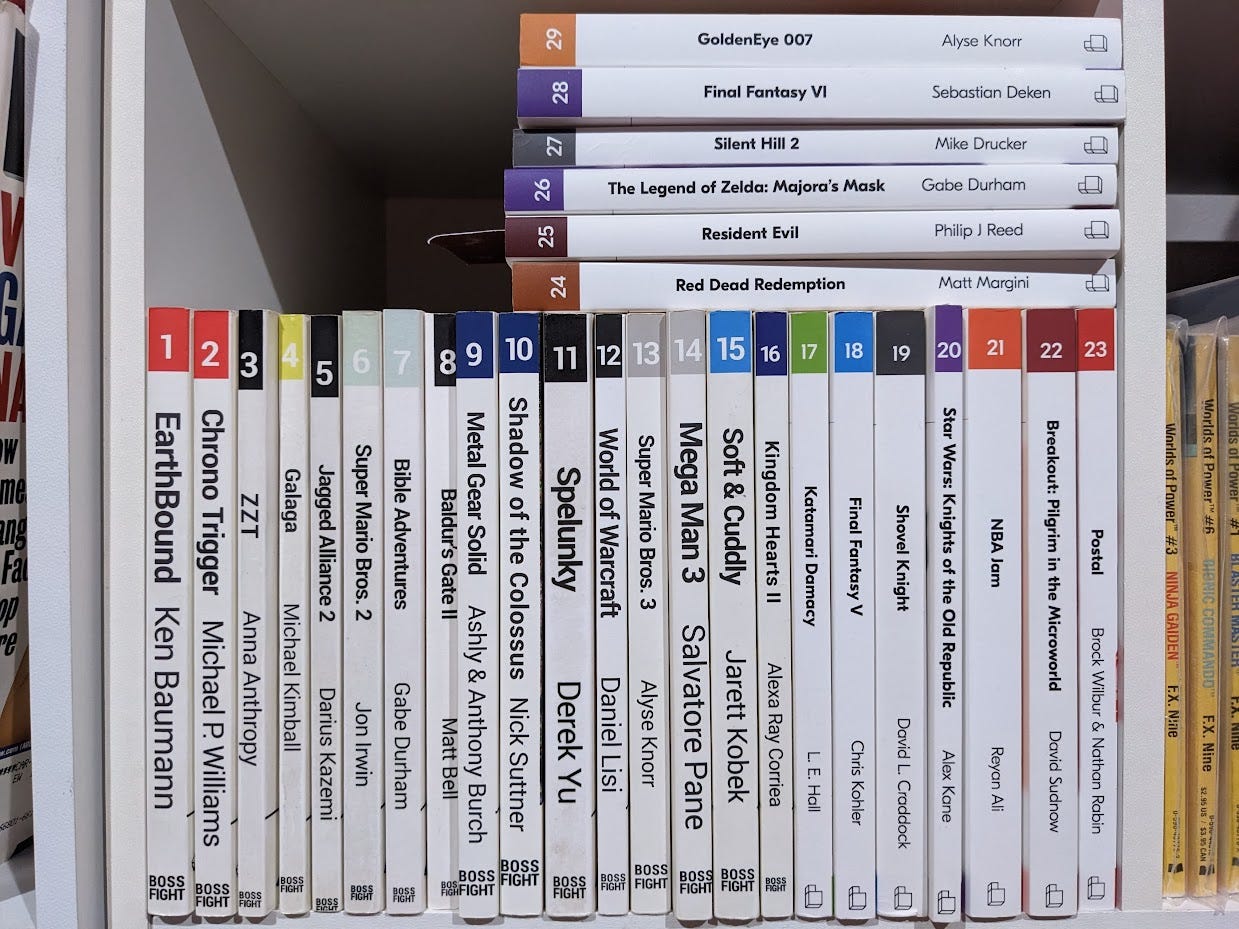
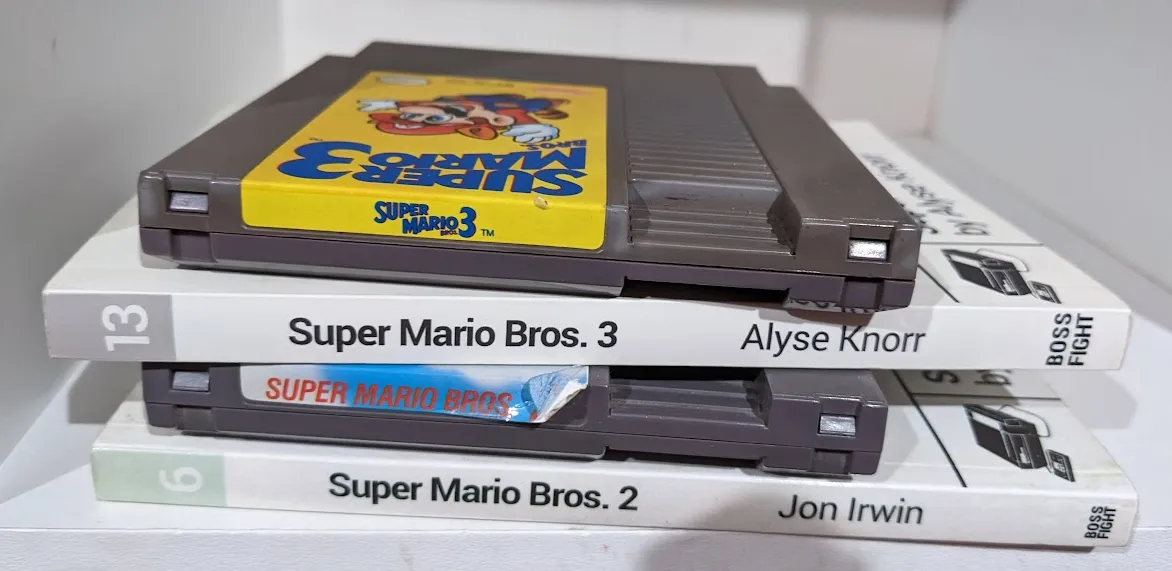
Years ago, decades maybe, I heard about a new book imprint called Boss Fight Books. At the time they had yet to publish anything, but they promised a series of books, each one dedicated to a single video game. An entire book = one video game. The audacity intrigued me.[1]Though a bit of research suggests that the publication I heard about all those years ago, in college, so at least before 2006, could not have been Boss Fight Books. Oh well, I still champion BFB for, … Continue reading
Years go by, I forgot about Boss Fight Books, until the press resurfaces amid the video game milieu that my gaming friends and I have subsisted upon as a shared space for all those years since. Word of this “video game press that publishes books about single video games” percolated amid our shared social threads. That seed planted years ago found sunlight.
Twenty-nine books later, I’m still a fan of the press; never wavering. The novelty still excites me. An entire book = one video game. Wow.
Wow.
I read a lot of books about video games, but those that focus on single games (even game’s I’ve never played, even never heard of) dominate my time. Reference texts that promise to catalog entire generations of games don’t excite me at all. Interview compilations are fun enough but tend to lack a narrative structure. Histories of single companies are nice, but they don’t get specific enough. Instead, I want to roll a grain of sand between my fingers and forget about the beach for a few hundred pages.
What beach?
Perhaps “simplicity” is the wrong term. By reducing the scope of a thing, the guardrails shrink too, meaning the author must be extra clever to mine and smith an interesting story as that space around their subject narrows. “Simplicity” maybe implies a vacuum where creativity isn’t welcomed. Maybe, I’m thinking “fragments?” Or maybe a “constituent,” like how politicians frame the citizens of their jurisdictions as pieces that have authority over their whole. No, no, I like “fragments” better.
I want to roll a grain of sand between my fingers and forget about the beach for a few hundred pages.
I’ve been working on my own fragment story. About a year ago I started writing a book about a single video game. What Remains of Edith Finch is, by video game standards, a “simplistic,” stripped-down representation of what a video game can be, so much so that the game might have trouble even contributing to a definition of “video game.” What Remains of Edith Finch is a walking simulator, which, for brevity’s sake I’ll say is a video game that favors story and exploration over mechanics and combat. There’s neither a win nor a lose condition. So, not really a game.
The challenge intrigued me. How will I write an entire book about such a simplistic game (with a playtime of about 2 hours, by the way), with very little history to lean on (it was released in 2017), and from a developer with only one other previously-released game? How can I see into the silica and oxygen of the grain of sand with enough passion and persuasion to dull the allure of the beach surrounding it?
One solution: use a kidney stone instead of a grain of sand; I promise you’ll forget about the beach when you have one of these.
My own personal interests, for sure, certainly pushed me to strip away the rest of the beach. Single phrases, presented in the game as diary entries, inspired full paragraphs. My own interest in game development encouraged me to peek beyond the game boundaries enough to satisfy a strange obligation I felt to include developer stories in the book.[2]I like reading developer stories, but, well, I’m shy and awkward so interviewing people is something I don’t look forward to…but, for my What Remains of Edith Finch book I did it anyway, a … Continue reading So, me being me (the only form I know how to take on) made me care about the core fragment of the thing.
But what kept me invested in writing the book—and what I was finally able to identify as my main attraction to most Boss Fight Books—is that the more powerful a microscope I applied to the subject, the more I leveraged my own personal history and stories to explode out the subject. The more granular the subject, the less objective history can be applied to it, meaning a higher reliance on subjective history, which is the history type I prefer to read.
Zooming in requires subjectivity to make the minutiae interesting. This was a big revelation for me. It allowed me to stop apologizing for my love of personal stories over objective history.[3]And for anyone who has played What Remains of Edith Finch, you can perhaps now understand why I was so drawn to the game’s themes of subjectivity.Interesting, huh?
The first Boss Fight Book, about Earthbound, by Ken Baumann, leans heavily into the author’s own life. It’s a memoir by way of video games as a landmark. It’s easy to read this first book as an untested “what if” on the concept of video games as a referent point for self-reflection. And it’s not at all apologetic. I like that.
Zooming in requires subjectivity to make the minutiae interesting.
As the Boss Fight Books imprint grew its catalog, the books would distance themselves from personal stories and lean hard into documenting history. Personal stories still existed (Galaga by Michael Kimball is almost 100% personal history, and is told in a unique, fragmented style, which seems fitting given this article; Breakout: Pilgrim in the Microworld by David Sudnow is a reprinting of a book from 1983, which feels like it must have been some sort of osmosis inspiration for Boss Fight Books; Postal by Brock Wilbur & Nathan Rabin is part history and part gonzo journalism). But over the lifespan of Boss Fight Books those personal stories slowly subsided in favor of something more…sterile.
I harbor no ill-will toward Boss Fight Books’ change in direction. I still eagerly absorb every word they publish.
Like cartridge width, like spine width.
For my book about What Remains of Edith Finch I wanted to—and perhaps, had to, given the narrow scope of the subject game—see how much of myself might be exposed when reflected against the game. Video games are important to me. Very important. I cling to video game worlds as a compulsion, bypassing even the slightest consideration that video game worlds aren’t real. It’s not absurd for me to map my life in tune to the changing of console generations or to retrace my life along the evolution from pixelated characters to motion-captured adults outfitted in ping-pong balls playacting adjacent a foley stage where serious adults twist stalks of celery to capture the sound of a snapped ulna. Without video games, my life’s map would lack its most important waypoints. The fiction of video games informs my reality, even if only to keep me tethered to it.
The fiction of video games informs my reality, even if only to keep me tethered to it.
Writing this book about a tiny fragment of the video game universe has shown me, without a doubt, that video games are important, that video games are a reciprocal medium that changes us just as they ask us to change them, that games are, in fact, real.
So, why when things get small do I get interested? Because close examination of the small things forces a close examination of myself. Call it ego. Call it self-discovery. Call it…yeah, ego is probably right.
Share in the comments, what video game has made you contemplate your own life in an unexpected way?
Though a bit of research suggests that the publication I heard about all those years ago, in college, so at least before 2006, could not have been Boss Fight Books. Oh well, I still champion BFB for, if not planting the seed, at least cultivating it.
I like reading developer stories, but, well, I’m shy and awkward so interviewing people is something I don’t look forward to…but, for my What Remains of Edith Finch book I did it anyway, a little bit.