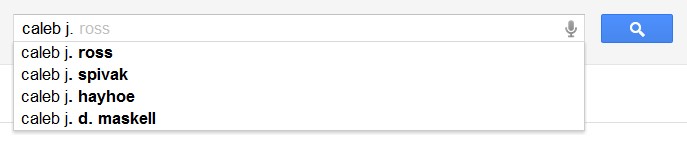
The always wonderful Jane Friedman recently posted and responded to a question from a writer about the standardization of an author name and how search engines interpret (or cannot interpret) the various spellings of a single author’s name. I won’t post Jan O’Hara’s entire question here, but definitely check it out. A representative excerpt follows:
Depending upon the blogging platform I’m using, it variously codes my name as OHara, O’Hara, O\Hara, or Hara…While some search engines or bookselling sites prompt the reader to find the correct spelling, this is not consistent. I cannot be guaranteed a reader who searches for “ohara” will be sent on to “O’Hara.”
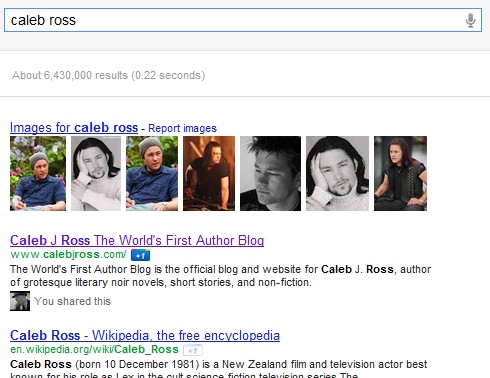
This is an important dilemma. In fact, it’s one I myself have wrestled with for years. The truth is, way back in 2000 or so when I first started seriously considering a career as an author, I went by Caleb Ross (sans the middle J ). The reason: calebross.com was already taken. And not just by another nobody. Caleb Ross is apparently a well-known actor, most famous for his role on TV show called The Tribe. So, my secret goal in life was to become so popular that searches for Caleb Ross would instead lead to Caleb J. Ross content.
But after so many years of fledgling popularity, I pretty much gave up and decided to focus (rightly) on my writing instead of my name. Little did I know that focusing on my writing would become a huge help in gaining that coveted #1 position in the search results (more on that later). As I become more aware of how search engines work my efforts to take the #1 position became more focused. How did I do it? How did I “train” the search engines to know that searches for Caleb Ross could indicate a desire for Caleb J. Ross content?
First, how do search engines work?
I eat and breathe search engines, but I understand that most people don’t. Therefore, I want to give a quick summary of how a search engine works, with special respects to the problem of standardizing names. If you know how search engines work, skip this first section.
When you do a search on Google (I’ll speak to Google specifically here, but most of this information can be applied to any good search engine) the search engine results page (SERP) is not actually displaying live data from the websites it lists. Instead, the SERP is actually showing copies of the website data. Google routinely takes snapshots of every website in the world (called crawling or spidering) and stores copies in its own databases (called indexing), much like a giant file cabinet. Why is this important? Because before a search engine displays the results for a query, it is applying a top-secret algorithm to all of the websites in its file cabinet. This algorithm attempts to determine which websites are most relevant to your search query (FYI, the fact that websites are indexed on Google’s own servers rather than stored only on local website servers is one of the reasons why search results appear so quickly…if that interests you, look for your Welcome to the Nerd Club membership card in the mail shortly).
So how does Google decide that one website is more relevant than another? How would Google know that when someone is searching for ohara that he actually means O’Hara? That, my friend, is why Google rules the world. Few people know the actual algorithm. However, there are some known factors which can be used to help make sure Google understands that ohara is the same person as o’hara.
The importance of proper anchor text
One of the most important ranking factors is inbound links, which are the links on other websites that point back to your own site. Google considers each inbound link like a vote for the linked site. Basically, the more other sites link to your site, the more important Google assumes your site to be. Of course there are caveats to this, but the basics are all we need right now. But the link itself isn’t all that matters. Also important is the anchor text, or the highlighted part of a link. For example, in this sentence the anchor text would be “this sentence.” For a better example, see the first paragraph of this (already lengthy) blog post where I link back to Jane Friedman’s blog using the anchor text “posted and responded to a question from a writer about the standardization of an author name.” Basically, I am telling the search engines that the linked page on Jane Friedman’s blog has something to do with a question from a writer involving the standardization of an author name and that Jane Friedman’s blog should get a vote for that query.
Back to author name standardization. If I want people searching for Caleb Ross to see calebjross.com in the search results, one way to encourage that would be to place links throughout the internet that point to calebjross.com and contain the anchor text “Caleb Ross.” And this is exactly what I did.
Since March I have been involved in a 70+ blog tour where I have offered guest posts to a variety of literary and author blogs. Each blog post contained a short bio, in which, for the last 10 or so guest posts, I included the following line (links included):
This is a guest post by Caleb J Ross (also known as Caleb Ross, to people who hate Js) as part of his Stranger Will Tour for Strange blog tour.
What seems like a slight humorous aside is actually a conscious effort to help Google understand that people searching for Caleb Ross may in fact mean Caleb J. Ross. Couple this sly insertion with the boatloads of content I was creating and distributing online, and eventually the search engines recognized that Caleb J. Ross may be worthy of Caleb Ross searches (though The Tribe’s Caleb Ross still appears predominately in image searches…and rightfully so; he’s way better looking than me).
The importance of tying all of your social profiles and blogs together
We all have social profiles. Way too many social profiles. Counting all of the profiles I maintain with regularity, I have about nine. Most social profiles offer an area to include external links to other sites. Utilize these areas to include links to each of your other social profiles.
For the more advanced user consider implementing the rel=”author” markup. I won’t go into depth about how to implement it (go to this official Google support answer topic for in-depth info), but it is important to understand its potential power. Consider this: you write for multiple blogs, have multiple social profiles online, and you want to help Google understand that single authors often produce content all over the internet. Enter the rel=”author” markup. When implemented correctly, here’s what a SERP will look like:
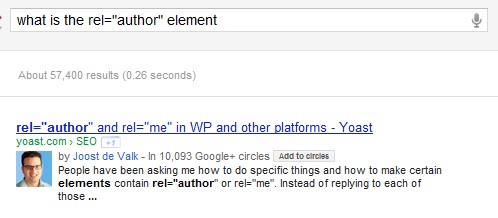
Google has been pushing this markup a LOT lately. And if Google is pushing something, you can be certain that it is important, or at least will be in the near future.
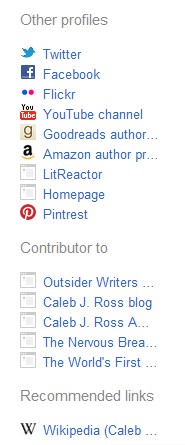
Which brings me to Google+. To some, Google+ is just another social network. To search engine nerds like myself, Google+ is nothing short of a revolution. I won’t turn this post into a manifesto, but I do want to highlight a couple very important aspects of the Google+ profile. First, at this time Google+ requires either a real name or a known pseudonym which means the name in a Google+ profile will certainly carry more weight than a name in a different social profile. My recommendation is to build your Google+ profile around your preferred professional name. Second, Google+ contains a dedicated profiles sidebar (see screenshot below). Most important to note is the “Contributor to” section. If you’ve read this blog post then you probably already know what to do here. If you skipped everything above: list the author archive page urls for all the blogs you contribute to in this section.
Now, go to sleep. This has been quite the lengthy post.