Category: General News

  • Extinction Journals by Jeremy Robert Johnson

    When a man in a suit made of cockroaches meets a man in a suit made of Twinkies — well, that’s about as easy as subtraction gets.

    From Jeremy Robert Johnson’s Extinction Journals

    About a year ago I came across this novella, fell in love, then promptly forgot it in favor of my ever-increasing to-read stack. Shame, really. Recently (today, actually) I revisited the story, coming away from the experience with all the enthusiasm I had after the original read.Extinction Journals cover

    Extinction Journals manages the high-concept, visceral storytelling consistent with Bizarro literature, but delivers in addition, literary quality unfortunately uncommon with a lot of work in the same genre. The literal tale is of a man, the sole survivor of a nuclear cataclysm, searching the country for survivors in a suit made of cockroaches. The deeper tale explores survivor’s will, collective consciousness, and how the two working together can be an apt gateway to the primal instincts forgotten in a world that would destroy itself with it’s own creations (while also managing to touch on snark-less political commentary).

    Buy, read, enjoy.


  • all about the writing

    Reaching for conversation I once said to Ron Carlson, author of many short story collections including The Hotel Eden and At the Jim Bridger, after his book reading in Emporia, KS (USA) that touring has got to be one of the best things about being a writer.“No,” he said. “It’s all about the writing.” Yeah, I said, but knowing that people actually want to hear you read has got to stroke your ego just a bit. He insisted still that “it’s all about the writing.”

    Okay, so it’s all about the writing, but the occasional piece of fan mail must help push through the days, weeks, months of solitude as the writer writes what he can later claim it was all about. Can I say this from experience? Yes and no.

    Last month I received a couple pieces of fan mail. How, I thought, do I have a single fan, let alone a group whose tensions might provoke one member to single him-or-herself out to make such boisterous claim? I have very few pieces on the public forum and very few people have read what I haven’t yet placed publicly, so how do I have a fan (or two)?

    Turns out I don’t. But Caleb Ross, the star of some show called The Tribe, does. In fact he has at least two fans of which I am aware, both with brief tongues and an annoyingly proud sense of self. Please observe these two emails sent to Caleb Ross the writer, addressed to Caleb Ross the actor:

    Subject: Letter from a big fan
    From: (hidden)
    To: bookrecs@calebjross.com Hi Caleb! I´m a big fan of yours. I have watch you as “Lex” in “the tribe” for almost every part of it. I´m from Sweden in Europe and I hope that you are going to visit my country soon. My name is (hidden) and my e-mail adress is:
    (hidden) So please write to me and I can tell you that I also act in teaters and films in my own country.

    Impassioned? Moderately. Flawless use of broken English? I like is say YES.

    Subject: Tja

    From: (hidden)

    To: (hidden)

    I am Maria. I am 14 years old. I Live in Sweden. You are My Idol! I see Tribe every day
    From Maria


    Darling? A little. Less desperate than the first email? Definitely.

    Do I poke fun out of jealously? Maybe, but to be honest my true beef stems from the fact that these people care almost enough about their “idol” to read a website bearing his name before submitting a fan letter. Look here for the first ever news post on this site. At least two Caleb Ross’s exist on this planet of ours and until “fans” are able to discern one from the other I claim the right to poke all the fun I want.

    But instead of poking fun my time would probably better be spent writing. I’ll go do that now.


  • Remember to BLINK by Jason M. Heim (first published at DepravedPress.com)

    Remember to BLINK by Jason M. Heim (first published at DepravedPress.com)

    Note: This review originally appeared in the now defunct DepravedPress.com

    Jason M. Heim. Remember to Blink. Lulu.com, 2003-04. $15.99, paper, ISBN: 1-4116-1121-7.

    The narrator of Jason M. Heim’s debut novel, Remember to Blink, suffers from what might best be described as a chronic case of boredom. Taking a cue from his mundane job in computer software maintenance at one of the world’s largest computer manufacturers, the unnamed narrator creates for himself an autopilot personality which he uses to handle tedious tasks while a separate, conscious part of his brain can ponder deeper ideas: “[…] whatever high concept my mind thinks is the flavor of the month. Things like evolution” (19). And evolution is one of the many trains this mind rides throughout the novel’s stream-of-consciousness styled rant, presented successfully, as a well crafted novel about a struggle for control and the resulting infinite burden this struggle carries.

    What might initially seem like a cheap gimmick, the narrator claims early on in a faux forward that he is not an author, and later (but still very early in the novel) that he has done no research, outlining, or preparation, ultimately proves to be a necessary admission. The narrator claims at the top of page 2:

    Given my mind’s tendency to wander, I can’t promise chronological continuity. And it may seem like it doesn’t make sense. For you, the beloved reader, these disjointed accounts of my life may seem to be rather random. But if you’re going to understand, you need to experience it. For me, this lack of continuity is a way of life.

    This clever device—a therapeutic memoir—allows any inconsistencies and character flaws to be glossed over and forgotten. Fortunately, however, flaws and inconsistencies are few and the story holds together well, presenting itself in such a way that only this straightforward narrative style could justify.

    Obvious comparisons to the contemporary trend of first-person, nihilistic, stream-of-conscious novels will be made. Unfortunately, the popularity of Fight Club by Chuck Palahniuk and its more popular movie adaptation have made it hard to claim the schizophrenic narrator as an original device (RTB’s minimalist style and use of jargon-laden rants doesn’t help to broaden the distinction). But RTB handles the burden well. By subtly—and more importantly, consciously—creating the autopilot personality Heim’s narrator is able to introduce and develop the ulterior personality as an part of himself, rather than attempting to fool the reader into thinking it is a completely separate person.

    Furthering the success of this distinction Heim transitions seamlessly early in the novel from the autopilot as a concept to the autopilot as a believable and effective character trait. Step back and hear of this novel from a friend and you would understandably doubt this sort of effective execution, but read the damn thing and you’ll see that it works.

    RTB is a theme-driven novel, using the characters’ mind-space to explore these themes. Think the way most contemporary literature commentaries tend to do. Any of Palahniuk’s earlier works are arguably platforms to express the author’s social discontent. Bret Easton Ellis’s American Psycho is similar in this regard; sacrificing deep character development for social observation. Heim goes this route, exploring the motif of control as a way to steer evolution. But the novel tends to suffer from its own exploration of tedium as the ultimate destructor. Page after page of cleverly twisted phrases designed to appear deep can wear at a reader’s mind. The rants can be very insightful—especially toward the end of the novel when the narrator’s newly discovered philosophy of Christianity is skillfully incorporated into his already robust set of beliefs—but before the reader really has time to absorb the moments of insight he is shoved into another rant filled with more clever phrases—sometimes logically related; sometimes not. But this is all, as the narrator states early on, a way to “[…] figure out how I got here” (2). And the patient reader willing to accept this will be greatly rewarded by the satisfying climax and unconventional denouement (hint: when you think you’ve found a plot hole in chronology, you haven’t).

    Despite a few jarring choices in narrative style, Remember to Blink succeeds as a probing literary novel with a lot to say and the right mouth to say it. One would hope that Jason M. Heim has more to say and won’t make us wait long to hear it.

  • Emporium: Stories by Adam Johnson

    Midnight finds us rolling through the waves of the old Double Drive In, the gravel crunching under our tires, the Monte Carlo’s trunk bottoming out like it used to, and all the broken glass, beer caps, and bullet casings now sparkle like stars.

    From “Trauma Plate” as included in Emporium

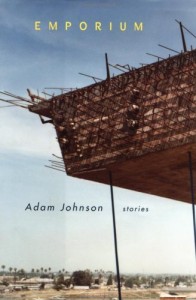
    Emporium taught me more about short story craft than most textbooks dedicated entirely to the topic. Adam Johnson has what some may call a natural story-telling ability, and I’d agree for the most part, but nature, I suspect, takes a person only so far, and Emporium exists as such a perfect specimen of contemporary fiction that I would hesitate to believe we as human beings have this innate level of ability.

    Yes, he has a flair for language. Yes, he can craft a compelling storyline. But what truly makes Adam Johnson endearing is his obvious knowledge of the craft. He has – and I would say this about very few people – a Richard Russo-ian ability for story.

    I read somewhere that Adam Johnson actually enrolled in his first university level fiction class by accident (he incorrectly transcribed a class number when enrolling, trying to fish for an easy A by taking a poetry class). Proof that accidents are God’s little way of being a hilarious son of a bitch.

  • When the Nines Roll Over & Other Stories by David Benioff

    …”How old were you the first time?”

    “The first time I shot someone? Nineteen.”

    Leksi nodded and opened his mouth, but forgot what he had meant to say. Finally, he asked, “Who were we fighting back then?”

    Nikolai laughed. “How old do you think I am, Aleksandr?”

    “Thirty-Five?”

    Nikolai smiled broadly, flashing his crooked teeth. “Twenty-four.” He pressed the poker’s tip against the base of Leksi’s skull. “Here’s where the bullet goes.”

    From “The Devil Comes to Orekhovo” as included in When the Nines Roll Over

    I can be a literary snob when I have to be. I’ll admit that critically praised contemporary fiction is never something I go out of my way to jump on. You’d sooner catch me reading a forgotten receipt than something sitting on a grocery store book shelf. Why? I just feel that a lot of great writing goes unnoticed, and it’s my job as an active member of the literary community to give the lesser-knowns a run when I can. Besides, if somethingWhen the Nines Roll Over cover truly is great I will eventually come back to it, later, at a time when just mentioning it in public won’t cause four-hundred people to start spewing hollow opinions (ex. see Invisible Man and The Stranger below). But When The Nines Roll Over eventually weaved its way onto my bookshelf.


    David Benioff captures the nuances of situation better than most seasoned novelists (though Benioff himself is no complete amateur, having written the novel and screenplay for The 25th Hour, and the screenplay for Troy), and is able to extract, and more importantly, impart empathy with absolute nonchalance.


  • The Condemned by Noah Cicero

    Were you ever drinking one night and thought, “I would like to kill myself, but I just don’t have a good reason. I wish my daughter would get hit by a car or I was a ground troop in The Iraqi War so people would say after I did it, ‘He had his reasons.”

    From “Civilization” as included in The Condemned

    Keep Going. When you land in a passage about a pregnant woman snorting cocaine and eating pussy, keep going. When you get halfway through a scene involving load blowing and load swallowing, keep going. Beauty exists at the end. And it is the rare beauty that informs everything prior.

    Noah Cicero has a way of bringing the most seemingly asinine and gratuitous scenes in toThe Condemned cover sharp focus with just a single paragraph or sentence. Take for instance the story “Gratuitous Kink The Immaculate Cherry Popping,” in which a long list of the protagonist’s sexual exploits is capped with the passage: “In most meaningless sex acts only one of the people has the motivation for a good time. Most of the time one person needs a psychological need fulfilled.” In one direct punch Cicero justifies the assumed gratuity, informs the protagonist, and opens theme all while keeping the momentum strong. In most hands Cicero’s subject matter would be perverse (Bizarro anyone?). In Cicero’s hands the perverse is simply a method for developing great characters.


  • Altmann’s Tongue by Brian Evenson

    He came close enough to her to see the webbed stresses on the surface of her eye spreading out from the minute white pocks of crushed glass. He wondered how it felt for her to have the roughness of the glass scratching against the insides of her eyelid, damaging it.

    From “Eye” as included in Altmann’s Tongue

    If you haven’t read anything by Brian Evenson then you haven’t seen the true capabilities of modern literature. Every line in Altmann’s Tongue simultaneously provokes, disgusts, and intrigues. And though much of the story collection might seem hard to comprehend at first a reader feels assured that Evenson leads a worthy journey. Do I know what the words “atumescence” or “transubstantiation” mean? I could venture a guess, but complete understanding is not what one seeks when reading Evenson. It’s about the journey, the path, and also about sucking a false eyeball out of a girl’s head (read “Eye”).

    Altmann's Tongue cover


    After reading this collection one might understand why the Mormon church excommunicated Evenson based primarily, if not entirely, on the content of Altmann’s Tongue. Or you might be like me and not quite understand the church’s action. But ultimately I thank the church for their decision. I wonder if Evenson would have been able to continue writing what he writes if supported by the Mormon religion. Evenson reads like pen without religion, going where it pleases no matter the hand steering it.