Category: Caleb’s Game Devlog

Thoughts on Game Development and Game Design. Expect quick-thought blog posts, scripted videos, and even podcasts. If you want to learn my philosophy on video game development, this is a great place to start (and end).

  • The UnFun Plateau: When Video Game Characters Act Too Real To Be Fun

    The UnFun Plateau: When Video Game Characters Act Too Real To Be Fun

    Subscribe on YouTube

    I was thinking about AI in video games, specifically the artificial intelligence that governs NPC and enemy behavior…more specifically the NPC enemy behavior in Tenchu: Stealth Assassins…MORE more specifically the NPC enemy behavior that causes inept guards to abandon their posts to chase balls of rice on the ground. What kind of idiot guard is so willing to ditch their security responsibilities for edible litter!? The correct answer is of course the same kind of goldfish-brained idiot guard who isn’t concerned that the ball of rice wasn’t there just two seconds ago.

    But taken outside the context of the questionable security guard hiring practices in Tenchu-land, there’s an interesting dissonance here that I’d like to explore. I want to talk about the tension between the human-like enemies and their purported human-like actions, and I want to explore the limitations that we as players require of our enemies. A truly intelligent enemy NPC is not what we want. We don’t even want artificial intelligence. We want scripted behaviors based on shortcut heuristics with game balance–not realism–being the end goal.

    And to be fair, enemy AI in video games is a bit of a misnomer. True artificial intelligence implies machine learning, and video game enemy artificial intelligence is really, as I said above, just a collection of scripted behaviors that account for a bunch of different enemy states. For example, if player is within x pixels of enemy, then enter the hunting state. If enemy’s health is below y%, then enter the flee state.

    But back to Tenchu and why I felt this scene with the dumb enemy chasing down a ball of rice was so funny. This is where the dissonance I mentioned earlier comes into play. Because we recognize this character as human, we are encouraged to expect human-like behavior from it. And chasing a random riceball is not human-like behavior. So, it’s funny. This exemplifies what’s called the Benign Violation theory of humor: Things are funny when they subvert our expectations but only when they don’t hurt anyone. This guy isn’t a real person, so, nobody was hurt.

    But what if this enemy character looked even more like a human? Then, chasing the rice ball would elevate from simply funny to hilarious. Let’s visit Metal Gear Solid and the series favorite disguise: the cardboard box. Realistic looking enemies. Convincing enemy behavior. Absurd cardboard box disguise. Hilarious.
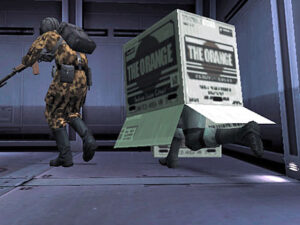
    It’s just a moving box, guys…nothing to see here.

    But, interestingly enough, because of the realistic portrayal of the human-like enemies, our laughter is curbed slightly. Benign Violation is tampered when we’re meant to be invested in what’s being harmed, even if only superficially. That’s why laughing at a news story about mass murder is sociopathic behavior. And maybe why bullies who laugh when they make kids cry should be taken to therapy.

    But gamers demand so many conflicting things. We want realism, but we also want enemy AI to respect our need for fun, meaning we don’t want our enemies to be super smart. We need our inept guards to eat discarded poisoned rice balls. We need our machine gun-toting soldiers to ignore a conspicuous cardboard box. Otherwise, the game wouldn’t be fun.

    This tension is a lot like the concept of the uncanny valley, but it’s not entirely the same thing. See, the uncanny valley is a term used to describe that point when human-like characters stop being emotive and relatable and instead become…creepy. I talk a lot about the uncanny valley (in terms of fiction in general) in a dedicated video here.

    What I’m talking about, this dissonance between how we feel a human-like character should act and our need for human-like characters to not act human-like is less an uncanny valley and more an unfun plateau. NPC enemies are allowed a generous range of displaying human-like characteristics, but once the NPC enemies become too human, too unpredictable, too smart, the fun would decrease very quickly.

    To be fair, I cannot think of a game that is too realistic–in terms of human-like characteristics on NPC enemies–to be fun, so this concept is truly just conceptual. If you have any examples of games that might fall off this unfun plateau, please let me know in the comments below.

    The unfun plateau highlights one of the many conflicts game designers have to wrestle with. And part of me credits the longevity of pixelated graphical styles in games to this dissonance and perhaps why PS1 and Nintendo 64 era limited polygons may never have the same shot at life beyond their initial generation. I’m not so dumb as to think nostalgia won’t trump all, but I’m careful to think this ludo anthropomorphic dissonance isn’t strong.

    Clips from the following videos are used in this video

    • https://www.youtube.com/watch?v=D9S_XbVhNgc
    • https://www.youtube.com/watch?v=A3LYSLq3XGk (Tenchu)
    • https://www.youtube.com/watch?v=EFlabF5M8s8 (Metal Gear Solid V)
    • https://www.youtube.com/watch?v=pPeAE4AvfTA (F.E.A.R)

    Music Credits

    8bit Dungeon Level Kevin MacLeod (incompetech.com), Licensed under Creative Commons: By Attribution 3.0 License, http://creativecommons.org/licenses/by/3.0/
  • Introducing Towering Tom: Toilet Defender

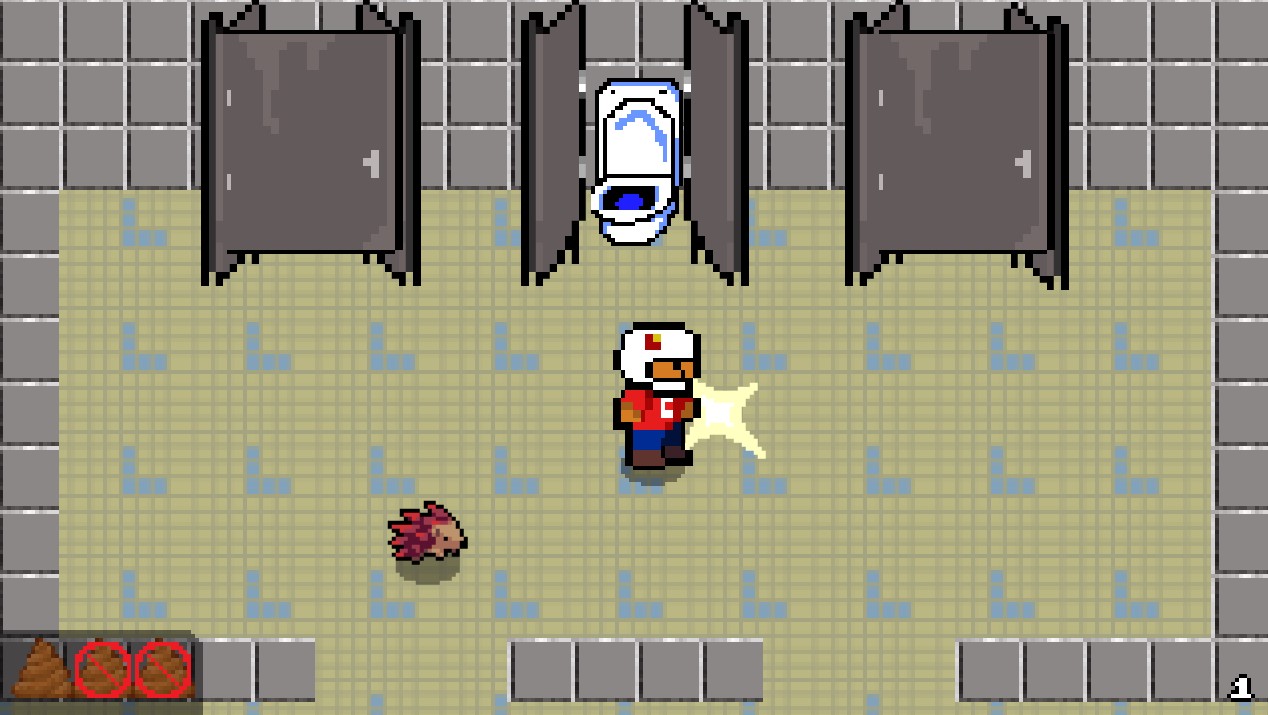
    Introducing Towering Tom: Toilet Defender

    For those of you who know me as a wanna-be video game developer, you may know that I have been documenting my journey learning various game engines and coding languages at my Game Dev Log page. For the rest of you, well, I guess I’m sorry you weren’t let in to that part of my life. But in my defense, you could have asked. I mean, how much do you really care about me if you don’t even ask about my passions. What a jerk you are. (more…)

  • Are Old Games Good?

    Are Old Games Good?

    Subscribe on YouTube

    Are the games we grew up with really the beacons of gaming perfection that we think they are? Can we trust nostalgia?

    Are games from our youth better than current games? I’m sure what I find amazing now will be laughably archaic in your future 2078 home, which certainly contains at least one room dedicated to dismissively laughing at relics from the past. And if your future home doesn’t have such a room, well, then I don’t know why we’re putting all this money into stocks, and don’t you dare tell me that money went toward your kids’ college education. College isn’t necessary in the future. College is the exact type of past relic at which you’d better be laughing from your future Dismiss-O-Room (™).

    What I’m really talking about is nostalgia. If we assume videogames, at least here in the US, weren’t really commonplace until the late 70s at the earliest but more likely the early- to mid-eighties, that means people like current me, in their 30s and 40s, are the first generation of people to have videogames as a nostalgic referent. That means we’re the first people to be able to claim that videogames were way better when we were young, meaning we–the “1up generation”–need to keep one very important thing in mind…videogames were not way better when we were young.

    Nostalgia, by definition, is lie.

    According to Alan R. Hirsch in his report, “Nostalgia: A Neuropsychiatric Understanding,” nostalgia is

    “a longing for a sanitized impression of the past […] not a true recreation of the past, but rather a combination of many different memories, all integrated together, and in the process all negative emotions filtered out.”

    In other words: a lie.

    Nostalgia does good work for humans, mainly by highlighting positive moments of our youth. It’s bittersweet sure, as we can be tricked into thinking things will never be as good as they once were, but the net effect is that life feels more meaningful and, by proxy, death feels less frightening. Nostalgia smooths over the rough parts of childhood, so we aren’t emotionally weighed down by how awkward we were as kids.

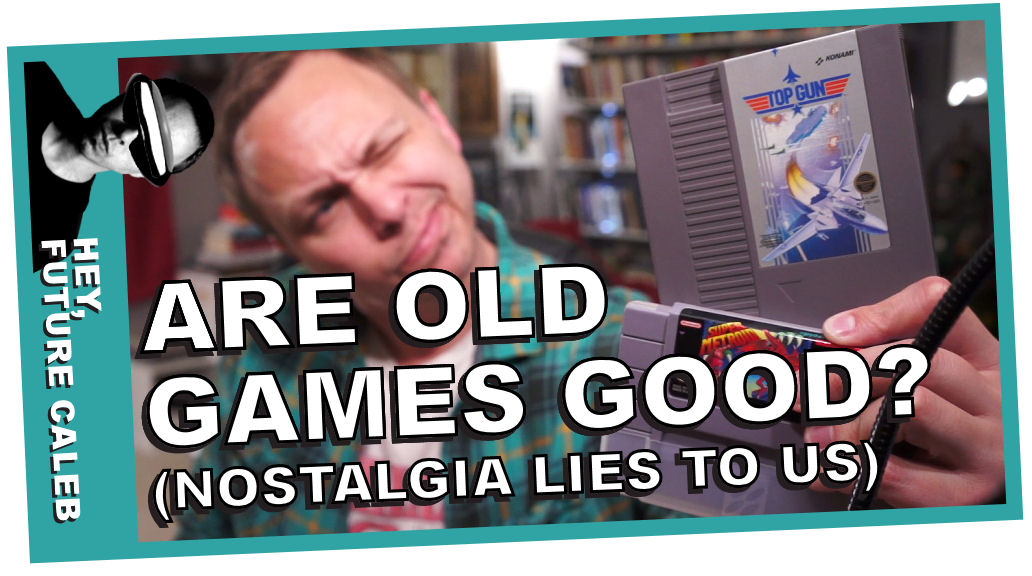
    The problem with nostalgia is that it is powerful. Very powerful. I will both probably defend the old game Top Gun on the NES even though it’s probably objectively not good. My question is, does the degree of that power change as the amount of time increases between me and the nostalgic referent, and as the number of possible replacements for that referent inevitably increases?

    Half of me thinks, yes, I hope I do remain ignorantly nostalgic. I don’t want future Me to decide, as I sit surrounded by all types of future gaming innovations and ubiquitous mechanics-expanding peripherals, that Super Metroid sucks. Present Me loves Super Metroid. It’s the best game ever.

    The other half of me thinks that my connection to a game, and any judgement passed on that game, will diminish as time passes. And the greater my breadth of experience–vis-a-vis the number of additional games I’ve played–increases the possibility of finding better games to drown out the old, not actually good, games. Otherwise, what does that say about the innovation of the video game medium? That it’s stagnant? I don’t want that.

    So I’m saying two things here:

    1. I want to believe in a world where a quarter-of-a-century old game isn’t the peak of my experience, but…
    2. I also don’t want that experience, and all of the emotional energy I’ve invested in it over the years, to be false.

    I understand it’s not binary. I can discover a new favorite game while still considering Super Metroid a great game. So perhaps that’s the simple resolution to this situation. “Good” works on a spectrum. But even if I accept that, I’m still interested in whether or not the power of nostalgia can be affected by increased temporal distance and a deeper experience pool.

    Happily, I think this question can be tested. Unlike event-based nostalgic referents like schoolyard games, birthdays, and lighting dams on fire, videogames and other forms of media, are able to be relived and re-examined objectively. The context could never be recreated, of course, but the artifact itself, as it existed back then, exists today.

    Am I ready for this though? Am I really willing to accept that these games, which I remember as wonderful games, actually suck? Am I okay to be confronted by proof that these pillars upon which I built my childhood are cracked?

    Video Sources

    The following are YouTube videos licensed under CC BY 3.0

    • https://www.youtube.com/watch?v=hCXNXGvYfVk
    • https://www.youtube.com/watch?v=fzsctHHb-JQ

    Music Credits

    • 8bit Dungeon Level Kevin MacLeod (incompetech.com), Licensed under Creative Commons: By Attribution 3.0 License, http://creativecommons.org/licenses/by/3.0/
  • Is the Walking Simulator Still a Thing?

    Is the Walking Simulator Still a Thing?

    Subscribe on YouTube

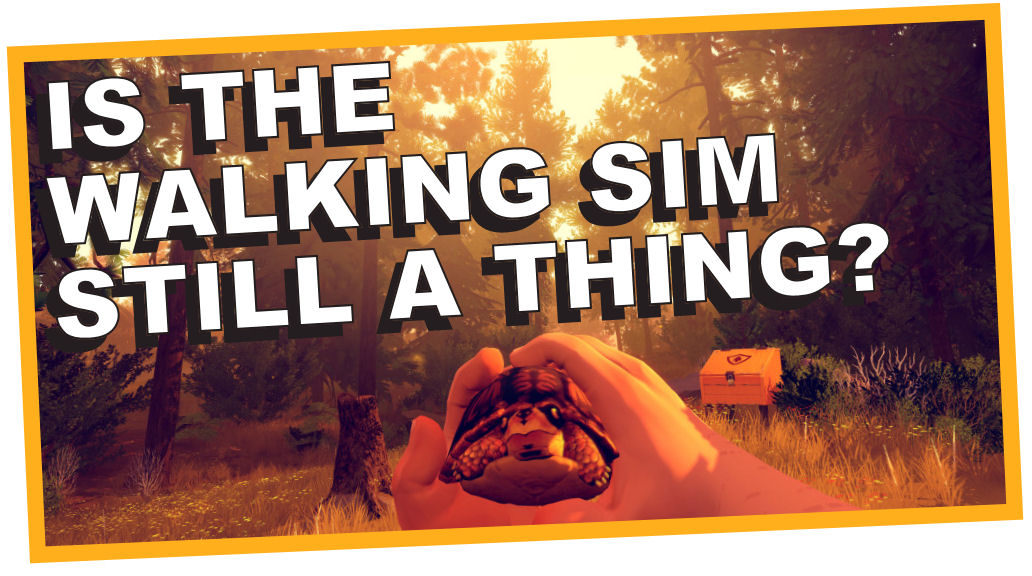
    The walking sim has earned a spot in my top 3 gaming genres, and this includes your standard hyphenates, your action-adventure, your puzzle-platformer, your action-rpg, and so on, so I’m considering literally dozens of genres when I make this claim that the walking sim is so, so good.

    I’m not a martyr here. Plenty of people are defending the genre and the name. But for the most part, walking sims still represent a very peripheral part of the gaming ecosphere. And I’ve been wondering why that is?

    I think, unlike many other genres, walking sims require personal vetting prior to getting praise. You can’t get someone excited by the plot of a walking sim.

    Consider these scenarios:

    You: “So, what’s this game Firewatch about?”

    Me: “You walk around looking for forest fires while talking on a radio.”

    You: “So, what’s this game Everybody’s Gone to the Rapture about?”

    Me: “You walk around looking for spirits while talking to nobody.”

    You: “So, what’s this game Gone Home about?”

    Me: “You walk around your home while talking to nobody.”

    You: “No thanks.”

    Conversely, consider this scenario:

    You: “So what’s this game Bloodborne about?”

    Me: “You hunt out demon monster things with a variety of badass weapons.”

    You: “Is there simulated walking?”

    Me: “Only if you want to be scythed by a blood-thirsty farmer.”

    You: “Awesome!”

    But anyone who has played Firewatch, Everybody’s Gone to the Rapture, Gone Home or even Dear Esther, which most consider to be the first official walking sim, knows that it’s hard to properly explain the experience of a walking sim. And that’s the point of a walking simulator, really: to provide an experience above all else. Above mechanics. Above gameplay. Above even the traditionally inherent sense of victory with a game, a player is subjected to the experience. This reality simply doesn’t make good let’s play fodder or TV commercial fodder. It’s a hard sell.

    Walking sims have earned a place in my top 3 genres because, well, because I took the time to play them. And they’ve simply yet to let me down.

    But back to that traditionally inherent sense of victory that I mentioned above. Walking sims are often pushed aside, I think, because walking sims defy what it means to be a game.

    Let me explain. Developers (and gamers) love a cross breed. Action game + adventure game = action adventure. Puzzle + platformer = puzzle-platformer. Action + RPG = action-RPG.

    But walking simulator is the one genre that resists being absorbed into a hyphenate. Its mechanics are defined by exclusion. You wouldn’t have an infinite runner walking sim, for example, because the genre conventions are polar opposites. Endless runner = go fast, avoid objects. Walking Sim = go slow, explore objects. But even less absurd pairings aren’t​ really possible. You couldn’t have an RPG walking sim or an action adventure walking sim, and this is the case primarily because a defining characteristic of a waking sim is the absence of a lose condition. The only option is completing the game. (though a BitterEmpire article does make a good point that should the player give up when the narrative stops being interesting, that could be considered a sort of lose condition. This is a point that I’m open to exploring, but also a point that I think adheres to all game genres, so I’m not fully inclined to accept it as unique to the walking sim.). All other game genres insist upon a lose condition. That is, by definition, an important component of what it means to be a game. Sure, micro moments within a walking sim can have binary outcomes (open the desk drawer or don’t), but the genre doesn’t have a single global objective that can be failed.

    So the obvious question is, are walking sims even games? Well, for the sake of retail placement and consistency within the industry, yes, they will always be shelved and discussed as games. But I don’t believe they actually are games. This may be a personal belief; I tend to align to the side of game formalists, as opposed to game abstractionists, a distinction that is discussed in a great video by Jamin Warren when he explores the definition of a game as outlined by Jesper Juul.

    But this refusal by some to accept the walking sim as a proper game is why fans of the genre, as least I speak for me, have this incessant drive to defend it. Walking sims defy what gamers have come to accept as a game. But this is also why the genre has risen so quickly, I think. If a category name is disparaging, defenders will rise.

    So, what’s the future of the walking sim? Despite my assertion above that walking sims inherently avoid hyphenation, smart developers will find a way to take what’s great about the walking sim and merge those aspects into other genres.

    A great example that I recently played is the 3rd person walking sim platformer Bound (walking platformer?). Bound focuses on the environment. Bound focuses on narrative momentum. Bound lacks a lose condition. Sure you can fall off the edge, but when you do you immediately respawn. But it’s not just the perspective that bucks the walking sim establishment. The game is a platformer. The game even has minor combat elements, but not enough to pull the genre away from walking sim and toward action.

    Mentioned:
    What is a game? And why it matters! | Game/Show | PBS Digital Studios youtu.be/H0ReU2tvLFo
    In Defense of the Walking Simulator, from Bitter Empire http://bitterempire.com/defense-walking-simulator/

    The following are YouTube videos licensed under CC BY 3.0
    youtube.com/watch?v=GqmDXAh_wRg
    youtube.com/watch?v=3DPXyCaTMnw
    youtube.com/watch?v=W54YRYpLZng