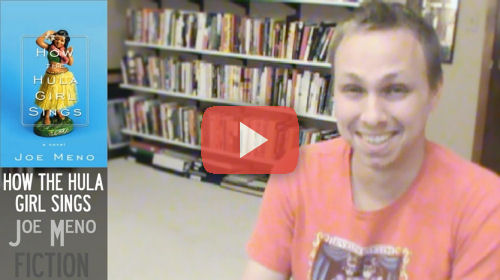
Hear the amazing, mostly made up story of how I got my copy of Joe Meno’s How the Hula Girl Sings signed by the author during the 2004 Association of Writers and Writing Projects conference in Chicago, IL. You’ll hear the first-hand account of how I knew Meno as a musician first and an author second, why I should be more sensitive to Hula throat issues, and why Joe Meno owes me a royalty check.
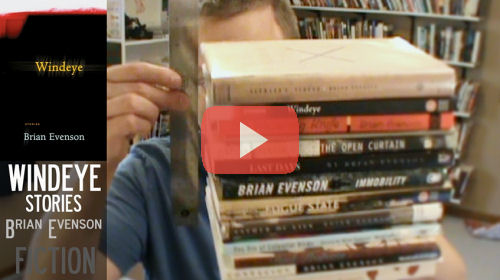
I’ve never hidden my love for the work of Brian Evenson. In fact, overly enthusiastic may be a good way to describe my infatuation. His stories are like none other, both in concept and execution. So, know that this review of Windeye, Evenson’s latest story collection, comes to you with a deep history of appreciation. You aren’t getting a first-time reader here. You are getting a fan’s true perspective. With that being said, WHAT A DAMN FINE BOOK!
Click the image above to watch the video at YouTube
Hear the amazing, 100% true(ish) story of how I got my copy of Jonathan Franzen’s Freedom signed by the author during an author reading in Kansas City on September 22, 2010. You’ll hear the first-hand account of my bravery in the face of an elderly security guard, the strength of punches needed to take babies down, and why I’m glad Franzen is an author rather than a professional investment broker.
Click the image to play the video review (opens in YouTube)
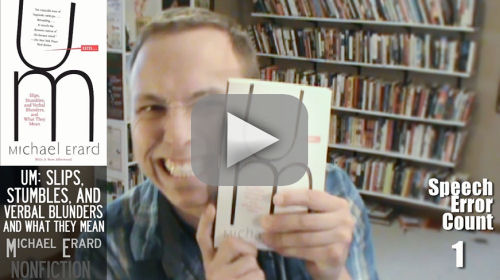
I’ve realized during my few months of video-making, along with my previous couple of years making podcasts, that I tend to break apart my speech with ums, uhs, ers, ahhs, and every other sort of cerebral flatus out there. A desire to break away from so many speech errors is one of the reasons I picked up Michael Erard’s book Um: Slips, Stumbles, and Verbal Blunders and What They Mean. My thinking was that if I could understand why I flub my words, then I could eventually eradicate those flubs.
I’m likely beyond help, but at least this book did teach me that speech blunders are perhaps less something that needs to be cleaned away, and more something that we all need to approach differently. Speech errors aren’t, by themselves, errors at all. Instead, what’s important is measuring speech disfluency from a baseline. Think of reading ums and uhs as similar to reading a lie-detector test; we’re all our own level of nervous even without being hooked up to a spooky machine. The trick is to measure how much more nervous we get when asked potentially compromising questions.
Many theories have been created to explain the meaning of a speech error including ones from Viennese professor Rudolph Meringer who supposed that language is like a living organism whose evolution is responsible for our collective blunders; Yale psychologist George Mahl who chalks speech errors up to anxiety; and the famous Sigmund Freud who felt that speech errors were windows into the speaker’s subconscious.
Click here to watch the video review of Um: Slips, Stumbles, and Verbal Blunders and What They Mean (or click the image above). DON’T FORGET TO SUBSCRIBE TO MY YOUTUBE CHANNEL!