Subscribe on YouTube
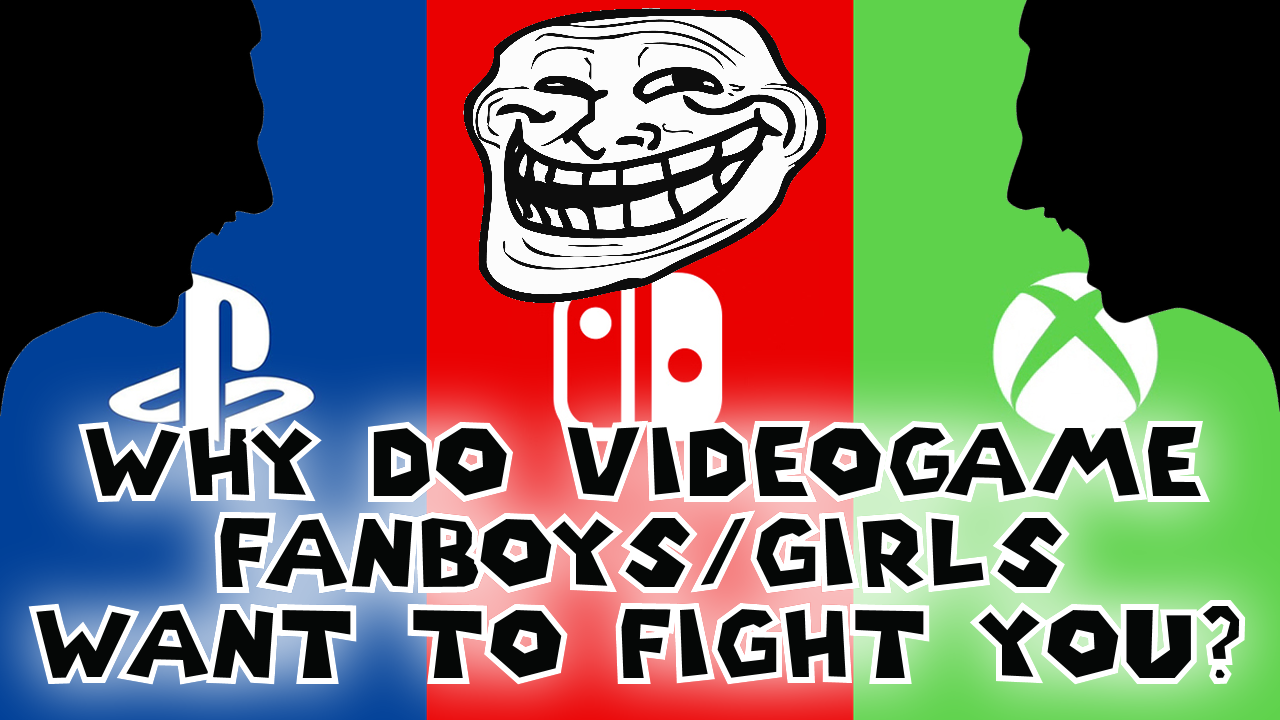
Today I’m asking, what is it that turns a person into a “fanboy” and why are these fanpeople so eager to make outrageous claims and fight you?
Fanpersonism is an affinity for a brand or entertainment IP over another that is so strong it inspires aggressive defense of the thing despite its flaws.
It’s the reason I pre-ordered Fallout 76, despite all signs indicating it would be terrible.
It’s the reason that as I played it I tried convincing myself that I was having fun.
It’s the reason I told myself, after I stopped playing it, that I would return when the “minor” bugs were fixed.
It’s the reason I call those bugs “minor.”
But why am I a Fallout fanboy? And why do I get angry when other people don’t appreciate the beauty of Fallout? And what does this have to do with sexism in video games? You didn’t expect that last question, did you? I zig and zag, people.
Right away, I must say that this video might upset you. The very nature of investigating fanboyism or fangirlism means that I’ll be telling you that the things you love might not be that great. So, even though we may all be fanpeople, let’s agree that console gaming and PC gaming are both great, Apple and Android products are both great, XBox, Playstation, and Nintendo consoles are all great. And we are all human and therefore all susceptible to the various psychological mechanisms that make us act in strange ways. Don’t try to convince me that you are better than everyone else. You are not.
To understand fanpersonism is to understand choice-supportive bias. This is the idea that once you’ve made a choice about something, you’ll naturally look favorably upon things that support your choice and will downplay or ignore things that don’t. Said another way, it’s trying to avoid buyer’s remorse.
One experiment shows this well. Psychologists Robert Knox and James Inkster went to a horse track to ask the gamblers about their confidence levels in the horses they bet on. They asked some gamblers before they placed bets and others after. Knox and Inkster found that gamblers had much stronger convictions about their chosen horses after they’d placed the bets. Meaning: people don’t want to believe they’ve made a bad choice.
So, why is it so hard to change direction, to change affinity, to admit Fallout 76 sucks?
To acknowledge that you’ve made the wrong choice, specifically one so tied to your own sense of identity, requires an enormous lack of ego, a degree of egolessness that I find most humans simply don’t possess.
But more than that, our choices, especially brands and entertainment IPs, and perhaps especially in the realm of geek culture, are closely tied to our very identity as a person. When I wear a Fallout t-shirt, my identity becomes intertwined with Fallout, and with Bethesda, and with being a gamer. I want people to see me as a Fallout fan, as a Bethesda fan, as a videogame fan. I have what consumer psychologists call “high self-brand connection.”
Fanpersonism dovetails with the concept of deindividuation that I discussed in a previous video. Deindividuation is the process of taking on the motivations of a group as your own personal motivations diminish. Once deindividuized, you’ve committed to a group and reflect that group’s motivation. Then fanpersonism kicks in and it becomes hard to turn away or criticize the group that you’ve committed to.
This brings us to the sexism I mentioned earlier.
It’s no secret that women gamers have suffered over the years, for nothing more than simply being women who play games. One person in particular, Anita Sarkeesian, made a name for herself by bringing to light a lot of the hurtful depictions of women in videogames. This unfortunately resulted in a wave of anger from (I assume mostly) males that ranged from simply calling Sarkeesian a liar to death and bomb threats. Did simple sexism cause this? Most certainly. But sexism alone probably doesn’t account for all the anger.
Sarkeesian criticized something–video games–that many people consider part of their identity. To acknowledge sexism in videogames is to acknowledge both our own ignorance of and our approval of the prevalence of sexism in videogames. For an egotistical species, that’s a big ask.
This isn’t to diminish the hatred Sarkeesian unfairly endured. She’s right to call out hurtful depictions of women in videogames. I’m glad she does. I just think the power of “high self-brand connection” and choice-supportive bias, no matter the role they played in Sarkeesian’s plight, is incredibly interesting, and Sarkeesian’s plight does give us a powerful case on which to apply such a lens.
We are the things we buy and the clothes we wear and the games we play. To attack those things, even only a portion of those things, is to attack us as individuals. And it hurts. But we’re a strong, adaptive species. And with this awareness I am ready to comfortably say “Fallout 76 is not good.”
And once again, read “Getting Gamers: The Psychology of Video Games and Their Impact on the People who Play Them” by Jamie Madigan.
Also, for a deeper, personal dive into the world of sexism in video games, specifically from the perspective of a game developer, I highly recommend the memoir “Crash Override: How Gamergate (Nearly) Destroyed My Life, and How We Can Win the Fight Against Online Hate” by Zoe Quinn.
Mentioned and Further Reading: