This makes two videos in a row in which I wear a Nick Cave & the Bad Seeds shirt and drink Sexy Betty Imperial Stout. No, I’m not a slob drunk; I simply recorded two videos in a row.
Amanda Gowin’s Radium Girls is all sorts of interesting. It’s weird, it’s heartfelt, it’s wavering, it’s beautiful, it’s poetic, and it’s a bunch of other things I can’t think of right now because I’m tired.
Kyle Minor’s In the Devil’s Territory is rural family noir at its best, with lots of back-woods religion overtones, and family dynamics rooted in harsh sexism where women are taught to be subservient to men and men are trained to exploit that subservience.
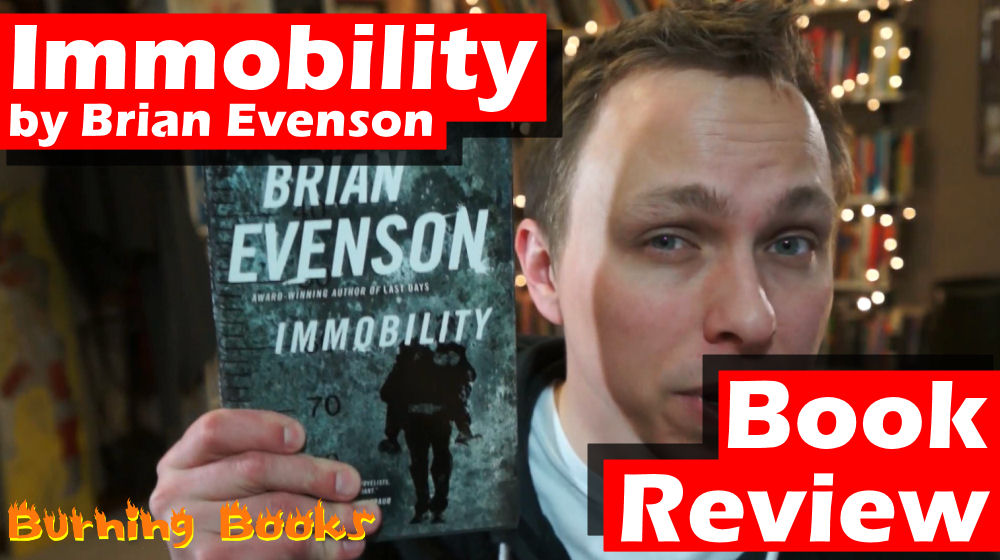
Immobility is about an amnesiac man named Horkai, and in typical amnesic style Horkai begins this novel having no idea who he is, where he is, or who those around him are. So, he must trust the word of those around him, namely a man named Rasmus. Rasmus tells Horkai that he has been brought out of a cryogenic state after 30 or so years and must go on a mission to retrieve something for Rasmus. So, Horkai does.
Now the first half of the novel plays around with Horkai’s alternating discovery of and hesitation to accept his surrounds. It’s a typical blank memory novel for a while. But then, the novel quickly becomes so much more. It becomes, what I interpret, as a commentary on organized religion, specifically the aggressive, and perhaps selfish, nature of religions missionaries.
See, during Horkai’s journey, he finds people who seem very willing, eager even, to help him. They seem trustworthy. And each time, the reader is lulled into a sense of trust. We want to believe these people are truly out to help Horkai. But they never are.
Evenson’s own struggles with organized religion are documented online, so I won’t go into them here, but this book feels to me like perhaps his most personal. And this includes The Open Curtain which very much plays with the conventions of Mormonism, and until Immobility, I would have called his most religion-conscious book. And what’s interesting is that Immobility does this without overtly calling attention to itself as an exploration of religion.
So even if you don’t like long form detestation of religion–all two of you out there, right, because I know you guys like to party heathen style–even if you don’t like this kind of book, don’t discount it. There’s a lot more to love here. For instance, the story takes place in an alternate history setting, post-apocalyptic, similar to Cormac McCarthy’s The Road. The main character, Horkai, has no legs and must be carried by two people who are referred to as mules, and who refer to Horkai as a burden. Mix in a bit of The Matrix, some sci-fi elements, and sprinkle a bit of pestled viagra, which must be in there because I was rock hard while reading this.
Reading Stephen Graham Jones is like being on a manhunt for a double amputee. Even when I get him, I don’t get all of him.
Nick Bruiseman is a has-been PI who lives in a storage locker in Stanton, Texas. A small town, 3,000 people, where everyone knows everyone. So when Bruiseman gets hired, things turn incestuous quickly.
The book will be released in March 2014. If you are a fan of detective novels and oral storytelling, then I definitely recommend it. But know, you’re going to have to work for your reward.
I’ve read a lot of Stephen Graham Jones (show stack), and I’ve thoroughly enjoyed just about all of it.
Jones is an evasive storyteller, very difficult to pin down and with plots that are often difficult to follow. And I think with Not For Nothing, his 18th book, I’ve finally figured out why.
First, his very conversational approach to storytelling, much like one would imagine a storyteller around a campfire. His sentences are often very beautiful, but made so by disregarding some grammatical conventions. He’s fine with sentence fragments and orders extra commas like their free. He’s an oral storyteller above all else, I think. He just happens to write the stories down.
Second, his dialog is full of non sequiturs. When used sparingly, a non sequitur can describe the relationship between characters better than anything else. Don DeLillo is the king of this. But when every exchange has that “inside joke” feel, it can be difficult for a reader to establish a firm footing with the characters.
Third, Jones uses very, very, very little “refresher” text, text used to reminder the reader of important characters and events. When you’re reading a 267 page book, it’s necessary to be reminded often why characters, events, or places are important, or even just to be reminded why we should care about a particular name. Jones doesn’t do this very often. I chalk this up to Jones being a mad genius. Honestly, I think Jones’ brain operates so quickly that to him, something briefly mentioned 250 pages ago is still as fresh in his mind as something mentioned 2 pages ago.
Fourth, characters are often introduced quickly only to be forgotten for full chapters before being introduced again. They aren’t allowed to stick. Now, for a book like Not for Nothing, where new names seem to pop up every few pages, I’m left trying to re-familiarize myself with characters constantly.
If all of these things seem to you like they’d contribute to a very confusing story, you’re right. His stories can be confusing. Incredibly at times. But often, that’s the appeal. Much like tracking down our aforementioned legless fugitive, the thrill for me is watch the unfamiliar and at times erratic escape path. To fully capture the fugitive, all four limbs intact, might not be very satisfying. Because then you’ve got just another convict in custody. Where’s the fun in that? Who wants to read just another detective story?
Fair warning: this is probably the dumbest thing I’ve ever done on this channel. And I’ve done a lot of dumb stuff. But you’ve been warned. Therefore, I’m free to dumb it up all the way to eleven.
I posted an initial thoughts video of S. a couple weeks ago. Now I’m back with my full review. But this one is different. See, I already reviewed the book on the November 27th episode of the Booked. Podcast. And rather than rehash my thoughts on my YouTube channel, I figure I would do what a truly lazy person would do and hire some sock puppets to re-enact parts of the Booked. Podcast conversation.
Flushboy by Stephen Graham Jones is my kind of book. Family dysfunction with a power element of the grotesque, in this case, the father’s entrepreneurial drive toward starting a drive-thru urinal franchise.
![I was happy to not know what was going on: a video book review of Radium Girls by Amanda Gowin [video]](https://calebjross.com/wp-content/uploads/2014/06/Thumbnail-Radium-Girls-review.jpg)
![Rural family noir: a video book review of In the Devil’s Territory by Kyle Minor [video]](https://calebjross.com/wp-content/uploads/2014/04/Thumbnail-Devils-Territory.jpg)
![A video book review of The Girl in the Picture by Denise Chong [video book review]](https://calebjross.com/wp-content/uploads/2014/03/TheGirlInThePicture-Thumbnail.jpg)