Another Roxane Gay® observation gets the Caleb jumping-on-board treatment. In her post over at HTML Giant, Gay talks about the James Frey writing factory, and how its existence speaks to the strange desperation of writers (particularly MFA-pursuing writers) to be published, even when facing little to no financial or celebrity gain. The following line caught me, and while powerful in its own right, my mis-reading is what really got me thinking. Brackets: MINE ( I had to insert something of myself into this statement as a meta-nod to the topic)
“The desire to be published, for some [reason], is so desperate and so intense they will do whatever it takes.”
Why?
Answer: We are trained to be ego maniacs.
The loudest, most boastful vainglorious attitude gets applauded while humility gets ignored. This is not surprising, as the very act of braggadocia is a stimuli. It doesn’t matter that silence (which implies humility) is the very nature of books. Reality TV continues to be made, and reality TV stars continue to get book deals.
Social networking and Blogging have taught us that even if what we have to say isn’t worth anything, we are for some reason less human if we don’t say it. And because the worldwide target marketing demographic thinks so too, those who say the most, the loudest, will find favor with publishers.
I’ve got to give credit to the reading populace, though. Books have managed to outlast other forms of leisure in terms of resisting the ego. First magazines. Then TV. Then Movies. But now, unfortunately, it seems books are only successful when they inspire the hope of a movie adaptation.
The truth is, not everyone has something worthy of wide attention. Yes, each person has something important to say, but often that thing is important to a small group of people (family and friends – which is where Vanity and Print on Demand come into play, but that’s for another post). Book publishing was at one time the main way give the widely-important IDEAS (caps intentional) a larger audience. Today, literally every thought, whether minutely or widely important, has the same range. I have as much potential to reach the world with my Tweeted fart joke as the President does with his Tweeted fart joke. Social blogging culture has simultaneously trained us to over-inflate the importance of our ideas AND give us a world-wide platform for those ideas. Hell, I’m a victim to this right now.
But as with everything, even idea saturation (and the vanishing author advances that comes with it) does have benefits.
As a physically weak man, I embrace that people are allowed to exist in their heads, now. Manual labor isn’t necessarily the common proof of societal participation and benefit. Words and thoughts are now as visible as sweat and dirt. You used to have to afford a suit and nice care to be thought of as beneficial to society in terms of your intellect. Now, a base understanding of HTML and an internet connection will do just fine.
And hopefully, if monetary gain becomes less viable, only the widely important ideas will rise.
My wife told me that today was prematurity awareness day. Alright, alright, I get it. You could have been a little more subtle with the suggestion, but I get it.
Hey, this problem is no picnic for me either…
…what?
Whoops.
What I mean is, boooooo premature birth.
My boy was five weeks premature. He had a few health issues, but he’s perfect now. He’s one of the lucky ones. Nobody knows why so many babies are born premature, but with continued education, awareness, and funding, maybe we’ll find out soon. Please, take a few moments to peruse the March of Dimes site. Shed a few tears. Pretend you had something in your eye. Then smooth everything over with your friends by talking about football and fantasy leagues.
Roxane Gay comes clean about her approval of dirty money over at HTML Giant. She forces me to ask similar questions of my own moral aversion to sponsorship dollars. Historically, when presented with the opportunity to accept money by way of advertising, sponsorship, etc. I’ve justified the decision by passing the dollars along to those who I feel it rightfully belongs to (authors, editors, etc.). I’ve never kept any for myself. But Gay makes me ask: why not?
For me, the decision comes down to a basic function of economics. Authors need time to write. Money buys time. The moral ambiguity part comes into play when an author is offered money before the author has something worth writing about. Then it becomes an issue of monetary motivation, which I think, kills the idea of art. <meta>Unless the intention of the art is to comment on the monetization of art. </meta>
Of course, this one-sided conversation of mine hinges on the highly unlikely problem of being offered sponsorship dollars enough to feel morally conflicted.
Jason Behrends over at Orange Alert once frequently posted what he called Tweet Reviews, which are basically collections of <=140 character reviews of each track on a single album. Really cool idea. I don’t think he ever actually tweeting the reviews though. So, I am going to steal/borrow…sterrow…his idea, and take it to the logical next level.
I’ll be focusing on books, specifically books which are organized in a way conducive to individual tweets. This would be short story collections, literary journals, online zines, anything comprised of individual works.
Perhaps the best way to explain this would be by way of example.
As some of you may know, my novel Stranger Willis set to be released in March 2011 by Otherworld Publications. I miss the road (which remains unmoving just outside my office window). So, I want to do another tour. Announcing the
Posting for Strange: The Blog Orgy Tour II: Stranger Will: (Unnecessary Colon)
(I’m still working on the name)
My goal this time is to embark on a marathon blog tour, from the release of Stranger Will in March all the way to the November 2011 release of my second novel, I Didn’t Mean to Be Kevin(Black Coffee Press). This is quite ambitious, but I’ve been looking for a good way to get burned out on this whole writing thing. I think this is it.
So my question is: will you help?
My primary request is for one day’s worth of blog space. I’ll write a post which you will publish a pre-determined date. Simple. This post can be entirely my own, or it can be an interview, or I could write a review of a book…whatever, really. If you have a cool idea, I’m all for it. I would like to try and fit my post content into the content of your site (when in Rome, blog as the Romans blog). If you critique cartoons, I’ll do the same. If you review lit journals, I’ll do the same.
My secondary request would be for you to spread this tour stop request to all of your lit-reading friends and contacts. Obviously I will need a lot of sites in order to fill the 32+ weeks of tour time. If I average 3 posts per week, that’s 96 sites. Damn. If you know someone with a writing-related blog, please pass along my information. Or even pass his/her information my way and I’ll reach out.
If you are able to help, please let me know. Though I won’t start posting until the middle of March 2011, I’ll need as much time as possible to organize all of the dates and content with the various website editors.
Please contact me at caleb [at] calebjross [dot] com. Put something about the blog tour in the subject line, so my spam bots know that you’re cool.
I’ve been asked a few times lately why I give so many 4-5 star ratings at online book sites like Goodreads and Amazon. “Surely,” goes the thinking, “not all books I read can be ranked among the top 80% of all books.”
Well, actually they can. Here’s how.
Getting rid of the 1 star possibilities:
If a book disappoints me withing the first 50 pages or so, I won’t finish it. And by not finishing it, I don’t feel as though I have the right to give it a ranking. I can’t rate a beer without feeling its hangover, right? This eliminates the majority of 1 star possibilities.
Getting rid of the 2 and 3 star possibilities:
A book, by the time I open it, has already survived multiple filters, and in having done so, is sure to find my favor. My brethren over at The Velvet and The Cult are my taste-makers. Having received praise from those groups of readers, a book has already beaten the 2 star, and possibly the 3 star, level.
Very rarely do I pick up a book without any prior introduction. In fact, the most recent example is Chip Kidd’s novel, The Learners, which I bought based on Kidd’s reputation as a book designer (and the video below). My purchase had nothing to do with his reputation as a writer (I’m not sure he has one, good or bad, having only two novels published). I haven’t read the book yet, so let’s hope my anti-book-by-its-cover reaction proves just.
How much faith do you, as a reader, truly put into ratings book site ratings?
During a recent discussion on NPR, Heather Fain, marketing director for the publisher Little, Brown and Co. said that “the greatest marketing tool we have in publishing — and probably will never change — is word of mouth.” This means not only literal friend-to-friend and bookseller-to-buyer hand selling, but also online forums, reviews, blog comments, and social network discussion. For the most part, authors have little control over this. One aspect authors can control: the old fashioned website.
Optimizing a website so that it can be more easily found by readers is to most authors, I would assume, a foreign concept. Not that I am discrediting authors; I simply hope that most of you aren’t as nerdy as I am. Having a platform (re: a stable of willing buyers) is becoming more and more important to publishers. Optimizing your web presence is an important way to grow that platform.
Many of the SEO (Search Engine Optimization) best practices for commercial sites are relevant when working with a personal site. Keyword-rich content, meta development, inlinks, all of these things are important. However, there are some major differences to consider. I’ll be focusing on those differences.
First, determine the purpose of your website. Is it to covert sales? Is it rack up a long list of newsletter subscribers? Is it to provide general awareness of yourself and your books? Most of you are likely part of the third item—most book sales will happen off-site, at either an online book store or through a brick-and-mortar store; and newsletters, though highly converting[1], are generally geared more toward e-commerce consumers and repeat consumers. There is a place for all three of these items in a single website, of course, but I’m going for focus in this already lengthy post.
Monitoring Traffic
You need a way to analyze your website traffic. I recommend Google Analytics because it is free, extremely robust (intimidating so), and super easy to incorporate. If you can’t measure your site’s performance, you’ll never know if you efforts are truly working. Some free blog sites don’t allow Javascript (which Google Analytics uses), but in those cases the blogging platform usually has a rudimentary traffic measuring application already built in.
Keywords
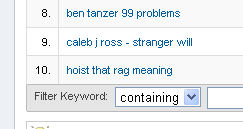
Think of keywords as the terms used to find a website. For example, someone may type Hoist That Rag meaning and end up seeing my page in the Google search results. And in fact, they did:
The 8th, 9th, and 10th top referring keywords for a given time-frame
Using Google Analytics, I can see what terms people searched to find my site. I recommend expanding your keyword set using these terms as a guide. For example, using the term Hoist That Rag meaning, I could imagine that people coming to my site might be interested in Tom Waits, Tom Waits Lyrics, and perhaps more generally, downtrodden, crooner, barfly personas. Additionally, keywords that searchers may not have used, but ones you feel are relevant to your site, are worth considering. For example, nobody came to my site using the term “grotesque noir fiction,” but I may want them to. I’ll add that to my list.
So, what to do with this keyword knowledge…
Content
By “content” I am going to be focusing on blogs. Individual page content, such as your bio, about, and work pages should be filled with keyword rich content, but blogs offer a more consistent stream of new content, which search engines (and readers) love.
Write blog posts that blend what you want to say with what you know people have already searched for. Keeping the examples above, I could write posts about barflies, Tom Waits, and perhaps how many of his lyrics feel like grotesque noir (“Eyeball Kid” comes to mind). The basic idea is to give search engines as many opportunities to validate your site in the eyes of readers.
Search engines put a strong focus on in-bound links (re: links from other sites to yours). When content is created specifically to attract links, this is called link bait. So how can you use your site’s past performance to anticipate link bait opportunities? I’ll use an example from my site to illustrate.
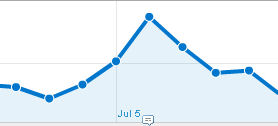
On July 6th, I noticed a spike in site traffic. Upon digging into my analytics, I found that a recent post, “Great Unexpected Literary References,” which highlights literary references in cartoons, managed to be linked to by a couple moderately popular literary blogs.
A July 5th spike in traffic. What is this about?
To capitalize on potential continued interest in this type of content, I then created more content with similar ideas. And in fact I started an Unexpected Literary References category for this very purpose. It continues to be a fairly popular category (in terms of my site’s overall traffic).
Content is great for bringing readers to you, but what about getting your content in other places?
This is part of what is called off-site optimization…
Community participation
Getting content and in-links is important to search engines, but don’t forget that you are blogging for human readers. Comment on other blogs, join forums, follow authors on Twitter, friend authors on Facebook, but above all, be active. Involve yourself in the online literary community. This is good practice, even if you don’t have a site to promote.
Basically, by proving your love to other humans, as a byproduct, you will be proving your worth to search engines. Each LEGITIMATE link you put out there is another rung in your search engine ranking ladder (notice the word LEGITIMATE; spamming is bad, search engines are smart about penalizing you for spammy links, and humans are smart about blacklisting shits who throw irrelevant links all over the web).
But you only have so many hours in the day, you say…
Be your own Press Release distributor
Use RSS to import your blog feeds into your various social networking and profile pages. Goodreads, Amazon, and Facebook, for example, allow authors to have their blog posts automatically posted to profiles. This means that you hit “post” once at your own blog, and your content feeds to those various other networks.
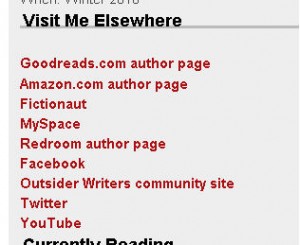
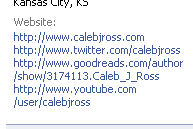
Be sure to cross-link all of your profile pages and your website. If possible, list your Twitter, Goodreads, Facebook, YouTube, Fictionaut, and all the other social pages you maintain on all of those various networks. Sometimes, you are only allowed one site link. In this case, I would recommend listing your website. A close second would be your Facebook profile.
Profile links in my homepage sidebar
Profile links in my Facebook sidebar
Measuring conversions
Since most author pages aren’t focused on product conversions (purchases usually take place off-site, at an Amazon.com or independent bookseller like Kansas City’s Rainy Day Books) it doesn’t make sense to focus on actual product sales as a measure of performance. If looking to measure conversions, a newsletter sign up or comment submission may be more appropriate. Think of yourself as being in the business of establishing a relationship, not in the business of bookselling. Google Analytics has a built in method of tracking conversions.
(Note: for those of you already familiar with SEO, you will notice that I didn’t include anything about meta content, title tags, <h> tags, and other behind-the-scenes tactics. I avoided these simply to keep this article focused. I may touch on them in the future)
[1] ExactTarget is an email marketing company, so be weary of fully embracing these numbers.