Tag: owc

  • The real questions authors need to ask when deciding between self-publishing and traditional publishing

    The real questions authors need to ask when deciding between self-publishing and traditional publishing

    With the news of sudden-star Amanda Hocking circumnavigating – and established-star Barry Eisler eschewing –  traditional publishing in favor of self publishing, I thought it important to collect my thoughts on the topic from the perspective of aspiring authors.

    Getting a book published is easy. Anyone with $5 and a Lulu account can do it (or for a bit more can go through Createspace, direct to Lightning Source, or any other PoD route). So the discussion for authors must change from how to be published to how best to be published.

    Think about it this way, if you are offered a 20% royalty on books sold (which is actually high for most publishers), that means you are giving up on 80% of your potential profit. The truth is when signing a publishing contract you are paying the publisher to sell your book.

    Much of the information out there about self-publishing vs. traditional (legacy?) publishing is explained from the perspective of the publishing industry. But what about author?

    Below is a straightforward list of things that every author should consider before deciding how best to publish. Admittedly, I haven’t always asked these specific questions myself, but I’m learning. And by proxy (re: reading this blog post), you are learning.

    You vs. prospective publisher: Social Media Presence

    Ask, does this publisher have more Twitter followers, Facebook fans, or a better established blog than you? Is the publisher actively engaging readers on these various platforms?

    Word of mouth sells books. Social presence (particularly online consumer book reviews) is the internet equivalent of word of mouth.  Closely examine, and scrutinize if necessary, your prospective publisher’s social media presence. Spend some time perusing the DIALOG (caps intentional) that the publisher is having with readers.

    You vs. prospective publisher: Industry connections

    Does the publisher engage in industry events such as the AWP Conference or BookExpo? Does the publisher have distribution relationships that you can’t have? Be careful with this one; distribution is easier today than ever, for both publishers and authors. eBooks can be streamlined by a service like Smashwords. Print book distribution to online retailers such as Amazon and Barnes & Noble is simple when using a PoD services like Lightening Source.

    The toughest fight for self-published authors (and most small press publishers) is brick-and-mortar store distribution. Even though “Thirty percent of books are still discovered in the brick-and-mortar bookstore” I personally feel that as eBooks increase their claim in the collective reader conscious store presence will become less and less important.

    As the capital-I Industry continues to become the lowercase-i industry, the options available for authors to become an active player are ever-widening. This means that many of the once-sacred insider realms are increasingly more accessible to authors.

    You vs. prospective publisher: Advertising budget and capabilities

    Do you see advertising for the potential publisher anywhere? Keep your expectations realistic with this one. Very few publishers are going to have hi-profile advertising in magazines and industry trades. Think smaller. Do you see publisher ads at some of your favorite blogs or lit sites? Do you subscribe to the publisher newsletter; how does advertising look there?

    I would place advertising capabilities low on the priority list. I feel that because word-of-mouth is the most important form of advertising, paid placement in traditional outlets tends to come across as white noise to most readers. Paid ads are more about branding than converting book sales.

    You vs. prospective publisher: Time

    Does the publisher have more time than you to sell books? Going it alone, the author will have to dedicate a lot of time to the mundane crap (formatting a book for e-publishing/printing, for just one example). Often, this time component is the deal breaker/maker for an author.

    As an author, I would assume that your main motivation with this whole writing thing is to well, write. When promotion and back-end businessy stuff occupies your day, you will be left without any remaining time to write. Then we’re at the circular problem of having dedicated so much time to promoting book number one that you are then left without a book number two to promote.

    All authors, whether self-supporting full-timers or career-dreaming hobbyists will be expected to contribute to promotion. But how should your time be realistically divided?

    You vs. prospective publisher: Other authors on the label

    This one is more of a prospective publisher vs. prospective publisher dilemma. Say you’ve decided that going the traditional publishing route is for you. Now, which one do you choose?

    The company you keep can become your most supportive street-team. A rising tide lifts all boats, so to speak. Explore the online presence (and sales data, if possible) of other authors on the label. Do these authors have more readers than you? Could readers of their work be readers of yours? Would you have a drink with these people?

    Digest this information. Then ask: Is the prospective publisher able to sell 80% more books than you could without the publisher?

  • Stranger Will tour stop #8: Nik Korpon’s blog

    Stranger Will tour stop #8: Nik Korpon’s blog

    Click here to read the guest post. Also, don’t forget that if you comment on all guest blog posts, you will get free stuff.

    About the Stranger Will Tour for Strange:

    My goal is to post at a different blog every few days beginning with the release of his novel Stranger Will in March 2011 to the release of my second novel, I Didn’t Mean to Be Kevin in November 2011. If you have connections to a lit blog of any type, professional journal or personal site, please contact me. I would love to compromise your integrity for a day. To be a groupie and follow this tour, subscribe to the Caleb J Ross blog RSS feed. Follow me on Twitter: @calebjross.com. Friend me on Facebook: Facebook.com/rosscaleb

    See all tour stops here

  • Stranger Will tour stop #7: Thunderdome (again!)

    Stranger Will tour stop #7: Thunderdome (again!)

    Click here to read the guest post. Also, don’t forget that if you comment on all guest blog posts, you will get free stuff.

    About the Stranger Will Tour for Strange:

    My goal is to post at a different blog every few days beginning with the release of his novel Stranger Will in March 2011 to the release of my second novel, I Didn’t Mean to Be Kevin in November 2011. If you have connections to a lit blog of any type, professional journal or personal site, please contact me. I would love to compromise your integrity for a day. To be a groupie and follow this tour, subscribe to the Caleb J Ross blog RSS feed. Follow me on Twitter: @calebjross.com. Friend me on Facebook: Facebook.com/rosscaleb

    See all tour stops here

  • Stranger Will tour stop #6: HTMLGiant

    Stranger Will tour stop #6: HTMLGiant

    Click here to read the guest post. Also, don’t forget that if you comment on all guest blog posts, you will get free stuff.

    About the Stranger Will Tour for Strange:

    My goal is to post at a different blog every few days beginning with the release of his novel Stranger Will in March 2011 to the release of my second novel, I Didn’t Mean to Be Kevin in November 2011. If you have connections to a lit blog of any type, professional journal or personal site, please contact me. I would love to compromise your integrity for a day. To be a groupie and follow this tour, subscribe to the Caleb J Ross blog RSS feed. Follow me on Twitter: @calebjross.com. Friend me on Facebook: Facebook.com/rosscaleb

    See all tour stops here

  • Stranger Will tour stop #5: The Velvet Podcast

    Stranger Will tour stop #5: The Velvet Podcast

    Today’s post is a special audio interview over at The Velvet Podcast. Click here to go to  the guest post. Also, don’t forget that if you comment on all guest blog posts, you will get free stuff.

    About the Stranger Will Tour for Strange:

    My goal is to post at a different blog every few days beginning with the release of his novel Stranger Will in March 2011 to the release of my second novel, I Didn’t Mean to Be Kevin in November 2011. If you have connections to a lit blog of any type, professional journal or personal site, please contact me. I would love to compromise your integrity for a day. To be a groupie and follow this tour, subscribe to the Caleb J Ross blog RSS feed. Follow me on Twitter: @calebjross.com. Friend me on Facebook: Facebook.com/rosscaleb

    See all tour stops here

  • Social media is a natural fit for authors. Tip your readers!

    Social media is a natural fit for authors. Tip your readers!


    When I’m not authoring mind explosions, I spend part of my time professionally involved with social media. One of the items my company stresses with our clients is that social media is not about pushing a message of product, product, product. It’s about engaging with customers and potential customers on a personal level. This means breaking the traditional advertising bullhorn approach of “BUY THIS NOW” with quips about the weather or TV shows, for example (though perhaps still tangentially related to the company’s product line). For most companies, dialog sans advertising is a foreign concept. For authors, this should be easy.

    Authors are their books

    Authors are inextricably linked to their products in a way that traditional companies are not. Denis Dutton in The Art Instinct: Beauty, Pleasure, & Human Evolution explores the idea that fiction always concerns and navigates three persons, one of whom is the author.

    “There is also the transaction between reader and author—the latter understood by the reader as an actual person, the creator of the story, who negotiates between the various points of view of fictional persons (the characters), the author’s own point of view, and the point of view of the reader. These three elements are present in every experience of fiction; in fact, they exhaust the list of operative elements” (pg 124).

    Authors control the show by “persuading, manipulating, wheedling, planting hints, adopting a tone, and so forth: whatever will appeal to the reader and create a convincing interpretation, including interpretations of ambiguous events. This makes the experience of a story inescapably social” (pg 125).

    The author is always present. This is not the case when, for example, going to a pizza shop; you don’t normally consider the pizza chef when eating pizza, whether consciously or unconsciously. When reading, you do consider the author.

    Authors vs. books: one is not more important than the other

    The author’s aversion to social media is understood. Most of us like to think of our work not as a product to be sold but as an artifact worth cherishing and that the book should be thought of independently from the author. It’s a simple personal life vs. profession life argument. However, this is a romantic ideal, not a reality.

    The truth is our DVD-behind-the-scenes-extras culture has trained us to expect glimpses of the minds behind the art. This expectation should be embraced, not avoided. Would Dostoyevsky fall from his pedestal if he tweeted that he had a particularly terrible sandwich from the corner bistro? Maybe, for some. But I think the number of current readers that would be alienated by this humanization would be offset by a crowd of new potential readers who would be endeared by the man’s personal revelations.

    Take Ray Garton (@RayGarton) for example. Here’s a writer I would never have known had it not been for his phenomenal presence on Twitter. He’s personable, rarely salesy, and funnier than most tweeting comedians. I didn’t learn about the author after learning of his books. Instead I got interested in the books after learning about the author, which is a transposition that seems to be more and more common.

    How to engage using social media

    An article at the London Book Fair site offers this advice for authors looking to engage in social media:

    “It’s probably a mistake for authors to be part of more than one network – it’s simply too time-consuming to keep up with several accounts, so choose Facebook or MySpace, but not both. They should also be aware of posting in haste the sort of personal detail that may be repented at leisure, and they should certainly resist the urge to respond to every criticism and to promote their own work at the expense of others. More than one exposé has demonstrated the dangers of that.”

    I would agree with all but the first point. There are many tools available to make simultaneously posting to multiple platforms easy (Tweetdeck, Twitterfeed, and RSS Graffiti together will take care of 99% of your cross-posting needs). Besides, not all of your potential readers are on a single network; you should be where your readers are (NOTE: as of this posting, I have actually deleted my MySpace account. Shame on me, I suppose. MySpace caters to MTV watchers, and I don’t think my readers fit that demographic. Now, if The Discovery Channel or the Film Noir Foundation buy MySpace, then I’ll probably be back).

    A few more tips:

    • Work humor into your messages. Nothing breaks down defenses quite like humor.
    • Post messages a few times/day if possible. Publish blog posts a few times/week.
    • Leave comments on reader blogs (like this one) and Facebook messages. Re-tweet reader tweets.
    • Your first priority should be engaging with readers. Selling books should be a second or third tier goal.
    • The Simon & Schuster.biz site has many more tips. Go there.

    Consider yourself a member of the literary community, not just a content producer

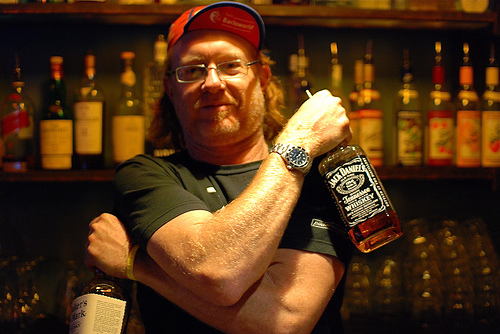
    Honestly, when perceived as a gesture of inclusion, the author who doesn’t participate in social media could be seen as a kind of a dick. I don’t want to generalize—there are valid reasons for not participating, of course—but for those authors without a good reason, refusing to interact with readers is like not tipping your bartender.

    Photo credit: http://www.flickr.com/photos/jcroft/

  • Ideas I’ve had (probably while drinking): bottle stories

    Ideas I’ve had (probably while drinking): bottle stories

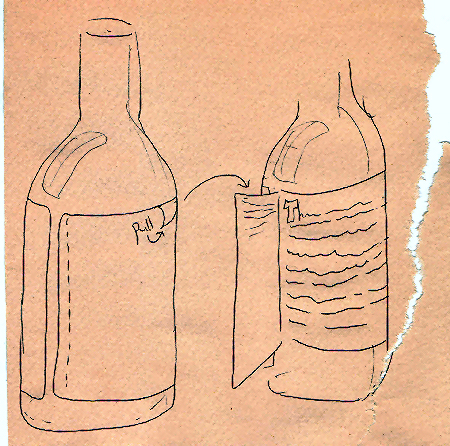
    The beer bottle label is grossly misappropriated real estate. When sold as a six- or twelve-pack, the bottle label is hidden by the outside packaging. And nobody buys a single bottle of beer. So why not use the label for something more than null-advertising? We drink for the morning after stories over greasy breakfast, so why not pull those stories back by a few hours and give them when drinking?

    The content of the stories could be anything from true life tales of drunken debauchery, to short fictions that somehow involve drinking, to short bios of famous authors (and their drunken exploits), to stories that incorporate the unique canvas (stories about glassblowers or, if drinking a red ale, vampires).

    For those advertising traditionalists, the label facade could be left intact, reserving a hidden underside for the story. Think the way cigarette cartoons often display coupons.

    Attention investors: money please!