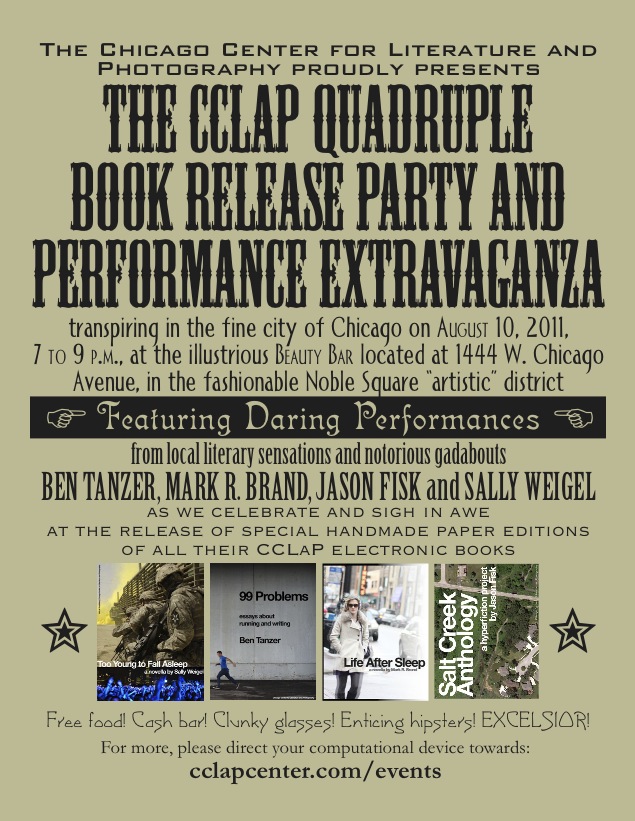
The Chicago Center for Literature and Photography, or CCLaP, is proud to announce their latest local live event, a large-scale party to celebrate the release of their first four paper books this summer. An electronic publisher since 2007, CCLaP has been quietly releasing new special-edition, handmade “Hypermodern” paper editions of its four titles throughout the summer; and on August 10th the group will be gathering at the popular Beauty Bar in the Bucktown neighborhood for drinks, free food, and a half-hour reading from all four featured authors, as well as a few surprise guests. Beauty Bar is located at 1444 West Chicago Avenue, and the free event will take place from 7 to 9 p.m., the reading itself from 8:00 to 8:30. All four books will be for sale individually for $20 apiece; or for one night only, attendees can purchase all four in a bundle for only $50.
Books and performers being featured that night include the novella “Too Young to Fall Asleep” by SALLY WEIGEL, about a Radiohead-listening “emo” high-school student who volunteers for the Iraq War (originally published in 2009);“99 Problems” by BEN TANZER, essays about the mental intersection between running and writing (originally published in 2010); “Life After Sleep” by MARK R. BRAND, a day-after-tomorrow tale concerning a device that allows people to only need two hours of sleep a night (originally published this past winter); and “Salt Creek Anthology” by JASON FISK, a collection of linked “micro-stories” regarding four trashy couples in the far Chicago suburbs (published this summer).CCLaP’s “Hypermodern” series is an attempt to create special collector-worthy editions of all the center’s electronic books, reasonably priced yet expertly made; they feature handmade hardbound covers, including a color photo of the ebook’s original cover adhered to the front, external Coptic stitching, whimsical decorative endpapers, a special signature/provenance page for collectors, and a full Colophon in the back listing all materials used. CCLaP itself has been open online since 2007, and with a handful of local live events held in varying venues across the city each year; the center also produces a semi-weekly podcast, sells general giftstore-style merchandise, and publishes over 150 book reviews a year at its popular website. Among other accolades, it’s been featured twice at respected arts guide BoingBoing.net, and its blog is followed by almost ten thousand unique monthly visitors.
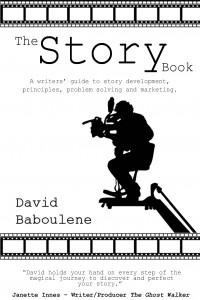
Following is a guest post from David Baboulene, author of The Story Book. He is currently preparing to defend his Ph.D. thesis at Brighton University that subtext is the defining substance of story, and by measuring subtext presence, depth and extent, he can tell you in advance how successful a story is likely to be.
If you are like me, you are unlikely to understand the next two paragraphs, but by the end of this article we will visit them again and hopefully you willunderstand them and your life will be all the richer for it and you will love me. Here we go, then:
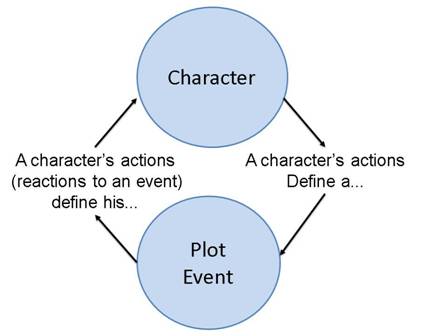
Plot is character, and character is plot, because as soon as a character takes a meaningful action, his action is driving your plot (whether you like it or not). Conversely, as soon as an event happens which elicits a meaningful reaction from your character, then his true character is developing in the eyes of the audience (whether you like it or not).
Note that it is not the event which reveals a player’s character, but his reaction to the event. The action he takes defines his character. Similarly, it is not the event which drives the plot (as you might expect), but the action taken by the character that defines the event, and drives the plot.
Confused? Let’s step through some explanation, and then come back to these paragraphs at the end and see if we have got anywhere.
Action without character
Let’s look at what happens if we separate plot from character. There are three levels of action without character, each with increasing subtlety.
1. At the blatant end, we have an event with no character involvement whatsoever. Lightning strikes a tree in a remote forest. So what? It’s not a story because no reaction is required of an emotional protagonist. This is not a story. This is a screensaver.
2. In the middle ground, we have an ‘emotionally detached’ action. If you watch the news and see that someone was killed in New York, the event is meaningless because you are not emotionally connected with the individuals on the news.
If we increase the known character, we increase the emotion: say we find out that John Lennon has been shot in New York. This is a person we ‘know’; we have been through his Act l and Act ll, and now relate to the tragedy at climax. Look at the emotion on the faces of the friends and relatives of the deceased in New York as they experience the same death, but on a different level of emotional involvement.
3. The most subtle example of action without character actually happens rather a lot in stories that fail to grip. A character takes an action, but it is not a meaningful action, because there is no dilemma riding on his decision to act. If the character is, say, Luke Skywalker, we know he will ‘decide’ to kill the next stormtrooper to come round the corner, and the one after that, and the one after that. Sure, his life is under threat, but that just serves to make his decision to kill even more obvious. His decisions involve no dilemma, so we learn nothing about his true character. However, if the next representative of the Dark Side to come round the corner is also… his father, suddenly he has meaningful decisions and difficult choices with severe consequences. Can he kill his father? Can he risk not killing his father? Now his decision is meaningful… and we in the audience cannot move until we know what he is going to do…
Character without Action
From the opposite end of the argument, let’s say we are shown a man. So what? Until he does something, we don’t know anything about him. Let’s dress him up as a policeman. OK, so now we have some characteristics as our brains overlay stereotypical presumptions about what makes up ‘Policemen’, but beware: this is still an individual without character.
Characteristics are just the wrapping. We don’t know if this person is courageous, extrovert, alcoholic, cowardly or a good father. We don’t even know if he is a criminal or not! Only his actions can reveal these things. When he is faced with a difficult decision
– say, to risk his own life to save someone else’s,that is when we will find out about his true character. What he does will define him. And guess what: what he does – the actions he takes – instantly becomes the plot (whether you like it or not).
A player’s character is defined only by his meaningful actions. The plot is defined only by the actions taken by the players
Writers are taught to define their characters in isolation. They also have a plot they have mapped out to the finest detail. They then find that the way the character wants to behave, if he’s true to himself, is not helpful towards a plot which needs a different behaviour to drive it believably. The story is compromised from the outset because the character is not credible in taking the actions the plot demands.
Considering either plot or character in isolation from the other will trip you up, because whichever you consider will drive the other whether you like it or not. The practical point is that we effectively have to develop both plot and character at the same time and as the same thing. Join them together. Don’t think about ‘plot’ and ‘character’. Think about the two as a single entity made of Character Behaviours. This entity is called a story.
Stories are about character behaviours. What characters do is who they are and what characters do is what happens.
When your writing has this unity of character and plot, your stories will burst into a third dimension of power that comes from consummating their relationship. And you’ll know it and feel it when it happens, and you’ll never write without it again. So, do those first two paragraphs make sense now?! If not, do please get in touch and I will send you the complete chapter on Plot and Character from which this post is drawn.
Best of luck in your writing.
David
Since first being published in 2002, David Baboulene has produced two humorous books, two children’s books and has had three film productions deals, two in Hollywood and one in the UK. His fifth publication – ‘The Story Book‘ provided readers with an understanding of what stories are, why the exist and what authors do that give stories power.
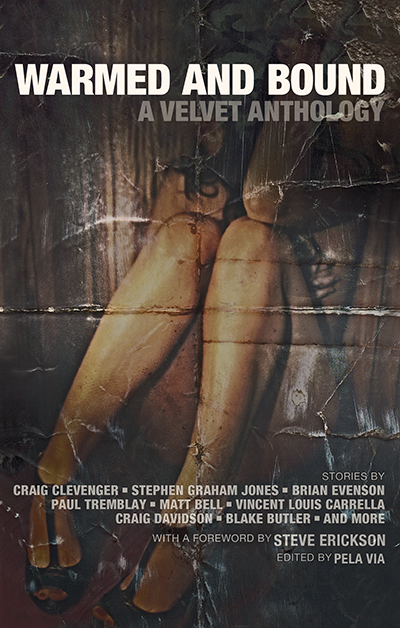
The day of attrition is upon us. Also, coincidentally, the day that Warmed and Bound is released is also upon us. For those of you not yet in the know, prepare to be baptized.
For those with an tendency toward great noir fiction, this collection simply will not disappoint. In fact, the amazing Steve Erickson has offered his own view words to this effect:
“The writers of The Velvet are contemporary fiction’s most effective and least self-conscious aesthetic guerrillas…the result is fiction at once conceived from high artistic intent and executed with depraved populist energy.”
Here’s a bit from Pablo’s Stranger Will investigation:
There can come a point where the magnetism of the internal conflict of a central character can be abandoned or toned down for “the reveal” the exposition of the superficialities of the plot (“whodunit”, as they say, taking center stage) a delicate tension can be lost which to me is always a shame.
Returning to Chinatown, a piece exemplary of what I consider a flaw in some branches of noir, a piece in which the unveiling of who-did-what-to-who-and-why-and-when demolishes the connection to the world, takes the intimacy of the shared experience and makes it remote, only observed, no longer “lived” (even only vicariously). Because of Chinatown, of the letdown I feel every time I get wrapped in its spell and its spell for me falls limp, I always dread when it seems we’re going to learn of a “dark secret” or “a cover up” or any of the conventions, it gets my guard up.
And Ross plays in the tropes, as though cognizant of precedent as something essential. This was evident to me from early on, inseminated in the prose, the clip-and it reinforced my reading it through my own stance on genre.
Pablo D’Stair simply doesn’t stop. He has recently begun yet another project. His Why’d You Go and Do That? series asks authors to confess to a long hidden secret, and subsequently answer a few questions about how that secret may have forged the author’s thematic sensibilities. This guy has so much going on that he’s basically become his own online school. Though I hope this trend of uncomfortable confession doesn’t take over his entire curriculum; someone will likely be calling HR.
Head over to the Why’d You Go and Do That? site to read my confession, my answers, Pablo’s confession, and his answers to my questions. Here’s a taste:
So, first thing I’d like to ask—coming at less the full on subject matter here, but one of your set-up points—is whether you feel in your desire to write some drive to eventually “be free of the tedium of a job” so to speak—do you, at this time, earnestly find time-at-work to be time-away from-writing? And to further a bit, do you think if you didn’t have to work, if you were set-up, well-to-do, that you would fill that time with writing, with active pursuit of your literature? I’ve always been good with having a job, myself, never really (principally) found it as something that takes away from writing and I’ve met some people who I think kind of say they think working is a drain, but really that’s just something they say (as in, I doubt if they didn’t have to work they’d really produce any more or less). Ideally, do you think writing, or any art, is something that should have room to breathe, space, time, something built of a life without such concerns as dayjobs and all? A lot of questions, so answer
however you like—I guess it boils down to “Do you think time away from writing, required time away, is the enemy of writing?”
For a long time I thought of my dayjob simply as something I do between bouts of writing. I’ve realized, fairly recently, that my position on the dayjob was due primarily to me having a shitty one. Now, I’m actually quite content and often find myself letting dayjob duties infringe in what would traditionally be considered my writing time. I hope this is not a testament to an eventual takeover of the dayjob stuff, wherein the writing would dissipate completely. I’m sure it isn’t; writing means too much to me.
More to your question, I know, quite for sure, that should I be given all day to write I wouldn’t use the day in that way. I work best with a balance of outside obligations and writing struggle. If writing were all I had to do, I wouldn’t have any other option to oppose. We need conflict. People need to work in order to appreciate their off-time. I need my job to appreciate my writing time. Required time away therefore might be quite the opposite of the enemy; it could be the best possible mate.
What follows is a conversation between myself and writer and Warmed and Bound editor, Pela Via. Why? We like chatting about ourselves. Or, read a much prettier version at Pela’s blog.
Pela Via: Thanks for talking to me again, Caleb. You are one of the hardest workers in contemporary fiction; I always love a chance to corner you into a long, stifling conversation. Are you as prolific as you seem?
Caleb J. Ross: Prolific is a term that seems appropriate at first, but really a better way to say it would be “got lucky all at once.” Stranger Will and I Didn’t Mean to be Kevin, the two 2011 novels, were both written a few years ago, each a year or so apart. And the novella also to be released this year, As a Machine and Parts, was written even later than the novels. This is all to say that I spent about eight years writing the books, but the one year release schedule implies otherwise. I’m actually quite the disappointment.
PV: Hardly. Your short work is everywhere. Do you plan to release any books in 2012?
CJR: As for 2012, nothing is contracted yet. But I have plenty to write.
PV: What do these two novels represent in your writing career?
CJR: The books both deal with parenthood, but from opposite angles. Stranger Will is about a parent not wanting his child. IDMtbK is about a child wanting nothing more than to have a parent. IDMtbK was written later, and I see it as a reaction to Stranger Will; it is both a personal goal (as in “now, let me see if I can to the opposite of what I just did”) and a reader-based goal (as in “I had better show readers that I’m not as crazy as Stranger Will would imply”).
PV: Do you feel more official this year, as a writer? I know it’s not your first book, but Stranger Will is your first published novel. Has it helped your ego?
CJR: The ego has taken a bit of a stroke, for sure. What makes me feel the most validated with Stranger Will is that I have a lot of strangers commenting on the book. With Charactered Pieces, my first book, I would say about 70% of the readers knew me personally. With Stranger Will that number seems significantly different.
PV: I’m frightened of reaching that place where my work is just barely popular enough to be reviewed by non-friends (and consequently panned).
CJR: I wouldn’t worry about having strangers review your work. I’ve found that the panning is about the same with strangers and friends. The difference being that friends tend to critique you as a person along with the work (“Wow, I can’t imagine you writing something like this”) whereas strangers tend to focus on the work itself.
PV: Interesting. So does it sting a bit more, then, when it comes from friends, if they have a complaint? Does it feel like they’re speaking to your general ability as a human and writer?
CJR: Most of my friends who read early drafts are writers themselves, so I understand that all intentions are good. That said, it can still sting. But the sting is more because of my passion for the work rather than my relationship to the reader. (more…)

![[Guest Post] Character and Plot – One and The Same Thing..?: A guest post from David Baboulene](https://calebjross.com/wp-content/uploads/2011/07/Story-290x120.jpg)