Tag: other writers

  • Emporium: Stories by Adam Johnson

    Midnight finds us rolling through the waves of the old Double Drive In, the gravel crunching under our tires, the Monte Carlo’s trunk bottoming out like it used to, and all the broken glass, beer caps, and bullet casings now sparkle like stars.

    From “Trauma Plate” as included in Emporium
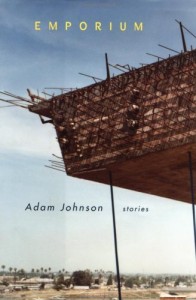
    Emporium taught me more about short story craft than most textbooks dedicated entirely to the topic. Adam Johnson has what some may call a natural story-telling ability, and I’d agree for the most part, but nature, I suspect, takes a person only so far, and Emporium exists as such a perfect specimen of contemporary fiction that I would hesitate to believe we as human beings have this innate level of ability.

    Yes, he has a flair for language. Yes, he can craft a compelling storyline. But what truly makes Adam Johnson endearing is his obvious knowledge of the craft. He has – and I would say this about very few people – a Richard Russo-ian ability for story.

    I read somewhere that Adam Johnson actually enrolled in his first university level fiction class by accident (he incorrectly transcribed a class number when enrolling, trying to fish for an easy A by taking a poetry class). Proof that accidents are God’s little way of being a hilarious son of a bitch.

  • When the Nines Roll Over & Other Stories by David Benioff

    …”How old were you the first time?”

    “The first time I shot someone? Nineteen.”

    Leksi nodded and opened his mouth, but forgot what he had meant to say. Finally, he asked, “Who were we fighting back then?”

    Nikolai laughed. “How old do you think I am, Aleksandr?”

    “Thirty-Five?”

    Nikolai smiled broadly, flashing his crooked teeth. “Twenty-four.” He pressed the poker’s tip against the base of Leksi’s skull. “Here’s where the bullet goes.”

    From “The Devil Comes to Orekhovo” as included in When the Nines Roll Over

    I can be a literary snob when I have to be. I’ll admit that critically praised contemporary fiction is never something I go out of my way to jump on. You’d sooner catch me reading a forgotten receipt than something sitting on a grocery store book shelf. Why? I just feel that a lot of great writing goes unnoticed, and it’s my job as an active member of the literary community to give the lesser-knowns a run when I can. Besides, if somethingWhen the Nines Roll Over cover truly is great I will eventually come back to it, later, at a time when just mentioning it in public won’t cause four-hundred people to start spewing hollow opinions (ex. see Invisible Man and The Stranger below). But When The Nines Roll Over eventually weaved its way onto my bookshelf.


    David Benioff captures the nuances of situation better than most seasoned novelists (though Benioff himself is no complete amateur, having written the novel and screenplay for The 25th Hour, and the screenplay for Troy), and is able to extract, and more importantly, impart empathy with absolute nonchalance.


  • The Condemned by Noah Cicero

    Were you ever drinking one night and thought, “I would like to kill myself, but I just don’t have a good reason. I wish my daughter would get hit by a car or I was a ground troop in The Iraqi War so people would say after I did it, ‘He had his reasons.”

    From “Civilization” as included in The Condemned

    Keep Going. When you land in a passage about a pregnant woman snorting cocaine and eating pussy, keep going. When you get halfway through a scene involving load blowing and load swallowing, keep going. Beauty exists at the end. And it is the rare beauty that informs everything prior.

    Noah Cicero has a way of bringing the most seemingly asinine and gratuitous scenes in toThe Condemned cover sharp focus with just a single paragraph or sentence. Take for instance the story “Gratuitous Kink The Immaculate Cherry Popping,” in which a long list of the protagonist’s sexual exploits is capped with the passage: “In most meaningless sex acts only one of the people has the motivation for a good time. Most of the time one person needs a psychological need fulfilled.” In one direct punch Cicero justifies the assumed gratuity, informs the protagonist, and opens theme all while keeping the momentum strong. In most hands Cicero’s subject matter would be perverse (Bizarro anyone?). In Cicero’s hands the perverse is simply a method for developing great characters.


  • Altmann’s Tongue by Brian Evenson

    He came close enough to her to see the webbed stresses on the surface of her eye spreading out from the minute white pocks of crushed glass. He wondered how it felt for her to have the roughness of the glass scratching against the insides of her eyelid, damaging it.

    From “Eye” as included in Altmann’s Tongue

    If you haven’t read anything by Brian Evenson then you haven’t seen the true capabilities of modern literature. Every line in Altmann’s Tongue simultaneously provokes, disgusts, and intrigues. And though much of the story collection might seem hard to comprehend at first a reader feels assured that Evenson leads a worthy journey. Do I know what the words “atumescence” or “transubstantiation” mean? I could venture a guess, but complete understanding is not what one seeks when reading Evenson. It’s about the journey, the path, and also about sucking a false eyeball out of a girl’s head (read “Eye”).

    Altmann's Tongue cover


    After reading this collection one might understand why the Mormon church excommunicated Evenson based primarily, if not entirely, on the content of Altmann’s Tongue. Or you might be like me and not quite understand the church’s action. But ultimately I thank the church for their decision. I wonder if Evenson would have been able to continue writing what he writes if supported by the Mormon religion. Evenson reads like pen without religion, going where it pleases no matter the hand steering it.


  • Carnival Wolves by Peter Rock

    I am eight times as old as this child, he thought. Do I know eight times as much? No. Not nearly.

    From Peter Rock’s Carnival Wolves

    Think of Carnival Wolves as a reverse picaresque novel divided into short stories. Where a traditional picaresque novel might follow a single character as he/she is affected by various

    Carnival Wolves cover

    other characters, Carnival Wolves examines how a single character affects those various other characters. Simple, right?


    Each section describes a unique setting, one in which the protagonist is suspiciously absent. But as the action evolves into a complete story, the protagonists shows up in some , natural way, if even for a single sentence. It is merely his presence that strings this novel together. At times I thought that maybe the publisher tacked on the “A Novel” tag just to sell more copies – as the novel reads more like a short story collection. Oh, well. Smart marketing, I suppose.


  • Toxicology by Steve Aylett

    Acres of grass were blow to italics

    From “Repeater” as included in Toxicology

    I’ve never been a fan of the futuristic, cyber-puck, apocalyptic, neo-noir—and however many other tags you want to tack on there—genre. My reason: I just plain had more important things I wanted to read. Simple. But those damn Amazon.com recommendations…


    Aylett can twist a sentence like nobody I’ve ever read. Mark my words: he will be famous one day for the phrases he can craft. In fact, he recently self-published a book made up entirely of quotes from his thirteen novels (though Toxicology is a short story collection,Toxicology cover he’s got a few from it in there as well). So maybe I’m jumping on the wagon a bit late.


    You’ll love Aylett for his language, his conceptual brilliance and his satisfying structure (predictable, though, once you get to know his style). Throughout nearly every story in this collection the reader follows this mental pattern:

    1. First half: “What the hell is going on here?”

    2. Second half: “Oh, I think I’ve catching on.”

    3. Last sentence: “What the fuck just happened?”

    That’s two questions in only three thoughts. This means you should buy this collection now.


  • The Stranger by Albert Camus

    Maman died today. Or yesterday maybe, I don’t know. I got a telegram from the home…

    From Albert Camus’s The Stranger (translation)

    Short novel. Simple premise. A man gets arrested and persecuted for essentially not grieving his mother’s death the “proper” way. Sure there is more it, but this is the main idea.


    This novel taught me so much about seeing the world through multiple perspectives. It’s one thing to know the centric tendencies of people. It is quite another to realize that you are most likely participating in those tendencies. Think about how many people out there would, in the event of a mother’s death, shift blame to the son when he shows no real emotion or concern for the death. The narrator in The Stranger actually goes on a dateThe Stranger cover with a woman he met the day following the death.

    But Camus handles the subject beautifully. Aside from the murder of an Arab (which would have been no more than a misdemeanor during the setting’s time in France) the narrator is an all around good, innocent man. He just didn’t have the “typical” relationship with his mother.

    The Stranger sort of makes me want to spend more time with people I feel indifferent towards in case they ever turn up dead.