Tag: other writers

  • My 2010 Lit Midget list of forthcoming small press books

    My 2010 Lit Midget list of forthcoming small press books

    The Millions recently posted a list of 2010 books forthcoming from literary giants. I’m looking forward to quite a few on that list. But, I think we are due a list from literary midgets, too, right?

    So here they are (the ones I can think of right now, anyway. I reserve the right to add more):

    Sawako Nakayasu’s Texture Notes and Travis Nichols’s Iowa from Letter Machine Editions. I only recently heard about Letter Machine Editions, and, other than a few excerpts from the above titles, I have no reason to think these books are worth anticipating. But I like the press’s simple webpage and their equally simple book design. I never said the lit midget list had to be supported by my knowledge of a press or its authors, did I?

    Noah Cicero’s The Insurgent from BLATT Books. Lot’s of people don’t like his stuff. I do. Will I ever look back on a Cicero book as a pivot point in my life? Probably not. Will I continue to read his stuff anyway? Yes.

    Scott C. Rogers’s Love Like a Molotov Cocktail to the Chest from Black Coffee Press. The potential here is all in the title. How could you not read that and sense at least a hint of potential? You can’t.

    Tim Hall’s One Damn Thing After Another from OW Press. Yeah, I’m partial. I have a hand in bringing this one to life. But know this: I would never have gotten my hand involved if I didn’t respect Mr. Hall, and more importantly, his writing. He’s good. Real good.

    Joshua Mohr’s Termite Parade from Two Dollar Radio. I’ve followed Two Dollar Radio for a while. Everything they release could be worthy of a spot on this list. They have a style in both literary and visual aesthetics that works for me. This title in particular looks enticing.

  • Tom Waits Raps?

    Tom Waits Raps?

    Tom Waits stands as one of the most innovative artists alive, mixing crooner piano tunes, industrial percussion, and all the styles between in a way that compliments, though dissonantly, his abrasive voice. Woven throughout his catalog, there’s hip hop, too, from when hip hop was beat poetry. Take 1978’s “Step Right Up” from his Small Change album:

    Step Right Up

    Then, as Waits fell in with (helped create?) the garbage clank-boom crowd, he upped the percussion, giving his hip hop styles more “edge:”

    Top of the Hill

    Dog Door

    But, during last night’s Sonic Spectrum show with Roger Moore (a program I love, by the way), I heard a Tom Waits track that clearly marks the man’s furthest stretch into hip hop:

    Though my initial reaction was one of disgust. Not because Waits had further adopted hip hop (I like hip hop) but because he had done so to such a extreme level. I love Waits for the way he manipulates styles for his own use, not the other way around. He should mold hip hop; hip hop should not mold him.

    But, as Waits music tends to do, the track is growing on me. His first verse (after the chorus, which he performs as well) reminds me of (hed) P.E’s “Pac Bell,” with it’s vibrato gravel quality to the vocals.

    Pac Bell

    All in all, I’m glad Waits is still fighting. Considering his last two albums were a B-Sides collection followed by a live recording, I imagined that perhaps he was winding down. This track makes me think he’s possibly not quite done.

  • CHARACTERED PIECES, given the Bosworth treatment

    CHARACTERED PIECES, given the Bosworth treatment

    Mel Bosworth, skullcap connoisseur and Pushcart nominee, has a burgeoning series of youtube videos in which he reads stories by other writers. The short videos (usually less than a minute or so) work well to break down a dull day. And if you are too busy to watch, you can at least listen – Mel’s got a great reading voice.

    His latest, him reading the opening section of CHARACTERED PIECES. I’m thrilled and honored.

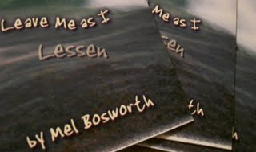
    One of my first intros to Mel’s work was via Folded Word’s single story “mini-mags.” The story: Leave Me as I Lessen. The reaction: floored. I meant to post about this great story before, but my goddamn life got in the way. So, I say, read it now, here. It is only downloadable for free until December 15.

  • Nothing for Money OR How to Diminish a Prize’s Power

    Nothing for Money OR How to Diminish a Prize’s Power

    After Blake Butler, editor of the print lit journal NO COLONY, posted an aside about publishing and Pushcart-nominating anyone willing to pay $650, Shya Scanlon called his bluff, and quickly rallied 65 people, each willing to fork over $10, to put together a composite of 150 word prose chunks. That’s 9,750 words by 65 authors, each with claim to 1/65th of a Puschart nomination.

    The entire point of Butler’s original offer, I think, was to comment on how easy it is to manipulate these sorts of literary prizes. In truth, anyone with anything published can be nominated for a Pushcart. All it takes is an editor willing to write your name on a piece of paper. And in a world of zero-overhead POD printing, anyone can be an editor. I hope that those in charge of choosing the Pushcart winner know how to filter out stuff like this NO COLONY thing (unless, who knows, this collective piece ends up being the bee’s knees).

    Plus, I don’t know that anything of this scale, amid these terms, has ever been done. And more and more I am learning that firsts count for a lot when trying to sell yourself and your work. Look at Blake Butler, who recently sold destroyed (but still readable) copies of his book SCORCH ATLAS and has vowed to eat an entire copy of the book, one page at a time. What did these firsts help him achieve? A recent contract with Harper Perennial. (It helps too that his work is pretty damn excellent).

    Participating writers include:

    Me
    Ryan Call
    Shy Scanlon
    Richard Thomas
    Nathan Tyree
    J.A. Tyler
    Jackie Corley
    Nik Korpon
    Christopher J. Dwyer

    …among exactly 56 others.

  • Beer und Questions Asks – Gordon Highland

    Beer und Questions Asks – Gordon Highland

    GHBANNER_signed

    Gordon Highland is not Drew Ballard. Though, to know the former after reading the latter, one might not recognize a distinction. Ballard, the protagonist of Highland’s first novel, Major Inversions, has much in common with his author: 80’s tribute band member, check; film scoring history, check; unending wit, check. Film set drug dealer…no.

    After reading Major Inversions, I sat with Gordon to ask him a bit about these parallels (as well as a couple especially interesting others). Check out the video interview, the first of what I hope to be a series of author interviews called Beer und Questions Asks.

    Buy a copy of Major Inversions online at Amazon.com. I recommend it.

    Further reading:
    My review of Major Inversions at Outsider Writers Collective
    Gordon Highland homepage

  • Fans of Sideshow Fables

    Fans of Sideshow Fables

    SideshowFables_Banner

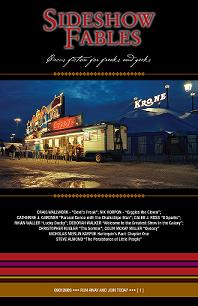
    When Sideshow Fables creator Paul Eckert approached a group of writers (to which Paul and I belong) about creating a magazine of circus themed tales, I said a silent thank you on the behalf of all readers. He’s got it right, I think. Going about fanbase-building and marketing in the way that independent record companies have been doing for years is a wise move when falling publisher profits has become too common a story.

    It was at last year’s AWP Conference in Chicago when I heard a panel of small press publishers (I can’t remember any of them, I apologize) where one of the editors made mention of the indie record label model. The publishing logic having always been, we will make readers fans of authors. But, said the editor, why not make readers fans of the publishers? It seems obvious. And to do that, readers have to be able to count on publishers to deliver SideshowFables1writing with a certain consistency among publications.  An example on the record label side: I know that anything Barsuk Records or ANTI Records puts out, I’ll love it. They have a fan in me. Some of the smaller book presses, like 6 Gallery Press and even larger Independents like MacAdam/Cage, have captured my money in the same way. If publishers put money toward their own brand and not the brand of the authors they represent, then how could they not come out on top? (Though, I do think putting some money toward crafting an author career is important – after all, publishers need material to support whatever reputation they are trying to cultivate).

    All this is to say that with Sideshow Fables, I know exactly what I am getting. But don’t confuse this with rehash; the individual author’s themselves will provide the fresh voices necessary to keep the rag from getting stale. The first issue alone has work from Steve Almond, Nik Korpon, Colin McKay Miller, Nicholas Merlin Karpuk, and Craig Wallwork – quite a variety of voices.

    I recommend you pick up a copy (full disclosure: I have a story in this first issue). You may like it. And if you do, you can count on liking all of the issues to come.

  • The Coming (Staying?) of Metafiction…

    The Coming (Staying?) of Metafiction…

    HOLpageBANNER

    Metafiction (see: “intertextual fiction”): self-referential fiction. A simple definition but one open to great possibilities. Think of the infinite mirror effect in that when two similar subjects are forced to reflect each other, self-commentary snowballs.

    For me, the pull started with Jorge Louis Borges’s story, “The Garden of Forking Paths”:

    “In all fictional works, each time a man is confronted with several alternatives, he chooses one and eliminates the others; in the fiction of the almost unfathomable Ts’ui Pen, he chooses – simultaneously – all of them. He creates, in this way, diverse futures, diverse times which themselves also proliferate and fork…No one realized that the book and the labyrinth were one and the same.”

    Wow.

    For Borges, character was secondary to plot, a tactic generally snubbed by the literateri as a convention of commercial(ized) fiction. But for Borges, the philosophical ideas were so strong that they became characters in and of themselves. The Library of Babel and The Circular Ruins (both appearing in stories of the same name) are far more interesting concepts than any character that may be dropped within them.

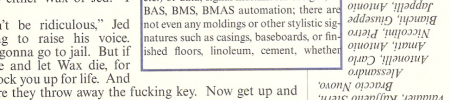
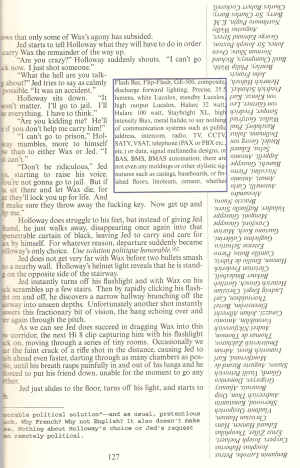
    A few years after I discovered Borges, I happened upon Mark Z. Danielewski’s HOUSE OF LEAVES which takes the idea of Metafiction and mashes it against illustrative elements to create both a figurative and literal labyrinth with(in) the text. See this and try not to drool:

    HOLpage

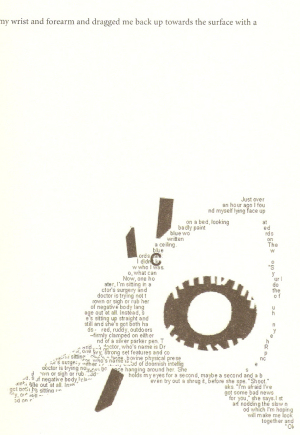
    Then I found Steven Halls, THE RAW SHARK TEXTS which, while obviously influenced by HOUSE OF LEAVES, succeeds as a great story in its own right.

    RSTpage

    I bring up Metafiction for two reasons:

    1) I think we are only beginning to see with Metafiction what will certainly become a much more popular style in the years to come. With desktop publishing at a point that anyone with a computer and a thumb can layout a book, and with other artistic mediums now being so easy to manipulate on-screen, the possibilities truly are endless to create mini-networks of self-referential “book objects.” And where there is ability, there will be a niche (then (un)fortunately a grocery store shelf) to fill.

    2) What else is out there? I’m looking more for the book that manipulates the physical features of a book (more like HOUSE OF LEAVES rather than manipulates the concept (less like Borges’s work). Post a comment, guide me.