Tag: newsletter

  • Colored Chalk: Issue Four – Big Brother in my Pocket

    Colored Chalk: Issue Four – Big Brother in my Pocket

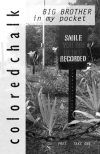
    Issue Four of the Colored Chalk zine has hit the virtual bookshelves. I swear, this thing just keeps getting better. And I don’t say that as an ego stroke considering I am a co-editor. The proof: I had absolutely nothing to do with this issue.

    This issue contains some fantastic stories by Charles King, Richard Thomas, Jason Kane, Colin McKay Miller, Chris Deal, Michael A. Kechula, Gary Paul Libero, Gavin Pate, Michael Paul Gonzalez, and Tyson Estes.

    As always, the issue can be viewed online and can also be printed and stapled for local distribution. Call it permissible thievery.

    Issue Four theme: Big Brother in my Pocket:

    Surveillance used to be difficult.

    Tracking a person’s every move required a lot of legwork. Following, stalking, tracking, chasing. Exhausting.

    These days, you’ve got digital, got the capability to replicate every letter, every word, every sound, every pixel.

    Record.
    Upload.
    Share.
    Show everyone.
    Tout triumphs.
    Lament setbacks.
    Rant and complain.
    Brag about crimes.

    Monitoring you used to be a challenge, but something changed. Somebody must have promised you something for all your hard work. Promises make people so much more helpful.

    To all you writers out there check out the Colored Chalk homepage for guidelines and information on the issue 5 theme: Sins of the Father. This theme spawns from an essay of the same title by brilliant writer Will Christopher Baer.

  • Colored Chalk, the zine: Issue Three

    Colored Chalk, the zine: Issue Three

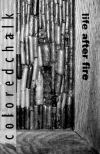
    The Colored Chalk zine once again has me at the helm, wearing the editor cap. The theme: Life After Fire

    Suffering an unbiased attack we are entirely reactionary. Some call this response the truest kernel of instinct and accept death with stoic certainty. Some call death the culminated answer to questions asked of gods over an entire lifetime.

    Yet some survive. Carrying for the rest of their lives the burden of informed choice.

    The following stories are those choices…

    This issue, I think, is out best yet. It features stories by Nik Korpon, Michael A. Kechula, Anthony David, Richard Thomas, Chris Deal, Charles King, Michael Paul Gonzalez, Joel Shoemaker, Sean P. Ferguson, Mark Grover, and Keith Haworth. Google all of them, read some of their other stories. I promise you won’t be disappointed.

    As always, the issue can be viewed online and can also be printed and stapled for local distribution. Onward, and fill all the empty tables at neighborhood coffee houses, bathrooms, and daycares.

    Don’t forget that Colored Chalk is always open to submissions. Check out the Colored Chalk homepage for guidelines and information on the issue 4 theme: Big Brother In My Pocket.

    Click here to see the issue is all its magnificent page-turning glory.


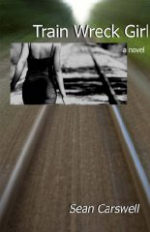
  • Train Wreck Girl by Sean Carswell

    Train Wreck Girl by Sean Carswell

    Carswell, Sean, Train Wreck Girl. San Francisco: Manic D Press. 2008. paper,ISBN: 978-1-933149-21-9

    Train Wreck Girl by Sean Carswell
    Train Wreck Girl by Sean Carswell

    Before I go any further, know that Train Wreck Girl will easily be one of the best novels of 2008. At 20 pages in, the earth paused. I remained absolutely entranced through the final page. Novels like this don’t happen very often, so pay attention.

    Train Wreck Girl poses as a fairly straightforward story of a man traveling cross-country to flee his past, returning years later, only to re-immerse in all that he tried to originally escape. He’s outgrown this childhood town of Cocoa Beach, FL, but only in width. The slug line describes the narrative beautifully: One man’s quest to figure out what to do with his life now that it is too late for him to die young.

    Beyond the immediately arresting imaginative structural elements (the first chapter is told as a countdown to New Year’s, 1999; some following chapters are told as itineraries outlining the protagonist’s day life) is a narrative so beautifully balanced between plot and character that it wasn’t uncommon for me to breeze through 50 pages without realizing a single blink.

    The protagonist, Dan, for example, is a poor, seemingly uneducated man, yet carries an impressive cultural awareness that artfully dodges the dirty savant trope so common with “hard life” literature:

    She called me white trash. Which hurt. The “trash” part I can take. But I don’t know why she had to throw “white” in there. [pg. 18]

    Or this observation, when introducing two of the narrator’s old friends:

    Marigold wore a ring on her left ring finger. Christian didn’t. I took that to mean they were engaged. [pg. 45]

    It is this uncanny ability to completely mine a character with initially apparent minutiae that allows Train Wreck Girl to avoid so many potential pitfalls into character-generic cliché. This could have easily been a simple crime novel, a straightforward road trip story, or even a terrible love story. But it isn’t. Perhaps it is this very ability to tease, while simultaneously comforting the reader that carries the novel.

    Here’s the ultimate test of a successful novel: can the story humanize a scene involving people farting on a corpse? Train Wreck Girl can, and does.


  • "Hoist That Rag" still "Hoist That Rag"

    "Hoist That Rag" still "Hoist That Rag"

    Tom Waits, Tulsa OK, 6.25.08

    I’ve been working on a novel for the past couple years inspired by the Tom Waits song, “Hoist That Rag.” This song is as close to religion as I get.

    Strangely, or perhaps fittingly, I don’t know the literal meaning of the song. There’s a guy named Piggy, something about rat addresses, and of course, as with most religions, there are crying babies involved. What this means for my novel-in-progress is that everything is simply an interpretation. Again, very fitting with religion in general.

    This past week I had the opportunity to experience this song live (Tulsa OK, USA, at the Brady Theater, 6.25.08). I had been looking forward to this show for months, but it wasn’t until I was standing in line at the venue that I began to have reservations about hearing “Hoist That Rag” live.

    Until the performance my experience of the song had been entirely self-contained. But, how would my view change when surrounded by hundreds of individuals each with their own connections to the song? Would my interpretations be marred by theirs? Would the voices around me, some singing along, some rudely talking about unrelated domestic issues, become part of a revised vision of the song, and by extension, my novel-in-progress?

    Thankfully, not completely. The world shut down during the song. Yes, I recorded the performance (see YouTube video below), but I intentionally kept from looking at the LCD monitor the entire time. I wanted the performance to enhance my vision of the song, not distort it.

    I wonder then, how, if at all, my manuscript will change because of this new association. Understand that when dealing with an 80,000 word novel inspired by a 139 word song there is going to be a huge portion of “all me” there, but still, if the core impetus changes then will the entire novel change as well? Considering that I have not yet finished the novel, I guess I will never know. But it makes me wonder if perhaps I should have never gone to the show.

    Wait…no it doesn’t. The show was one of the most amazing experiences of my life. Fuck the novel if it means loosing the show.

    [media url=”http://www.youtube.com/watch?v=sqqxDbYx9sM”]


  • Colored Chalk, the zine: Issue Two

    Colored Chalk, the zine: Issue Two

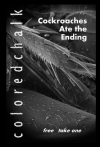
    This issue’s theme spawns from the great mind of Kurt Vonnegut, via your issue two editor, Jason Heim.

    Vonnegut wrote:

    “Give your readers as much information as possible as soon as possible. To heck with suspense. Readers should have such complete understanding of what is going on, where and why, that they could finish the story themselves, should cockroaches eat the last few pages.”

    And that’s just what we aimed to do with this issue of Colored Chalk.Colored Chalk Issue 2

    I have a piece in this issue, “Exhibit One: A Letter From Alex Fumar,” which I hesitate to mention simply because it’s impact is so reliant on context. Read outside the Colored Chalk zine my piece would make absolutely no sense, and could possibly put first time readers off of my work for good. My logic is that if I called attention to “Exhibit One,” then I might as well call attention to other printed pieces which would make no sense out of context. For instance, my letter to the editor in the June 2007 issue of Spirit, the Southwest Airlines magazine (yes, THE Southwest Airlines magazine).

    But, I’m a whore, so go on and read: “Exhibit One: A Letter From Alex Fumar.

    And while your at it, here’s Spirit Magazine’s Letter of the Month from June 2007.

    Don’t forget, the Colored Chalk zine can be printed and distributed, hassle-free (and all other kinds of free) if you’re in the mood to spread the word. Just click here, print, staple, and force upon strangers.

    And if you are in the mood to not spread the word, pick up a copy at Kansas City’s own Prospero Books on 39th Street.

  • Book marketing in a market uninterested in books

    Marketing a book in an increasingly visually driven society is a tough role. Not to mention the ever decreasing number of people who actually read (books that is, not this stupid blog). According to statistics from sources that sound legit* 80% of U.S. families did not buy or read a book last year [2002]. I’m hoping this figure can be taken literally to mean that these families did not physically purchase the book as a single group, with each member holding an edge of the book and simultaneously placing it on the bookstore counter. I would have never thought any family to do such a thing, so really the 20% of families who do is pretty eye opening. Unfortunately, the literal interpretation is a ridiculous dream. The truth is, most people simply do not read books.

    But don’t fret my fellow 20%-ers. Veronis, Suhler & Associates investment banker** says that each day in the U.S., people spend 4 hours watching TV, 3 hours listening to the radio and 14 minutes reading magazines. Why is this good? Because more and more authors are turning to just such TVs (or computer monitors; they’re both square and full of pixels) in order to push their wares.

    Here are a couple of my favorites:

    Douglas Coupland’s 3 spot campaign for his novel, Gum Thief (a YouTube page)

    Dennis Cass’s spot for his memoir, Head Case:

    [media url=”http://www.youtube.com/watch?v=yxschLOAr-s”]

    Oddly enough however, I don’t own either of the two advertised novels. The ads worked well for me aesthetically, but considering my current stack of 53 too-read books I’m just not in the market for more quite yet. So consider this post simple word-of-screen advertising.

    * Jenkins Group, inc; they have the word “group” in their name. Nothing more is needed to connote reputability.
    ** Why is an investment banker devoting time to these sort of statistics? I don’t care; they are associates! See above asterisk for the power of organizational tags.
    Here’s the for real page from which these statistics were pulled

  • Scarlett Jo’s no no

    Scarlett Jo’s no no

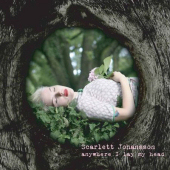
    Until today I’ve thought to keep this page about my writing – the physical, textual, words and paper aspect of my writing. Today, however, I feel compelled to stray, if only slightly, into the meta aspects of myAnywhere I Lay My Head by Scarlett Johansson writing – the ambient noise and inspiration surrounding my work. Today’s theme, Tom Waits, the core inspiration for my current novel-in-progress, “Hoist That Rag” (I’ll look into the legal issues with such blatant inspiration once I secure a publisher).

    Scarlett Johansson, of film and my dreams fame, yesterday released Anywhere I Lay My Head, an album of Tom Waits covers, give the lone original “Song For Jo.” Before I rant, let me put my love of Tom Waits into context: I have more Tom Waits CDs, posters, and inspired literature than I have love notes to my wife (most of the love letters I write go to Tom Waits; sorry Jenn). Waits is the single greatest recording artist in history, without argument. Needless to say, when I first heard late in 2007 about Johansson’s then forthcoming album I cried a little. But then I heard her take on the famous “Summertime” (see link below) and cried a little, again, but this time with an optimistic grin. This song is phenomenal.

    Today, I cry yet again. Anywhere I Lay My Head is astoundingly terrible. The music itself is unique enough to intrigue, but somewhere along the line producer David Andrew Sitek (of TV on the Radio and my nightmares fame) felt it hilarious to turn Johansson’s vocals into a deep throated, Madonna-drowing-in-a-well, reverb orgy. Excessive reverb can work for a record (D*R*I’s Smoke Rings, for example, one of my top albums of 2007), but the style has to mesh with the music. Anywhere I Lay My Head does not do this.

    Shame on you David Andrew Sitek for stealing something beautiful.

    ***Before I go I do want to reserve the right to let this album grow on me. I’ve spun it three times so far, and though I don’t anticipate a change, I have been corrected in the past. Hell, the first time I heard Tom Waits I had to fake my head bob.

    Anywhere I Lay My Head by Scarlett Johansson