Tag: newsletter

  • Nothing for Money OR How to Diminish a Prize’s Power

    Nothing for Money OR How to Diminish a Prize’s Power

    After Blake Butler, editor of the print lit journal NO COLONY, posted an aside about publishing and Pushcart-nominating anyone willing to pay $650, Shya Scanlon called his bluff, and quickly rallied 65 people, each willing to fork over $10, to put together a composite of 150 word prose chunks. That’s 9,750 words by 65 authors, each with claim to 1/65th of a Puschart nomination.

    The entire point of Butler’s original offer, I think, was to comment on how easy it is to manipulate these sorts of literary prizes. In truth, anyone with anything published can be nominated for a Pushcart. All it takes is an editor willing to write your name on a piece of paper. And in a world of zero-overhead POD printing, anyone can be an editor. I hope that those in charge of choosing the Pushcart winner know how to filter out stuff like this NO COLONY thing (unless, who knows, this collective piece ends up being the bee’s knees).

    Plus, I don’t know that anything of this scale, amid these terms, has ever been done. And more and more I am learning that firsts count for a lot when trying to sell yourself and your work. Look at Blake Butler, who recently sold destroyed (but still readable) copies of his book SCORCH ATLAS and has vowed to eat an entire copy of the book, one page at a time. What did these firsts help him achieve? A recent contract with Harper Perennial. (It helps too that his work is pretty damn excellent).

    Participating writers include:

    Me
    Ryan Call
    Shy Scanlon
    Richard Thomas
    Nathan Tyree
    J.A. Tyler
    Jackie Corley
    Nik Korpon
    Christopher J. Dwyer

    …among exactly 56 others.

  • Orange Alert! Caleb talks!

    Orange Alert! Caleb talks!

    Blogs have two major purposes: 1) to serve their ego-maniacal masters (hopefully not my site), and 2) to alert the somewhat socially inept to trends befitting their interests (am I’m closer to this one). A couple years ago, Tim Hall directed me to What to Wear During an Orange Alert, which has consistently fallen into the latter category (wow, two uses of the word “latter” in consecutive blog posts. Pompous, I may be). When it comes to music, art, and literature, Jason Behrend’s Orange Alert delivers beautifully.

    So, in a weird mix of the aforementioned purposes, I’m here to tell you that Orange Alert has posted a new interview with yours truly (***creepy picture warning***).

    Among topics discussed:

    • The Process for getting my work in front of faces (re: stalking)
    • What kinds of books should be reviewed (re: hocking)
    • Some of the music I’ve been listening to lately (re: rocking)

    Any opinions? The internet makes all opinions valid. Be sure to post comments here or at the Orange Alert post. I suggest subscribing to the Orange Alert RSS feed. I do. And all my ideas are pretty damn swell.

  • Beer und Questions Asks – Gordon Highland

    Beer und Questions Asks – Gordon Highland

    GHBANNER_signed

    Gordon Highland is not Drew Ballard. Though, to know the former after reading the latter, one might not recognize a distinction. Ballard, the protagonist of Highland’s first novel, Major Inversions, has much in common with his author: 80’s tribute band member, check; film scoring history, check; unending wit, check. Film set drug dealer…no.

    After reading Major Inversions, I sat with Gordon to ask him a bit about these parallels (as well as a couple especially interesting others). Check out the video interview, the first of what I hope to be a series of author interviews called Beer und Questions Asks.

    Buy a copy of Major Inversions online at Amazon.com. I recommend it.

    Further reading:
    My review of Major Inversions at Outsider Writers Collective
    Gordon Highland homepage

  • Fans of Sideshow Fables

    Fans of Sideshow Fables

    SideshowFables_Banner

    When Sideshow Fables creator Paul Eckert approached a group of writers (to which Paul and I belong) about creating a magazine of circus themed tales, I said a silent thank you on the behalf of all readers. He’s got it right, I think. Going about fanbase-building and marketing in the way that independent record companies have been doing for years is a wise move when falling publisher profits has become too common a story.

    It was at last year’s AWP Conference in Chicago when I heard a panel of small press publishers (I can’t remember any of them, I apologize) where one of the editors made mention of the indie record label model. The publishing logic having always been, we will make readers fans of authors. But, said the editor, why not make readers fans of the publishers? It seems obvious. And to do that, readers have to be able to count on publishers to deliver SideshowFables1writing with a certain consistency among publications.  An example on the record label side: I know that anything Barsuk Records or ANTI Records puts out, I’ll love it. They have a fan in me. Some of the smaller book presses, like 6 Gallery Press and even larger Independents like MacAdam/Cage, have captured my money in the same way. If publishers put money toward their own brand and not the brand of the authors they represent, then how could they not come out on top? (Though, I do think putting some money toward crafting an author career is important – after all, publishers need material to support whatever reputation they are trying to cultivate).

    All this is to say that with Sideshow Fables, I know exactly what I am getting. But don’t confuse this with rehash; the individual author’s themselves will provide the fresh voices necessary to keep the rag from getting stale. The first issue alone has work from Steve Almond, Nik Korpon, Colin McKay Miller, Nicholas Merlin Karpuk, and Craig Wallwork – quite a variety of voices.

    I recommend you pick up a copy (full disclosure: I have a story in this first issue). You may like it. And if you do, you can count on liking all of the issues to come.

  • Charactered and Vain make for great reading

    Charactered and Vain make for great reading

    mask_vainMagVain Magazine could claim more ancestral lit zine origins than most. They have the staple bound VainCovercover of an indie mashup, the forward thinking mindset of an east coast glossy, the strong literary content of small press chap network, and the design sensibilities of art school college grad with trust fund comfort to keep his ideals high and his being higher.

    Writer, editor, designer, and 1000 more -ers, Richard Thomas, turned me on to Vain Magazine last year when his story, “Underground Wonderbound” graced its pages. I was impressed, not only with his story, but with the overall aesthetic appeal of the magazine. Too often, hand-stapled, small print magazines get the scoff. This one deserves some praise.

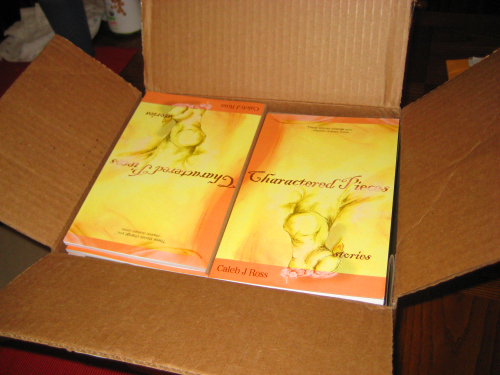
    Now, after all that build up, I’m here to let the ego shine. My story, “Charactered Pieces,” appears in the new issue, #7, right now. I wrote the original version of this story in college, and it has been sweating since. The Vain Magazine version is a much better, much more mature version, but still has all the underdeveloped Siamese twin left leg goodness of the original.

  • The Coming (Staying?) of Metafiction…

    The Coming (Staying?) of Metafiction…

    HOLpageBANNER

    Metafiction (see: “intertextual fiction”): self-referential fiction. A simple definition but one open to great possibilities. Think of the infinite mirror effect in that when two similar subjects are forced to reflect each other, self-commentary snowballs.

    For me, the pull started with Jorge Louis Borges’s story, “The Garden of Forking Paths”:

    “In all fictional works, each time a man is confronted with several alternatives, he chooses one and eliminates the others; in the fiction of the almost unfathomable Ts’ui Pen, he chooses – simultaneously – all of them. He creates, in this way, diverse futures, diverse times which themselves also proliferate and fork…No one realized that the book and the labyrinth were one and the same.”

    Wow.

    For Borges, character was secondary to plot, a tactic generally snubbed by the literateri as a convention of commercial(ized) fiction. But for Borges, the philosophical ideas were so strong that they became characters in and of themselves. The Library of Babel and The Circular Ruins (both appearing in stories of the same name) are far more interesting concepts than any character that may be dropped within them.

    A few years after I discovered Borges, I happened upon Mark Z. Danielewski’s HOUSE OF LEAVES which takes the idea of Metafiction and mashes it against illustrative elements to create both a figurative and literal labyrinth with(in) the text. See this and try not to drool:

    HOLpage

    Then I found Steven Halls, THE RAW SHARK TEXTS which, while obviously influenced by HOUSE OF LEAVES, succeeds as a great story in its own right.

    RSTpage

    I bring up Metafiction for two reasons:

    1) I think we are only beginning to see with Metafiction what will certainly become a much more popular style in the years to come. With desktop publishing at a point that anyone with a computer and a thumb can layout a book, and with other artistic mediums now being so easy to manipulate on-screen, the possibilities truly are endless to create mini-networks of self-referential “book objects.” And where there is ability, there will be a niche (then (un)fortunately a grocery store shelf) to fill.

    2) What else is out there? I’m looking more for the book that manipulates the physical features of a book (more like HOUSE OF LEAVES rather than manipulates the concept (less like Borges’s work). Post a comment, guide me.

  • Colored Chalk #9 now live. Heaven or Hell? We’re taking a vote.

    Colored Chalk #9 now live. Heaven or Hell? We’re taking a vote.

    CC9Banner

    Hard to believe we are already at issue #9. And the stories just keep getting better. This new issue is all about Heaven and Hell.

    From Richard Thomas, #9’s editor, and Colored Chalk staple:

    IS IT YOUR IDEAL HEAVEN OR UNBEARABLE HELL?

    One man’s ceiling is another man’s floor. One man’s trappings are another man’s freedom. What is heaven and hell to you? Is it brimstone and hooves opposing angels floating on ethereal clouds? Is it merely the eternal battle of dark vs. light, good vs. evil, right vs. wrong? Is it pushing a boulder up a hill day after day to no avail or having your liver eaten for eternity, each new dawn awakening to this horrible echo? Is it just a quiet moment of peace, that subtle bliss as you fall asleep or waking next to those you love?

    The writers in this issue of Colored Chalk all speak about their versions of heaven and hell, visions of horrible moments they hope will never happen to themselves, or the ultimate goal, the rapture and pinnacle of good and all that is right in the world and beyond. Or maybe it’s just a weekend stuck in a crummy hotel, a quick kiss before leaving for work, the commute that drains your life force, and the smiling face of a daughter or son eager to have you home.

    Now wait…where were we…heaven, or hell? You tell me. I hope you enjoy the work of these gifted writers as much as I do.

    Issue 9 contains fine work Zsa Zsa Wong, Vincent Louis Carella, Beth Mathison, Craig Wallwork, Karen Brown, Shaindel Beers, Christopher Dwyer, M. Kilbain Lazer, Paul Mallaghan, Michael Paul Gonzalez, Valerie Geary, Kara Kilgore, Gayle Towell, Gavin Pate, and Nik Korpon

    As always, we promote legal theft as a downloadable and distributable .pdf file. Go to the Issue 9 page for details, printing instructions, and visual over-stimulation.