Episode #006 of The Velvet Podcastjust went live a few hours ago. Gordon Highland, Jesse Lawrence, Logan Frost, and Stephen Graham Jones talk about:
Please, give it a listen. Subscribe via Feedburner, Podcast Alley, or iTunes. |
|
Tag: newsletter
-
The Fringe Detriments of Writing Fiction
In response to Mr. Highland’s challenge to come up with a counter point to my list of the fringe benefits of writing, I offer to you, the fringe detriments of writing:
- Not enough people worship me. Jesus had a whole pool of suckers to write for him. Am I comparing myself to Jesus? Yes. Which brings me to…
- An inflated ego brings nothing but misery. But on someone as awesome as me, misery looks damn good.
- Something can easily take years to write, but can be read and forgotten in hours (wow, that was a bit of an honest one. I wasn’t expecting that)
- If you are so brash as to call your writing an art-form, very few people will be interested. People who don’t care for art will change the subject. People who don’t write but enjoy art will simply not believe you. And people who do write and do enjoy art will immediately resent you for stealing their form. Those few that do take interest will likely wane once you start describing character motivations and narrative arc. The trick, I think, is to write about boobs.
- If the page is a reflection of your soul, as hippy writers like to say, then a writer must be fully aware and be willing to accept that your life and soul both suck. Get a job, hippy!
- Paper cuts are a job hazard. Pen stabbings are too. Computer maulings happen. I once choked on the “T” key. These are all self-inflicted. For fuck’s sake, I sit in front of a computer for hours each day; I go mad!
- One man’s masterpiece is another man’s throw-in to offload a used lawn mower at his yard sale.
- When caught burrowing in a dumpster, the excuse “it’s research for a project” only works once. Subsequent times require the truth: “I’m a writer, so I am homeless.”
-
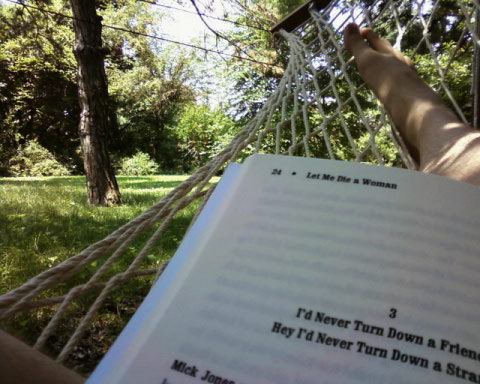
Kansas City Reading Coves – my hammock
I bring you #3 of a hopefully long-lived series: Kansas City Reading Coves.
When I can, I like my coves like my Republican nudists: free swinging and white.
Today’s cove: my hammock – my house
Simply put, my hammock is the greatest reading cozerie since the 70’s invented bean bag chairs. I could sit here for hours, and often I do, reading, smoking cigars, drinking beer, and swinging only as much as the wind wants me to. The hammock is my heaven on Earth. Take that God!
If you are ever in my area, call ahead and the hammock is yours for the afternoon…unless I am already occupying it. We could share, I guess.
Rankings out of 10:
Smoking accommodations 10 It’s outside! It’s my effing house! Furniture comfort 10 Have you ever sat in a hammock? Like a cloud, people. Quiet level 8 Lawn mowers cause a bit of ear pain, but other than that, I suffer only the harsh music of nature. Mosquito buzzing sucks. Temperature comfort 5 I’ve got to go average here. I only sit in the hammock when the weather is nice, so truthfully, this should be a 10. I’d like to sit here every day, but the hot and cold extremes make that impossible. -
Great Unexpected Literary References
(part of my ongoing Unexpected Literary References series)
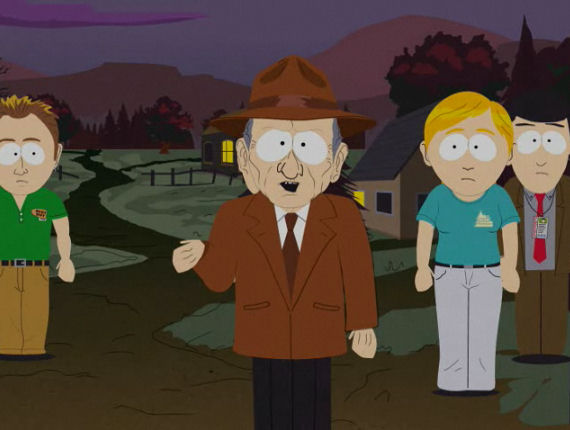
When watching a rerun of the “Britney’s New Look” episode of South Park a few nights ago, I caught an allusion to the famous short story, “The Lottery,” by Shirley Jackson (minute 16:36 in the clip here). Which makes me wonder, in what other unexpected places do literary references and allusions appear?
Staying in the South Park world, there is the “A Dickens Classic” episode, which is an overt retelling of Charles Dickens’ Great Expectations. More recently, The episode “The Tale of Scrotie McBoogerballs” is an extended commentary on Catcher in the Rye’s controversial reputation.
But beyond those borders, below are a few I remember (having been refreshed via a few internet searches). What others are there?
The Simpsons
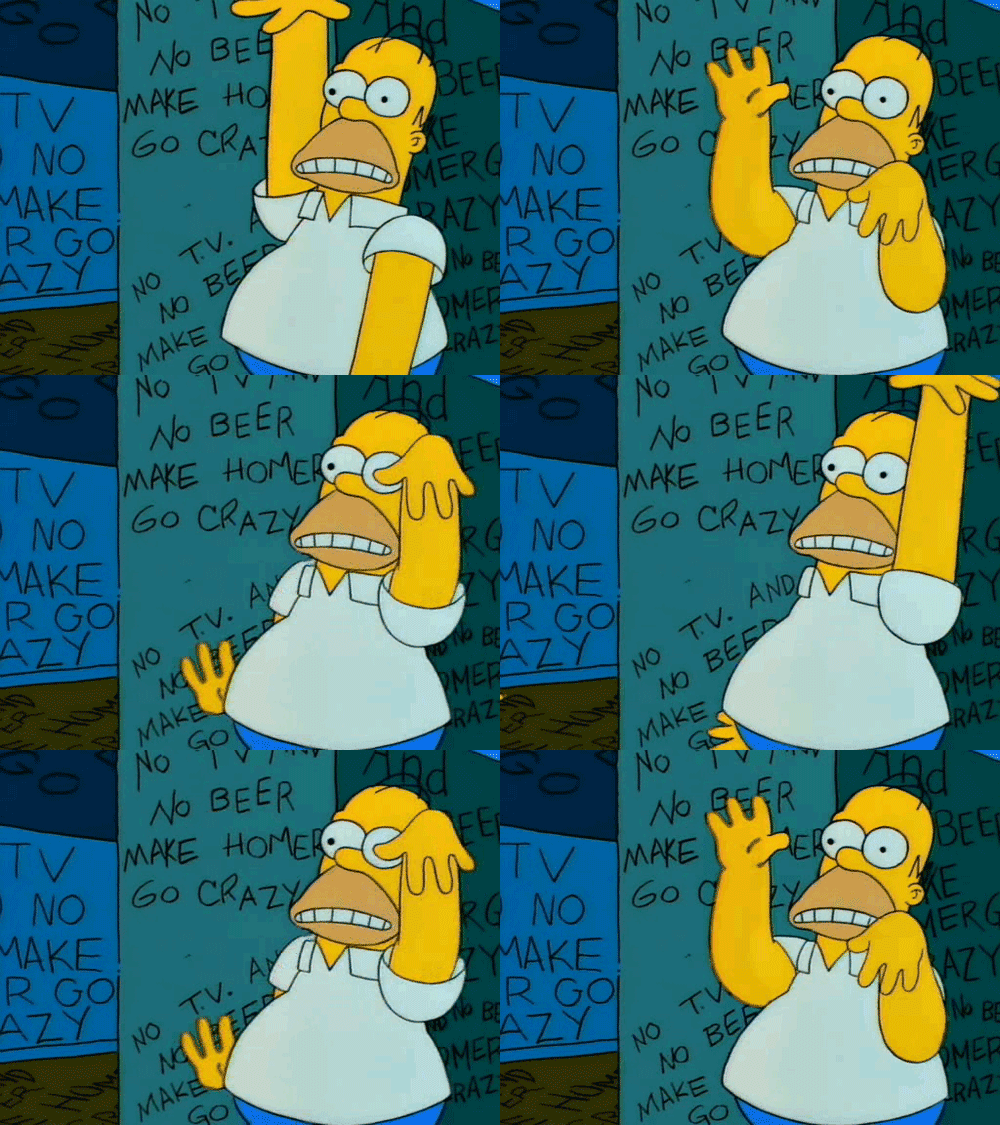
- ep Treehouse of Horror V | The “All work and no play makes Jack a dull boy,” from Stephen King’s novel, The Shining, is ‘Homerized’ to “No TV and no beer make Homer go crazy.”
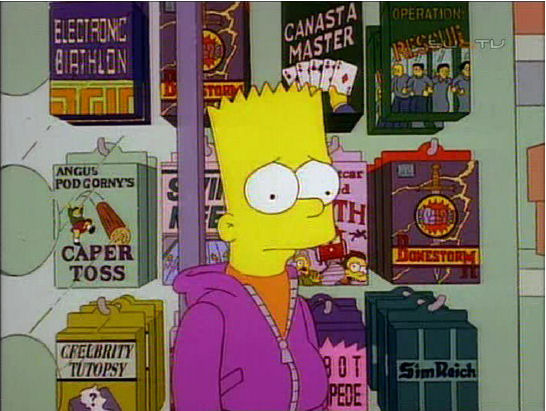
- ep Marge Be Not Proud | a shelf of video games contains one game called Canasta Master, which is a parody of the novel The Vegas Kid by Barney Vinson.
- ep Diatribe of a Mad Housewife | Thomas Pynchon is depicted in cartoon form (clip below)
Looney Tunes/Merrie Melodies
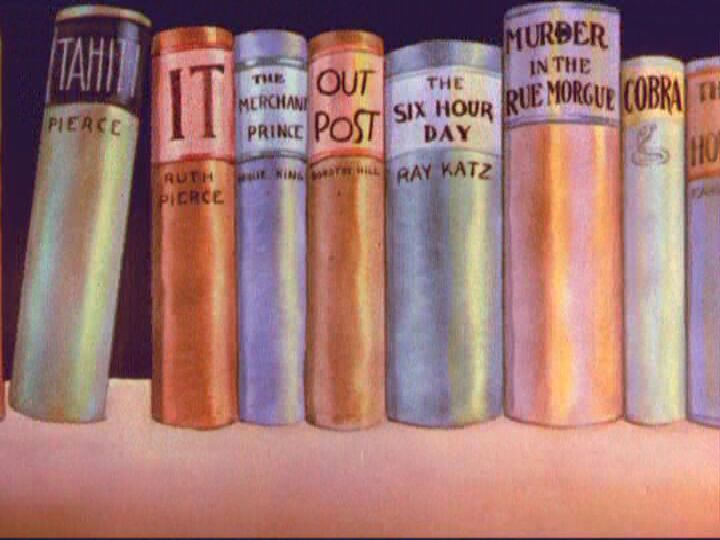
- ep Have You Got Any Castles? | This episode I remember, all these years after first seeing it as a child, is a amalgamation of classic literary references. So much so that a web page has been created outlining these mentions.
Family Guy
- ep Peterotica | On the DVD version of this episode, one of the erotic novels Peter writes is called “Catch Her in the Eye,” a reference to J.D. Salinger’s Catcher in the Rye
- ep Jerome is the New Black | During Quagmire’s rant about hating Brian, he hones in on Brian’s habit of giving copies of J.D. Salinger’s Catcher in the Rye to women.
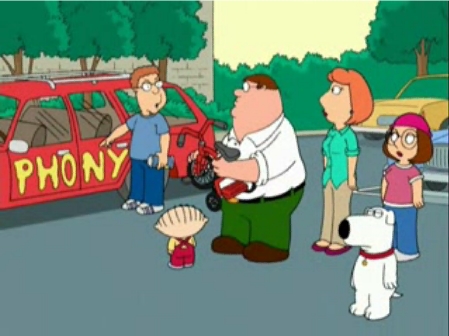
- ep The Kiss Seen Round the World | In the episode a secondary character repeatedly claims that Peter is a ‘big fat phony’, a term that is used throughout J.D. Salinger’s Catcher in the Rye.
- ep Hannah Banana | Chris does a book report on Catcher in the Rye, but merely describes being about a literal catcher in the rye.
- ep A Fish Out of Water | In the episode, Peter spontaneously combusts, which is a reference to the novel Bleak House by Charles Dickens.
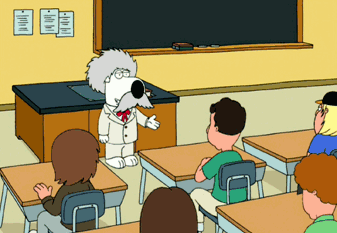
- ep Fast Times at Buddy Cianci High| Brian assigns a book report on the Charles Dickens novel, Great Expectations. In this same episode, Brian dresses up as Mark Twain to help inspire his remedial English class.
- There are a lot of Stephen King references in this series. Here’s a page about it.
- ep He’s Too Sexy for His Fat | Stewie references the ending of the 1956 novel by Frank Gipson, Old Yeller, when he implies killing Brian.
Aqua Teen Hunger Force
- WP ep Frat Aliens | The frat alien asks Frylock if “Holden Caulfield” was at a party, which is a reference to J.D Salinger’s Catcher in the Rye (and is also a fairly common way of asking party goers if they carried any marijuana).
Futurama
- ep War is the H-Word | The Philip K. Dick short story, Imposter, is referenced when a bomb-toting robot is embedded with a trigger phrase which ignites the bomb. In this same episode, a sign outside a convenience store reads “Free bag of Ice-9 with 6-pack,” which is a reference to the substance Ice-nine, from the novel Cat’s Cradle by Kurt Vonnegut.
- ep Treehouse of Horror V | The “All work and no play makes Jack a dull boy,” from Stephen King’s novel, The Shining, is ‘Homerized’ to “No TV and no beer make Homer go crazy.”
-
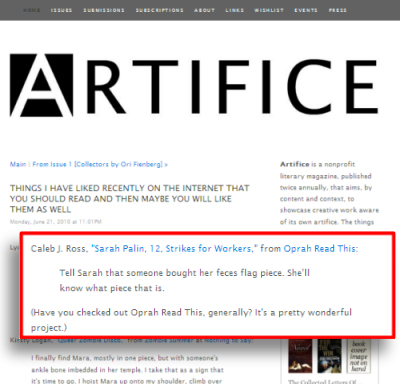
Artifice Magazine likes me
And I like you, Artifice Magazine.
A bit more praise here for the Oprah Read This >> Oprah, Read This project.
-
Resurrecting the Author Career, Returning to Whisky and Words
 Disclaimer: I am far from a career author. I’ve made enough money to buy a few fifths of whisky and some diapers for my baby, so needless to say I’ve got a long way to go. The following plan reflects this outsider (re: possibly ignorant) perspective.
The idealized author spends his time alone, churning out typewritten manuscripts to meet constant deadlines. He drinks. Probably smokes. He’s respected. He vacations in tropical seclusion, but still, even with the changed view, he writes. He has no day job. He is an author. Writing puts his kids through college.
There is a reason this image contains a typewriter. Much like the machine itself, the idealized author is all but extinct. I think a lot of writers would like to go back to this model. Is it possible to not just retain the author career, but to make it thrive?
Given the following set of assumptions, I believe it would be possible to bring back the author career:
- Content will continue to outweigh consumption
- The marketplace is spoilt by free content, and much of that content will continue to be free
- eBooks/eReaders will be a primary content medium within the next decade
- The cost to produce and distribute market-quality products will continue to fall
More authors are producing more content than ever, so it’s fair to say the larger onus is on the publishers to bring back the career. The problem is that publishers have no incentive right now to court authors in the way they once did. Publishers have the above items #1 and #2 going for them. A culture of expected free content coupled with an overflow of content, means authors have been trained to work for cheap or free.
But, authors have items #3 and #4 above as important pieces of leverage. If publishers don’t adapt to the changing market, and work with authors to do so, then the publishers will die. Because authors have the ability to create and distribute their own work, and because they have been trained to work for nothing, authors have little to lose by abandoning the publisher. Without authors, publishers die. Without publishers, authors continue.
What can be done?
- Consolidate the agent and publisher roles. Basically, this combined entity should act as a time and beaurocracy manager for authors. Today, authors have the ability to publish and distribute their own content without the help of agents and publishers. If this Pub/Agent composite can give authors time to write, then they will ultimately be given the sort of consistent product that the marketplace loves. Marketing thrives on trends. Giving authors time is the way to nurture trends.
- Increase author royalties. As media becomes electronic, the savings on overhead and distribution must be passed on. Court your talent, publishers. I’ve read the arguments against electronic media being cost-savers for publishers, and I just don’t believe them.
- Embrace the eBook paradigm shift. As a reader, I haven’t yet fallen in love with eBooks. As a writer, I am very excited by the possibilities. Instead of fighting to keep print alive, fight to make eBooks thrive. eBooks have the potential to increase the pool of readers, much as the iPod did for music enthusiasts.
- Brand yourselves as independent records labels do. Make fans out of your press, not just out of your authors. I won’t go into much depth here about this, but we do have an episode forthcoming at the Welcome to The Velvet podcast on this topic.
What can writers do?
- Provide consistent and brandable content. As Dan Holloway says in the comments at Jane Smith’s How Publishing Really Works blog, “If you are writing for the art, by all means try your hand at getting an agent, but don’t be upset if you don’t get one – and if the feedback is that you should be more commercial in order to get one, then make the decision – do you want to write for the pay packet, or do you REALLY want to do it for the art? And if it’s the latter, don’t expect to be picked up, or blame the publishers when you aren’t.”
- Prove that you can provide that content. As Jane Smith says in a response to the above comment, “I think that a big reason that most writers make such a paltry amount is that there are lots of people out there who call themselves writers but who only really dabble with writing: they sell an article every now and then, take several years to write just one book; sure, they’re writers–but not full-time, serious writers.”. A career author must write as though it is a career.
I want to sit alone and write fiction for a living. Help me do that. Make me believe.
-
Results of 5,000 words for Father’s Day
As far as meeting this goal, I failed. I did not reach 5,000 print-quality words in one day. However, I did learn something very important. I am simply not meant to write all day. I am glad that I can no longer blame my non-productivity on time constraints. In fact, I actually work better given 2-3 hour windows. As you can see by the time-line below, the day started off quite well.
10:08a (1 word) first word (The), first cup of coffee (Soy Chai Latte with an extra shot – It’s like beer: start the night with something exotic so that when you are drunk later you don’t care what brand you are drinking). 11:08a (570 words) went to the bathroom, took in a chapter of Saramago’s The Stone Raft, and gave the dog a treat. She’s been really good about not killing me, considering I am not a daily occupier of this house. 11:22a The headphones already hurt. Time to try listening to Bohren und der Club of Gore through speakers. Less ear pain, but too much outside noise mucking up what is supposed to be a way of isolation by sound. 12:05p (958 words) 2nd cup of coffee, this time black. 1,000 words in 2 hours. Things are not looking good. At this rate, 5,000 words will take me 10 hours, which I simply don’t have. Boooooo to goals. 1:16p (1,496 words) I said I wouldn’t, but I’ve got to get out of the house. I may slowly be realizing that I am just not meant to “go under” when I write. Could I be a normal 2-3 hour max/session writer? 2:44p (1,496 words) Notice the word count has not moved in 1 ½ hours. I drove to get a sandwich, then decided to drive home to finish the day. My wife has taken our kid to a friend’s farm for naturey stuff. So, I should have a couple more hours to at least round the count to 2,000 words. 6:04p (1,731 words) I’ll call these last 3 ½ hours a break, even though the duration really constitutes forfeiture. During this time I ate a couple donuts, drank some coffee, bought two Jose Saramago books (and learned that he has two posthumous English language translations forthcoming this year, Little Memories, an autobiography which I assume will be prepared for publication even considering his recent death, and Elephant’s Journey), and also a few Moleskine notebooks (which I learned is pronounced mol-a-skeen’-a, and not mol-skin as I had been doing for years). But I did come back to writing, and I did manage to pound out a few more words. 7:19p (2,041 words) I’m getting a shower. What to make of this? As much as I would like live the romanticized writer’s life, I simply do not have the constitution to do so. My apologies to anyone who gambled incorrectly on this outcome. My advice is that next time you wager money on someone’s likelihood to meet a goal, don’t use me if your choose the affirmative side.
