You don’t have my handsome voice to fluff your ear chubs this time, but I promise you won’t be disappointed by the talent here. Featuring three brand new voices to The Velvet Podcast. Make them feel welcome.
Writers Richard Thomas (Transubstantiate), Nik Korpon (Stay God), Pela Via and Nic Young grind out the topic of sex and violence in fiction and their complex relationship to sadistic bedfellows, love and shock..
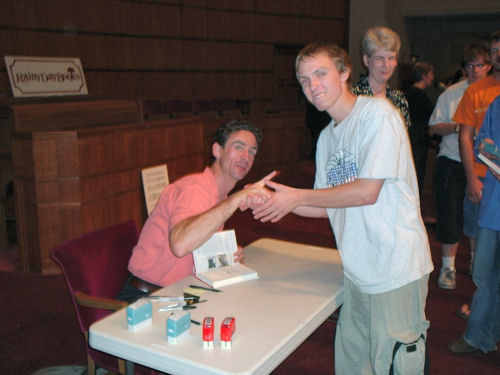
Mr. Gordon Highland and I took in a Jonathan Franzen reading this evening at the Kansas City Unity Temple (presented by Rainy Day Books). Franzen read from the same stage on which I met (re: awkwardly shook hands with) Chuck Palahniuk a few years ago. I bring these two authors together here not just because of their temporal-turned-spacial bond, but because the association allowed me to ponder their very different approaches to the live author reading.
Via a video posted on August 14th, Franzen noted his “profound discomfort” in having to make promotional author videos, basically, to me, implying that any promotional discussion taken place off the page stands in contrast to the intimate nature of a novel…
I get that. In fact, I may even sometimes agree with that. So I was glad when one of the audience members during the night’s reading asked a question that allowed Franzen to tangentially elaborate on his remarks (I post the abbreviated question below to show that Franzen wasn’t specifically addressing the above video, but instead a matter that relates to the video’s message):
Q: When the writer reaches a certain level of prominence, does the focus on the author’s personality threaten to overshadow the work or become an irrelevant distraction?
“The weird thing is, the way people think they know who you are is based on very little information…Obviously the point of that entire episode (referencing the infamous 2001 book club situation between himself and Oprah Winfrey), was not to teach one person, me, not to trust media representations of the actual personalities of people, but that is the lesson I took from it.”
“It’s not bad in the same way that it was bad when Hemingway and Faulkner became public figures because I think the culture wasn’t so distracted back then…The whole culture of selling has become personalized. I don’t think it’s all bad. The kind of frenzy and the kind of gotcha culture….and the opinions based fourth- or fifth-hand on something, that’s an artifact of our electronic culture, and probably bad. That’s what good books are supposed to be helping to resist.”
So on to Palahniuk, who seems to embrace the idea of a novelist performer. His events are the anti-reading, full of fainting fans, inflatable sex dolls, and morally questionable book inscriptions, on top of the reading itself. The performance has become the reading for Palahniuk fans.
What is the author’s role in performance-based book promotion? Should authors resist performance, forcing the reader (and the reader’s forum discussion, online book reviews, and, ahem, blog posts) to testify for a book? Or, should authors embrace the possibilities of our changing culture? Perhaps in the world of Kindles and Nooks, the author video will become to the new book cover, the new visual representation of a book.
Awkward Palahniuk handshake
And for no real reason, here’s a photo I took of Denis Johnson singing
Bob Dylan songs at the 2004 Tin House Writers Workshop
Or is it meta-non-fiction? Is all non-fiction meta? Are there any examples of non-meta-non-fiction? If we were introduced to an author who wrote a historical account of Indian bread and Greek cheese that constantly pulled from the text to state bluntly, “I am no expert. This history is just my opinion,” would we have met a non-meta-feta-naan-non-fiction author? Okay, that last one was dumb.
I respect Tim Hall, both as a writer and a person, at a level that few others have been able to reach. Not that I’m picky about whom I worship, but of all the gods in my life, Tim is one of the platinums.
I met Tim through the Outsider Writers Collective a couple years ago. As a newbie to the site, I was embraced immediately by everyone there, but Tim seemed to reach out just a little further. He’s taught me so much about book promotion, relationship building, and being cool (though I’ve got a lot to learn about that last item).
Everyone should abandon this blog post right now and head over to the revamped Undie Press site.
I plan on spending some time digging more into the site tonight, but at first glance here’s what I see:
A photo column from the wonder and beautiful, photographer and writer Kristin Fouquet
Quick, before they are outlawed. Inhale, inject, and/or read these recently-legalized vices el pronto:
A Mel Bosworth is worth a follow-up story chapbook called Grease Stains, Kismet, and Maternal Wisdom. Street date of NOW! Mine is on my way. Based on Mel’s previous work, I can expect some glorious toilet time in the near future.
1 Ben Tanzer will run you 99 Problems (that was an easy conversion). This book is a collection of essays about running. I’m no runner. Write a book called 99 Pastries, and I’m all over it (though I am all over 99 Problems, too; I finally bought a copy today). Want a taste? Meet a guy named Jason Behrends over at the Orange Alert Podcast, episode 27. Tell him “Compulsions” sent you.
1 Nik Korpon is worth 3 CD cases full of drugs, 2 heart-sick slackers, and 1 preorder date of October 1st, for his debut novel Stay God. I am currently devouring an advance copy of the book for the second time. I could go bankrupt reading this book.
Baxter once said that a man in the woods was about the purest thing there was in the world, and the closest he could come to knowing God. A man can never buy with money this thing that the Lord gave him for free, he said. That sense of awe and respect one derives from the trees and the earth and all things that dwell in between them. He told Jacob that poetry was all around him, in the grass and on the surface of the leaves, and that the Bible was full of good words designed to mimic what could never be written, but could sometimes be heard and always seen—the rising water, the falling rain, the rush of river and wind, the passage of cloud banks and great ruminant herds, buffalo and elk and the trailing packs of carnivores, both man and wild dog, wanderers all, in endless migration to the grasslands that feed them. He told him that magic is neither myth nor mystery but that which cannot be explained or understood—which is how the world was and should always be. There’s magic in a caterpillar, he told him, and in an acorn and behind the stars. His ancestors had understood this. They worshipped the forest as some white men worship God. He had only come to know and love God through time spent in the woods and through his proximity to death, which he gained in the trenches of the first great war.
However, instead of being only an instigator in big news, I want to report it. Below is my first official Blame Caleb Exclusive!
(BCE)–Gluteal aficionado reverses his long-held controversial stance on large asses. Says Mr. A-Lot: “They just aren’t exotic anymore.”
Sir Mix-A-Lot became famous after the 1992 release of his pro-butt cheek manifesto, “Baby Got Back,” currently in its 34th pressing. The release of this manifesto took both the intellectual and libidinal communities by storm.
“The problem is that too many white boys did in fact shout,” Mix-a-Lot says in reference to a particularly layered passage in which he implies the reluctance of Caucasian males to express sexual interest. “Once the mainstream embraced my philosophy, Rump-o’-smooth-skin’s no longer suffered insecurities about their shape. So I became just another talentless fat guy with nothing to offer.”
Within weeks of the release of “Baby Got Back,” fatties throughout the country rejoiced. As expected, enormous women are split on how to feel about Mix-a-Lot’s recent announcement. One particularly gross woman felt betrayed. “He said he loved us. Now he says we are nothing, it’s like…” (recording inaudible due to mouth full of donuts). Other women, such as The Wild Hole Stripclub’s notoriously self-confident Ms. Chocolate Mousse is indifferent. “Everybody loves us. We don’t need him.”
When asked about the timeliness of the announcement, Mr. A-Lot says, “I was inspired to come clean after Stephen Hawking recently modified his original acceptance that God had a role in creating the universe.” Hawking argues his theory in his new book, The Grand Design, as reported at The Guardian. “So as God is to Hawking,” Mix-A-Lot says, “the ass is to me.”