Tag: newsletter

  • Preorders are now being accepted for As a Machine and Parts. Preorders will be SIGNED.

    I am so incredibly thrilled to announce that my newest book, As a Machine and Parts, is now available for preorder. Simply click over to the Aqueous Books website to order. ALL PREORDERS WILL BE SIGNED. Unfortunately, they will be signed by me. I tried to reanimate Christopher Reeves or get Stephen Hawking here to do the signing–as that would not only be incredible, but would play nicely into the man/machine hybrid themes of the book–but for some reason I couldn’t get their people to connect with my people. Maybe their people are dead and/or paralyzed, too.

    There are a few amazing deals going on that make preordering even more worth your time and money.

    1. If you preorder As a Machine and Parts (or buy any of my books, actually) you will get a copy of my newest short story collection, Murmurs: Gathered Stories Vol. One for FREE! Click here for details.
    2. Word on the street is that Aqueous Books will be running a Black Friday sale (not what you think, fans of slavery) where any 2 Aqueous Books titles can be had for a measly $20. Check out the Aqueous Books store page for details. My recommendation would be pair As a Machine and Parts with Aaron Polson’s The Saints are Dead. It’s a damn fine read.
    3. You can actually combine the two offers above and still get Murmurs for free.

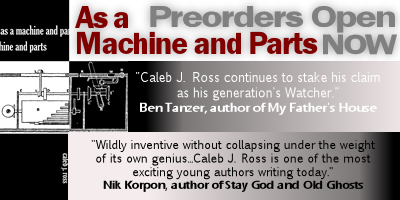
    If you don’t order the book, you are basically calling these people liars:

    There was once a Marvel comic book called “What if…” and in it Uatu the Watcher, a bald sage-like character with an enormous head spun speculative tales of alternative versions of the Marvel Universe you thought you knew. With As a Machine & Parts Caleb J. Ross continues to stake his claim as his generation’s Watcher, which should not be construed as a commentary on his beautiful, yet clearly fake head of hair, but instead as an observation about the scope of his imagination and his ongoing vision of what the world can be, might be and just maybe will be if Ross has anything to say about it.

    Ben Tanzer, author of Most Likely You Go Your Way and I’ll Go Mine

    As a Machine and Parts is equal parts hilarious, absurd and touching. It’s the kind of book that after reading makes you say, ‘Damn, why didn’t I think of that first?’ only to realize you couldn’t have done it so well. Wildly inventive without collapsing under the weight of its own genius, As a Machine and Parts proves that Caleb J. Ross is one of the most exciting young authors writing today.

    Nik Korpon, author of Stay God and Old Ghosts
  • Neil Gaiman on The Simpsons, tween lit lovers rejoice and/or get depressed

    (part of my ongoing Unexpected Literary References series)

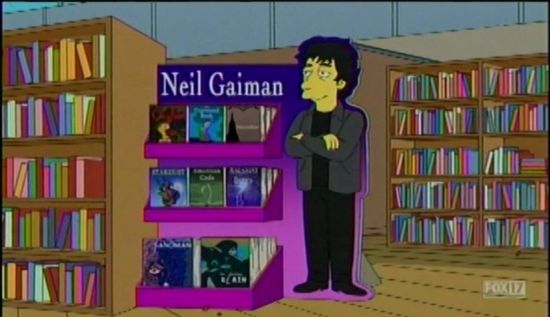
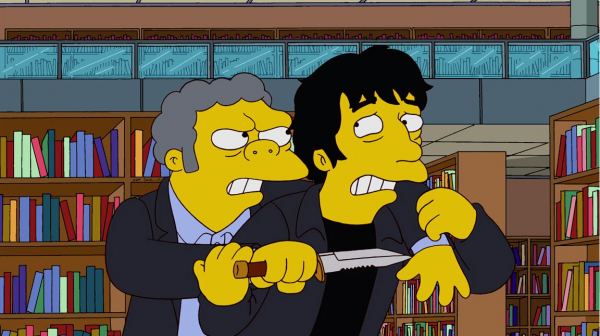
    Yesterday (11-20-2011) The Simpsons continued its legacy of literary references with an episode featuring Neil Gaiman, author of American Gods, Anansi Boys, and many others . The episode, “The Book Job” (season 23, episode 6), explores the culture of tween lit, specifically stories featuring vampires and magicians, using an Ocean’s Eleven-style heist as the plot backdrop. Though the episode speaks primarily to the idea that tween lit may be hugely factory produced for market consumption rather than intellectual stimulation, the optimistic take-away is that even in a world where television and the internet dominate as means of entertainment and information distribution, books seem to be making a resurgence. This, my hope anyway, will seed these tween literateurs with a life-long love of reading.

    About “The Book Job“:

    Lisa becomes disheartened when she learns the shocking truth behind the “tween lit” industry and her beloved fantasy novel characters, but Homer decides to cash in on the craze and forms a team to group-write the next “tween lit” hit, with the king of fantasy, Neil Gaiman, lending his expertise to the effort. After catching the eye of a slick industry publisher at the Springfield Book Fair, the team gets an advanced copy of their work and discovers that the corporate lit business is a bigger operation than they imagined.

  • The Tale of Scrotie McBoogerballs vs. The Catcher in the Rye

    (part of my ongoing Unexpected Literary References series)

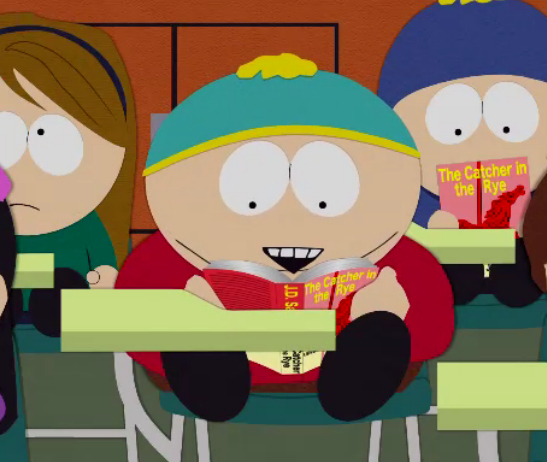
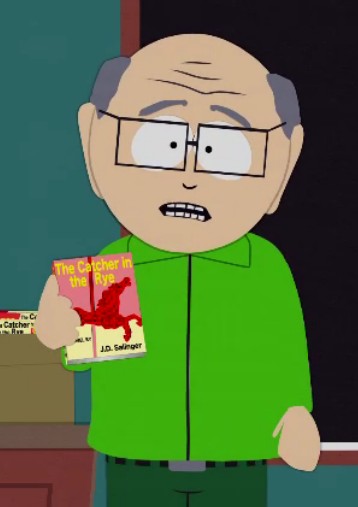
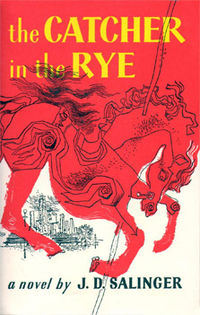
    I briefly mentioned this Unexpected Literary Reference way back on the first official post of this series, but this one certainly deserves some special attention. The Tale of Scrotie McBoogerballs (Season 14, Episode 2) is an episode of South Park that speaks directly to the idea that historically banned books, placed in the context of modern media, simply don’t have the power that they once may have. The is called out for being a poor commentary on contemporary teenage angst.

    About The Tale of Scrotie McBoogerballs (taken from Wikipedia):

    The students at South Park Elementary are assigned to read The Catcher in the Rye, and grow excited when Mr. Garrison tells them that the book has caused so much controversy, it has been banned frompublic schools in the past. However, after reading the book, StanKyleCartman, and Kenny are angry to find the content completely inoffensive, and feel the school has “tricked” them into reading. They decide to write their own offensive novel, The Tale of Scrotie McBoogerballs, with the intention of disgusting as many people as possible and getting the book banned…Fearful they will get into trouble for the book’s content, Stan and the boys tell Butters he actually wrote the book.

  • Two Looney Tunes literary references (well, one literary and one drama)

    (part of my ongoing Unexpected Literary References series)

    It has been quite a number of years since I woke early to watch Saturday morning cartoons. People of my age (late 20s) will remember that Saturday morning was often reserved for a solid 3-4 hour block of cartoon watching. But since the introduction of all-cartoon networks like Cartoon Network and even Nick Jr. (as a stand-alone network, not as a day-time block on Nickelodeon), the idea that cartoons are something to be packaged and presented only once per week has become a bit of a foreign concept.

    So, you can imagine my glee when I brought my son (2 1/2) into the living room this morning, turned on the TV, and found not only cartoons, but the very Looney Tunes cartoons I watched as a child (and as a hungover college student). Looney Tunes always had a reputation for mixing the literary with the cartoon. Back in the 50s and 60s (when the episodes I am most familiar with were originally made) books were still a key form of entertainment. Therefore, including literary references wouldn’t have been such a shocker. Which is why finding two references, back-to-back, wasn’t surprising this morning.

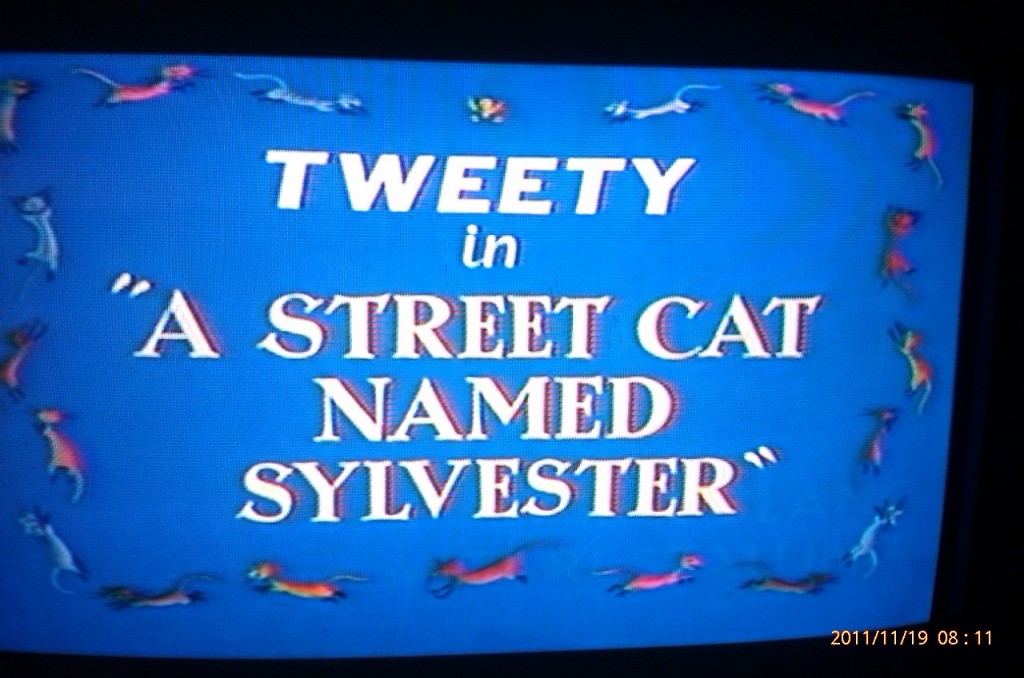
    This first one actually comes from a play, not a book, but the writer, Tennessee Williams, is considered by many to be as much a literateur as any author. I am not familiar enough with A Streetcar Named Desire to know if this Looney Tunes’ episode plot of “A Street Cat Named Sylvester” actually reflects the plot of the play.

    About “A Street Cat Named Sylvester“:

    Tweety stumbles into Sylvester’s house looking for shelter and Sylvester hesistates if he saw a tweety bird in the same manner Tweety wonders if he saw a ‘Putty Cat’. Sylvester snatches him inside but has to hide Tweety in a vase covered by books, when Granny appears. While an injured Hector remains bedridden, Sylvester causes whatever diversion he can to stop Granny from spotting Tweety, making Granny give multiple doses of medicine to Hector. When Hector gets in Sylvester’s way from eating Tweety, Sylvester injures himself. Tweety spikes Hector’s medicine resulting in Sylvester ingesting the disgusting stuff.

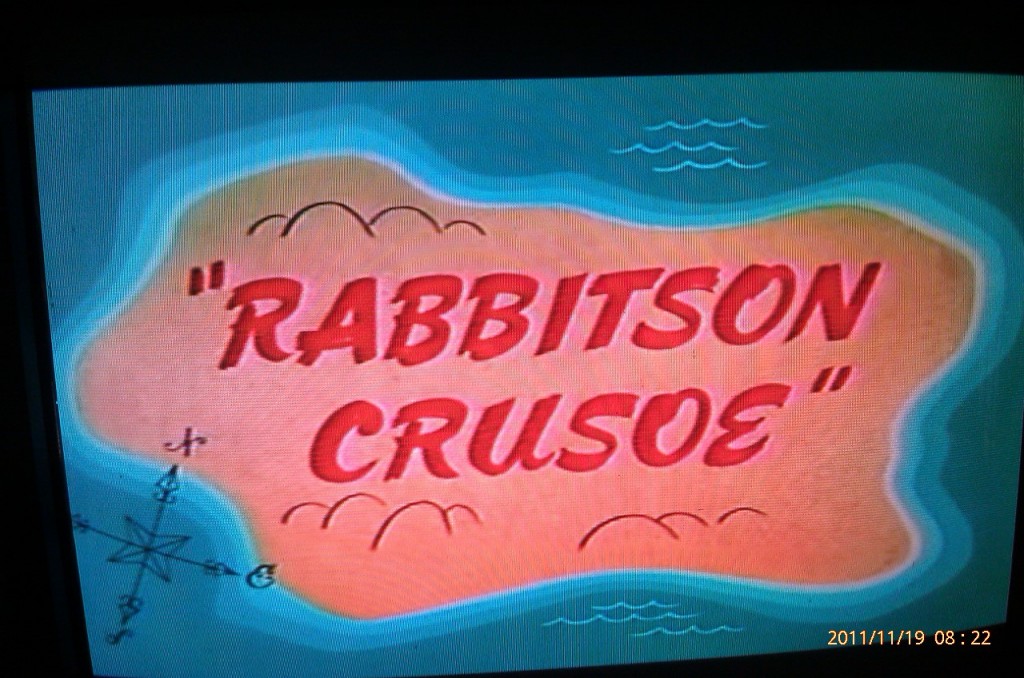
    The second reference of the morning comes from an episode called “Rabbitson Crusoe” which obviously comes from the title of the novel Robinson Crusoe. Like the previous reference, I don’t know enough about the original referent to know how much the Looney Tunes episode plot plays off of the literature plot. I can say that the Looney Tunes episode is pretty good (Bugs Bunny and Yosemite Sam; you can hardly do better)

    About “Rabbitson Crusoe“:

    Yosemite Sam narrates that a low tide and high rocks caused his shipwreck on a small island. After the ship’s remaining food stores have been used up, the only source of food is from a coconut tree on an adjacent island. Crossing between the islands, however, is always difficult because of a man-eating shark called Dopey Dick (another parody, this time based on Moby-Dick). Sam manages to get rid of the shark, who jumps after him on land, only by having a mallet ready on the tree with which to whack the shark back. On his way back to his island, he’s chased again by the shark, but this time has a baseball bat ready to whack the shark. Sam mutters that the shark has tried getting him for 20 years, but misses every time. As a result, one can infer that since the shipwreck, Sam has been marooned on the island for the amount of time described above.

    Enter Bugs Bunny and the chase antics we all know and love.

    Side-note, the new, updated version of Looney Tunes and Merrie Melodies called The Looney Tunes Show is actually pretty amazing. I recommend for anyone who grew up on the original.

  • American Dad says The Hunt for Red October is boring

    (part of my ongoing Unexpected Literary References series)

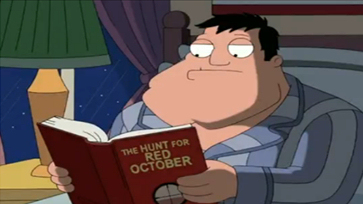
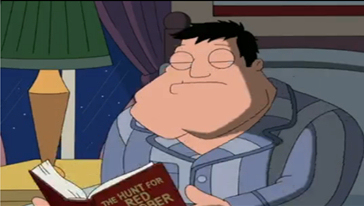
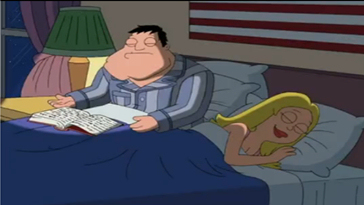
    Another Unexpected Literary Reference spotting, this one from Season 9, Episode 4 (“Stan Time”) of the amazing series American Dad. the screenshots below don’t translate the humor very well, so if you can find a full version of the episode online. Basically, Stan has been trying to read The Hunt for Red October for years, but is never able to get past the first paragraph. In this sequence, he still doesn’t make it.

  • Solarcide interviews me, one of the most interesting interviews yet: The Digital Age of Domestic Grotesque

    Nathan Pettigrew, one of the two minds behind the lit site Solarcide, asked me for an interview a few days ago. This guy knows how to ask questions, ones that not only evoke my own passion for the subject matter but also make it easy for me to answer in a way that is hopefully entertaining for readers.

    Head over to Solarcide now. Read the interview. Learn of my greatness.

    Here’s a taste of Nathan’s humbling intro:

    He’s one of literature’s most lethal rising stars and highly prolific with not one, but four new releases in 2011.

    His debut novel from earlier this year, Stranger Will (Otherworld Publications), established Caleb J. Ross as a true talent to be reckoned with. His writing can be described as stylistically beautiful while depicting some of the darkest and most disturbing worlds that fiction has to offer.

    Picking up on concurrent themes throughout his work pertaining to family, some have begun to refer to his style as Domestic Grotesque—a genre all his own.

  • Stranger Will Tour Stop #75: Big Other, CALEB HAS LEFT THE BLOGOSPHERE!

    75 blog posts. Seven-five. It’s hard to believe that I started this marathon blog tour back in March. I’ve had some good times promoting my novels, and it’s fitting that I can revisit and summarize some of those good times at the Big Other blog, which was the second stop on my tour all those months ago.

    Click here to read the final guest post of the Stranger Will Tour for Strange blog tour. Also, don’t forget that if you comment on all guest blog posts, you will get free stuff.