
Hey Xbox and Playstation fans, I’m one of you, I love video games, and I’ve got some wonderful news to share with you. Xbox. Playstation. They both believe in console generations. They just lie to us about it differently. Maybe “wonderful” isn’t the way to describe that news, but it’s one less thing we all need to waste energy fighting about. (more…)
Tag: Microsoft
-
Will Playstation ever offer Playstation exclusives day one on Playstation Now?
I was recently asked by TopSpot123 if I thought Playstation 5 games would appear on Playstation Now, the service from Playstation that allows subscribers to download and steam over 650 games from across three Playstation console generations . Of course they will. Why not? But then I thought more and realized, there’s lots of “whys not” which open up to a larger, and perhaps more interesting question: will Playstation Now ever offer same-day and date exclusives like Xbox’s Game Pass does?
So, to the first question: Will Playstation Now feature Playstation 5 games. Yes, Playstation Now, and I’ll throw in Playstation Plus, Playstation’s online service, will have Playstation 5 games. Eventually. Definitely not at launch. Let’s use history as an example. The Playstation 4 was launched in November 2013. Playstation Now was launched just over 1 year later, in January 2015. And it wasn’t until almost 3 years after that that Playstation 4 games were added to the Playstation Now service. When the amount of money made from games sales, via system sales of course, begins to diminish, that’s when games from that system will fold into the subscription service.
Let’s look at some numbers to highlight this point. In the 50 months between the Playstation 4 system launch and the appearance of Playstation 4 games on the Playstation Now service, Sony had sold 73.6 million consoles. That’s about 1.47 million units per month. In the following 29 months between January 2018 and May 2020, Sony had sold about 1.2 million consoles per month. While not a dramatic difference, and averaging in this way can be misleading, this does point to the inevitable slow down in the second half of a console generation’s life.
Software is where the money is. For Sony, the consoles sell the software. If consoles sales are slowing that means software sales are slowing, which means it’s time to sell the software in a different way. Therefore, Playstation Now and Playstation Plus get current generation games and the marketing team has a sweet, sweet marketing beat they can leverage.
So, my estimate is that we’ll see Playstation 5 games hit Playstation Now and Playstation Plus in the middle of 2022, assuming this coming Playstation 5 generation will be about 5 years, which is shorter than the previous generations, but that’s a topic for a different video (a video that ReviewTechUSA already did, in fact. Watch it here).
If we look at the closest direct Sony competitor, Microsoft, they have been much more aggressive with incorporating next generation games into their subscription service, Game Pass, and by all accounts it seems to be doing really, really well for them. So I asked myself, will Sony ever take a similar approach. Will Playstation ever offer Playstation exclusive games on Playstation Now at the game’s launch?
My immediate response was “of course not.” Consumers have consistently shown that they are willing to spend $60 per exclusive title, so why would Sony risk that revenue for potentially less revenue from a subscription model. But I wasn’t satisfied with a hot-take assumption. So I scoured the internet, crunched some numbers, took some naps, and it turns out, Sony, a company that lives by its exclusive games and their $60 price tags, might actually be better off if they offered exclusive titles on Playstation Now at launch, exactly like Microsoft does with Game Pass.
First, we’ve got to figure out 1) how many exclusives we’re talking about here, 2) how many copies each exclusive sold, 3) the Playstation Now cost to the consumer, and 4) the count of Playstation Now subscribers. Sprinkle in some assumptions about margins, throw out variables I can’t account for because I’m dumb, and in turn add a bunch of asterixis, and voila. We have a tasty business case.
First, let’s figure out how much money Sony has made from its exclusive titles. For my purposes, I’m going to restrict to the top selling exclusives, and also just the exclusives released after Playstation 4 games were added to Playstation Now in December 2017. Yes, it’s true people who buy a Playstation 4 today could go back and buy those pre-December 2017 exclusives, but I’ve got to make a cut-off somewhere.
Between December 2017 and May 2020, Playstation had 6 exclusives that meet the top-selling criteria, with a total of 36,300,000 copies sold according to various sources all documented in Wikipedia..
Take this number, multiply by $60 per game and then again by 55% to account for the platform royalties and Sony’s first party publishing fee, and we get a staggering $1,197,900,000 of net revenue from 6 games during a 2 year period as our baseline. Not bad.
Now, we need to compare this to the revenue Sony could have made if they instead pushed a Playstation Now that offers these same exclusives on launch. There’s going to be a lot of hypotheticals and assumptions and straight-up guessary coming up, so all you data scientists that accidentally found my channel when searching for actual data, get ready to cry.
So first, we need to figure out how many users currently subscribe to Playstation Now. We know that as of May 2020 Sony has sold 111,000,000 Playstation 4 consoles. We also know that as of the same month and year, Playstation Now had 2,200,000 active subscribers. That’s just about a 2% subscriber rate, but for the longest time the subscriber rate was closer to 1%, so I’m going to use 1% as my figure. Now of course, there are plenty of weirdos like me who have purchased multiple Playstation 4s over the years, but we’re going to stick with 1%.
Let’s imagine that 1% of users subscribed to Playstation Now since its introduction in December 2017. We apply 1% to each month’s cumulative console sales, then multiply each of those figures by the respective month’s Playstation Now rate, which was $19.99 until October 2019 when the rate changed to $9.99 per month. This calculates to $471,329,414.50 worth of revenue between December 2017 and May 2020. This, obviously, is far below the non-subscription revenue mentioned earlier. So on the surface, it seems Sony’s is smart to push individual game sales over Playstation Now subscriptions.
Now I know this logic is flawed. I’m assuming people are ignoring multi-month discounts and special promo rates. I’m suggesting that subscriber rates remain constant month-to-month. I’m not considering revenue from non-exclusive titles. And related to that, I’m kinda assuming a false binary here. I’m suggesting Sony can only sell exclusives individually OR they can only offer exclusives through Playstation Now. But I know that makes no sense.
After all, if exclusives were offered at launch as part of Playstation Now, logically the 1% subscriber rate would increase, right? But by how much? Well, to figure this out I took the sales totals of those six aforementioned exclusives and divided by the 111,000,000 install base to estimate an Exclusives Adoption Rate. Surprisingly, the numbers ranged considerably from 4% for Ghosts of Tsushima, which is understandable given how new it is, to 12% for Marvel’s Spider-Man. When I average all of the EARs together I get 5%. So, maybe we should assume an 5% subscriber rate. I plug this in and instead of a measly $471.3 million in subscriber net revenue, we get $2,356,647,072. Now we’re cooking with money covered in gas.
But we could go even further. Let’s pretend Sony could do just as good a job marketing their subscription program as Microsoft has with Game Pass. As of May 2020, Game Pass, which promotes same day exclusives as one of its primary value propositions, is subscribed to by 20% of Xbox One owners (Game Pass subscriber count divided by Xbox One install base). If we then increase the imagined 5% subscriber rate to the still imagined 20% rate of Xbox, we’re then looking at $9,426,588,290.00 in net revenue. Now we’re cooking with pure gold covered in gas.
So, will Playstation Now ever offer Playstation exclusives day one? No, probably not. Sony is weird.
-
The Google Graveyard is NOT evidence of Stadia’s demise!
The Google Graveyard is a myth. Well, it’s not a myth, myth. It’s right there. But the way it’s been used as a harbinger of Google Stadia’s inevitable doom is wrong. I’m going to tell you why.
Ever since Google announced their game streaming initiative, called Stadia, large pockets of the gaming world have doubted its potential to succeed, and some outright hate Stadia for even existing. Now, believe it or not, I don’t necessarily blame them. Antagonism towards the unknown can be a natural reaction. I get it. Here’s this mega corporation, Google, trying to buy it’s way into the living rooms of gamers who have already aligned themselves to companies and platforms that have had to work hard for years to earn that alignment. Stadia’s existence, to those devoted Microsoft, Sony, Nintendo, and PC fans probably feels disingenuous and pompous.
But sometimes the justification of that antagonism is flawed. Such is the case with the Google Graveyard.
The Google Graveyard is an online repository of over 200 apps, services, and hardware that Google has launched and later killed since Google’s creation in 1998. By contrast, Google currently has 224 active apps, services, tools, and pieces of hardware, many of which are so ubiquitous you probably forgot about them. You’re probably watching this video on YouTube, from a link maybe sent by Gmail, or you discovered this video in a Google search while listening to YouTube Music by way of your Google Fiber internet connection. Maybe you took notes while watching this video using Google Keep or a Google Doc on Google Drive, but then realized you liked writing in notebooks more, so you clicked an ad, served by Google, to buy some notebooks. But the notebooks came back damaged, so you called up customer service on your Pixel phone, using Google Fi phone service.
I understand that this series of events is absurd. Nobody loves a single company that much. But my point is that when criticizing Google for killing off products, you’ve also got to keep in mind the many important things Google has maintained.
But me simply stating that observation isn’t enough. Rather than simply reflecting on those numbers, we have to ask why a company, any company, would stop maintaining certain products. The short answer is, because those products don’t generate revenue.
A for-profit company like Google exists to make a profit. Historically, Google’s main revenue source comes from their Ads service, which relies on users. The more users Google has, the more people they can sell ads to. There’s a trend with these cancelled services: they don’t generate revenue in-and-of-themselves. Rather, they aim to increase users, to then increase ad revenue.
Of the 204 products currently in the Google Graveyard (as of 7/22/2020), 163 are services with ambitions to increase the number of users. If these services don’t increase user counts enough to increase ad revenue then shareholders are upset and Google has no choice but to kill the services.
Simply put, if a product isn’t contributing to increased revenue, then it should be killed. This isn’t just a Google decision. This is a good business decision.If Stadia doesn’t contribute to increased revenue, either by way of game sales, hardware sales, service sales, or more engaged users that can be advertised to, then Stadia should be killed. Microsoft would make the same decision. Sony and Nintendo would as well. In fact, these big players in the gaming world have been doing it for years and to a much more aggressive extent than Google. Let’s talk about the Xbox Crypt, the Playstation Cemetery, and the Nintendo…another word for Graveyard. The Nintendo Necropolis.
Google has canceled about 50% of its products in its 22 years of existence. Keep in mind, this 50% rate isn’t limited to just gaming hardware, which is another problem with citing the Google Graveyard as evidence of Stadia’s impending doom, but I won’t parse that because I’m going to show you that it doesn’t even matter. Sony, Nintendo, and Microsoft are much more egregious with killing products.
I’m going to focus on first party consoles specifically. If I were to expand to services, apps, console accessories, and software, each of these gaming platforms would have a much higher kill rate. Imagine all of the controller and console stands, charging stations, and of course, games that are no longer available. How many games in all the various form factors are no longer produced? It’s important to realize that each game and each delivery mechanism–physical and digital–is a different SKU, and therefore a different product and should be factored into the respective company’s graveyard, if this graveyard debate is one you want to have. Which, again, the entire point of this video is that the graveyard argument doesn’t make sense.
Xbox has released 10 consoles since 2001, with 8 of those either killed or in the process of being killed. That’s an 80% kill rate with an average of 0.42 consoles killed per year.
Playstation has released 21 consoles since 1994, with 15 of those either killed or in the process of being killed. That’s a 71% kill rate with an average of 0.58 consoles killed per year.
And then there’s Nintendo. Oh boy. It’s impossible for me to track down every official sku for every Nintendo console and handheld, so I stuck to the main ones. Nintendo has released 32 consoles over the years since 1977, with 29 of those either killed or in the process of being killed. That’s a crazy 91% kill rate with an average of 0.67 consoles killed per year.
Stadia, on the other hand, has had one console/service since 2019, with 0 of those killed. I understand this is an absurd data-point, but that’s partly my point. If the graveyard argument must be honored, then we cannot look at just Xbox, we have to look at all of Microsoft. We cannot look just at Playstation, we have to look at all of Sony. And I’m way too lazy to continue beating this dead horse.
History shows that major video game platform companies kill a console roughly every two years. As streaming services become more popular, I estimate we’ll start to see things adapt, and we’ll see a major iteration of each streaming platform once every two years.
You may be thinking, “but Caleb, many of the consoles you mention are iterations and evolutions of previous consoles. Why continue selling an Xbox One when there’s an Xbox series X?” I promise you, if the Xbox One, or the Playstation 4 could continue to drive profit, Xbox and Playstation would continue selling them. But competition with other platforms means consoles become obsolete, so those consoles get sent to their respective graveyards. If these companies could get by with selling the exact same console for 20 or 30 years, they absolutely would. But us consumers don’t let them. Therefore, products get killed. If anyone is to blame–or get credit for–the product graveyards, it’s us. Us consumers are the grim reapers.
But if we are going to entertain that logic, as flawed as it may be, then you must also allow Google the benefit of iteration and evolution. One example is Google Play Music, which is slated to be sent to the graveyard at the end of 2020. Antagonists toward Stadia will claim this is yet another killed service without accepting that Google Play Music’s functionality is being absorbed into YouTube Music, which isn’t dead. Google Hangouts is becoming Duo. YouTube Leanback became obsolete as Smart TVs got smarter. Of course there are several examples of products that have been killed entirely without being absorbed into other products, but to ignore those that don’t follow such a path to death is irresponsible.
Lastly, consider that the video game industry is a known entity. Google has a history of innovating with new products that aren’t aligned to such established frameworks. Often, Google is iterating upon the very search service that it helped pioneer in 1998. With such innovation comes great risk. I’m surprised only 50% of Google’s products have been killed, honestly. Because video games have an audience and a stable history, I don’t see Stadia getting tossed into the Graveyard anytime soon.
Now, I’m not going to suggest that Google will never kill Stadia. I don’t know that any more than the haters themselves. But I can say that citing the Google graveyard as evidence of such an argument either way is ignorant at best and disingenuous at worst. I don’t blame any of these companies for canceling products. That’s part of running a smart business.
-

Drinking & Knowing Things: E3 2018 Thoughts – Masters of Unlocking Podcast Episode 023
[powerpress] Subscribe to Masters of Unlocking: A Video Game Podcast by clicking over to the official websiteE3 2018 is officially in the books! We give a run down of the presentations from Sony, Nintendo, Microsoft, Bethesda, CD Projekt Red, and Ubisoft and discuss our thoughts. (more…)
-
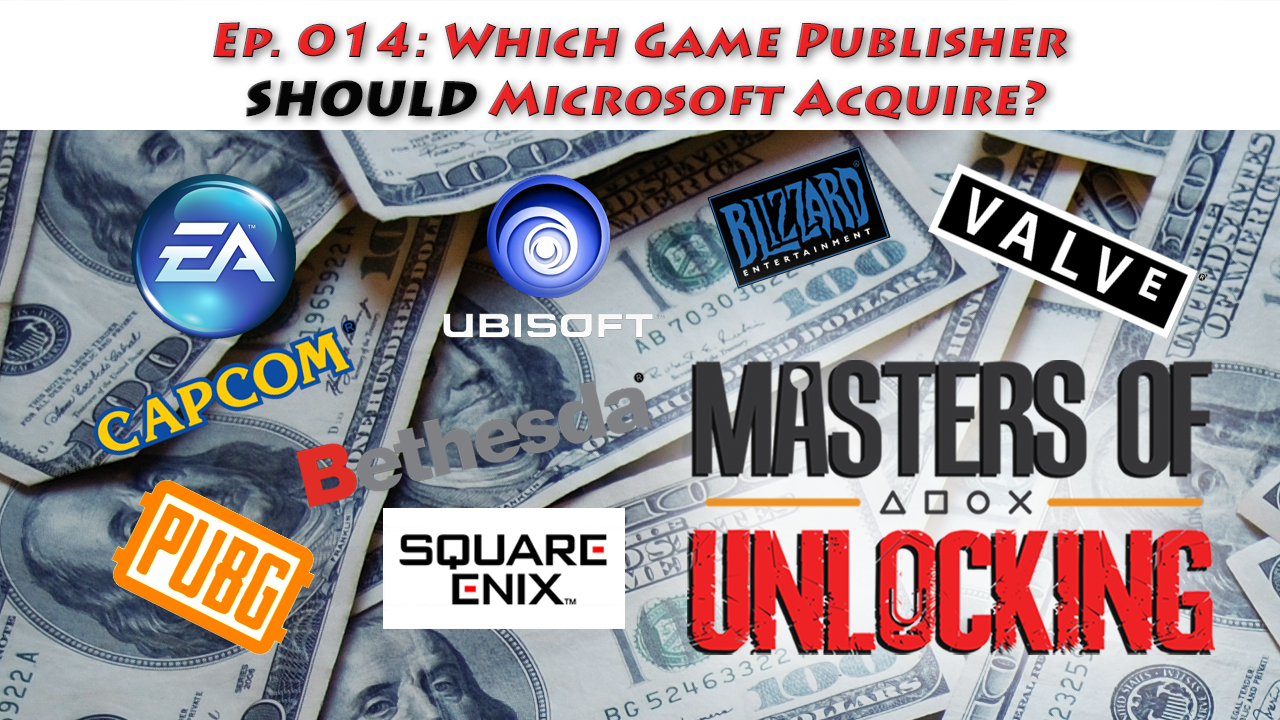
Which Game Publisher SHOULD Microsoft Acquire? – Masters of Unlocking Podcast Episode 014
[powerpress] The rumor mill is running wild about Microsoft buying EA, Valve, or PUBG. We look at why those don’t make sense and propose three new contenders for who we think House Xbox SHOULD acquire.Show Notes
- Gaming Archaeology:
- Caleb and VGCollectaholic recap their recent game pickups
- Epic Set List:
- Discussion of what we’ve been playing recently & our spoiler-free thoughts
- What’s News:
- Toys R Us closing 20% of its stores – we reminisce about TRU and Kay*Bee Toys
- I spent 453 hours in Fallout 4 and all I got was this stinking inner peace
- A truly unique piece of Zelda: Breath of the Wild art
- Mario Kart coming to a smartphone near you
- Red Dead Redemption 2 delayed
- Nintendo Switch’s online service finally gets a date
- Father of Playstation stepping down as Sony’s CEO
- Main Event:
- Rumors abound about a potential looming video game publisher acquisition by Microsoft. We look at the rumored names – EA, Valve, and PUBG Corp – and then ask who SHOULD Microsoft acquire? Turns out… it’s not one of those three.
- Gaming Archaeology: