The credits are rolling on a really fun first-person puzzle game with a science fiction motif in which advanced AI-turned-fully-sentient machines have caused problems and humans have to use their uniquely capable human brains to save themselves, ultimately encouraging the player to ask “what’s really the difference between people and robots?”
Though the game traffics in themes, genres, and styles that plenty of other games have trafficked in before (Portal, Portal 2, Q.U.B.E, Q.U.B.E 2, The Talos Principle), I happily jumped into The Turing Test with the same amount of vigor and excitement I will continue to do so for every one of the inevitable forthcoming games that do this exact same thing. I like narrative games. Story in games is often the glue that holds the pieces together and keeps the single-player gamer invested. I like puzzle games. They are slow-paced and they make me feel really smart. But puzzle games with stories are very hard to do right. It’s hard for game designers to give a narrative reason for puzzles to exist in a world. Some games ignore all logic and just lean into the puzzles as part of the game’s charm. The Resident Evil series, for example, does this really well.
Most games never try for logic and simply never try mixing these two things. Puzzle games are most often hyper-focused on the puzzles themselves. All else is pulled away. Think of a game like Tetris or even World of Goo, where the story is there but it’s limited to essentially text screens between the puzzles.
Storytelling in a puzzle world is hard. That is, except when that world’s story is specifically about testing a human’s puzzle-solving abilities. And to make the conflict in the story work, the human must be pitted against an entity of intelligence great enough to fool the human: an Artificially, super intelligent, self-learning villain, for example.
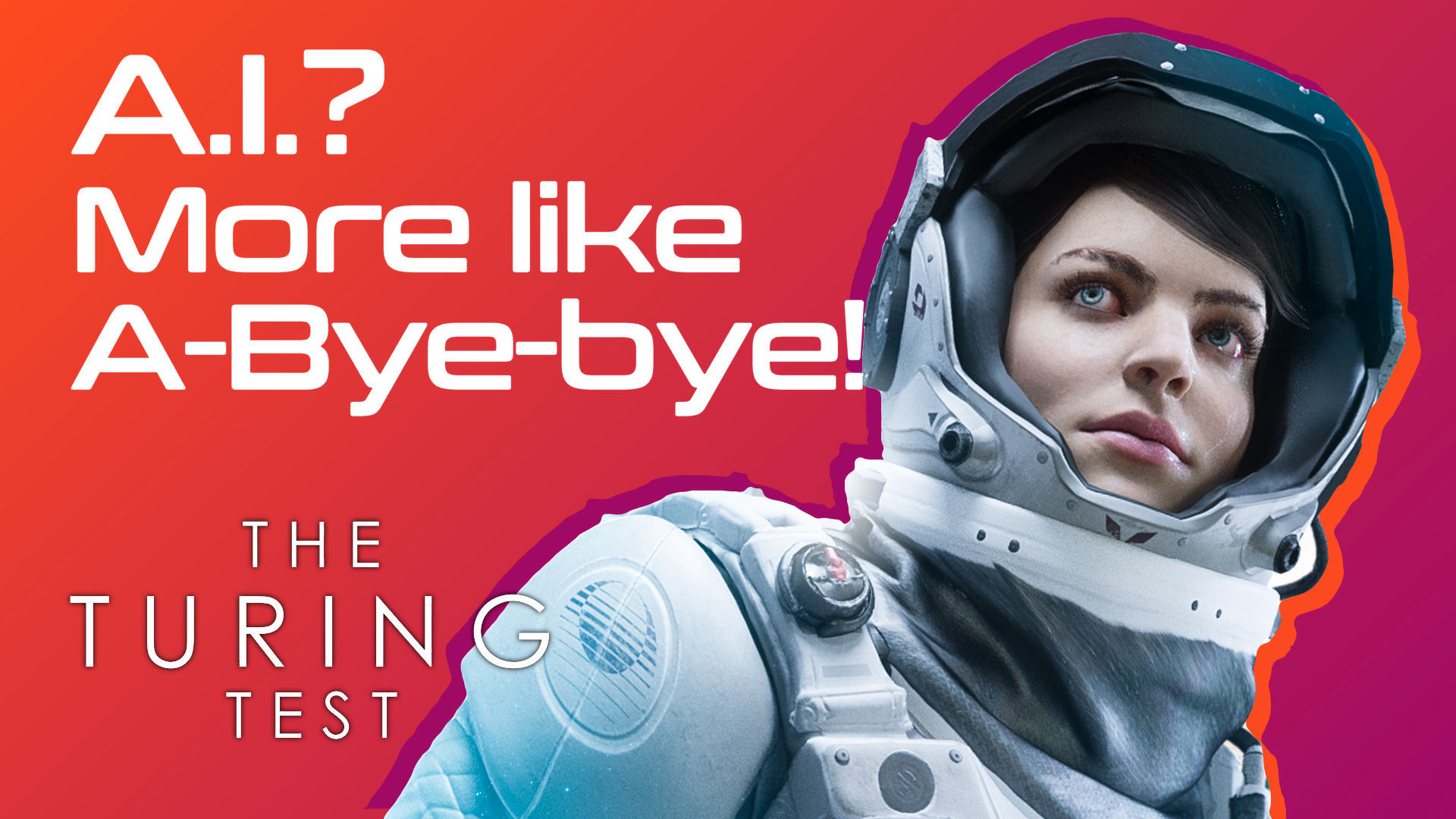
The villain with The Turing Test is an AI named T.O.M. T.O.M. controls a space station on Europa, one of Jupiter’s moons. You play as Ava, a scientist who has arrived at the space station to rescue the station’s crew who haven’t been heard from in a long time. T.O.M. coaches Ava throughout the space station as she solves puzzles to reach the missing people. T.O.M. also slowly tries to influence Ava’s perception of her mission, insisting that she’s not meant to rescue the crew. Rather, she’s meant to kill the crew to ensure they never return to Earth. See, the crew has become infected with an organism that grants eternal life. Bringing such an organism back to Earth would cause an extinction level event. If people can’t die, the world is doomed to overpopulation, endless cancer, and on and on.
The tension here, the fuel that keeps the player interested, is when T.O.M.’s logical reasoning is pitted against Ava’s emotional reasoning. T.O.M. tells Ava that the death of her crew is logical, in that it will prevent countless other deaths. Ava, however, is a sappy meat-bag and wants to pull a Joel in order to save all her Ellies.
But what about the puzzles? This is a puzzle game, right? The Turing Test offers typical switch puzzle mechanics—activating a switch opens a door—but as levels (or Sectors, as they are called here) advance, new mechanics are introduced. You get time activated switches, robot companions, the ability to control cameras, and even for short times, you get to control a turret gun.
The final 3rd of the game is considerably easier than the first two thirds, which I appreciate. At some point in every puzzle game with a campaign I feel like I’ve proven myself able to overcome challenges. That moment generally happens around the 70-80% mark. But I usually still feel compelled to complete the game. The Turing Test understands this and instead focuses on story for the final third, with the puzzles being only easy to moderately challenging.
In comparison to other games of this type, specifically those I mentioned at the start of this video, The Turing Test lands right in the middle, not as good as Portal and Portal 2, and the Talos Principle, but a bit better than Q.U.B.E and Q.U.B.E 2, but not by much. All of these games are fantastic if you have an urge to make an AI villain look weak and pathetic fool.