Tag: game development

  • Learning Things I Don’t Want to Learn but Need to Learn Anyway (Maybe)

    Learning Things I Don’t Want to Learn but Need to Learn Anyway (Maybe)

    I recently completed an animation course in Blender. I have no plans to use Blender animations in my games.

    My Blender learning journey has been one so far focused on modeling, shading, and UV texturing. Soon I’m going to start sculpting. All of these focuses are applicable to the game-making journey I’m traveling right now. But animation…well, I’m either building a game that doesn’t use animations or, more likely, I’m avoiding making a game that uses animations because animations are effing intimidating.

    I have some history with animation. In college, I created a Flash cartoon series called The Thirsty Gerbil Super Things (check out this one episode that still survives), recently I completed a short Unity animation course (focused on the Mecanim system), and even more recently I completed an animation section in a very popular 3D modeling course. What I’ve learned from the latest Unity and Blender courses is that animation is really hard and when something goes wrong, knowing how to fix it is pretty hard. Usually I have to start over.

    I know that learning animation in Unity is going to be very important eventually (and is probably very important now, but again, I’m fighting hard to avoid having to actually master animation).

    But how exactly does animating in Blender relate to animating in Unity? I don’t know. The Blender animation course that I recently took doesn’t describe how to get Blender animations into Unity, meaning my practical use for the learnings is far removed.

    So why not just skip the animation section? Because I’m afraid that without taking the course in the proper order I’ll miss the required knowledge for advancing through future courses. Also, if I skipped the animation course, I will have missed out on creating the very cool animation above.

    So, to summarize:

    1. I know learning animation is important
    2. I’m intimidated by learning animation, so I’m avoiding it as much as possible
    3. I have no practical use in mind for animation, which supports my aversion
    4. Looked forward to a future devlog where I inevitably dismiss animation as “super easy”
  • Video Game Music is Pretty Damn Great

    Today we talk about that stuff that goes in your ears when you play a video game. No, not the wet fingers of an annoyingly immature roommate or little brother (though, in this case I’m pretending both the immature roommate and the little brother are named Wily, so getting a “wet Willy” at least makes some kind of sense). No, we are talking about video game music!

    Join us as we talk about the music we’re listening to and the game music we love. Last, but not least, join us in a video game music listening party of sorts as we listen to four tracks created by the Flyover Indies community, which can be listened to as part of the full Flyover Dailies 2021 album, available here: https://flyoverindies.bandcamp.com/album/flyover-dailies-2021

    The sounds we mentioned are:

    The Flyover Indies songs and song-makers we mentioned are:

    The mentioners of the aforementioned mentionables are:

    • Charlotte Trible (@ctrble)  – co-founder of Flyover Indies and game developer
    • Gage Bradley (@DrumGadget_433) – member of Flyover Indies, musician, and game developer
    • Nash High (@nash_high) – member of Flyover Indies, musician, and game developer
    • Caleb J Ross (@calebjross / https://calebjross.com) – member of Flyover Indies and game developer

    If you have any comments to make on this or any Flyover Indies Podcast episode, feel free to Tweet us @Flyoverindies or email us at contact@flyoverindies.party. We might just read your tweets or emails in a future episode.

    Play some of our games here: https://itch.io/games/tag-flyover-indies

    Intro and outro music by Nash (https://www.nashhigh.com)

    Subscribe to the Flyover Indies Podcast:

  • We Talk Video Game Controls

    The game-making lessons we learned are:

    • Button combos don’t have to be complicated if the designers leverage “domains of knowledge” (also mentioned: Caleb’s video, “Button Combinations Should Be Complicated! Why Aren’t They? (Video Game Controls)”
    • “input recycling”… “input pairing”…? Almost every virtual action in the game shares a physical input with another virtual action (Overcooked 2)
    • Introducing more complex controls over time (Animal Crossing New Horizons)

    (more…)

  • Solve a puzzle with cats and laser pointers? We talk Brainstorming!!!


    The game-making lessons we learned are:

    • Lack of exposition + personal artifacts = introspective environmental storytelling. Gamifying the mundane. Anywhere decisions can be made (ex: where to place physical items in a room) a game can be born. (Unpacking). Shout out to Ian Bogost’s “How to do Things with Video Games.”
    • All characterization is with dialog, conversations with demons. Fiction writing rule: Dialog, not exposition, makes for the best characters. Show don’t tell. This game is a reminder that mechanics alone don’t need to bear the weight of a game alone; the “what a crazy character that is” appeal can support and, maybe even, still the show. (Shin Megami Tensei 5)
    • Obligation is inherently less motivating than discovery. Obligation lacks personal investment. (Mass Effect 2)

    (more…)

  • What is Procedural Generation and How Can We Get Caleb to Not Hate it?


    The game-making lessons we learned are:

    • Music both directs and enhances the mood. Chill must support a chill atmosphere but also it provides feedback to the player that this is a game (or section of a game) that should allow for chilling out. Lack of enemies alone doesn’t signify a conflict-free scenario. (Valheim)
    • Pawns as a terrain generator. Live environment manipulation disguised as offensive actions. (Chess)
    • Character movement is the most important part of games in which moving a character is central to the experience. Duh, right? I’ll be refining movement in my next game for a very long time before moving on. This means the environment and puzzles I create will be anticipating the good movement, rather than possibly having been built with sub-par (ie, only suitable) movement in mind. (NieR Replicant ver.1.22474487139…)

    (more…)

  • If you aren’t passionate about your project, do you really understand your project?

    One of the best TV shows of all time is Reno 911. It’s a mockumentary style series in which a squad of inept police officers in Reno, Nevada are followed around by a camera crew for…some reason. [1]btw, I am super happy that the mockumentary genre has so far avoided needing to justify the cameras. Somehow, this complete refusal to acknowledge the occasion, and instead fall hard into the ego … Continue reading

    One of my favorite skits involves an apartment fire. A panicked tennant tries to convince police officers and firefighters to brave the burning building in order to rescue the only copy of his in-progress novel. This man’s life work is about to be destroyed.

    This scene is a potentially heavy one wrought with questions about the frailty of a human being’s contributions to a world always trying to destroy them. Think about it: in one instant, this person’s entire record of being, his legacy, could disappear completely. In a way, destruction of a legacy is even more daunting than destruction of one’s own life. A legacy is forever. A life isn’t.

    Instead, Reno 911, being a comedy show, pauses to allow the police officers and firefighters to consider the merits of the novel before deciding whether or not to rescue it. This forces the novelist to defend his work…which he simply cannot do. Over the course of the skit, the officers and firefighters ask questions that the author cannot answer. Simple questions about the book’s plot are met with the author’s deflated attempts to rationalize the book’s hackneyed themes. In the end, we see the author learn a valuable lesson, as spoken by one of the firefighters: “If you can’t get excited about your work, how can you expect anyone else to?”

    If you can’t get excited about your work, how can you expect anyone else to?

    This is advice I’d received in college (as I pursued an English Literature degree), but never really processed. Well, I guess I processed it, but in a way that I don’t think the advice intended.

    In college, I took this advice to mean that everything I create should be so different and so creative that its novelty alone would inspire passion in both me and the audience. I reasoned that it’s easy to get excited about my work when the work itself is so…out there. And this worked…for me. For the audience? Not always. I was passionate, sure, but I was passionate for an idea that was difficult for an audience to care about. In other words, my passion was not contagious. The audience had no reason to engage with it.

    Rather, the advice means something else, I think. It means that a creator should not avoid convention; a creator should instead be able to get excited about conventions and genre tropes. A creator should understand why conventions and genre tropes work and should use their creativity not to avoid conventions but to accept them for what they are and to build something special with them.

    The novelist in the Reno 911 skit immediately deflated when asked to defend his work. He collapsed amid accusations of trite storytelling. Instead, he should have embraced the accusations. He should have defended his creative choices and his role in writing a novel that fits within expected genre tropes.

    I think about this often when designing games. Sometimes I worry about “creating yet another platformer” or “creating yet another game with a humanoid player character.” And so I have to remind myself that platformers are great, that humanoid characters are great. The sign of a creative game maker with eyes toward a legacy isn’t about creating something brand new from nothing, but is about something so much harder and ultimately more worthy of praise: creating something brand new from something. Because with “something” comes expectations and opinions, and navigating those expectations and opinions to emerge on the other side with a product people love, now that’s something to get excited about.

    Footnotes

    Footnotes
    1 btw, I am super happy that the mockumentary genre has so far avoided needing to justify the cameras. Somehow, this complete refusal to acknowledge the occasion, and instead fall hard into the ego mania of the situation, is funnier than any contrived justification could ever be.
  • I know I need to eat an apple, but I can’t remember how to take the first bite

    You know, when you’re watching a coding tutorial and you think things are going great? You’re even a few steps ahead of the instructor. The world is your oyster, and your oyster is a perfectly encapsulated method with no exception errors for miles. It’s a good feeling, right?

    But then, the tutorial ends. You throw away your freshly coded pearl-making shell and decide to test yourself by building the oyster from scratch.

    You freeze. What the hell was step one, again?

    My first, and so far still biggest, frustration when learning how to make games is the post-tutorial paralysis.

    As the steps come, those steps seem logical enough. Every instruction reads like a natural progression. Like chewing once and then chewing again. “Of course I’m meant to chew again; there’s still food in my mouth and chewing feels right.” Run that while loop until the food is masticated enough to swallow. There comes a point in all tutorials, about 75% through, when I think “if my internet went out right now, I could finish this lesson. I don’t even need the rest of this tutorial.” In other words, the tutorial has taught me that swallowing is the natural next step after making mouth mush.

    But then I get cocky. I close out the tutorial and I try taking a bite all by myself. Suddenly, I’ve never held an apple before. I have no idea what to do first.

    This post-tutorial paralysis still happens to me a lot, though thankfully, a lot less than it did when I first started learning how to code.

    Part of this paralysis comes from the inherent problems with learning by tutorial. Tutorials are often meant to teach a specific task, not a general concept. I don’t advocate avoiding tutorials as a beginner. Task-oriented tutorials can still be helpful simply by their required exposure to a system. But it remains true that tutorials are designed to teach rote processes. Rote process isn’t very conducive to learning.

    Tutorial paralysis is exacerbated by the near-infinite nature of task solutions. One tutorial “teaches” to bite an apple by applying pressure from your lower jaw while another “teaches” to apply pressure from the incisors, while a third says to rotate the apple 90 degrees along the x axis. As a beginner you fear there’s only one way to bite an apple, and to find that right way is a battle unto itself.

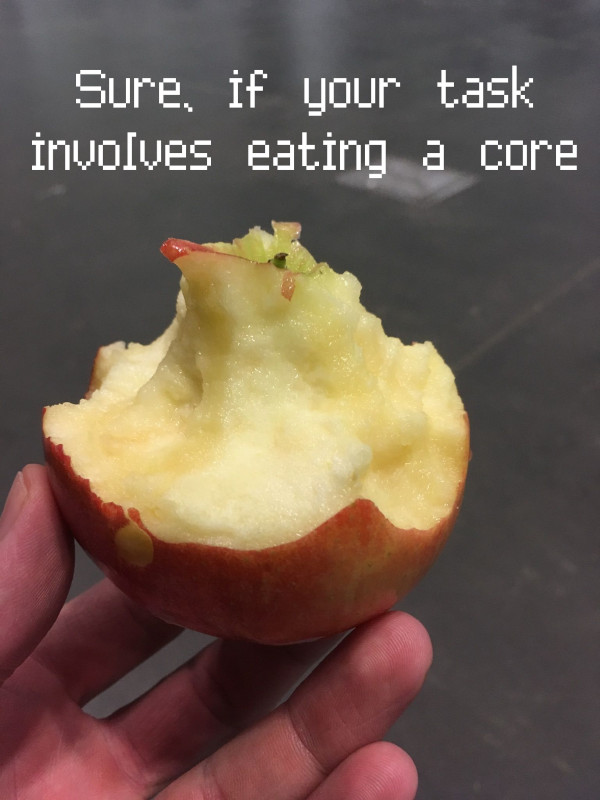
    Hand holding an apple core
    And if your task includes sounding like a douche every time someone says they are going to eat an apple.

    So, maybe there isn’t a single right way! Freedom acquired, right?

    Well, no.

    This idea that this apple-eating program can be approached in infinite different ways only furthers my paralysis. Even with infinite possibilities, I still tell myself that there is one ideal way of doing a thing. If I understood the problem well enough, then there is still an ideal, right? Infinite solutions don’t restrict a perfect solution, right?

    This is much scarier. Knowing that I’m learning from someone who may not know this ideal (or that, I am not smart enough to understand the problem well enough to know if this person is tutorializing to an ideal), is the blind leading the blind. I don’t know what I don’t know.

    Over time, I’ve come to terms with this fallacy of the attainable ideal. “Attainable” being the key word. I still feel there’s an ideal; I’m just getting more comfortable with understanding that it’s unattainable. Or, if it is attainable, I’ll never know that I’ve attained it. I’m blind, but I know I’m blind and will never not be blind, so I accept my blindness.

    TL;SRiT (Too Long; Still Read it, Though):
    There are infinite ways to eat an apple. Some may be better than others, but that doesn’t mean you shouldn’t eat the apple. And over time, you’ll learn new ways to eat new apples and perhaps, maybe, possibly (though I have my doubts) you’ll find out that some apples are best eaten in certain ways. At that moment, you will have become an apple eating master and will sound like a douche when you tell other people that they eat apples the wrong way.

    If you are reading this and are not me, check out a few games I’ve made here: https://calebjross.itch.io/