
When I’m not authoring mind explosions, I spend part of my time professionally involved with social media. One of the items my company stresses with our clients is that social media is not about pushing a message of product, product, product. It’s about engaging with customers and potential customers on a personal level. This means breaking the traditional advertising bullhorn approach of “BUY THIS NOW” with quips about the weather or TV shows, for example (though perhaps still tangentially related to the company’s product line). For most companies, dialog sans advertising is a foreign concept. For authors, this should be easy.
Authors are their books
Authors are inextricably linked to their products in a way that traditional companies are not. Denis Dutton in The Art Instinct: Beauty, Pleasure, & Human Evolution explores the idea that fiction always concerns and navigates three persons, one of whom is the author.
“There is also the transaction between reader and author—the latter understood by the reader as an actual person, the creator of the story, who negotiates between the various points of view of fictional persons (the characters), the author’s own point of view, and the point of view of the reader. These three elements are present in every experience of fiction; in fact, they exhaust the list of operative elements” (pg 124).
Authors control the show by “persuading, manipulating, wheedling, planting hints, adopting a tone, and so forth: whatever will appeal to the reader and create a convincing interpretation, including interpretations of ambiguous events. This makes the experience of a story inescapably social” (pg 125).
The author is always present. This is not the case when, for example, going to a pizza shop; you don’t normally consider the pizza chef when eating pizza, whether consciously or unconsciously. When reading, you do consider the author.
Authors vs. books: one is not more important than the other
The author’s aversion to social media is understood. Most of us like to think of our work not as a product to be sold but as an artifact worth cherishing and that the book should be thought of independently from the author. It’s a simple personal life vs. profession life argument. However, this is a romantic ideal, not a reality.
The truth is our DVD-behind-the-scenes-extras culture has trained us to expect glimpses of the minds behind the art. This expectation should be embraced, not avoided. Would Dostoyevsky fall from his pedestal if he tweeted that he had a particularly terrible sandwich from the corner bistro? Maybe, for some. But I think the number of current readers that would be alienated by this humanization would be offset by a crowd of new potential readers who would be endeared by the man’s personal revelations.
Take Ray Garton (@RayGarton) for example. Here’s a writer I would never have known had it not been for his phenomenal presence on Twitter. He’s personable, rarely salesy, and funnier than most tweeting comedians. I didn’t learn about the author after learning of his books. Instead I got interested in the books after learning about the author, which is a transposition that seems to be more and more common.
How to engage using social media
An article at the London Book Fair site offers this advice for authors looking to engage in social media:
“It’s probably a mistake for authors to be part of more than one network – it’s simply too time-consuming to keep up with several accounts, so choose Facebook or MySpace, but not both. They should also be aware of posting in haste the sort of personal detail that may be repented at leisure, and they should certainly resist the urge to respond to every criticism and to promote their own work at the expense of others. More than one exposé has demonstrated the dangers of that.”
I would agree with all but the first point. There are many tools available to make simultaneously posting to multiple platforms easy (Tweetdeck, Twitterfeed, and RSS Graffiti together will take care of 99% of your cross-posting needs). Besides, not all of your potential readers are on a single network; you should be where your readers are (NOTE: as of this posting, I have actually deleted my MySpace account. Shame on me, I suppose. MySpace caters to MTV watchers, and I don’t think my readers fit that demographic. Now, if The Discovery Channel or the Film Noir Foundation buy MySpace, then I’ll probably be back).
A few more tips:
- Work humor into your messages. Nothing breaks down defenses quite like humor.
- Post messages a few times/day if possible. Publish blog posts a few times/week.
- Leave comments on reader blogs (like this one) and Facebook messages. Re-tweet reader tweets.
- Your first priority should be engaging with readers. Selling books should be a second or third tier goal.
- The Simon & Schuster.biz site has many more tips. Go there.
Consider yourself a member of the literary community, not just a content producer
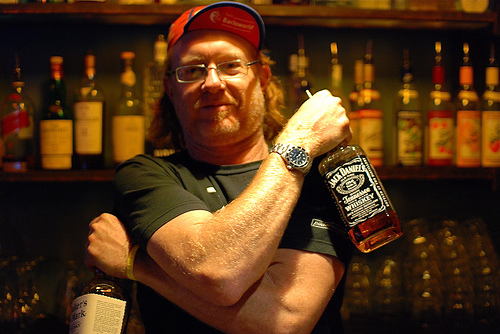
Honestly, when perceived as a gesture of inclusion, the author who doesn’t participate in social media could be seen as a kind of a dick. I don’t want to generalize—there are valid reasons for not participating, of course—but for those authors without a good reason, refusing to interact with readers is like not tipping your bartender.
Photo credit: http://www.flickr.com/photos/jcroft/