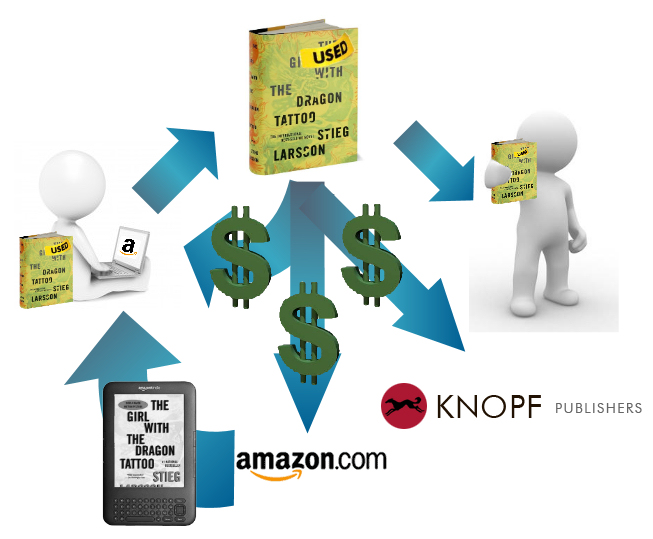
The slow eBook adoption of many publishers, and especially of bookstores, is not surprising. For the publishers, monetizing an eBook, with the lack of overhead and reduced production costs, makes justifying print book sticker prices tough. For bookstores, well, it’s pretty obvious why they wouldn’t jump on the eBook wagon.
But there has to be a way to keep bookstores alive, right? Bookstores aren’t like traditional commerce storefronts, in that they represent a mindset, a way of life, and the best ones promote a sense of community. People don’t just buy books there. People feel at home there. Which makes me believe that book shoppers haven’t stopped shopping in brick and mortar stores because eBooks are so much more convienent and so much cheaper. I think book shoppers have stopped simply because bookstores aren’t offering a “bookstore experience” for shoppers. If bookstores sold eBooks, I think readers who enjoy the bookstore experience would be willing to visit said bookstores to buy eBooks.
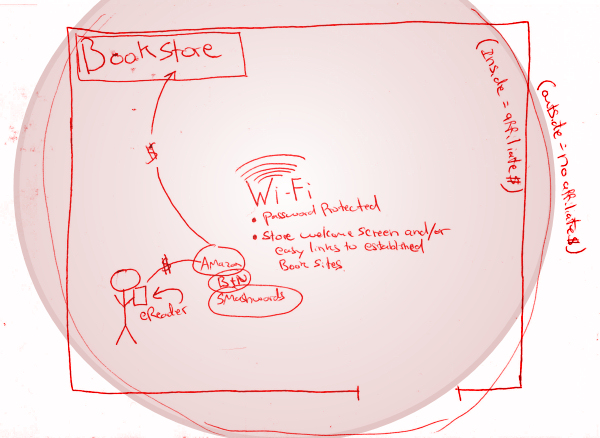
But how to make it work? Introducing the Wireless Purchase Radius.
Bookstores should set up a secured wireless network for their shoppers (most of them have these already). Now, instead of simply offering the wireless service as a convenience to coffee drinkers, use the service to entice readers to purchase eBooks at the bookstore.
Here’s the methodology: a shopper enters the store, logs on to the wireless network, and begins shopping online for eBooks. The store can leverage this shopper’s intent to purchase in one of two ways:
- The store has set up it’s own eBook storefront, available only to people logged into their secure network (hotels do this all the time), which offers eBooks either at a discounted rate or with value-added specials. Perhaps, in keeping with the sense of community, a purchase through the store eBook site also offers free copies of local writer’s books. Or maybe every purchase comes with a ticket to some local event or coupons for store coffee.
- The other idea is that the bookstore sets up affiliate programs with established sites (Amazon.com, B&N.com, etc.). Affiliate links are already something that anyone can set up; the bookstore would not even have to establish new relationships with the book sites. In this method, the shopper would log onto the bookstore wi-fi network, and would be greeted with a store screen (just like in the above example) only this time there would be links to each of the major book seller sites. Once a user clicks on one of those sites any purchase the user makes would be part of the total affiliate buy, meaning the store would get a percentage of purchases from each of the items that the shopper buys (not even just books).
This would work, right? Especially, if there is a way to set up affiliate code tagging on a mass level to anyone using the store’s wi-fi network (this would remove the need for a store screen when the shopper first logs on). Of course, I’m not sure if such a thing is possible.
But the general idea, of using a wi-fi radius to encourage in-store sales is a good one.
Someone do this now!
Subscribe to be immediately notified when new posts go live:
[subscribe2 hide=”unsubscribe”]