…Phil Jourdan is a damn good runner-up.
Here he reads a page or so from my story “Click-Clack” which a lot of people seem to really like (both the story and Phil’s voice).
I’ve called myself a writer of grotesque family fiction, but what does that term really mean? I give a brief definition of grotesque domestic fiction, or grotesque family fiction, by way of example, in an earlier blog post:
Take a family situation—usually some sort of broken family dynamic—mix in something grotesque—possibly morbid but not necessarily—and you’ve probably got domestic grotesque.
But I don’t know if that fully captures it. Up front, I have to say that I’ve always been the type to back away from definitions that try too hard to avoid definition. You know the type; those writers who say, “No, I don’t write horror fiction, I write transgressive commentaries on modernist life where social norms are exposed as metaphorical fangs in the collective neck…” But in the world of marketing, it is important to simultaneously embrace and reject established genres. You know, ride coattails while sewing your own. So, I write literary fiction but I actually write domestic grotesque fiction.
With that in mind, I coined the term “domestic grotesque” fiction, which Solarcide called a genre all my own (though, probably because I’ve been promoting the term as my own). In that Solarcide interview, I use a scene from Stranger Will to exemplify the term:
I find something inherently interesting with taking the trope of father/son catch and twisting it just enough to be jarring (re: dead raccoon) but still remain entirely relatable. These subtle twists are where I get the descriptor for my work, domestic grotesque.
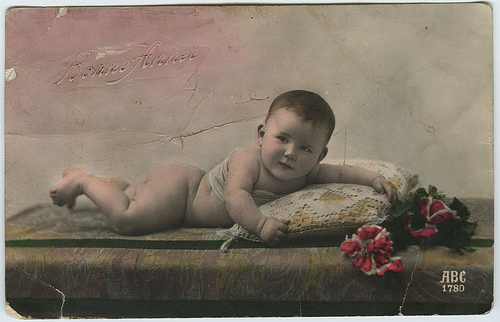
So why do I write domestic grotesque fiction? Part aesthetics and part concept penetration. Domestic grotesque fiction isn’t only fun to write, it also allows me to very effectively zero in on an idea by pairing dissimilar concepts. Stranger Will = pregnancy and cleaning up dead bodies. I Didn’t Mean to be Kevin = lost parenthood and body parts. “Click-Clack” = newborn baby (implying potential) and mental retardation (no potential). It’s fun.
Subscribe to be immediately notified when new posts go live:
[subscribe2 hide=”unsubscribe”]Photo credit: http://www.flickr.com/photos/paulgrand/451080165/

“Click-Clack” is a favorite of my stories. It has a rhythm and a focus that I am particularly proud of. So, it makes me all warm and bound to read Matthew C. Funk‘s review of the story at Spinetinger Magazine. Spinetingler, for whatever beautiful reason, has decided to review a handful of stories from the recent Warmed and Bound anthology, in which my story, along with 37 others, appear for your reading pleasure.
Rather than blather on, I’ll just post a few of Mr. Funk’s words:
Click-Clack by Caleb J. Ross is attuned to these mortal rhythms, and makes them sing seamlessly in a narrative that is as much a ballad as it is lyrical prose. This vignette is a song masquerading as short story. It achieves this with a brilliance as flawless as any modern masterpiece of music.
Ross crafts wondrously illustrated personalities. Jack and Ernie are vivid as both symbols in a fable and people in a beautiful and brutal struggle.
This deep understanding of the dynamic between father and son is just one aspect of Click-Clack’s beauty. Ross also infuses the work with flourishes of consonance, rhyming words in a subtle way that make the power of rhythm a real force for the reader…His rhythms run through it like tides. They rise and fade in the writing like the passing of trains.
Click-Clack hits all the right notes. It is a pin-point, sad-hearted portrait of the track of birth and death that fathers and sons must follow. It took on speed, swept me up and kept echoing after it passed…Do not miss this train.
Read the full review at Spintingler Magazine. While there, take in the rest of the words, both kind and not so kind, about Warmed and Bound.