Category: Video

  • Is the Walking Simulator Still a Thing?

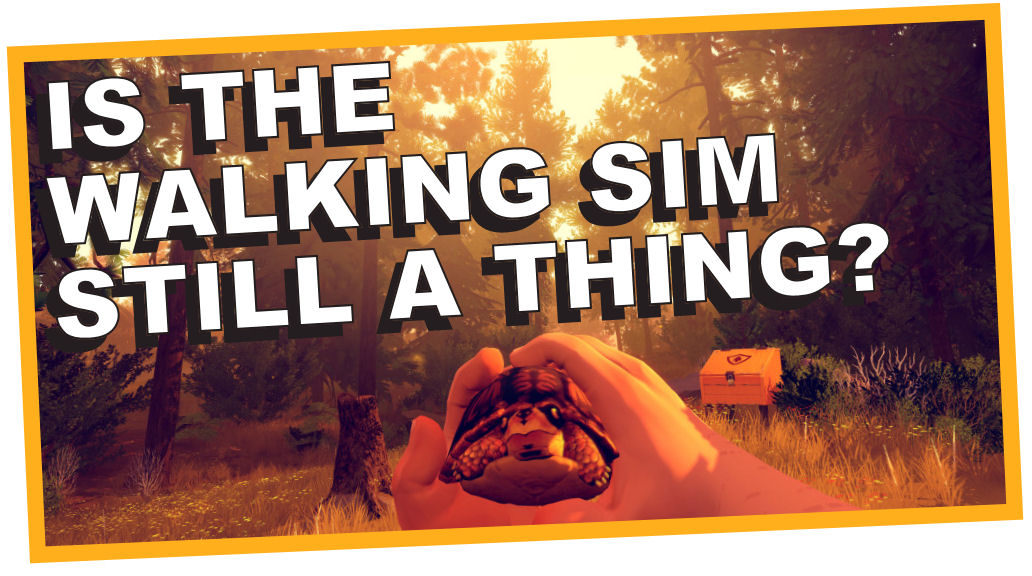
    Is the Walking Simulator Still a Thing?

    Subscribe on YouTube

    The walking sim has earned a spot in my top 3 gaming genres, and this includes your standard hyphenates, your action-adventure, your puzzle-platformer, your action-rpg, and so on, so I’m considering literally dozens of genres when I make this claim that the walking sim is so, so good.

    I’m not a martyr here. Plenty of people are defending the genre and the name. But for the most part, walking sims still represent a very peripheral part of the gaming ecosphere. And I’ve been wondering why that is?

    I think, unlike many other genres, walking sims require personal vetting prior to getting praise. You can’t get someone excited by the plot of a walking sim.

    Consider these scenarios:

    You: “So, what’s this game Firewatch about?”

    Me: “You walk around looking for forest fires while talking on a radio.”

    You: “So, what’s this game Everybody’s Gone to the Rapture about?”

    Me: “You walk around looking for spirits while talking to nobody.”

    You: “So, what’s this game Gone Home about?”

    Me: “You walk around your home while talking to nobody.”

    You: “No thanks.”

    Conversely, consider this scenario:

    You: “So what’s this game Bloodborne about?”

    Me: “You hunt out demon monster things with a variety of badass weapons.”

    You: “Is there simulated walking?”

    Me: “Only if you want to be scythed by a blood-thirsty farmer.”

    You: “Awesome!”

    But anyone who has played Firewatch, Everybody’s Gone to the Rapture, Gone Home or even Dear Esther, which most consider to be the first official walking sim, knows that it’s hard to properly explain the experience of a walking sim. And that’s the point of a walking simulator, really: to provide an experience above all else. Above mechanics. Above gameplay. Above even the traditionally inherent sense of victory with a game, a player is subjected to the experience. This reality simply doesn’t make good let’s play fodder or TV commercial fodder. It’s a hard sell.

    Walking sims have earned a place in my top 3 genres because, well, because I took the time to play them. And they’ve simply yet to let me down.

    But back to that traditionally inherent sense of victory that I mentioned above. Walking sims are often pushed aside, I think, because walking sims defy what it means to be a game.

    Let me explain. Developers (and gamers) love a cross breed. Action game + adventure game = action adventure. Puzzle + platformer = puzzle-platformer. Action + RPG = action-RPG.

    But walking simulator is the one genre that resists being absorbed into a hyphenate. Its mechanics are defined by exclusion. You wouldn’t have an infinite runner walking sim, for example, because the genre conventions are polar opposites. Endless runner = go fast, avoid objects. Walking Sim = go slow, explore objects. But even less absurd pairings aren’t​ really possible. You couldn’t have an RPG walking sim or an action adventure walking sim, and this is the case primarily because a defining characteristic of a waking sim is the absence of a lose condition. The only option is completing the game. (though a BitterEmpire article does make a good point that should the player give up when the narrative stops being interesting, that could be considered a sort of lose condition. This is a point that I’m open to exploring, but also a point that I think adheres to all game genres, so I’m not fully inclined to accept it as unique to the walking sim.). All other game genres insist upon a lose condition. That is, by definition, an important component of what it means to be a game. Sure, micro moments within a walking sim can have binary outcomes (open the desk drawer or don’t), but the genre doesn’t have a single global objective that can be failed.

    So the obvious question is, are walking sims even games? Well, for the sake of retail placement and consistency within the industry, yes, they will always be shelved and discussed as games. But I don’t believe they actually are games. This may be a personal belief; I tend to align to the side of game formalists, as opposed to game abstractionists, a distinction that is discussed in a great video by Jamin Warren when he explores the definition of a game as outlined by Jesper Juul.

    But this refusal by some to accept the walking sim as a proper game is why fans of the genre, as least I speak for me, have this incessant drive to defend it. Walking sims defy what gamers have come to accept as a game. But this is also why the genre has risen so quickly, I think. If a category name is disparaging, defenders will rise.

    So, what’s the future of the walking sim? Despite my assertion above that walking sims inherently avoid hyphenation, smart developers will find a way to take what’s great about the walking sim and merge those aspects into other genres.

    A great example that I recently played is the 3rd person walking sim platformer Bound (walking platformer?). Bound focuses on the environment. Bound focuses on narrative momentum. Bound lacks a lose condition. Sure you can fall off the edge, but when you do you immediately respawn. But it’s not just the perspective that bucks the walking sim establishment. The game is a platformer. The game even has minor combat elements, but not enough to pull the genre away from walking sim and toward action.

    Mentioned:
    What is a game? And why it matters! | Game/Show | PBS Digital Studios youtu.be/H0ReU2tvLFo
    In Defense of the Walking Simulator, from Bitter Empire http://bitterempire.com/defense-walking-simulator/

    The following are YouTube videos licensed under CC BY 3.0
    youtube.com/watch?v=GqmDXAh_wRg
    youtube.com/watch?v=3DPXyCaTMnw
    youtube.com/watch?v=W54YRYpLZng

  • One Hour of PREYer: Playing the PREY Demo [VIDEO]

    One Hour of PREYer: Playing the PREY Demo [VIDEO]

    Subscribe on YouTube

    I’ve been looking forward to Prey for a while, so when a demo comes along, I must play it. I don’t do very many Let’s Plays on this channel, but I’ve made the decision that should I do any more Let’s Plays on this channel, they will likely only be demos. Why? Implicit brevity.


  • Remember Yooka-Laylee? [VIDEO]

    Remember Yooka-Laylee? [VIDEO]

    Subscribe on YouTube

    Hey future Caleb, so you found your copy of Yooka-Laylee buried in a box in your attic and you wonder what your past self thought of it. The magic of the internet (with a helpful dollup of camera technology) allows you to relive such opinions.

    (more…)

  • Will the Nintendo Switch Last? [VIDEO]

    Will the Nintendo Switch Last? [VIDEO]

    Subscribe on YouTube

    Hey past, current, and future viewers. I take a few minutes to talk with my future self about the longevity and legacy of the Nintendo Switch. Give me your thoughts in the comments below. Does the Switch have lasting power?

  • Master Blaster vs Master Blaster Zero: How do the Stories Compare? [VIDEO]

    Master Blaster vs Master Blaster Zero: How do the Stories Compare? [VIDEO]

    Subscribe on YouTube

    I compare the intros to Blaster Master (on the NES) to Blaster Master Zero (on the Switch), two games with decades of technological advances between them.

    Also, I know that Blaster Master is a localized version of the Japanese Famicom game, Chô Wakusei Senki Metafight. This localization likely explains the problems with the NES story. Still, I’ve got to go with what’s given to me.

  • Yooka-Laylee to Amanda Palmer in 6 Degress of Pixelation [VIDEO]

    Yooka-Laylee to Amanda Palmer in 6 Degress of Pixelation [VIDEO]

    Subscribe on YouTube

    I’m simply too excited to Yooka-Laylee to sit idly by and not direct that excited energy into something. So, I bring you another episode of 6 Degrees of Pixelation. This time I connect Yooka-Laylee with Amanda Palmer (and I never once mention that Amanda Palmer plays the ukulele! I’m either an idiot or a king of self-control).

    Like many other episodes in this series, I’m basically taking things I like and trying to find a way to make them exist in the same universe. If you don’t like the things I like, that’s okay. I still love you.

    You know that social theory that everyone on earth can be connected to anyone else by no more than 5 intermediaries? They call that 6 Degrees of Separation. I do the same thing here, except I connect video game topics in strange ways using 6 Degrees of Pixelation.

    Click here to access the Google Doc with the script and sources.

  • Shantae Risky’s Revenge and The Pirate’s Curse – a review [VIDEO]

    Shantae Risky’s Revenge and The Pirate’s Curse – a review [VIDEO]


    Subscribe on YouTube

    Welcome to The One Thing, a video game review series that does something a bit different. Rather than try to touch on all the features that make a game great, I attempt to distill a game down to a single element that I believe is integral to the experience of the game. This may not be the only thing that makes a game great, but if someone asked me to tell them why Shantae works, specifically games 2 and 3, I’d start with The One Thing.

    What is the one thing? With Shantae, it is the consistent attention paid to retro platformer details while respecting the modern gamer. The game plays well, has great characters, oozes charm, and encourages exploration–all very important to platformers of my youth. And while doing this the game also embraces modern elements such as a refreshingly gradual difficulty curve, plenty of save points, unlimited lives, and bosses that aren’t so much Nintendo-hard as they are I’m-an-adult-and-don’t-have-much-time-to-play-games-easy. If I had to smoosh this The One Thing into a single phase I’d say the Shantae games are Fun.

    The term fun is more broad than I prefer, but every time I tried to think of something more poignant, I came back to “fun.”

    I love a 2d platformer. I hesitate to call it nostalgia because the 2d platformers of my youth were generally so difficult that having a nostalgic association with them comes across as a bit Stockholm syndrome-y, that psychological phenomenon in which hostages develop feelings for their captors. I’m not going to thank Contra for hurting me over and over. But the best 2d platformers–and modern platformers do this especially well–feature an impressive amount of control, just enough puzzle solving and physical destruction to keep things interesting, and a learning curve that’s fair, meaning if something goes wrong, it’s not the game’s fault. It’s the player’s fault. Like Stockholm Syndrome. Alright, I conceded that their are similarities… Contra only hurts me because she cares.

    See, Shantae reminds me what it’s like to be loved. And, I know, this stockholm syndrome thing is getting old fast, but let me extend the metaphor a bit, at least enough to allow me to reign it in. See, Shantae is beautiful 2d platformer, made to look like a 16bit entry from the mid 90s, but it benefits from the vast knowledge that gamers and game developers have collectively gathered and refined since the 90s. Back then, games were long because developers wanted you to get your money’s worth. But now, we understand that gameplay is far more important. Imagine a game like Ninja Gaiden on the NES, but not necessarily difficult, and instead of being pushed back into a chasm every time you get hit, the game actually understands that without fair control, a game is nothing. That’s Shantae. And to be fair, that’s Shovel Knight. That’s Teslagrad. That’s Steamworld Dig. That’s so many other great platformers and puzzle platforms that take the aesthetic simplicity of the retro and merge it with the gameplay sophistication of the modern. I love a 2d platformer. I love Shantae.

    Here’s an important note: a game can be enjoyable without being fun. Borderlands 2 is enjoyable. It looks great. It’s got some great humor. But it’s pretty boring, honestly, after a few hours. Not fun. Same with Gianna Sisters. Starts off fun, but gets tedious fast. A game can be demanding, annoying, frustrating, but still be worth playing for reasons other than fun. Maybe it’s a self-empowerment thing, like actually completing Ghosts n’ Goblins (which I’ve never done, btw). Maybe the game is intellectually engaging like The Beginner’s Guide or emotionally engaging like Everybody’s Gone to the Rapture. These games may have elements of fun, but fun certainly isn’t their central intent.

    So how do the Shantae games do it?

    What Shantae does is take what we know we love about the past, what we perhaps didn’t realize we love about the past, and what we love about modern gaming, and package it into a beautiful, perfect couple of games, and it does this all by not restricting itself to standard platformer conventions.

    You’ve got minor RPG elements with weapon upgrades, character power ups, but unfortunately no branching paths. Shantae dabbles in metroidvania with semi-open maps that encourage revisitation once new powers are acquired. The final leg of Risky’s Revenge, game 2 in the series, provides a short side scrolling shoot em up diversion. Acquiring animal powers is common in the game, which is reminiscent of many early era platformers, most notably to my mind, Little Nemo the Dreammaster (I love that game). And though I cannot pinpoint specific influences, the game has a Mega Man feel to it (Perhaps it’s these on-rails platforms). Shovel Knight by way of Ducktales also seem to have some influence.

    The only gripe I have is the steep increase in difficulty during the final leg of the final stage of game 3, Shantae and the Pirate’s Curse, where timing had to become impeccable. That was a bit of a let down. I had come to respect the game for not having to rely on difficulty to make it worthwhile, vying instead for ease (which some of us like, dammit). But that’s a minor gripe.

    Why am I speaking only of Shantae: Risky’s Revenge (2) and Shantae and the Pirate’s Curse (3), games 2 and 3 in the Shantae series. I haven’t played the first game in the series, but from what I understand, games 2 and 3 top the first in all ways, so I’m okay with not having played it. Add to this that the first game is currently selling for hundreds of dollars, and, well, it’s just not feasible for me to play it.

    These versions of Shantae are distributed by Limited Run Games, meaning unfortunately for you, they now cost a lot of money. Limited Run Games, as the name implies, presses limited runs of games and once they are sold they are sold forever. And if you are a collector, don’t be fooled by what may appear to be two different covers for each game. The cover is simply reversible.

    Luckily, you can download digital versions of these games for PS4 and Wii. Even more luckily, the next Shantae game in the series will be released later this month (December 2016). Shantae: ½ Genie Hero is a kickstarted game, and the first to move away from pixel-based visuals to a clean HD look. I honestly don’t like the change, but I also understand that my dislike is entirely based on aesthetics. As long as the game plays like a Shantae game and is written like a Shantae game, then the visuals shouldn’t distract me. This new game is developed by the same studio that did all the previous games (WayForward) so I shouldn’t be disappointed.

    Let me know in the comments below if you’ve played the Shantae games 2 and 3, and whether or not you agree with my observations, specifically regarding fun.

    What games would you recommend for people who like the Shantae games?

    And please, if you like this The One Thing approach to video game reviews, let me know. I make decisions based on the comments, so you, dear viewer, are all powerful.

    If ever I meet someone who left a comment on one of my videos IRL, I’ll buy that person a beer.

    Research/Sources/Credits/Inspirations (this is not a comprehensive list, as that would be impossible, especially the “inspirations” items)

    The following are YouTube videos licensed under CC BY 3.0

    Music Credits