I was thinking about AI in video games, specifically the artificial intelligence that governs NPC and enemy behavior…more specifically the NPC enemy behavior in Tenchu: Stealth Assassins…MORE more specifically the NPC enemy behavior that causes inept guards to abandon their posts to chase balls of rice on the ground. What kind of idiot guard is so willing to ditch their security responsibilities for edible litter!? The correct answer is of course the same kind of goldfish-brained idiot guard who isn’t concerned that the ball of rice wasn’t there just two seconds ago.
But taken outside the context of the questionable security guard hiring practices in Tenchu-land, there’s an interesting dissonance here that I’d like to explore. I want to talk about the tension between the human-like enemies and their purported human-like actions, and I want to explore the limitations that we as players require of our enemies. A truly intelligent enemy NPC is not what we want. We don’t even want artificial intelligence. We want scripted behaviors based on shortcut heuristics with game balance–not realism–being the end goal.
And to be fair, enemy AI in video games is a bit of a misnomer. True artificial intelligence implies machine learning, and video game enemy artificial intelligence is really, as I said above, just a collection of scripted behaviors that account for a bunch of different enemy states. For example, if player is within x pixels of enemy, then enter the hunting state. If enemy’s health is below y%, then enter the flee state.
But back to Tenchu and why I felt this scene with the dumb enemy chasing down a ball of rice was so funny. This is where the dissonance I mentioned earlier comes into play. Because we recognize this character as human, we are encouraged to expect human-like behavior from it. And chasing a random riceball is not human-like behavior. So, it’s funny. This exemplifies what’s called the Benign Violation theory of humor: Things are funny when they subvert our expectations but only when they don’t hurt anyone. This guy isn’t a real person, so, nobody was hurt.
But what if this enemy character looked even more like a human? Then, chasing the rice ball would elevate from simply funny to hilarious. Let’s visit Metal Gear Solid and the series favorite disguise: the cardboard box. Realistic looking enemies. Convincing enemy behavior. Absurd cardboard box disguise. Hilarious.
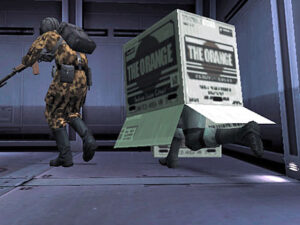
But, interestingly enough, because of the realistic portrayal of the human-like enemies, our laughter is curbed slightly. Benign Violation is tampered when we’re meant to be invested in what’s being harmed, even if only superficially. That’s why laughing at a news story about mass murder is sociopathic behavior. And maybe why bullies who laugh when they make kids cry should be taken to therapy.
But gamers demand so many conflicting things. We want realism, but we also want enemy AI to respect our need for fun, meaning we don’t want our enemies to be super smart. We need our inept guards to eat discarded poisoned rice balls. We need our machine gun-toting soldiers to ignore a conspicuous cardboard box. Otherwise, the game wouldn’t be fun.
This tension is a lot like the concept of the uncanny valley, but it’s not entirely the same thing. See, the uncanny valley is a term used to describe that point when human-like characters stop being emotive and relatable and instead become…creepy. I talk a lot about the uncanny valley (in terms of fiction in general) in a dedicated video here.
What I’m talking about, this dissonance between how we feel a human-like character should act and our need for human-like characters to not act human-like is less an uncanny valley and more an unfun plateau. NPC enemies are allowed a generous range of displaying human-like characteristics, but once the NPC enemies become too human, too unpredictable, too smart, the fun would decrease very quickly.
To be fair, I cannot think of a game that is too realistic–in terms of human-like characteristics on NPC enemies–to be fun, so this concept is truly just conceptual. If you have any examples of games that might fall off this unfun plateau, please let me know in the comments below.
The unfun plateau highlights one of the many conflicts game designers have to wrestle with. And part of me credits the longevity of pixelated graphical styles in games to this dissonance and perhaps why PS1 and Nintendo 64 era limited polygons may never have the same shot at life beyond their initial generation. I’m not so dumb as to think nostalgia won’t trump all, but I’m careful to think this ludo anthropomorphic dissonance isn’t strong.
Clips from the following videos are used in this video
- https://www.youtube.com/watch?v=D9S_XbVhNgc
- https://www.youtube.com/watch?v=A3LYSLq3XGk (Tenchu)
- https://www.youtube.com/watch?v=EFlabF5M8s8 (Metal Gear Solid V)
- https://www.youtube.com/watch?v=pPeAE4AvfTA (F.E.A.R)
Music Credits
8bit Dungeon Level Kevin MacLeod (incompetech.com), Licensed under Creative Commons: By Attribution 3.0 License, http://creativecommons.org/licenses/by/3.0/