Authors need to know how to optimize their web presence for search engines. SEO for Authors aims to do just that. Why do authors need to know about search engine optimization? So that when readers are using a search engine to find information related to an author’s work, the author’s website, social profiles, Amazon author page, Wikipedia page, and others have the best possible chance of appearing.
My goal is to post at a different blog every few days beginning with the release of his novel Stranger Will in March 2011 to the release of my second novel, I Didn’t Mean to Be Kevin in November 2011. If you have connections to a lit blog of any type, professional journal or personal site, please contact me. I would love to compromise your integrity for a day. To be a groupie and follow this tour, subscribe to the Caleb J Ross blog RSS feed. Follow me on Twitter: @calebjross.com. Friend me on Facebook: Facebook.com/rosscaleb
Recently, I was kindly invited to participate in a panel on social media during the 2011 AWP (Association of Writers and Writing Programs) conference in Washington DC. Joined by Tanya Egan Gibson, Dan Blank, Bethanne Patrick, Christina Katz, and moderator Jane Friedman, the panel succeeded in opening up and emphasizing both the possibilities and importance of social media in developing an author’s platform.
Having never before participated in an AWP panel (though I have attended many), I was initiated only from the perspective of an audience member. Knowing that an uninteresting topic coupled with boring presenters may drive the audience to mutiny, I came prepared to be as concise and witty (hopefully) as possible. Overall, I consider my effort a success. Of course, having the aforementioned panelists at the dais made failure near-impossible.
I’ve argued before that and author should openly embrace social media; the goal of both online social engagement and book-bound literary endeavors are the same: communicating on a human level. While naysayers abound, the consistent monologue about the form (such as this very AWP panel) seems to slowly be cultivating a more accepting and even more eager mindset.
Social media is easy to disparage as meaningless socializing, undignified shilling, or time better spent writing. Yet sharing information online and having conversations with readers is critical to spreading the word about what you (or your organization) does. Online community building can help develop a long-term readership, plus open up new opportunities.
During a recent discussion on NPR, Heather Fain, marketing director for the publisher Little, Brown and Co. said that “the greatest marketing tool we have in publishing — and probably will never change — is word of mouth.” This means not only literal friend-to-friend and bookseller-to-buyer hand selling, but also online forums, reviews, blog comments, and social network discussion. For the most part, authors have little control over this. One aspect authors can control: the old fashioned website.
Optimizing a website so that it can be more easily found by readers is to most authors, I would assume, a foreign concept. Not that I am discrediting authors; I simply hope that most of you aren’t as nerdy as I am. Having a platform (re: a stable of willing buyers) is becoming more and more important to publishers. Optimizing your web presence is an important way to grow that platform.
Many of the SEO (Search Engine Optimization) best practices for commercial sites are relevant when working with a personal site. Keyword-rich content, meta development, inlinks, all of these things are important. However, there are some major differences to consider. I’ll be focusing on those differences.
First, determine the purpose of your website. Is it to covert sales? Is it rack up a long list of newsletter subscribers? Is it to provide general awareness of yourself and your books? Most of you are likely part of the third item—most book sales will happen off-site, at either an online book store or through a brick-and-mortar store; and newsletters, though highly converting[1], are generally geared more toward e-commerce consumers and repeat consumers. There is a place for all three of these items in a single website, of course, but I’m going for focus in this already lengthy post.
Monitoring Traffic
You need a way to analyze your website traffic. I recommend Google Analytics because it is free, extremely robust (intimidating so), and super easy to incorporate. If you can’t measure your site’s performance, you’ll never know if you efforts are truly working. Some free blog sites don’t allow Javascript (which Google Analytics uses), but in those cases the blogging platform usually has a rudimentary traffic measuring application already built in.
Keywords
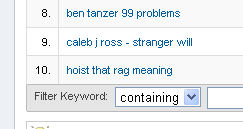
Think of keywords as the terms used to find a website. For example, someone may type Hoist That Rag meaning and end up seeing my page in the Google search results. And in fact, they did:
The 8th, 9th, and 10th top referring keywords for a given time-frame
Using Google Analytics, I can see what terms people searched to find my site. I recommend expanding your keyword set using these terms as a guide. For example, using the term Hoist That Rag meaning, I could imagine that people coming to my site might be interested in Tom Waits, Tom Waits Lyrics, and perhaps more generally, downtrodden, crooner, barfly personas. Additionally, keywords that searchers may not have used, but ones you feel are relevant to your site, are worth considering. For example, nobody came to my site using the term “grotesque noir fiction,” but I may want them to. I’ll add that to my list.
So, what to do with this keyword knowledge…
Content
By “content” I am going to be focusing on blogs. Individual page content, such as your bio, about, and work pages should be filled with keyword rich content, but blogs offer a more consistent stream of new content, which search engines (and readers) love.
Write blog posts that blend what you want to say with what you know people have already searched for. Keeping the examples above, I could write posts about barflies, Tom Waits, and perhaps how many of his lyrics feel like grotesque noir (“Eyeball Kid” comes to mind). The basic idea is to give search engines as many opportunities to validate your site in the eyes of readers.
Search engines put a strong focus on in-bound links (re: links from other sites to yours). When content is created specifically to attract links, this is called link bait. So how can you use your site’s past performance to anticipate link bait opportunities? I’ll use an example from my site to illustrate.
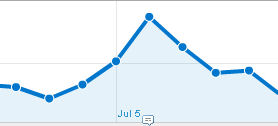
On July 6th, I noticed a spike in site traffic. Upon digging into my analytics, I found that a recent post, “Great Unexpected Literary References,” which highlights literary references in cartoons, managed to be linked to by a couple moderately popular literary blogs.
A July 5th spike in traffic. What is this about?
To capitalize on potential continued interest in this type of content, I then created more content with similar ideas. And in fact I started an Unexpected Literary References category for this very purpose. It continues to be a fairly popular category (in terms of my site’s overall traffic).
Content is great for bringing readers to you, but what about getting your content in other places?
This is part of what is called off-site optimization…
Community participation
Getting content and in-links is important to search engines, but don’t forget that you are blogging for human readers. Comment on other blogs, join forums, follow authors on Twitter, friend authors on Facebook, but above all, be active. Involve yourself in the online literary community. This is good practice, even if you don’t have a site to promote.
Basically, by proving your love to other humans, as a byproduct, you will be proving your worth to search engines. Each LEGITIMATE link you put out there is another rung in your search engine ranking ladder (notice the word LEGITIMATE; spamming is bad, search engines are smart about penalizing you for spammy links, and humans are smart about blacklisting shits who throw irrelevant links all over the web).
But you only have so many hours in the day, you say…
Be your own Press Release distributor
Use RSS to import your blog feeds into your various social networking and profile pages. Goodreads, Amazon, and Facebook, for example, allow authors to have their blog posts automatically posted to profiles. This means that you hit “post” once at your own blog, and your content feeds to those various other networks.
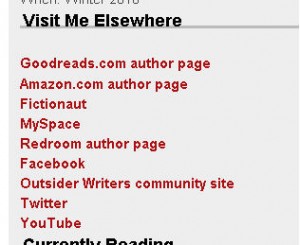
Be sure to cross-link all of your profile pages and your website. If possible, list your Twitter, Goodreads, Facebook, YouTube, Fictionaut, and all the other social pages you maintain on all of those various networks. Sometimes, you are only allowed one site link. In this case, I would recommend listing your website. A close second would be your Facebook profile.
Profile links in my homepage sidebar
Profile links in my Facebook sidebar
Measuring conversions
Since most author pages aren’t focused on product conversions (purchases usually take place off-site, at an Amazon.com or independent bookseller like Kansas City’s Rainy Day Books) it doesn’t make sense to focus on actual product sales as a measure of performance. If looking to measure conversions, a newsletter sign up or comment submission may be more appropriate. Think of yourself as being in the business of establishing a relationship, not in the business of bookselling. Google Analytics has a built in method of tracking conversions.
(Note: for those of you already familiar with SEO, you will notice that I didn’t include anything about meta content, title tags, <h> tags, and other behind-the-scenes tactics. I avoided these simply to keep this article focused. I may touch on them in the future)
[1] ExactTarget is an email marketing company, so be weary of fully embracing these numbers.
Disclaimer: I am far from a career author. I’ve made enough money to buy a few fifths of whisky and some diapers for my baby, so needless to say I’ve got a long way to go. The following plan reflects this outsider (re: possibly ignorant) perspective.
The idealized author spends his time alone, churning out typewritten manuscripts to meet constant deadlines. He drinks. Probably smokes. He’s respected. He vacations in tropical seclusion, but still, even with the changed view, he writes. He has no day job. He is an author. Writing puts his kids through college.
There is a reason this image contains a typewriter. Much like the machine itself, the idealized author is all but extinct. I think a lot of writers would like to go back to this model. Is it possible to not just retain the author career, but to make it thrive?
Given the following set of assumptions, I believe it would be possible to bring back the author career:
Content will continue to outweigh consumption
The marketplace is spoilt by free content, and much of that content will continue to be free
eBooks/eReaders will be a primary content medium within the next decade
The cost to produce and distribute market-quality products will continue to fall
More authors are producing more content than ever, so it’s fair to say the larger onus is on the publishers to bring back the career. The problem is that publishers have no incentive right now to court authors in the way they once did. Publishers have the above items #1 and #2 going for them. A culture of expected free content coupled with an overflow of content, means authors have been trained to work for cheap or free.
But, authors have items #3 and #4 above as important pieces of leverage. If publishers don’t adapt to the changing market, and work with authors to do so, then the publishers will die. Because authors have the ability to create and distribute their own work, and because they have been trained to work for nothing, authors have little to lose by abandoning the publisher. Without authors, publishers die. Without publishers, authors continue.
What can be done?
Consolidate the agent and publisher roles. Basically, this combined entity should act as a time and beaurocracy manager for authors. Today, authors have the ability to publish and distribute their own content without the help of agents and publishers. If this Pub/Agent composite can give authors time to write, then they will ultimately be given the sort of consistent product that the marketplace loves. Marketing thrives on trends. Giving authors time is the way to nurture trends.
Increase author royalties. As media becomes electronic, the savings on overhead and distribution must be passed on. Court your talent, publishers. I’ve read the argumentsagainst electronicmedia being cost-savers for publishers, and I just don’t believe them.
Embrace the eBook paradigm shift. As a reader, I haven’t yet fallen in love with eBooks. As a writer, I am very excited by the possibilities. Instead of fighting to keep print alive, fight to make eBooks thrive. eBooks have the potential to increase the pool of readers, much as the iPod did for music enthusiasts.
Brand yourselves as independent records labels do. Make fans out of your press, not just out of your authors. I won’t go into much depth here about this, but we do have an episode forthcoming at the Welcome to The Velvet podcast on this topic.






 Disclaimer: I am far from a career author. I’ve made enough money to buy a few fifths of whisky and some diapers for my baby, so needless to say I’ve got a long way to go. The following plan reflects this outsider (re: possibly ignorant) perspective.