Category: Marketing & Promotion

  • Search Engine Optimization (SEO) for Authors

    Search Engine Optimization (SEO) for Authors

    During a recent discussion on NPR, Heather Fain, marketing director for the publisher Little, Brown and Co. said that “the greatest marketing tool we have in publishing — and probably will never change — is word of mouth.” This means not only literal friend-to-friend and bookseller-to-buyer hand selling, but also online forums, reviews, blog comments, and social network discussion. For the most part, authors have little control over this. One aspect authors can control: the old fashioned website.

    Optimizing a website so that it can be more easily found by readers is to most authors, I would assume, a foreign concept. Not that I am discrediting authors; I simply hope that most of you aren’t as nerdy as I am. Having a platform (re: a stable of willing buyers) is becoming more and more important to publishers. Optimizing your web presence is an important way to grow that platform.

    Many of the SEO (Search Engine Optimization) best practices for commercial sites are relevant when working with a personal site. Keyword-rich content, meta development, inlinks, all of these things are important. However, there are some major differences to consider. I’ll be focusing on those differences.

    First, determine the purpose of your website. Is it to covert sales? Is it rack up a long list of newsletter subscribers? Is it to provide general awareness of yourself and your books? Most of you are likely part of the third item—most book sales will happen off-site, at either an online book store or through a brick-and-mortar store; and newsletters, though highly converting [1], are generally geared more toward e-commerce consumers and repeat consumers. There is a place for all three of these items in a single website, of course, but I’m going for focus in this already lengthy post.

    Monitoring Traffic

    You need a way to analyze your website traffic. I recommend Google Analytics because it is free, extremely robust (intimidating so), and super easy to incorporate. If you can’t measure your site’s performance, you’ll never know if you efforts are truly working. Some free blog sites don’t allow Javascript (which Google Analytics uses), but in those cases the blogging platform usually has a rudimentary traffic measuring application already built in.

    Keywords

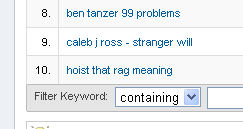
    Think of keywords as the terms used to find a website. For example, someone may type Hoist That Rag meaning and end up seeing my page in the Google search results. And in fact, they did:
    Hoist that Rag meaning
    The 8th, 9th, and 10th top referring keywords for a given time-frame

    Using Google Analytics, I can see what terms people searched to find my site. I recommend expanding your keyword set using these terms as a guide. For example, using the term Hoist That Rag meaning, I could imagine that people coming to my site might be interested in Tom Waits, Tom Waits Lyrics, and perhaps more generally, downtrodden, crooner, barfly personas. Additionally, keywords that searchers may not have used, but ones you feel are relevant to your site, are worth considering. For example, nobody came to my site using the term “grotesque noir fiction,” but I may want them to. I’ll add that to my list.

    So, what to do with this keyword knowledge…

    Content

    By “content” I am going to be focusing on blogs. Individual page content, such as your bio, about, and work pages should be filled with keyword rich content, but blogs offer a more consistent stream of new content, which search engines (and readers) love.

    Write blog posts that blend what you want to say with what you know people have already searched for. Keeping the examples above, I could write posts about barflies, Tom Waits, and perhaps how many of his lyrics feel like grotesque noir (“Eyeball Kid” comes to mind). The basic idea is to give search engines as many opportunities to validate your site in the eyes of readers.

    Search engines put a strong focus on in-bound links (re: links from other sites to yours). When content is created specifically to attract links, this is called link bait. So how can you use your site’s past performance to anticipate link bait opportunities? I’ll use an example from my site to illustrate.

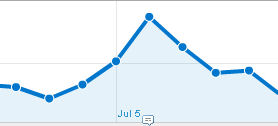
    On July 6th, I noticed a spike in site traffic. Upon digging into my analytics, I found that a recent post, “Great Unexpected Literary References,” which highlights literary references in cartoons, managed to be linked to by a couple moderately popular literary blogs.
    Traffic Spike
    A July 5th spike in traffic. What is this about?

    To capitalize on potential continued interest in this type of content, I then created more content with similar ideas. And in fact I started an Unexpected Literary References category for this very purpose. It continues to be a fairly popular category (in terms of my site’s overall traffic).

    Content is great for bringing readers to you, but what about getting your content in other places?

    This is part of what is called off-site optimization…

    Community participation

    Getting content and in-links is important to search engines, but don’t forget that you are blogging for human readers. Comment on other blogs, join forums, follow authors on Twitter, friend authors on Facebook, but above all, be active. Involve yourself in the online literary community. This is good practice, even if you don’t have a site to promote.

    Basically, by proving your love to other humans, as a byproduct, you will be proving your worth to search engines. Each LEGITIMATE link you put out there is another rung in your search engine ranking ladder (notice the word LEGITIMATE; spamming is bad, search engines are smart about penalizing you for spammy links, and humans are smart about blacklisting shits who throw irrelevant links all over the web).

    But you only have so many hours in the day, you say…

    Be your own Press Release distributor

    Use RSS to import your blog feeds into your various social networking and profile pages. Goodreads, Amazon, and Facebook, for example, allow authors to have their blog posts automatically posted to profiles. This means that you hit “post” once at your own blog, and your content feeds to those various other networks.

    Be sure to cross-link all of your profile pages and your website. If possible, list your Twitter, Goodreads, Facebook, YouTube, Fictionaut, and all the other social pages you maintain on all of those various networks. Sometimes, you are only allowed one site link. In this case, I would recommend listing your website. A close second would be your Facebook profile.
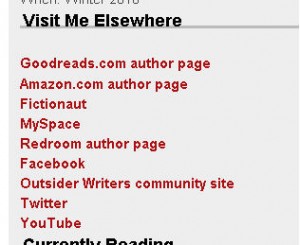
    Profile links in my homepage sidebar
    Profile links in my Facebook sidebar

    Measuring conversions

    Since most author pages aren’t focused on product conversions (purchases usually take place off-site, at an Amazon.com or independent bookseller like Kansas City’s Rainy Day Books) it doesn’t make sense to focus on actual product sales as a measure of performance. If looking to measure conversions, a newsletter sign up or comment submission may be more appropriate. Think of yourself as being in the business of establishing a relationship, not in the business of bookselling. Google Analytics has a built in method of tracking conversions.


    (Note: for those of you already familiar with SEO, you will notice that I didn’t include anything about meta content, title tags, <h> tags, and other behind-the-scenes tactics. I avoided these simply to keep this article focused. I may touch on them in the future)

    [1] ExactTarget is an email marketing company, so be weary of fully embracing these numbers.
  • Jonathan Franzen: “The whole culture of selling has become personalized”

    Jonathan Franzen: “The whole culture of selling has become personalized”

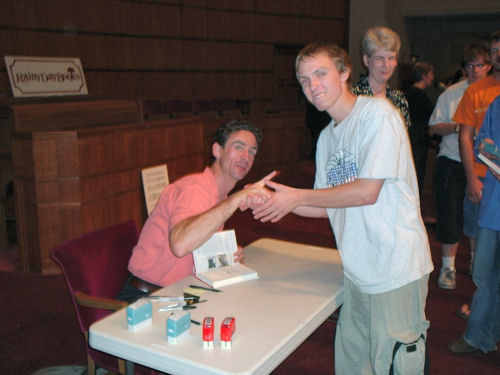
    Mr. Gordon Highland and I took in a Jonathan Franzen reading this evening at the Kansas City Unity Temple (presented by Rainy Day Books). Franzen read from the same stage on which I met (re: awkwardly shook hands with) Chuck Palahniuk a few years ago. I bring these two authors together here not just because of their temporal-turned-spacial bond, but because the association allowed me to ponder their very different approaches to the live author reading.

    Via a video posted on August 14th, Franzen noted his “profound discomfort” in having to make promotional author videos, basically, to me, implying that any promotional discussion taken place off the page stands in contrast to the intimate nature of a novel…

    I get that. In fact, I may even sometimes agree with that.  So I was glad when one of the audience members during the night’s reading asked a question that allowed Franzen to tangentially elaborate on his remarks (I post the abbreviated question below to show that Franzen wasn’t specifically addressing the above video, but instead a matter that relates to the video’s message):

    Q: When the writer reaches a certain level of prominence, does the focus on the author’s personality threaten to overshadow the work or become an irrelevant distraction?

    “The weird thing is, the way people think they know who you are is based on very little information…Obviously the point of that entire episode (referencing the infamous 2001 book club situation between himself and Oprah Winfrey), was not to teach one person, me, not to trust media representations of the actual personalities of people, but that is the lesson I took from it.”

    “It’s not bad in the same way that it was bad when Hemingway and Faulkner became public figures because I think the culture wasn’t so distracted back then…The whole culture of selling has become personalized. I don’t think it’s all bad. The kind of frenzy and the kind of gotcha culture….and the opinions based fourth- or fifth-hand on something, that’s an artifact of our electronic culture, and probably bad. That’s what good books are supposed to be helping to resist.”

    So on to Palahniuk, who seems to embrace the idea of a novelist performer. His events are the anti-reading, full of fainting fans, inflatable sex dolls, and morally questionable book inscriptions, on top of the reading itself. The performance has become the reading for Palahniuk fans.

    What is the author’s role in performance-based book promotion? Should authors resist performance, forcing the reader (and the reader’s forum discussion, online book reviews, and, ahem, blog posts) to testify for a book? Or, should authors embrace the possibilities of our changing culture? Perhaps in the world of Kindles and Nooks, the author video will become to the new book cover, the new visual representation of a book.

    Chuck Palahniuk Caleb J Ross
    Awkward Palahniuk handshake
    Denis Johnson Caleb J Ross
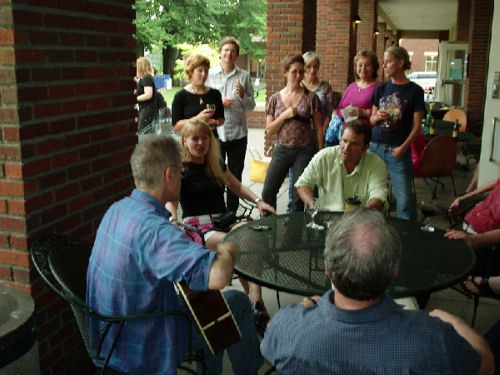
    And for no real reason, here’s a photo I took of Denis Johnson singing
    Bob Dylan songs at the 2004 Tin House Writers Workshop

  • White covers and isolated imagery: Why the trend?

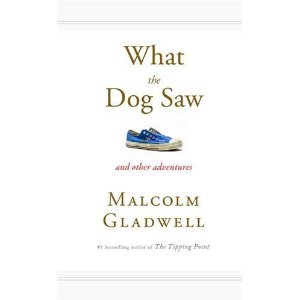
    I have noticed that over the past decade readers have been subjected to a trend in non-fiction book cover design. I am referring to the use of a white background to frame a single, striking element. For example:


    I understand the appeal from a marketing perspective. As online book buying grows in popularity, the book spine is becoming less important to shoppers. Instead, the idea with white-framed covers is to create as much visual distance and isolation with a book so as to set it apart from its surrounding mosaic. An added benefit for non-fiction books in particular is the sense of authority that comes with a single image. This says, “I am an expert on this topic. I am not going to stray into superfluous details. Prepare to learn.”

    I like the look, but I dislike the trend. I am a grump, though, and dislike most trends. I refuse to tell my wife that I don’t mind listening to her Ingrid Michaelson music simply because it’s on the radio sometimes. I even hate hipsters because they are too popular. How’s that for irony?

    I collected many, many such covers (and it didn’t take me long to do). Flip through the gallery below to see. Now, as an exercise in the inevitable futility of following trends, try to see if any of the white-framed books stands out when packed together with so many similarly designed books. Answer: none stand out. This book, if it were thrown into the mix, would certainly stand out. Here’s hoping busy book covers don’t become a trend.

  • Coming early 2011: Stranger Will (the book, not the creepy old man)

    Coming early 2011: Stranger Will (the book, not the creepy old man)

    Just when you thought you had over a year before getting offended by a book from me (I Didn’t Mean to Be Kevin, November 2011), I go and do something crazy like sign with another publisher to release a novel in March 2011. Stranger Will, a noir story of apathy and abortion, is coming early next year from Otherworld Publications.

    Otherworld Publications is a young publisher, but one with an impressive drive to promote its authors. This fact is not the sole reason I signed with them, though. This press seems to have acknowledged something that I, and the below authors, have known for a long time: The Velvet and The Cult are cesspools of untapped talent. Of the 11 current Otherworld authors (some noted on the Otherworld site, others not yet public knowledge), 5 have grown up at The Velvet and/or The Cult forums. I think we have Mr. Richard Thomas (Otherworld’s first author) to thank, as I am certain his word helped shimmy all of us followers in the door.

    Be on the lookout for these other forthcoming titles:

    December 2010 | Stay God by Nik Korpon. I had the privilege of reading an early draft of this novel. It’s good. Damn good. Preorder it in October.

    2011 | Out of Touch by Brandon Tietz. Otherworld is republishing Tietz’s originally self-published novel of decadence and excess turned sour

    2011 | We Are Oblivion by Michael Sonbert. I have his debut, The Neverenders, high on my to-read shelf. It is above Paul Auster and a book about beer. Consider my expectations high.

  • This Day In (Made) History

    This Day In (Made) History

    Today is my birthday. I’m not much of a celebrator of this, or any, traditionally celebrated day. I’m not a scrooge, a prude, or a buzkill. I’m just lazy. But my dis-affection hasn’t stopped others from wishing me all the best on this day.

    From family, to Facebook, to forums, virtual and physical friends alike have been fantastic.

    Below is an especially warming well-wish:

    This day in history (courtesy of Mr. Nic Young)

    1775 The Spanish establish a presidio (fort) in the town that became Tucson, Arizona.
    1833 Benjamin Harrison, 23rd President of the United States, is born (d. 1901)
    1858 Charles Darwin first publishes his theory of evolution in The Journal of the Proceedings of the Linnean Society of London, alongside Alfred Russel Wallace’s same theory.
    1890 H. P. Lovecraft, American writer, is born. (d. 1937)
    1907 Alan Reed, original voice of Fred Flintstone, is born. (d. 1977)
    1920 The first commercial radio station, 8MK (WWJ), begins operations in Detroit, Michigan.
    1920 The National Football League, (NFL), is founded in the United States.
    1931 Don King, American boxing promoter, is born.
    1948 Robert Plant, British Musician (Led Zeppelin), is born.
    1953 The Soviet Union publicly acknowledges that it had tested a hydrogen bomb.
    1966 Dimebag Darrell, American guitarist (Pantera and Damageplan), is born. (d. 2004)
    1970 Fred Durst, American singer (Limp Bizkit), is born. **Yeah, sorry about that.**
    1982 Caleb J. Ross, American author, is born. Caleb spent the majority of his formative years in a storm-wrecked grain silo, where he lived off the remains of the injured and dying animals he cared for with a measured degree of ineptitude. The general ambiance of his youth would inspire a keen interest in amateur taxidermy, a hobby that many historians believe caused the ostracization that led to the dark, anti-social themes of his written works. Caleb was nominated for the Nobel Prize in Literature in the August of 2012, whereupon he shed much of his acquired social stigma, but not the smell of formaldehyde.
    1986 In Edmond, Oklahoma, U.S. Postal employee Patrick Sherrill guns down 14 of his co-workers and then commits suicide.

  • Coming late 2011: I Didn’t Mean to Be Kevin (the book, not the apology)

    Coming late 2011: I Didn’t Mean to Be Kevin (the book, not the apology)

    It’s official. Negotiations have been negotiated. Signatures have been signed. Bells have been sleighed. I Didn’t Mean to Be Kevin will be published in late 2011 by Black Coffee Press. I’ll keep this announcement short and tidy; there is plenty of time for me to drone on about how proud I am of this book. For now, just make sure your nutting pants are clean.

    Perhaps not coincidentally, I do drink my coffee black.

    Black Coffee Press has a quite a list of books lined up for 2011-12. Some I am especially looking forward to are:

    A Shiny, Unused Heart by J.A. Tyler (2011)

    This guy is everywhere. J.A. Tyler is one of those names that materializes on every lit site, from the smallish to the giantish. Sometimes I theorize these appearances are simply to make me feel inadequate. Well done, sir.

    Code for Failure by Ryan W. Bradley (2012)

    Again, a writer whose name appears everywhere. I am not as familiar with Mr. Bradley’s work as I am with the other two fellows on my list, but based on what I do know, Code for Failure is not code for failure (ha, see what I did there).

    When You Are Sleeping I Will Evolve Into A Bird by Nathan Tyree (2012)

    Nathan Tyree and I put together a grand collection of stores called Oprah Read This >> Oprah, Read This, featuring too many fabulous writers to list here. Go to the site, read the stories, and anticipate Tyree’s Black Coffee Press book.

  • The Velvet Podcast, Episode 007: INTERVIEW with Blake Butler

    Episode #007 of The Velvet Podcast is now live!

    “If I made it I might as well destroy it by eating it” – Blake Butler

    In this interview episode of The Velvet Podcast, I interview Blake Butler, author of Ever (Calamari Press), Scorch Atlas (Featherproof Books) and the forthcoming There is no Year (Harper Perennial). Blake and Caleb discuss the impact of eReaders on visual-dependent literature, the novels vs. movies fallacy, and the importance of humility in a predominantly stuffy industry.

    Please, give it a listen. Subscribe via Feedburner, Podcast Alley, or iTunes.