Category: Marketing & Promotion

  • Micro-Syndication Magic: How to Annoy Many People At Once Using Social Network Syndication

    Micro-Syndication Magic: How to Annoy Many People At Once Using Social Network Syndication

    The people in my head often ask me, “Caleb, how are you seemingly in so many places online at once?” The simple truth is: magic. But not everyone is born with this gift (or curse, depending on which side of the superhero spectrum I’m internally agonizing over at the time). Over the years I’ve built up a failsafe system, though, so should Cash-4-Kryptonite stores suddenly saturate my suburb, I’ve got measures in place.

    Here’s my method.

    1. Establish a “content spring”

    I’m an organization nut. I need structure to survive. Online, when new social media networks materialize daily, organization can be tough. It is important to establish a “content spring,” a source from which most of your content will originate. The goal being to focus content creation efforts in a single place to avoid feeling overwhelmed by so many points of entry. In a perfect world, with perfect organization, you would be able to syndicate your content throughout your social networks with a single push of the “publish post” button.

    The most logical content spring is the good ol’ fashion blog. Blogging platforms have evolved considerably over the past few years, with most blog sites having enormous inbuilt configurability. For The World’s First Author Blog I use the WordPress platform, which is perhaps the most configurable of all blogging software. Expect most of this post to skew appropriately.

    2. Map your content routes (or, “build some tributaries,” if you want to maintain the spring motif)

    Step three will detail a few of the tools I use to get my content from the spring to..I don’t know, the ocean maybe, but before that, in keeping with my penchant for organizational nerdery, it’s important to map out exactly where you would like your different types of content to ultimately appear. Emphasis intentional: the idea of micro-syndication relies of focusing your content for specific audiences, even niche audiences within your own readership.

    “But Caleb, I want ALL of the content to go EVERYWHERE.” Well, hypothetical dissenter, while total media saturation may seem like a good goal, resources, time, and an ethical aversion to spamming friends and strangers should keep you from acting on this impulse.

    The goal of micro-syndication is to ensure that the right content gets to the right people. When you write a fantastic blog post about micro-syndication, your family and bar buddies on Facebook might not care. And all those Twitter bots that you think hang onto your every tweet, they don’t care either. But your readers and your marketing and social media friends might care a lot.

    I’ll use myself as an example. I have a personal Facebook page, a professional author Facebook page, various Twitter accounts (primarily my @calebjross account), a LinkedIn profile, and a few other profiles and websites. When I write a blog post, I don’t necessarily want to bombard every contact. What to do?

    UPDATE: I now use AlphaLinks for all of my text and image-based content syndication. AlphaLinks allows distribution to many platforms at once, including full blogging platforms like WordPress.com, Blogger, Typepad, and Tumblr. For video distribution I use OneLoad, which allows distribution to many video platforms at once, including Youtube, Vimeo, DailyMotion, MySpace, and Metacafe.

    3. Establish the filters (or, setting up strategic dams, or whatever fits with the spring thing. I’m beginning to regret this stupid running metaphor.)

    Know which tools are available and how they can help. Here are a few I use daily.


    Twitterfeed

    For highly customizable distribution to Facebook, Twitter, and LinkedIn (and fingers crossed more platforms in the future), nothing beats Twitterfeed. By using RSS feeds (which come built-in with most blogging platforms) Twitterfeed allows the user to direct specific feeds to specific social sites. What makes this system great is that by using category and/or tag data from your blogging platform, you can fine-tune the distribution path of your content.

    For example, I have my main homepage feed:

    www.calebjross.com/feed (“feed” may be a variety of RSS extensions. The WordPress default is “feed”)

    Which I send to my author Facebook page as well as my Twitter account (both accounts I use almost exclusively for reader/writer information).

    However, sometimes I create content on my homepage blog that isn’t very writerly, content that perhaps is better meant for those friends, family, and bots. In that case, I simply categorize the post as “un-writerly,” which creates this feed:

    www.calebjross.com/category/un-writerly/feed

    Twitterfeed has been set up to publish only posts from this feed to my personal Facebook page. Neat.

    YouTube Playlists combined with Shortstack and the YouTube SEO Playlist plugin

    With videos, my content spring is YouTube (I could host videos on my own site, but why the hell would I do that?) Now, take the concept of categories and tags described above and apply to video playlists. As I upload videos to the Caleb J. Ross YouTube channel, I assign them to playlists organized primarily for the purpose of syndication.

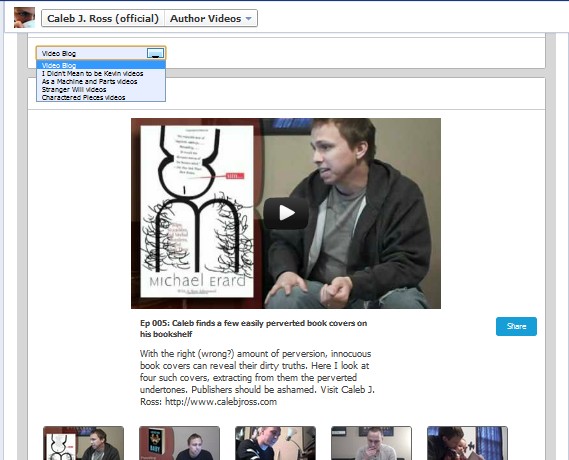
    The next step is simply finding tools to aggregate the videos. This is where the Shortstack app and the YouTube SEO Playlist Wordpress plugin come into play. Using the YouTube SEO Playlist plugin I am able to have videos from specific playlists automatically populate on my website. Head over to any of my book pages (Charactered Pieces: stories, for example) or my Author Video Blog page. Notice that only Charactered Pieces: stories related videos appear on the book page and only episodes in my author video blog series appear on the Author Video Blog page? That syndication is entirely automatic.

    This very same concept has been applied to my author Facebook page, using the Shortstack app. Notice the dropdown menu used for selecting playlists. Awesome.

    Another syndication solution to consider is Ping.fm. This service allows a single social network message to populate to 30+ different networks. It sounds pretty great until you realize that most of the networks are small, lesser-known properties (myYearbook, StreetMavens, Yammer, and others). I haven’t used Ping.fm yet (this post will be the first I attempt to distribute using the service). If anyone out there has used the service, I’d love to know your thoughts. And in keeping with the ease of syndication theme here, the WPing.FM plugin is available to further streamline distribution by connecting WordPress with Ping.fm.

    Tumblr and the Tumblrize WordPress plugin

    Tumblr is an enormously popular blogging platform, thanks in part to its effective merging of twitter-like following capabilities, Facebook-like social group curation, and traditional long form blogging capabilities. Because the network is so huge, it’s important for an author to be there. Luckily, the Tumblrize plugin is here to auto-populate posts from a primary blog to a Tumblr blog. And I know, all you SEOs out there, that I run the risk of duplicate content. For now, I’m testing that risk.


    On-Site Syndication/On-Site Curation

    Micro-syndication is important, but what about ensuring that the content you create is easily accessible to the right visitors on your site itself? I call this…wait for it…on-site syndication (I provide naming things consulting services at a fair rate). Traditionally, on-site organization has simply been part of a greater conversation called site navigation. But I think it deserves specific attention.

    One of the most effective examples of on-site syndication/curation is my use of category pages to organize particularly important blog post categories, effectively creating a type of micro-site with each category. Check out my SEO for Authors category (screenshot below), Book Marketing Tests & Studies category, or the World’s First Author Podcast category for examples.

  • The Second Conducting: What is the Value of a Goodreads.com book giveaway? 84% had never heard of me. 34% plan on reading my books.

    The Second Conducting: What is the Value of a Goodreads.com book giveaway? 84% had never heard of me. 34% plan on reading my books.

    Does giving away your books lead to more readers, and in turn, more fans?

    A few weeks ago I conducted a pretty in-depth study regarding the effectiveness of a Goodreads.com book giveaway in which I found that 93% of entrants had never heard of me and 88% planned on reading my books. Couple that with 51% of entrants signing up for my email newsletter, and the giveaway was well worth the two books I sacrificed.

    Science must be repeatable, right? A couple of weeks ago I ended yet another giveaway.

    The Setup

    I listed a 2 copy giveaway for I Didn’t Mean to be Kevin to take place between 3/14/2012 and 3/31/2012. During this time the giveaway received a total of 378 entries. After the giveaway was closed for entries, I sent a 9 yes/no question questionnaire to 222 entrants. 156 entrants could not be sent the questionnaire, either because I know them personally or because they entered the previous giveaway. I figured sending to these 156 entrants might spoil the results. The questionnaire contained the following questions:

    • Had you heard of author Caleb J. Ross before this Goodreads.com giveaway?
    • Had you entered a Goodreads Giveaway for a Caleb J. Ross book before?
    • Had you heard of the book I Didn’t Mean to be Kevin before this Goodreads.com giveaway?
    • Do you intend to purchase I Didn’t Mean to be Kevin in the future?
    • Do you intend to read I Didn’t Mean to be Kevin in the future?
    • Do you intend to read any other books by author Caleb J. Ross?
    • Do you plan to connect with author Caleb J. Ross on social networks such as Twitter, Facebook, and Google+?
    • If Caleb J. Ross were to visit your city/town for a reading, would you consider attending?
    • Did you answer these questions honestly?

    The Results of my Goodreads.com Giveaway

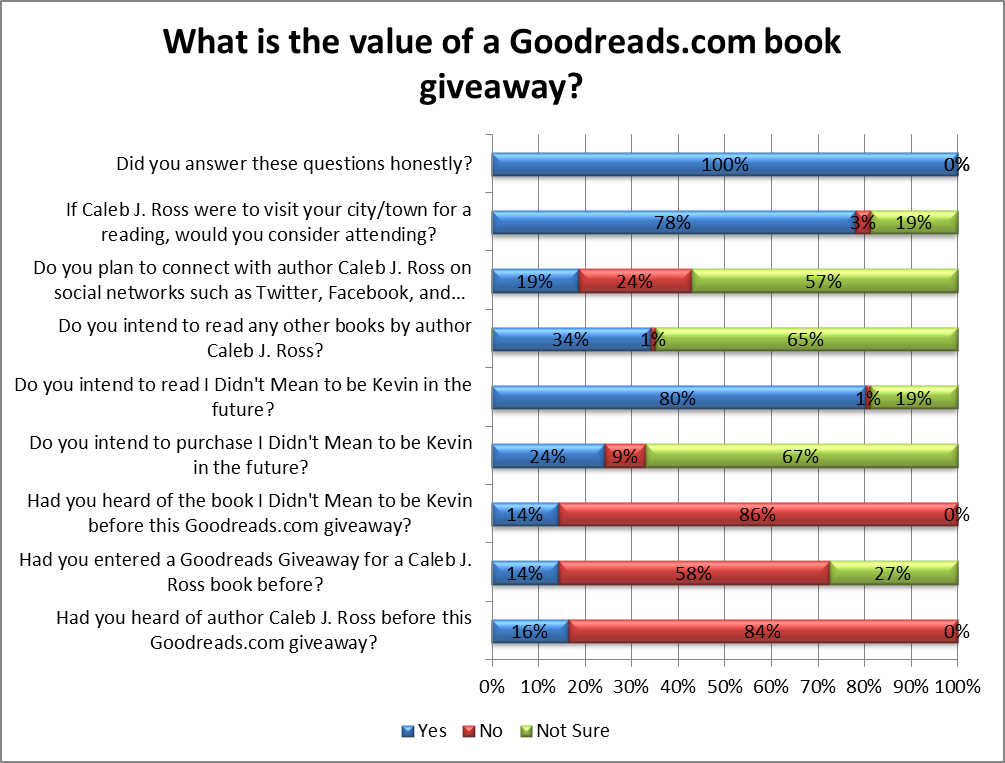
    • 84% of non-winning entrants had never heard of me before this contest. Translation: I’m speaking to an audience who might not otherwise have heard me. This is down from 93% from my initial giveaway. Am I becoming more popular among readers?
    • 86% of non-winning entrants had never heard of I Didn’t Mean to be Kevin before the contest.
    • 24% of non-winning entrants said they planned on purchasing the book, even though they didn’t win. This is a strange percentage when compared to the 8% of people who intend to read the book. This number is down significantly from the previous giveaway, I assume because of the addition of the “Not Sure” option into this recent questionnaire, which accounted for 67% of the entries.
    • 34% of non-winning entrants intend to read other books by me. This is a strong number, especially when compared to the 86% of entrants who had never even heard of me. Also, keep in mind the “Not Sure” option which made up 65% of responses.
    • 19% of non-winning respondents plan to connect with me on social networks. Not sure: 57%
    • 78% of non-winning respondents would come to a reading event if I were to visit their town. Not Sure: 19%

     Additional Results Not Included in the Chart Above

    • 62% of non-winning respondents signed up for my Email is Dead email newsletter (not included in the chart above). This is up from 51% from the previous giveaway. I credit a couple of things to this increase: 1) the newsletter purpose was spelled out more explicitly this time around. 2) I gave the questionnaire takers the choice of receiving newsletters for readers, one for authors, or one for both (as opposed to offering just a single non-descript newsletter option). Transparency about the content of these emails I feel made people more comfortable with signing up.
    • 26% of non-winning respondents left additional comments. New to this most recently giveaway, I included the option for the takers to provide feedback in a comments section. Generally speaking they were great comments, most of which I responded back to directly.
    • 31% of entrants for I Didn’t Mean to be Kevin also entered the As a Machine and Parts giveaway. This could mean they really liked my book idea and was inspired for another try, or it could mean they are serial giveaway-enterers.
    • The incentive to complete the questionnaire was free ebook copies of my story collections Charactered Pieces: stories and Murmurs: Gathered Stories Vol. One. 31% of entrants downloaded at least one copy of the books. Either people love filling out surveys or they’ve simply forgotten to download the books.

    Why so effective?

    The response-rate for the survey was an amazing 41% (compared to 29% for the previous giveaway. I wonder why). The industry open-rate for Art/Artist newsletters is 17.54% [1]. This isn’t exactly a parallel comparison, as open-rate is not the same as response-rate, but it’s a close enough comparison to provide some valuable insight. The response rate is also likely inflated because of the following factors (these are the same factors as the previous giveaway, so if you’ve read those, you’ve read these):

    • The entrants were already “in the sales funnel” in that they had already reached out with an interest in my book. In other words, I’m not blindly sending the survey to readers. I’m instead sending the survey to interested readers.
    • It’s possible that users may have only considered certain actions because the survey included them (connecting on social networks, for example). Would the respondents have connected with me on social networks had they not been introduced to the idea by way of the survey itself? Possibly not.
    • I promised free ebook downloads to all respondents. Obviously, free books must have a lot to do with the high response rate.
    • My communication was very sales averse. I approached giveaway entrants with respect. Truthfully, I am a naturally respectful guy, so I just spoke the way I would normally speak.
    • The survey was incredibly simple. 11 questions with 9 of them being yes/no questions.

    What are your thoughts? Have you conducted a similar survey? What did your results indicate?

  • Writing a Book Doesn’t Make You an Author

    Writing a Book Doesn’t Make You an Author

    The first of my hopefully long-running contributions to Phil Jourdan’s Slothrop blog is now live. The title, Writing a Book Doesn’t Make You an Author, isn’t meant only to be an attention grabber, but is actually true. I know, truth, right. Here’s a taste:

    The role of author has transformed almost as drastically as has media distribution support system. Authors can no longer be expected to simply produce content. Anyone with $10, a manuscript, and access to the internet can get a book listed on Amazon within minutes. Rather, the role of the author is to be an active, participating member of a book-loving community—by both consuming and creating content—and most importantly by legitimizing the importance of the literary community itself to those who may not be a part of it.

    Head over to Slothrop to read the post. Leave a comment. Let Phil know how much you love the article. Maybe he will have me back.

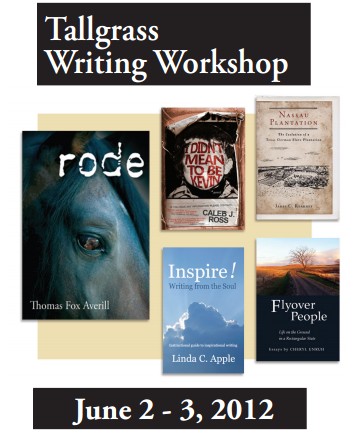
    Also, as a bonus, this article can act as a glimpse of what I’ll be teaching for June’s Tallgrass Writing Workshop at Emporia State University. If you like the article and will be in Kansas in June, sign up for the workshop.

  • Story Seeding and Social Media, I’m teaching both at the Tallgrass Writing Workshop in June.

    Story Seeding and Social Media, I’m teaching both at the Tallgrass Writing Workshop in June.

    I am honored to have been asked to teach a couple of sessions at the 2012 Tallgrass Writers Workshop at Emporia State University in June.

    If you will be in the Emporia area, you should register. Let me manipulate your mind to reflect my morbid desires. THE POWER!!!!

    I’ll be teaching:

    PLANTING A STORY: How to Grow a Plot from a Single Seed

    Author Stephen Graham Jones has said that many of his story ideas stem from misheard conversations. This session will explore the process of building an entire story from practically nothing, with special consideration given to dismantling the sham known as writer’s block.

    SURVIVING ONLINE: Why Social Media is Not a Waste of Time for Authors

    Some writers claim that time spent engaging in social media is time wasted. But what is an author but a communicator of ideas, and what is social media but a platform for exchanging ideas (primarily by text, I might add). This session will focus on how the entrepreneurial author, even without a book yet to promote, can use social media not just for nurturing a potential readership but for nurturing story ideas as well.

    Other workshop faculty include Thomas Fox Averill, Thomas Fox Averill, Linda Apple, Max McCoy, Jim Hoy, Cheryl Unruh, and Annie Wilson

    See full details at the Tallgrass Writers Workshop website or by downloading the workshop brochure.

  • Brand new story, “Different People Entirely” in the Ice Picks anthology. Horror? Yep.

    Brand new story, “Different People Entirely” in the Ice Picks anthology. Horror? Yep.

    When anthology editor S.S Michaels approached me last year about contributing a story to the Ice Picks: Most Chilling Stories from the Ice Plaza anthology, I hesitated for a moment. I never thought of what I write as horror. Grotesque? Sure. Morbid? Sometimes. Horror? No. But the more I thought about it, the more I accepted that a stretched definition of horror (never mind that I didn’t even consider a narrow definition at all) could very well encompass my work.

    Other people have thought of my work as horror, so I broke down and thought of the solicitation as a challenge. I came up with “Different People Entirely,” a story of a breaking family that embarks on a vacation to the Ice Hotel in Scandinavia. How does the family fare? Read for yourself.

    The anthology contains stories from the following authors:

  • Does posting purchase links in social network comments lead to book sales?

    Does posting purchase links in social network comments lead to book sales?

    It’s been only two days since I started my Annoying Links test, and though I originally intended to stretch the test for a full week, I am going to cut it short. Why? A couple of reasons. One, I simply feel dirty posting links everywhere (even though I stated very explicitly up-front that the links were for study purposes only). Two, though only two days have gone by, the test isn’t looking too positive.

    The abbreviated results

    Will posting self-promotional links in social network comments lead to book sales? Maybe. But is feeling like a dirty sales person worth it? No.

    The process

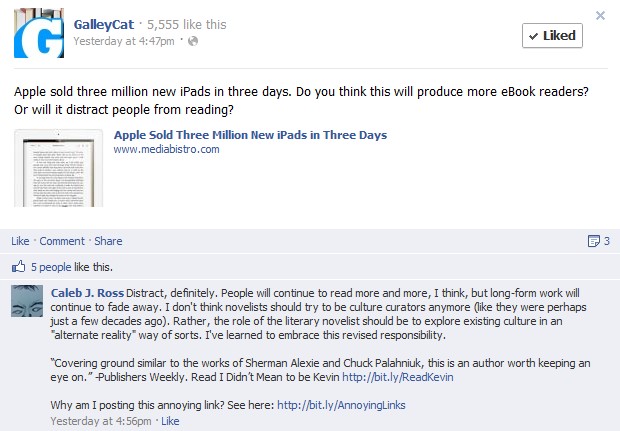
    Over the course of 2 days, I posted a total of 42 comment replies on Facebook and Google+, each containing two links at the end of the post. The posts themselves were genuine responses to comments, things I would have posted even if I weren’t conducting a test.

    The two links at the end of the post were 1) a self-promotional link for my book I Didn’t Mean to be Kevin and 2) a link to the original annoying link blog post which explained why I posted annoying links in the first place. Examples below:

    The results

    44 visits to explanation blog post. During the two day test I received 44 social referral visits to the You may notice some really annoying links out there during the next week post. The most important ones to look at are those from Facebook and Google+ (which are the two networks on which I posted links).

    • 19 visits from Facebook
    • 1 visit from Google+

    10 visits to the I Didn’t Mean to be Kevin purchase page. The I Didn’t Mean to be Kevin campaign page was established strictly for the purpose of this test, so it was restricted from being indexed by search engines which would potentially disturb the test. In other words, the most likely way someone could get to this page is through one of my comment posts.

    • 6 visits from Facebook
    • 1 visit from Google+
    • 2 direct visits (meaning the URL was likely copy/pasted)

    1 click on a link to purchase a book. I tagged each one of the bookseller links on the buy page with a Google Analytics event tracking code so I would know exactly how many times each was clicked.

    • 1 click

    Was it worth it?

    Out of 44 annoying links I received 1 potential book sale. In short, no, it wasn’t worth it.

    Sure, expanding the networks in which I posted links may have helped. I could have also posted more than 20 (x2) links per day. I might even have had some success by being more strategic with my posts. Or perhaps by rejecting the desire to qualify the links with a comment about their annoyingness could have helped. But, even with those assumptions, I’m just not comfortable with the shotgun link approach.

  • You may notice some really annoying links out there during the next week

    You may notice some really annoying links out there during the next week

    UPDATE: The results of this annoying link test can be found by clicking here

    (If you got to this page via an annoying social media or blog comment link, keep reading. This is all for the sake of science.)

    I’m a data nerd. I’ve gone record stating such, and I’ll go on record again. Something about seeing charts and graphs and trending lines and mapping the effect of X to Y and…let me pause to catch my breath a bit. I am fresh off a really successful Goodreads.com user study thing, so I’m itching to get back to the spreadsheets.

    So why tell you this? I am going to conduct a week-long test of sorts that will probably be a bit more intrusive than most of my other studies. I’ve noticed a lot of incessant product whoring on forums, blog post comments, and social status updates. You know the kind: “BUY MY BOOK HERE,” and “IF YOU LOVE VAMPIRES CLICK HERE.” Annoying right? But people keep doing it. Why? It must work, right?

    Right?

    Well, that’s what I’m going to find out. Over the next week or so I am going to end as many post comments and social status updates as possible with a link to the purchase page of my book. I’ll track the clicks to my website. I’ll also include a link to this blog post so that people are perhaps not entirely put off by the annoying sales pitches. I understand that having two links may dilute the test, but I’d rather play it safe and hopefully alleviate any hate.

    Once I have the results, I’ll post them here. Check back in about a week. The test may last longer, depending on how things work.

    I know this is risky—If I was smart I’d create fake profiles, rather than use my real ones, but I’m not smart.

    An example of the links you may see:

    Check out I Didn’t Mean to be Kevin, my newest novel: http://bit.ly/ReadKevin

    I Didn’t Mean to be Kevin, an “American road novel from hell”: http://bit.ly/ReadKevin

    “Covering ground similar to the works of Sherman Alexie and Chuck Palahniuk, this is an author worth keeping an eye on.” -Publishers Weekly. Read I Didn’t Mean to be Kevin http://bit.ly/ReadKevin

    Why am I posting this annoying link? See here: http://bit.ly/AnnoyingLinks