(This interview is cross-posted at Outsider Writers Collective)
Full disclosure: I’m writing this intro after having imbibed a few pints of Guinness at a downtown KC Irish pub called O’Dowds, which, as a nod to authenticity, has been given my grandmother-in-law’s seal of approval, all the way from Ballyshannon, Ireland. The inebriation is all the more fitting, considering Alan Kelly’s Dublin area connections.
Alan first contacted me, years ago, by the invitation in one of my first publication author bios: “He welcomes conversation via email.” I intended the trailing line to garner no more than a grin from the few who read it. But Alan’s willingness to contact a stranger should have clued me in early on to what a true individual he is.
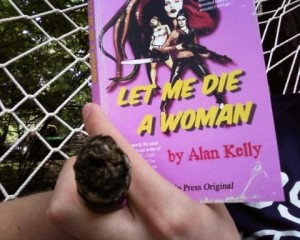
 We have been communicating online and following each others work since. When I first heard about his novella, Let Me Die a Woman, I was quite excited. As the title and cover art suggest, this book is unabashedly pulp. Having developed a sense of Kelly’s style, via his many reviews, interviews, and essays on the topic of b-reel pulp, I knew that this man is someone who takes great pride in his material. Though I wasn’t familiar with the nuances of this genre before reading Let Me Die a Woman, I knew that I was in very capable hands.
Caleb J Ross: It’s damn obvious that you love and respect the genre in which Let Me Die a Woman exits. It seems every one of your interviews and every essay you’ve written touches on, and pays homage to, the heroines that have come before yours. Angel Dare from Christina Faust’s Money Shot and Choke Hold, Bella from Helen Zahavi’s Dirty Weekend, Ariel Manto from Scarlett Thomas’ The End of Mr Y, Eloise Murphy from Danny Hogan’s Killer Tease, and Diana Kemp from Cathi Unsworth’s The Not Knowing all are referenced in a single question from your Five For interview at 3AM Magazine. How does Let Me Die a Woman’s Bunny Flask fit within this family of heroines?
Alan Kelly: I’ve always wanted to write a heroine (or anti-heroine) though Bunny is as much a homage to real-life horror icons such as Heidi Martinuzzi (editor of Pretty Scary) Shannon Lark (founder of The Chainsaw Mafia) my “Monster Kid” Alice Fiend has similar red hair to Rue Morgue’s former editor Jovanka Vuckovic and of course the lovely filmmaker, Gorezone columnist & Scream Queen Suzi Lorraine. Both Heidi and Jovanka are both in The Top 15 most influential women in horror and they are both brilliant at what they do, No, not brilliant, they are spectacular. Of course I’m not saying Heidi has ever cut anybody in two with a double-barrelled shotgun or Shannon is a murderous, chainsaw wielding vixen or that Jovanka is a vicious Alien queen with a pet monster who carves people up.
I reckon Bunny would love Diana and Angel and see them as wiser older sisters. Bella is a cold, calculated psychopath and I’m sure Bunny would appreciate her sense of humour. She’d never beat Eloise in a fight and would probably think Ariel was too academic and snooty. So Bunny, Alice and Kiffany are sort of an amalgamation of real and imagined heroines. I return to all these fictional characters now and again and am really excited about Choke Hold and Cathi’s forthcoming book. The world needs Angel Dare.

CJR: We both come from small towns, though I won’t be brash enough to compare our upbringing with any depth, as I’ve only been to Dublin once, and during that trip, though I stayed in a few small towns (hello to my family in Co. Sligo!) the trip wasn’t long enough to give me the ability to truly assess the areas. However, I’m sure we can both relate on the idea of returning home, after having been gone. Do you return to your village ever? What sort of reception do you get, considering the themes of your writing?
AK: I moved back home last year full-time. I was sick of the city and a family member was having health problems so I came home to stay with them. The village I live in is two miles from Wicklow Town (which is The Garden of Ireland) – oh it’s been insane since LMDAW was published! People have been lovely and very supportive. There are a lot of misconceptions about people who live in rural areas, a lot! In a way coming from a small village is sort of like having a lot of relatives – I realise how corny that sounds – I’ve lived in London and Dublin and to be honest I’ve become isolated and depressed in both cities which has led to me becoming really quite self-destructive. But moving on – In primary school every time my class was assigned an essay, I’d write fan-fiction and gleefully kill off all my classmates! The teachers used to be horrified and I was sent home several times but my classmates loved them! I even talked one of my teachers into letting the class watch Alien 3! Well I didn’t actually say it was that film! He switched it off almost immediately! I switched the cover with another film – The Neverending Story I think it might have been. Fun times. I would never show anyone my poetry, not family or friends and certainly nobody from my village – it’s something which is very personal, often brutal, something belonging to me and is none of anybody else’s business.
 CJR: True, corny. But so be it. I understand the feeling of family. And like a true family, I assume there is always that urge, whether embraced or not, to somehow make those hometown neighbors proud. Even the bullies and town jerks, somewhere there is a kinship there that warrants at least the striving for respect. Do you feel like you have this respect now that you have returned?
AK: I think there is a common decency which exists in small-places that is absent in any city. But of course, small places are not without the scum element. My family are a fairly close bunch and I mostly keep to myself. I have very few friends having lived away for many years. I like the country, I like walking down to The Monkey Pole on the beach in Wicklow Town or going to the lakes and looking out over the estuary or sitting in my local supping cider. Of course there are so many drawbacks to living somewhere so remote. No cinema, no culture, hard to meet new people, though there is a great little bookshop called Bridge Street Books. The bullies I couldn’t give a flying fuck about, I never did when I was growing up and I sure don’t now. I do go to the city quite a bit – mostly for books and to hook up with people I haven’t seen in a while. For now, I’m ok where I am, For now.
CJR: In your 3AM conversation with label-mate Danny Hogan, you briefly mention your current project: “The book I’m writing now is very different from Let Me Die A Woman: weird, visceral and inspired by an investigative piece I wrote while studying on missing migrant children in Ireland – 300 missing children in five years and its low profile. I was horrified by it and completely disgusted nobody seemed to give a fuck.” How did you get involved with the investigative piece that led to this project? Can you tell me more about this project?
AK: I was in my first year of journalism at BCFE and read an article in one of the broadsheets on missing migrant children. At first I didn’t really believe what I was reading so I phoned the journalist who had wrote the piece and contacted The Irish Refugee Centre. Still not entirely sure what I was hearing, I went further to the Irish Office of Migration and spoke to a man there. When I asked why this was so low profile and wondered why the media weren’t all over it he told me “it’s a matter of resources…”
Recently a 17 year old boy called Daniel McAnapsie was brutally murdered when he was supposed to be in the care of the HSE. His parents died when he was a child. He’d been in and out of care for most of his life. How can such precious life be so easily lost? Why don’t people try harder? This is appalling. Here is a piece about the migrant children. It is reported that 200 died while in care.
My next book will be an act of vengeance and retribution for children like this.
CJR: In Cathi Unsworth’s interview with you at Bookmunch, she says Let Me Die a Woman “is possessed of such audacious wit and originality that it seems the author has created a whole new trans-genre of his own.” Do you agree with this?
AK: I think she was very kind with that review, and she is an extraordinarily generous and supportive person and friend. I like that LMDAW doesn’t fit into any boxes and I do borrow from horror, noir, grindhouse and sci/fi quite a bit with it. At first I wasn’t even aware I was doing this, it sort of happened organically. I suppose you could describe is as “trans-genre” almost. It’s a mash-up of a lot of things. Quite chaotic and less ordered than what I am writing now.
CJR: Have you any experience with the Bizarro genre? As of the last few years, there have been many books released as part of this new(ish) genre, which you may find interesting. Basically, it is an anything goes category, where it is not uncommon to find men dressed in suits made of cockroaches, houses built with human bricks, and haunted vaginas. I’m not comparing your work to this (as I feel yours takes itself more seriously), but I’m wondering if you have any thoughts on this genre.
AK: I’ve read quite a bit of Bizarro and recently interviewed Jeremy Shipp (Cursed) and D. Harlan Wilson. I agree that it is an anything goes category and is sometimes slipstream, sometimes noir, sometimes comedy, sometimes horror. There are infinite permutations within this ‘genre’ and I think that is why I find it quite appealing. I can understand why others wouldn’t. But I like it. There is a literary website called Sein und Werden which publishes quite a lot of excellent, twisted, experimental fiction which you should definitely check out if you find the time. You could perhaps describe some of the content as the dark older sister of Bizarro. Other writers of Bizarro I like are Jordan Krall, Gina Ranelli and Tom Bradley. All fantastic.
CJR: I, being comparatively unschooled on the ladies of noir, found your roundtable discussion at Bookslut extremely informative. You seem intent on promoting hardboiled fiction, as almost every other word from you is in honor of writers who have come before you. Why such interest in pushing this genre? Why is it so important that other people read it?
 AK: Thank you. Hardboiled/noir/horror and outsider fiction are all areas I feel quite affectionate towards. They offer us glimpses into the gritty, the gory, the depraved and introduce us to characters we’d never meet in real life. I suppose a part of me is very much drawn to the dangerous element that exists in these fictions. As to pushing interest in the genre – I think for the most part it’s an area of literature which can be sometimes overlooked. They speak to and for the outsider, those who exist on the margins, the sort of characters you won’t see on The New York Times Bestseller lists. I would say my love affair with the weird and the brutal and the smart began with Poppy Z Brite and continued from there. Her writing led me to others – and being gay and liking aggressive writing I was like a moth to a flame picking up Matthew Stokoe and Dennis Cooper and Christa Faust. All writers who write about transgressive sexuality in a way that is intoxicating, intelligent and sometimes slightly insane. I ADORE Hard Case Crime and have nearly read all of their titles. Charles Ardai is just brilliant and I hope he continues to publish hardboiled fiction.
CJR: Bunny Flask’s situation is unique in that, without giving too much away, she is fighting against a force that is intent on ridding the world of all males. However, given the argument by many transgendered people that gender is inborn, Bunny, who is physically male but inherently female, could be either spared or slain by this force, depending on the above argument. Do you fear any backlash from the transgender community considering that Bunny’s willingness to destroy this force implies that gender may not be inborn?
AK: For Bunny, its personal and by the time the credits roll she is pretty much left with no choice but to stop Psyche and The Sisters. There are many variations of gender, I am inclined to agree with Kate Bornstein (101 Alternatives to Suicide, Gender Workbook) that the male/female binary does not exist and there are not two but several genders and that gender is linked to identity which is constantly changing and throughout our lives evolution of character is always happening, that change is an on-going process and that nothing is written in stone. The human race is on the brink of extinction. Bunny fights for them. Psyche is as much a threat to women as it is to men. Her fighting for the survival of men has got nothing to do with gender. It’s for the survival of humanity. I also think Bunny is a gender queer who identifies as female and that a lot of what happened to her in the past formed who she became.
Visit:
Alan Kelly (the author)
Pulp Press (the publisher)
Buy:
From Amazon.co.uk
Read:
The Outsider Writers Collective review of Let Me Die a Woman
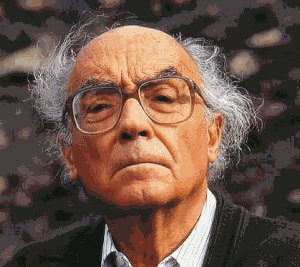 Jose Saramago, who quickly became one of my favorite authors after I read Blindness just last year, has died. But damn, he had a fine run, producing some of the most amazing novels I’ve ever read. There truly is no writing like Saramago writing.