Category: General News

  • A new podcast: Gamer Strangers. Let us know what you think.

    I had an idea for a podcast. So I made a test episode ready for your listening pleasure. Behold, episode zero of the Gamer Strangers Podcast.

    [powerpress]

    Some background info: In a hunt for Kansas City area gamers, I stumbled upon a group of people, two of which (NSA_iswatchingus and PairedRabbit) host the gaming podcast The Titled Gamer Podcast. This lead to me participating in episode 50 of their podcast which in turn opened up the opportunity for Nick (NSA_iswatchingus) to indulge me in a podcast idea that, selfishly, is meant to introduce me to more KC area gamers.

    Welcome to episode zero of the Gamer Strangers Podcast, a podcast that brings together two otherwise strangers based only on their mutual love of videogames. We scour the online and IRL videogame communities to find people that don’t know each other personally but do know that the other person loves video games. This conversation, we hope, takes that single point of video game love commonality and stretches it into a wonderful, lifelong friendship.

    Give it a listen, then let me know in the comments below what you think. Alternatively, let me know what you think via Twitter at @calebjross.

    And subscribe to The Titled Gamer Podcast.

  • I Stopped Writing Fiction…and that May be a Problem

    I Stopped Writing Fiction…and that May be a Problem

    ReadDontWrite

    About one year ago I stopped writing fiction. Despite being very proud of my output (five books of fiction, dozens of short stories and essays) and despite developing a small but eager audience of readers who looked forward to my work, I stopped. No ceremony. No real reason (that I know of, anyway). One moment I considered myself a writer of fiction. The next moment I did not.

    Why is this a problem? I have a collaborative novel (written with the amazing Nik Korpon, Richard Thomas, and Axel Taiari) to be published by Dzanc in 2015. Dzanc is a dream publisher, and the three aforementioned authors are dream collaborators. Luckily, I don’t need to be an active writer in order to promote the hell out of this forthcoming book (which I do plan on doing, so get ready world). However, I can’t help but think that with my dissolved passion for writing fiction, my promotional efforts may seem disingenuous. Imagine Aunt Jemima giving lectures to halls filled with syrup makers decades after she turned syrup warehouse into an airplane hanger. (more…)

  • Eat like an Author!

    Eat like an Author!

    ScotchCigarThe always awesome Lori over at The Next Big Book Blog is constantly coming up with cool ways to combine writing/reading with general interest topics like food and booze. Just last week she had me over for a series called Would You Rather in which she asked me a series of questions, all following the would you rather _____ or ____ format.

    12.  Would you rather be forced to listen to Ayn Rand bloviate for an hour or be hit on by an angry Dylan Thomas?
    Getting hit on by Dylan Thomas would be quicker, so I’ll go that route.


    Today, she gave me some space to provide a recipe for my favorite authorly meal, Aunt Caleb’s Author Surprise. The best part is, all the ingredients can be easily acquired at your local stepfather’s liquor cabinet!

    Click over to read how to make Aunt Caleb’s Author Surprise. Then stick around the TNBBC site and read a few more of Lori”s crazy author mashups.

  • Harry Crews on Big Families, Low Income

    Harry Crews on Big Families, Low Income

    HarryCrews

    Families were important then, and they were important not because the children were useful in the fields to break corn and hoe cotton and drop potato vines in the wet weather or the help with hog butchering and all the rest of it. No, they were important because a large family was the only thing a man could be sure of having. Nothing else was certain. If a man had no education or even if he did, the hope of putting money in the bank and keeping it there or owning a big piece of land free and clear, such hope was so remote that few men ever let themselves think about it. The timber in the county was of no consequence, and there was very little rich bottom land. Most of the soil was poor and leached out, and commercial fertilizer was dear as blood. But a man didn’t need good land or strands of hardwood trees to have babies. All he needed was balls and the inclination.

    from A Childhood: The Biography of a Place by Harry Crews (as compiled in Classic Crews: a Harry Crews Reader, 1995), pgs 30-31

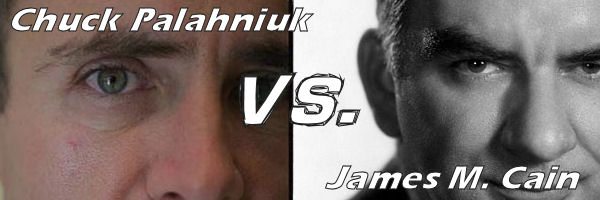
  • James M. Cain’s “Pastorale” vs. Chuck Palahniuk’s “Guts”

    James M. Cain’s “Pastorale” vs. Chuck Palahniuk’s “Guts”

    Palahniuk-vs-cain

    A few nights ago, when reading the James M. Cain short story “Pastorale,” I was struck by a scene that seemed very Chuck Palahniuk-ian[1]. A dead man is pulled out of a frozen lake; the man fell through the thin ice atop the lake when trying to retrieve the severed head of a man he helped kill earlier in the story.

    But unlike a Chuck Palahniuk story, “Pastorale” kept going. The shock was not the climax.

    shockValueI’m not sure why I immediately forced a comparison to Chuck Palahniuk. The writers, and their work, are completely different. I suppose the use of shock, which I consider a very Palahniuk thing, was used in “Pastorale” in a way that I wasn’t ready for.

    It’s important to state up front that I love Chuck Palahniuk’s writing. I’ll read every novel he writes, even if they continue to be as bad as his last few. This post isn’t a condemnation of his writing, but rather a critique of his storytelling by way of comparison to the author of, what some have called, one of the best novels of all time.

    For a shocking image to resonate beyond the original ick value the story context, specifically the characters within the story, must be able to exist beyond the shock. Yes, the image of the frozen man/severed head in “Pastorale” has inherent potency, but the story around it beautifully builds to the image, and more importantly continues on afterwards without the reader ever feeling like he is simply enduring an unnecessary, extended denouement.

    By contrast, a Chuck Palahniuk story is, well, Palahniuk-ian, partly because the shock value plays such an important role in the overall experience. Again, that’s why I love him. But when it comes to straight storytelling, with characters a reader is meant to empathize with, Palahniuk has nothing on Cain[2].

    Let’s compare the context-supported icy severed head image in “Pastorale” with what is perhaps the most well-known Palahniuk story, “Guts.” Like “Pastorale,” “Guts” contains a very shocking image, so shocking that it has caused more than 60 people to faint. That image: a boy forced to chew through his intestine to avoid drowning in a swimming pool.

    The intestine boy image is supported not by the character of the boy himself, but rather by a series of unfortunate events that leads up to the image. Palahniuk’s trademark rhythm of minimalist, straightforward commentary underscored by poignant observations contributes significantly to the experience. Take this example:

    Knotted inside the snake, you can see corn and peanuts. You can see a long bright-orange ball. It’s the kind of horse-pill vitamin my dad makes me take, to help put on weight. To get a football scholarship. With extra iron and omega-3 fatty acids.

    It’s seeing that vitamin pill that saves my life.

    It’s not a snake. It’s my large intestine, my colon pulled out of me. What doctors call “prolapsed.” It’s my guts sucked into the drain [Guts, pg 18]

    This is this literary version of that horror movie cliché. What’s that noise?…Oh, it’s just the cat…[villain suddenly appears]…STAB! Nobody cares who the victim is. Likewise, nobody cares about the identity of the boy getting his intestines sucked out by a pool filter. We want to see blood. We want to see undigested corn kernels.

    “Pastorale,” by contrast hinges around a man and a woman’s illicit affair and the somewhat mentally deficient accomplice, Burbie. See how I described that? It’s possible to describe the story without even mentioning the severed head. To describe “Guts,” however, requires a mention of underwater organ gnawing.

    To be fair, perhaps Palahniuk’s intention all along was to simply be shocking. Perhaps he’s not as concerned with crafting a character the reader cares about (and hasn’t been since Diary). Perhaps narrative arc isn’t a primary concern. I respect that for what it is. Here’s proof:
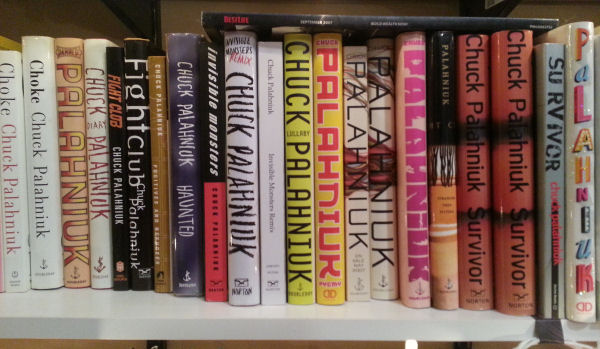
    Chuck Palahniuk book shelf

    I’m not immune to the lure of shock. In fact, I leverage the inherent power to shocking imagery in most of my work. My goal isn’t to leave a reader with only the sense of shock. My goal is to make the story itself so compelling that the shocking image can almost be forgotten. Check out my work. Spend just a few small dollars to read one of my books. Then tell me in the comments how dumb I am. Click over to my novels page to read more about what I write.

    Or, bypass my novels page and head straight to my Amazon.com author page to buy one of my novels. Might I recommend Stranger Will, As a Machine and Parts, or I Didn’t Mean to be Kevin?

    AmazonBuy


    [1] Yes, I know that Palahniuk came way after James M. Cain. Still, the scene reminded me of Palahniuk.

    [2] I haven’t read every Cain story. I have read almost every Palahniuk story. If there are some shitty Cain stories out there, let me know.

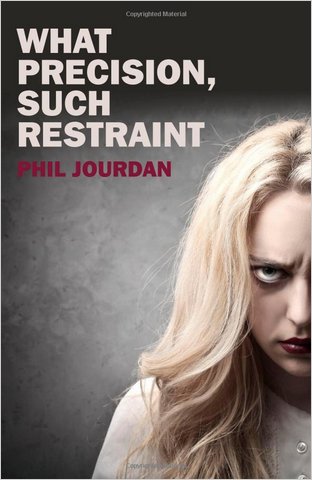
  • Short Story Every Day: “That Lombardi Thing” from Phil Jourdan’s What Precision, Such Restraint

    Short Story Every Day: “That Lombardi Thing” from Phil Jourdan’s What Precision, Such Restraint

    Click to buy
    Click to buy

    I read an early version of this collection, What Precision, Such Restraint, a few years ago, during which time I must have been drunk, since though I recall enjoying the collection I don’t remember it being so front-loaded with genius.

    I read two stories today, the first and second, chronologically. Both are amazing, but it’s the second I want to mention here, “That Lombardi Thing” which encapsulates what I consider to be the absolutely best kind of story: voice-driven, thought-provoking, and never too full of itself. This is why I love Saramago. This is why I love Brian Evenson (though his characters do tend to be a bit full of themselves, the stories aren’t). This is what I try to write.

    “That Lombardi Thing” explores the made-up (I think made-up) concept of Freudhacking, which is the practice of switching a person’s conscious with their subconscious. Thought-provoking: check. The narrator is a one-time practitioner of Freudhacking who wants nothing more than to be left alone, never to practice again. Voice-driven: check. The occasion for the story is that this old man practitioner is approached by a man who wants to know what it’s like to live without language. The old man thinks he’s nuts. Never too full of itself: check.

    The author, Phil Jourdan, tries to pawn this collection off as just a literary experiment without any merit beyond its own pages. He even calls the book a bunch of terrible names during a live reading in Boston a few months ago. It’s just proof of his genius that by telling the world of the book’s insufficient origins Phil can then be free to write whatever he wants, and the reader, having been briefed of the rubbish, can’t complain. Well, the reader won’t want to complain, so you failed, Phil.

    Rules for Short Story Every Day posts, designed to make me have to work as little as possible

    1. I’m not allowed to take notes as I read
    2. My commentary on each story should involve as little research as possible. I’m reacting to the story on a visceral level, not an intellectual level (though I reserve the right for overlap should my visceral mix with my intellectual)
    3. “Every Day” should be taken as the headline grabber it’s intended to be. I probably won’t
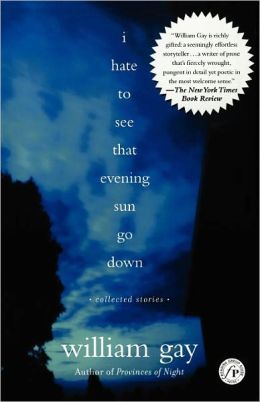
  • Short Story Every Day: “Sugarbaby” from William Gay’s I Hate to See that Evening Son Go Down

    Short Story Every Day: “Sugarbaby” from William Gay’s I Hate to See that Evening Son Go Down

    Click to buy
    Click to buy

    “Sugarbaby” from William Gay’s collected stories, I Hate to See that Evening Son Go Down captures slow, unaffected degradation of a marriage in ways I’ve never read before. The main couple, Beasley, and let’s say, Martha (as part of the rules, I’m not allowed to go back to the story at all, and I can’t remember the wife’s name) are seen within their small community as a pillar of marital perfection. They’ve en-joyed/-dured marriage longer than any other couple. One day, Beasley buys his wife a dog, a small, yap-yap-yap kind of dog, who doesn’t seem to appreciate the fine home Beasley has brought him into. Eventually, Beasley shoots the dog with a gun far larger than would be necessary to kill such a tiny animal. This fact, though not directly addressed, is mentioned only enough to be allowed to simmer in the reader’s head. This is what makes a Gay story so perfect: small actions and tiny mannerisms imply tremendous consequences.

    After a lifelong perfect marriage, Margaret suddenly abandons her husband. Beasley doesn’t react. This non-reaction is the impetus for an eventual divorce lawyer sent to Beasley’s house, a court supenona, and on and on the list goes, when really, Mildred never even tried to contact her husband after her split. This is where the reader is asked to pick a side. We choose Beasley because, yeah yap-yap dogs are terrible, and yeah, Megan should have given Beasley a phone call before sending in the law. What the fuck, Marge!

    So the reader roots for Beasley, yeah, perhaps by default, as we aren’t allowed to see Melissa’s side of the story. And sure, eventually Beasley kills a cop and “escapes” to live on his own in the wilderness, primarily to avoid paying 50% cash to his wife in lieu of 50% of his property (the property deal having long been decided by Melody’s lawyer as no longer enough), but despite all of this, we actually still feel for Beasley. It makes me wonder if my loyalty would be different if Beasley shot a real dog like a Golden Retriever.

    Rules for Short Story Every Day posts, designed to make me have to work as little as possible

    1. I’m not allowed to take notes as I read
    2. My commentary on each story should involve as little research as possible. I’m reacting to the story on a visceral level, not an intellectual level (though I reserve the right for overlap should my visceral mix with my intellectual)
    3. “Every Day” should be taken as the headline grabber it’s intended to be. I probably won’t