Category: Study (the world/the craft)

  • Social media is a natural fit for authors. Tip your readers!

    Social media is a natural fit for authors. Tip your readers!


    When I’m not authoring mind explosions, I spend part of my time professionally involved with social media. One of the items my company stresses with our clients is that social media is not about pushing a message of product, product, product. It’s about engaging with customers and potential customers on a personal level. This means breaking the traditional advertising bullhorn approach of “BUY THIS NOW” with quips about the weather or TV shows, for example (though perhaps still tangentially related to the company’s product line). For most companies, dialog sans advertising is a foreign concept. For authors, this should be easy.

    Authors are their books

    Authors are inextricably linked to their products in a way that traditional companies are not. Denis Dutton in The Art Instinct: Beauty, Pleasure, & Human Evolution explores the idea that fiction always concerns and navigates three persons, one of whom is the author.

    “There is also the transaction between reader and author—the latter understood by the reader as an actual person, the creator of the story, who negotiates between the various points of view of fictional persons (the characters), the author’s own point of view, and the point of view of the reader. These three elements are present in every experience of fiction; in fact, they exhaust the list of operative elements” (pg 124).

    Authors control the show by “persuading, manipulating, wheedling, planting hints, adopting a tone, and so forth: whatever will appeal to the reader and create a convincing interpretation, including interpretations of ambiguous events. This makes the experience of a story inescapably social” (pg 125).

    The author is always present. This is not the case when, for example, going to a pizza shop; you don’t normally consider the pizza chef when eating pizza, whether consciously or unconsciously. When reading, you do consider the author.

    Authors vs. books: one is not more important than the other

    The author’s aversion to social media is understood. Most of us like to think of our work not as a product to be sold but as an artifact worth cherishing and that the book should be thought of independently from the author. It’s a simple personal life vs. profession life argument. However, this is a romantic ideal, not a reality.

    The truth is our DVD-behind-the-scenes-extras culture has trained us to expect glimpses of the minds behind the art. This expectation should be embraced, not avoided. Would Dostoyevsky fall from his pedestal if he tweeted that he had a particularly terrible sandwich from the corner bistro? Maybe, for some. But I think the number of current readers that would be alienated by this humanization would be offset by a crowd of new potential readers who would be endeared by the man’s personal revelations.

    Take Ray Garton (@RayGarton) for example. Here’s a writer I would never have known had it not been for his phenomenal presence on Twitter. He’s personable, rarely salesy, and funnier than most tweeting comedians. I didn’t learn about the author after learning of his books. Instead I got interested in the books after learning about the author, which is a transposition that seems to be more and more common.

    How to engage using social media

    An article at the London Book Fair site offers this advice for authors looking to engage in social media:

    “It’s probably a mistake for authors to be part of more than one network – it’s simply too time-consuming to keep up with several accounts, so choose Facebook or MySpace, but not both. They should also be aware of posting in haste the sort of personal detail that may be repented at leisure, and they should certainly resist the urge to respond to every criticism and to promote their own work at the expense of others. More than one exposé has demonstrated the dangers of that.”

    I would agree with all but the first point. There are many tools available to make simultaneously posting to multiple platforms easy (Tweetdeck, Twitterfeed, and RSS Graffiti together will take care of 99% of your cross-posting needs). Besides, not all of your potential readers are on a single network; you should be where your readers are (NOTE: as of this posting, I have actually deleted my MySpace account. Shame on me, I suppose. MySpace caters to MTV watchers, and I don’t think my readers fit that demographic. Now, if The Discovery Channel or the Film Noir Foundation buy MySpace, then I’ll probably be back).

    A few more tips:

    • Work humor into your messages. Nothing breaks down defenses quite like humor.
    • Post messages a few times/day if possible. Publish blog posts a few times/week.
    • Leave comments on reader blogs (like this one) and Facebook messages. Re-tweet reader tweets.
    • Your first priority should be engaging with readers. Selling books should be a second or third tier goal.
    • The Simon & Schuster.biz site has many more tips. Go there.

    Consider yourself a member of the literary community, not just a content producer

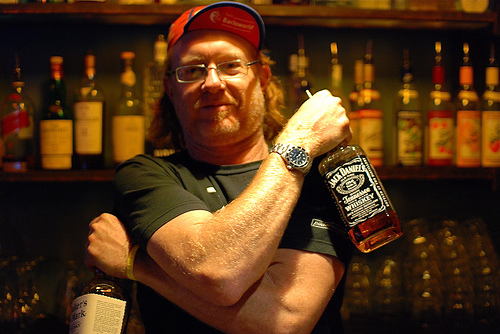
    Honestly, when perceived as a gesture of inclusion, the author who doesn’t participate in social media could be seen as a kind of a dick. I don’t want to generalize—there are valid reasons for not participating, of course—but for those authors without a good reason, refusing to interact with readers is like not tipping your bartender.

    Photo credit: http://www.flickr.com/photos/jcroft/
  • Literary critics aren’t dying, but they are threatening suicide…again.

    Literary critics aren’t dying, but they are threatening suicide…again.

    The December 31st, 2010 episode of the New York Times Review of Books podcast focused on a conversation on the relevance of professional literary criticism, especially in respects to the ‘everyone does it’ mentality associated with Amazon book reviews, Facebook statuses, and amateur lit crit blogs. Though the entire conversation was extremely interesting, the following point was especially intriguing. Said Katie Roiphe, a professor at the Arthur L. Carter Journalism Institute at New York University, about the current position of a critic in relation to what so many people want to call today’s death of literature (slightly paraphrased; dates are my insertions):

    It is tempting to say that we live in this dangerous death of literature, but the critic has always said that. If you go back to Matthew Arnold (1822-1888), if you go back to Dwight Macdonald (1906-1982), Randall Jarrell (1914-1965) and their generation. There is something romantic for the critic to see themselves as this lone, embattled defender of the culture against the vast desert that is our uncaring population. It’s an appealing stance, but I think we have to recognize that it is a romantic role that we embrace and somehow take on. In the end, the books remain, the critic remains, and I think that the idea of the death of the critic or the death of literature is just an eternal one for the critic, sort of a fascinating one for the critic.

    The concept of historic consistency when it comes to traditionally un-mainstream mediums has always fascinated me. It seems very generational-centric/ego-centric to think of our time as somehow more unstable or somehow better off in terms of literature. But even when I hear such a concise, and example-laden, view of this fallacy as quoted above, I still can’t help but dismiss it. Do I just want to be a part of a suddenly underdog industry? Or has the industry always been a consistent underdog? Or does the term underdog not apply?

    Be sure to read the corresponding essays from each of the episode panelists:

  • Kansas City Reading Coves – Outlaw Cigar (south)

    Kansas City Reading Coves – Outlaw Cigar (south)

    I bring you #5 of a hopefully long-lived series: Kansas City Reading Coves.

    When I can, I like my coves like my vaginas: humid and labyrinthine.

    Today’s cove: Outlaw Cigar (south) – 13700 Metcalf, Overland Park, KS 66223

    I’ve avoided this place for two reasons: 1) it’s a 30 minute or so drive from my house, and 2) the cigars are crazy expensive. The only time I came in here prior to today’s visit was a few months ago. That visit allowed me to not only witness the aforementioned crazy expensive cigars first hand, but also to glimpse the cigar lounge. From my vantage near the cash register I saw only a few leather couches and a TV mounted to the wall. Nice enough, but not nice enough to pay more than twice the standard going rate for a cigar. I left, planning never to return.

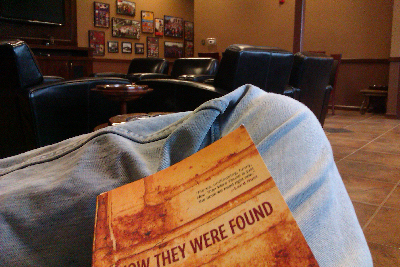
    Then today, I had a few hours to kill and was in the neighborhood, so I decided to take a deeper look. I am damn glad I did. The lounge, which might more rightfully be called an adjacent building, is just about all the things I could love in a reading cove. The first of two giant rooms contains about 15 leather chairs, 3 mounted televisions, and even a bar (which was closed on this Friday morning, but I assume opens  up during special events). Preferring a quiet place to read, the TVs put me off, but I endured. I read for about an hour, then when searching for a restroom, I happened upon a super secret back lounge, this one with TVs turned off. It was perfect. I sat for another hour, just me, Matt Bell‘s How They Were Found, and the silence. The setup almost justifies the cigar prices.

    The view from my secret-cove corner
    The view from my secret-cove corner (view unobstructed)
    The view toward my secret-cove corner

    Rankings out of 10:

    Smoking accommodations 10 The lounges are bigger than the rest of the store. Enough said.
    Furniture comfort 10 Very comfy animals died for these chairs.
    Quiet level 8 As long as the TVs are off, this place is great.
    Temperature comfort 3 I don’t think this place has heard of a heater. Maybe a heater would harm the humidors, I don’t know. But still, some space heaters or something would be nice.

  • The real reason authors get paid nil: content saturation.

    The real reason authors get paid nil: content saturation.

    Another Roxane Gay® observation gets the Caleb jumping-on-board treatment. In her post over at HTML Giant, Gay talks about the James Frey writing factory, and how its existence speaks to the strange desperation of writers (particularly MFA-pursuing writers) to be published, even when facing little to no financial or celebrity gain. The following line caught me, and while powerful in its own right, my mis-reading is what really got me thinking. Brackets: MINE ( I had to insert something of myself into this statement as a meta-nod to the topic)

    “The desire to be published, for some [reason], is so desperate and so intense they will do whatever it takes.”

    Why?

    Answer: We are trained to be ego maniacs.

    The loudest, most boastful vainglorious attitude gets applauded while humility gets ignored. This is not surprising, as the very act of braggadocia is a stimuli. It doesn’t matter that silence (which implies humility) is the very nature of books. Reality TV continues to be made, and reality TV stars continue to get book deals.

    Social networking and Blogging have taught us that even if what we have to say isn’t worth anything, we are for some reason less human if we don’t say it. And because the worldwide target marketing demographic thinks so too, those who say the most, the loudest, will find favor with publishers.

    I’ve got to give credit to the reading populace, though. Books have managed to outlast other forms of leisure in terms of resisting the ego. First magazines. Then TV. Then Movies. But now, unfortunately, it seems books are only successful when they inspire the hope of a movie adaptation.

    The truth is, not everyone has something worthy of wide attention. Yes, each person has something important to say, but often that thing is important to a small group of people (family and friends – which is where Vanity and Print on Demand come into play, but that’s for another post). Book publishing was at one time the main way give the widely-important IDEAS (caps intentional) a larger audience. Today, literally every thought, whether minutely or widely important, has the same range. I have as much potential to reach the world with my Tweeted fart joke as the President does with his Tweeted fart joke. Social blogging culture has simultaneously trained us to over-inflate the importance of our ideas AND give us a world-wide platform for those ideas. Hell, I’m a victim to this right now.

    But as with everything, even idea saturation (and the vanishing author advances that comes with it) does have benefits.

    As a physically weak man, I embrace that people are allowed to exist in their heads, now. Manual labor isn’t necessarily the common proof of societal participation and benefit. Words and thoughts are now as visible as sweat and dirt. You used to have to afford a suit and nice care to be thought of as beneficial to society in terms of your intellect. Now, a base understanding of HTML and an internet connection will do just fine.

    And hopefully, if monetary gain becomes less viable, only the widely important ideas will rise.

  • The Velvet Podcast, Episode 009: Does This Novel Make Me Look Fat?

    The Velvet Podcast, Episode 009: Does This Novel Make Me Look Fat?

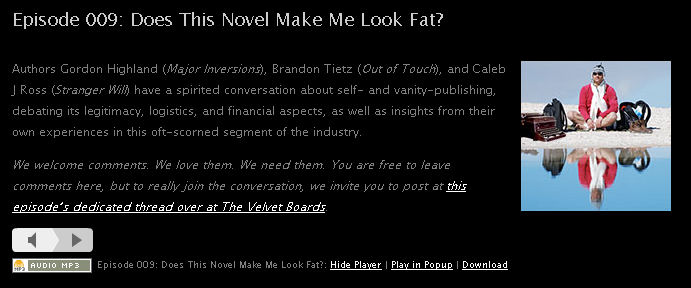
    Episode #009 of The Velvet Podcast is now live!

    Authors Gordon Highland (Major Inversions), Brandon Tietz (Out of Touch), and Caleb J Ross (Stranger Will) have a spirited conversation about self- and vanity-publishing, debating its legitimacy, logistics, and financial aspects, as well as insights from their own experiences in this oft-scorned segment of the industry.

    Please, give it a listen. Subscribe via Feedburner, Podcast Alley, or iTunes.

  • The Velvet Podcast, Episode 008: Don’t Pull My Hair Unless You Mean It

    The Velvet Podcast, Episode 008: Don’t Pull My Hair Unless You Mean It

    Episode #008 of The Velvet Podcast is now live!

    You don’t have my handsome voice to fluff your ear chubs this time, but I promise you won’t be disappointed by the talent here. Featuring three brand new voices to The Velvet Podcast. Make them feel welcome.

    Writers Richard Thomas (Transubstantiate), Nik Korpon (Stay God), Pela Via and Nic Young grind out the topic of sex and violence in fiction and their complex relationship to sadistic bedfellows, love and shock..

    Please, give it a listen. Subscribe via Feedburner, Podcast Alley, or iTunes.

  • Meta-fiction for babies.

    Meta-fiction for babies.

    Or is it meta-non-fiction? Is all non-fiction meta? Are there any examples of non-meta-non-fiction? If we were introduced to an author who wrote a historical account of Indian bread and Greek cheese that constantly pulled from the text to state bluntly, “I am no expert. This history is just my opinion,” would we have met a non-meta-feta-naan-non-fiction author? Okay, that last one was dumb.