Category: Study (the world/the craft)

  • Solarcide interviews me, one of the most interesting interviews yet: The Digital Age of Domestic Grotesque

    Nathan Pettigrew, one of the two minds behind the lit site Solarcide, asked me for an interview a few days ago. This guy knows how to ask questions, ones that not only evoke my own passion for the subject matter but also make it easy for me to answer in a way that is hopefully entertaining for readers.

    Head over to Solarcide now. Read the interview. Learn of my greatness.

    Here’s a taste of Nathan’s humbling intro:

    He’s one of literature’s most lethal rising stars and highly prolific with not one, but four new releases in 2011.

    His debut novel from earlier this year, Stranger Will (Otherworld Publications), established Caleb J. Ross as a true talent to be reckoned with. His writing can be described as stylistically beautiful while depicting some of the darkest and most disturbing worlds that fiction has to offer.

    Picking up on concurrent themes throughout his work pertaining to family, some have begun to refer to his style as Domestic Grotesque—a genre all his own.

  • How do readers choose books? (Poll Results)

    How do readers choose books? (Poll Results)

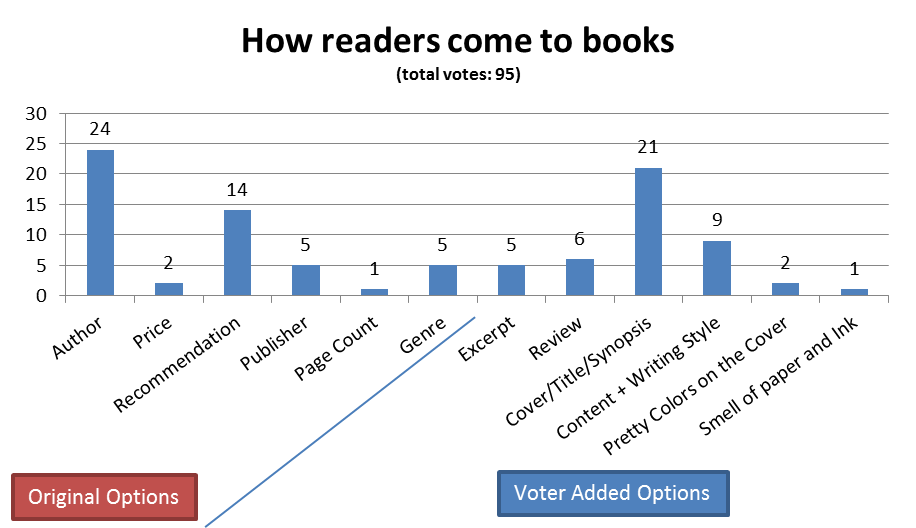
    I’m a data nerd. I’m a spreadsheet and chart nerd. Therefore, I could have made this lede a bit shorter and simply said “I’m a nerd.” Recently, I conducted a very unscientific poll on Twitter and Facebook, asking a general group of readers how they decide what to read when choosing a book.

    While this is an admittedly small poll with a slight slant toward people I know, even if tangentially (they are connected to me via Facebook and Twitter in some way), I feel the findings are still valid, at least as part of a possible larger survey. If anyone has the resources to conduct a larger poll, contact me. I’d love to see the data.

    Here are the results:

    Observations:

    • It has long been said that word of mouth is the best advertising for books, so it is slightly surprising to see “Recommendations” appear 3rd on the list.
    • “Author” being so high on the list is not surprising.  We live in egotistical times. And with the embrace of ego comes the worship of ego.
    • I didn’t think that “Cover/Title/Synopsis” would have been so important.  It is especially interesting that this option was a voter submitted option.
    • “Price” is very far down on the list. In a world of so much free content, seeing that people are still willing to pay for perceived value is encouraging.
  • Stranger Will tour stop #65: Richard Thomas’ blog, we argue the merits (or non-) of an MFA

    Today marks a special stop on my blog tour. Richard Thomas and I have it out a new installment of his dueling columns series which essentially pits two writers against one another to voice their individuals takes on a hot-button issue of the day. Our issue: to MFA or not to MFA. I’ve posted both of our write-ups below, which can also be seen at Richard Thomas’ site.

    Click here to read the guest post. Also, don’t forget that if you comment on all guest blog posts, you will get free stuff.

    FOR MFA PROGRAMS – Richard

    As Caleb mentioned in his column, if you want to teach at the university level, then you must get an MFA. And at many fine universities, you may need a PhD these days as well. In addition to that, most schools want you to have at least one published novel or short story collection (the bigger and better the press, the greater the recognition) as well as many stories published in the best journals and magazines in the country, and some teaching experience as well. But we’re not talking about that today, we’re talking about everything else that comes with your MFA experience and why you should spend the time, money, and effort to get an MFA. Here’s what I think about it all.

    Forced Reading and Analysis

    I know it seems like a horrible thing to say, but if you have deadlines, and if you’re spending money on something, you will most likely pay attention and work hard at it. If you have to turn in a short story, an annotation (based on a novel or collection that you had to read first, of course) by the end of each month, you are going to do it. I certainly do write stories on my own, and without deadlines, but I can honestly say that having a word count, a book (or two) to read each month, it kept me producing. My low-res MFA program down at Murray State University in Murray, Kentucky (where I’m just finishing up my studies) really pushed me—to write, to read and to analyze. I doubt I would have done this on my own. Maybe I would have, but the forced requirements left me no room to play around. And since I did pay for my MFA, no grants, scholarships or other aid, I took it seriously.

    Working Outside of Your Comfort Zone

    I can honestly say that there are many authors that I definitely would not have read if it wasn’t for my MFA program. While we did have the ability to pick our books to read over the course of each semester (7-11 titles), some of what my professors asked me to read were not up for discussion: the Norton Anthology of Short FictionThe New Yorker, and the Best American Short Stories anthology series. I read a wide range of authors that really helped me to see what the literary landscape is like today, as well as in the past hundred years or so. For our fiction genre lectures as well, we read Poe, Murakami, McCarthy, and many other authors that I either didn’t know very well, had read some of their work, or were totally new to me. Since my undergraduate studies at Bradley University were in Advertising/Communication, I was lacking in my literary studies. Between the work I found on my own (Holly Goddard Jones, Mary Gaitskill, Flannery O’Connor, Ron Rash), the work that was assigned, and the authors that I already loved, and decided to re-read or dig into deeper, the scope of my reading and analysis was much wider than I would have assigned to myself on the outside, in the real world. That’s something to consider.

    Mentors, Professors and Peers

    I studied under Lynn Pruett my first semester and she really helped me to hone in on the authors I already enjoyed and to write the first half of my second neo-noir novel (Disintegration) which I’m shopping now. But it was studying under Dale Ray Phillips(nominated for a Pulitzer Prize) that I really pushed myself. Or maybe I should say—was pushed. DRP got me away from the crutches and tricks that I used in my genre writing, where I often leaned heavily on sex and violence and the occasional twist ending, exploring fantasy, horror, crime, neo-noir, you name it. He wanted straight literary stories where nobody died at the end. What was his big line to me? Leave the slow reveal to the strippers. It was hard—really hard. I had to focus on the story, and the classic structure of a story, find my narrative hook, explore the conflicts in the lives of my characters, and bring it to a satisfying end. Above and beyond these two professors, I talked to many talented authors, teachers, and guest authors, who really enlightened me on so many subjects, as well as a gifted group of fellow fiction writers, poets, and essayists.

    Guest Authors

    I was talking to some author friends at a recent residency I was awarded (Writers in the Heartland) and I mentioned to the poet that I was constantly surprised by how much I enjoyed the guest poets at MSU. The same goes for a lot of the non-fiction authors. I was always surprised at how talented all of the guests were, from fiction writer Richard Bausch making me cry with his emotional truths, and essayist Heather Sellers making me laugh with her stories of facial blindness, to poets Linda Bierds and Alice Friman showing me the power of poetry, and journalist Nick Reding exploring the haunting world of crystal meth and addiction. The readings blew me away and the craft lectures were always enlightening and educational.

    Conclusion

    Do you need an MFA to write? No, you do not. You are certainly, if you are driven enough, capable of reading extensively, publishing widely, and studying on your own. But if you want to work with published authors in an environment with your peers, and get that extra push you may need to read, write and publish, then an MFA is a great place to study and create. I really enjoyed my time at MSU, and this program is still a relatively unknown and emerging program. If you can get into a top program, and get some financial aid, and especially if you are still unencumbered by a wife or husband and a household full of children, then I can’t think of a better way to massage your voice and grow as an author.

    AGAINST MFA PROGRAMS – Caleb

    First, a bit of context. Richard has an undergrad degree in Advertising and Communications with a minor in Psychology. He is currently pursuing an MFA. I have an undergrad degree in English Lit with a minor in creative writing. I am not currently pursuing an MFA. Why is this important? To show that I am coming at this question of education with a different educational history than Richard. Furthermore, as far as I am aware, Richard’s goal is to teach creative writing at a college level. An MFA is a requirement to do so. I do not want to teach. So I must argue this as though he and I are both looking at the MFA as a way to develop one’s creative writing abilities, not as a way to ensure a career in academia. If you want to be a professor, you can stop reading now; there really is no pro vs con debate.

    So, with all of those qualifiers out of the way, let’s get into the meat of the duel.

    Cost analysis

    At its core, an MFA program is an extension of the traditional 4-year undergrad program, and in being so carries financial and structure burdens similar to that of an undergrad program. What we are looking at then is cost. Basically, the cost of an MFA includes two things: connections and time. You’ll meet many famous writers and you’ll be forced to write. Both of these things are necessary for a serious writer. But, neither of these things is the sole intellectual property of the MFA program. For any serious writer, MFA or no, connections and productivity are things that will come as a result of dedication. Using my experience as an example (a sample size of one, I know, dangerous), within the first two years of post-undergrad life (2005-2007), I completed three novel-length manuscripts (two of which are to be published in 2011), became an editor at Outsider Writers Collective (where I’ve interacted with some of the best independent writers around), contributed book reviews to a variety of online zines, participated in Write Club (which surpassed my undergrad workshops in many ways, but not all ways), and met Richard Thomas (which ultimately led to my book being published by Otherworld Publications). Roxanne Gay, in a blog post at HTML Giant about this very topic of MFA, sums up my opinion nicely: “I do believe one should never pay for graduate school but that a graduate education is awesome.”

    I feel any higher education in the liberal arts should focus as much on the how tos as thewhys. From what I know of MFAs, there is a large why focus, specifically in regards to pedagogy, which is great. A good writer can write. A great writer can think. But again, if you have the passion to be a great writer, you’ll seek out the whys on your own. Does this mean an MFA is essentially a writing desk with a $30,000 gun to your head? Yeah.

    Craft analysis

    I don’t believe that the MFA program offers anything in terms of learning how to tell a story that an adequate undergrad program can’t offer. Continuing with my personal experience as an example, it may be that my undergrad experience was so great that I gained what I would consider the equivalent of an MFA (in terms of education, not in terms of papered credentials). My professor, Amy Sage Webb, continues to be one of my strongest supporters, and without her I may very well have moved right into an MFA program after undergrad. Though ironically enough Amy pushed me almost daily to pursue graduate school; perhaps in a strange Socratic way. What I learned as an undergrad, when weighing the pros/cons of grad school, is what Lincoln Michel, Master of Fine Arts and co-editor of Gigantic Magazine says in his reaction piece to Elif Batumans antiMFA review “bookreview: “Studying and critiquing an art form isnt the same as practicing it.” MFA programs train students to study and critique writing. The craft itself can be learned elsewhere. Sure, there’s a thesis/novel to be written during a two-year program, but any writer worth his own cramped knuckles will produce a manuscript in two years.

    I have to end by admitting that this opinion isn’t one I intend to keep, unchanged, for the rest of my life. I may want to teach one day. In fact, I’d be surprised if I didn’t attempt to teach someday. At that time, I’ll be in line for my MFA. But professorial aspirations aside, MFA’s just aren’t worth the time and financial investment.

    Takeaways:

    • An MFA may guide a student more directly than self-navigation through the vast land of education, but at a great financial cost
    • An MFA is necessary for teaching at a college. I think this is the case all around, but correct me if I am wrong.
    • Given the right undergrad program, one can learn just as much in terms of how tos and whys without pursuing an MFA.
    • If you want to be a great writer you will be a great writer; no MFA necessary
    • The internet makes it almost impossible not to network with established writers; no MFA program necessary.

  • Source of story ideas: Infographics

    Source of story ideas: Infographics

    A question many writers get is “where do you get your ideas?” This question often originates from one of two sources: 1) a desire for a new writer to find that secret arterial idea spring, or 2) a reassurance that the author isn’t insane (I assure you that the idea to embed fingernails into The Bible was not based on an actual event in my life).

    The truth is they come from everywhere. A mis-heard conversation, a sudden obsession with a particular song or painting, a dare; these things and more have been sources of my own stories for years. One of the recent areas where I’ve been seeing a lot of potential is infographics.

    For those not aware, infographics are basically graphical ways to show data. Data can be boring. Colors and drawings are fun. Therefore, the infographic.

    Below (way below, at the bottom of this post) I’ve included one such infographic that I think has some potential. I’ve isolated three of the data points following, and included a few initial thoughts on the possibilities each hold.

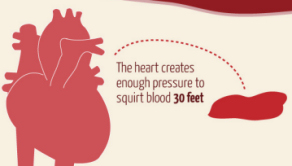
    That’s incredible. Imagine a what the science of such projection would look like in the hands of a madman. Or, imagine a climatic (though probably funny) scene in which a man stabs a guy and gets hit in the eye with blood.
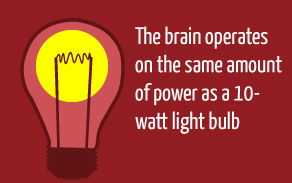
    So, The Matrix was full of shit, then? Still, knowing how little amount of power the brain actually takes to function could make for some interesting machine/man hybrid stories.
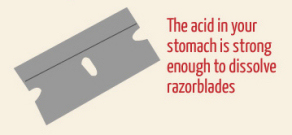
    Stomach acid harvested for use in either torture or construction. What about when someone is murdered by way of a knife to the stomach? Has acid ever leaked out, leaving a permanent scare on the hand of the killer? Perhaps in your story it has.

    (more…)

  • The real questions authors need to ask when deciding between self-publishing and traditional publishing

    The real questions authors need to ask when deciding between self-publishing and traditional publishing

    With the news of sudden-star Amanda Hocking circumnavigating – and established-star Barry Eisler eschewing –  traditional publishing in favor of self publishing, I thought it important to collect my thoughts on the topic from the perspective of aspiring authors.

    Getting a book published is easy. Anyone with $5 and a Lulu account can do it (or for a bit more can go through Createspace, direct to Lightning Source, or any other PoD route). So the discussion for authors must change from how to be published to how best to be published.

    Think about it this way, if you are offered a 20% royalty on books sold (which is actually high for most publishers), that means you are giving up on 80% of your potential profit. The truth is when signing a publishing contract you are paying the publisher to sell your book.

    Much of the information out there about self-publishing vs. traditional (legacy?) publishing is explained from the perspective of the publishing industry. But what about author?

    Below is a straightforward list of things that every author should consider before deciding how best to publish. Admittedly, I haven’t always asked these specific questions myself, but I’m learning. And by proxy (re: reading this blog post), you are learning.

    You vs. prospective publisher: Social Media Presence

    Ask, does this publisher have more Twitter followers, Facebook fans, or a better established blog than you? Is the publisher actively engaging readers on these various platforms?

    Word of mouth sells books. Social presence (particularly online consumer book reviews) is the internet equivalent of word of mouth.  Closely examine, and scrutinize if necessary, your prospective publisher’s social media presence. Spend some time perusing the DIALOG (caps intentional) that the publisher is having with readers.

    You vs. prospective publisher: Industry connections

    Does the publisher engage in industry events such as the AWP Conference or BookExpo? Does the publisher have distribution relationships that you can’t have? Be careful with this one; distribution is easier today than ever, for both publishers and authors. eBooks can be streamlined by a service like Smashwords. Print book distribution to online retailers such as Amazon and Barnes & Noble is simple when using a PoD services like Lightening Source.

    The toughest fight for self-published authors (and most small press publishers) is brick-and-mortar store distribution. Even though “Thirty percent of books are still discovered in the brick-and-mortar bookstore” I personally feel that as eBooks increase their claim in the collective reader conscious store presence will become less and less important.

    As the capital-I Industry continues to become the lowercase-i industry, the options available for authors to become an active player are ever-widening. This means that many of the once-sacred insider realms are increasingly more accessible to authors.

    You vs. prospective publisher: Advertising budget and capabilities

    Do you see advertising for the potential publisher anywhere? Keep your expectations realistic with this one. Very few publishers are going to have hi-profile advertising in magazines and industry trades. Think smaller. Do you see publisher ads at some of your favorite blogs or lit sites? Do you subscribe to the publisher newsletter; how does advertising look there?

    I would place advertising capabilities low on the priority list. I feel that because word-of-mouth is the most important form of advertising, paid placement in traditional outlets tends to come across as white noise to most readers. Paid ads are more about branding than converting book sales.

    You vs. prospective publisher: Time

    Does the publisher have more time than you to sell books? Going it alone, the author will have to dedicate a lot of time to the mundane crap (formatting a book for e-publishing/printing, for just one example). Often, this time component is the deal breaker/maker for an author.

    As an author, I would assume that your main motivation with this whole writing thing is to well, write. When promotion and back-end businessy stuff occupies your day, you will be left without any remaining time to write. Then we’re at the circular problem of having dedicated so much time to promoting book number one that you are then left without a book number two to promote.

    All authors, whether self-supporting full-timers or career-dreaming hobbyists will be expected to contribute to promotion. But how should your time be realistically divided?

    You vs. prospective publisher: Other authors on the label

    This one is more of a prospective publisher vs. prospective publisher dilemma. Say you’ve decided that going the traditional publishing route is for you. Now, which one do you choose?

    The company you keep can become your most supportive street-team. A rising tide lifts all boats, so to speak. Explore the online presence (and sales data, if possible) of other authors on the label. Do these authors have more readers than you? Could readers of their work be readers of yours? Would you have a drink with these people?

    Digest this information. Then ask: Is the prospective publisher able to sell 80% more books than you could without the publisher?

  • Blogging, Tweeting, and YouTubing from AWP all this week

    Blogging, Tweeting, and YouTubing from AWP all this week

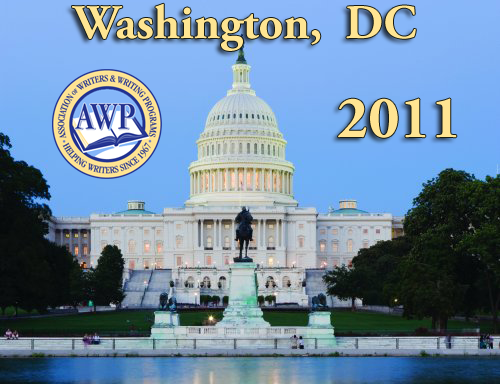
    Between February 2nd and 5th I will be attending the AWP (Association of Writers and Writing Programs) Conference in Washington DC. During this time I’ll be temporarily relocated.

    Check often at the following places, where I (and a team of writers) will be reporting on the happenings at the conference all week. Be sure to subscribe to the blog, YouTube channel, and Podcast feed, and follow the Twitter stream.

    My AWP Blog (www.calebjross.com/awpblog)

    Expect summaries of panels and daily roundups of general goings-on

    AWPtweets (http://twitter.com/awptweets)

    As the majesty of Twitter has allowed and encouraged, expect disposable minutia here

    AWP Channel (www.youtube.com/awpchannel)

    While I would love to upload videos of every reading and panel discussion I attend, I assume AWP would have some copyright issues with that. So, expect instead videos of selected readings and perhaps a few quick interviews from the book fair floor. We’ll see.

    The Velvet Podcast (www.thevelvetpodcast.com)

    Because The Velvet Podcast isn’t something reserved specifically for AWP (as the above mediums are), expect interviews and discussions that cross from the academic focus of AWP to the noir-lit yet still intelligent focus of the Welcome to the Velvet forums. At least that is the plan. The Velvet Podcast tends to be pretty receptive of almost anything, so, I guess, expect almost anything.

  • Validating the three publishing options: Traditional, Small/Independent, DIY

    Validating the three publishing options: Traditional, Small/Independent, DIY

    Honestly, when in the company of commercial press authors, defending my place as independent press author can be difficult. To those who have “made it” into the commercial presses, I would assume my defense comes across not nearly as articulately and convincingly as I would hope. Afterall, the examples of small press authors immigrating into the world of commercial presses far outweighs the number of commercial authors willing to emigrate to the small press world. The commercial press gatekeeper is much more discriminating than the indies; I understanding the disbelief. I too would go commercial if given the right opportunity.

    But things are getting easier. Not only are small press books showing face on historically commercial press-dominated shortlists (the recently announced 2010 National Book Critics Circle award finalists includes quite a few small press titles), but with the help of Jane Friedman the various publishing paths have been defined, and by extension, validated.

    In the summary of her Writers Digest Conference 2011 talk on publishing options Friedman very clearly explains what she sees as the basic three options for publishing:

    1. Tradition
    2. Independent or niche presses
    3. Self-publishing/DIY publisher

    But more, she outlines the viability of each path and goes even further to categorize according to which path that might suit them best. Her bullet-points follow:

    Pros, Cons, and Requirements:

    Traditional publishing:

    • It’s a commercially-driven business
    • Competitive – many people are trying to break in
    • National distribution – your work needs to merit that
    • Slower to market (usually)
    • Not the time to experiment
    • Persistence & patience
    • For non-fiction: you need a platform

    Small/independent press:

    • Weaker distribution, smaller print run
    • More personal attention, dedication
    • Usually less money
    • Niche marketing – smaller, specialized market; they’re experts in the field
    • More accepting of “art” (could be nonprofit), more service-minded

    DIY:

    • Entrepreneurial spirit
    • Direct connections with readership (for sales)
    • Must be comfortable with technology
    • Must enjoy connecting with people (online and off)
    • Requires energy to market and promote

    ALL of the options actually require energy to market and promote.

    It all boils down to you – your strengths, your work, your readers – to determine what’s best.

    Hell, just read the original post. (more…)