
Just some last-minute tidying up that neither I nor the publisher wanted to rush.
Just some last-minute tidying up that neither I nor the publisher wanted to rush.
This is a guest post by Nadia Jones who blogs at accredited online colleges about education, college, student, teacher, money saving, movie related topics. You can reach her at nadia.jones5 @ gmail.com.
I consider myself an indiscriminant and voracious consumer of fiction. While I mostly read novels, occasionally I find myself balking at the prospect of beginning yet another huge work of fiction, too exhausted by a previous book to dive into the new world of the next one. In these moments of reader fatigue, I take great solace in the numerous gifted short fiction authors writing today. I could go on about the classics (Carver, O’Conner, Hemingway, etc.) but I think current short fiction authors are much more fascinating reads, partly because their work is so immersed in the present.
Jennifer Egan
Jennifer Egan is a writer currently working out of Brooklyn, most recently recognized for her Pulitzer-Prize winning novel A Visit from the Goon Squad, released in 2010. The novel is called a novel but it reads more like a short story collection, with thirteen chapters cataloging the lives of interconnected characters across several decades. The characters deal with disappointment in their careers (mostly centered on the music industry) and in love, with the unrelenting passage of time driving the theme of every story. Seemingly insignificant characters in one story will reappear as the main character in a story several hundred pages later with new dimension and nuanced development. A character who you first encountered in high school will end up a completely different person by the last time you see them. Each story also follows a slightly different narrative structure; one story is even written in Power Point! I highly recommend any story in Egan’s “novel,” as they can all be enjoyed independently of each other.
Sherman Alexie
Sherman Alexie is a Native American author who writes about being a Native American in America, but the themes in his stories are relatable on a universal level. His short story collection The Toughest Indian in the World, published in 2000, is probably the best example of Alexie’s outstanding talent as a short fiction writer. Among his best stories in the collection is “Dear John Wayne,” an elderly Native American woman’s recollection to a professor about an affair she had with John Wayne over 100 years ago. More than just about being a Native American, the focus of Alexie’s stories can be distilled into the broader theme of identity. Who are you, what does it mean to be who everyone says you are, and how is that different from what you see in the mirror every day? His stories are often funny, and sometimes harsh and bleak in their subject matter, but they always ring true.
Haruki Murakami
Haruki Murakami became a superstar writer with his surrealist novels blending everyday life in Japan with unexplainable, even psychedelic events that make his characters question the nature of reality. But for all his mind-bending fiction, Murakami has also cultivated a strong collection of simple but powerful short stories. His collection After the Quake, published in 2000, features stories roughly associated with events following the 1995 earthquakes in Kobe, Japan. The stories reflect upon the unexpected events that can completely reshape ordinary life. The stories may initially read as breezy portraits of idiosyncratic characters, but look closer and you’ll see a depth of meaning behind every passage. Even though the stories are translated from Murakami’s Japanese, they don’t seem to lose any narrative impact as they weave between the lives of Japanese people trying to cope with events beyond their control.
I write domestic grotesque fiction, which is a term I think I made up, but is quite suiting to the themes and content of my stories and books. The most famous short story that I think would fit into the domestic grotesque genre is “Good Country People” by Flannery O’Conner (visualized quite creepily in this short film from the 1960s and quite cheesily in this student clip). Take a family situation—usually some sort of broken family dynamic—mix in something grotesque—possibly morbid but not necessarily—and you’ve probably got domestic grotesque.
As you can imagine, Christmas is a fun time for my family.
I’ve given quite a few quirky gifts. Though none could be tagged as grotesque, they are representative of the type of mind that would write a domestic grotesque story, I think. Tis the season and all that, so I figured I would share a few that I’ve so graciously given over the years.
 |
Kangaroo Scrotum change purseLucky Recipient: uncle Yep, it’s a real kangaroo scrotum. I bought one for myself years ago and still use it to this day. Quite durable, those marsupial nut sacks. |
 |
Remote Triggered Farting BearLucky recipient: sister Elegantly simple. Place bear near unsuspecting grandmother. Press remote button. Watch rest of family pretend to ignore what they assume is just a more audible version of what grandma does all the time. |
 |
Huggable Swearing BearLucky recipient: sister Elegantly simple. Place bear near unsuspecting grandmother. Tell grandmother to hug bear. Watch rest of family pretend not to be embarrassed as we hear an audible version of what grandma is thinking all the time. |
 |
Zebra/Tiger TableLucky recipient: mother. My mother refused to tell me what she wanted for Christmas, so I taught her a lesson by giving her a bunch of stupid crap. This table is probably the stupidest. Lesson learned, mom. I actually gave a zebra table (sans the tiger), but I couldn’t find a picture of it anywhere online. Though I think I like this one better. 2011 gift idea! |
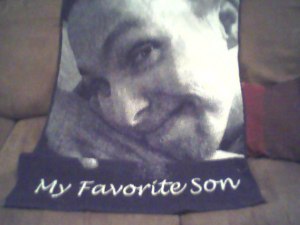 |
Bath towel with my giant face on itLucky recipient: mother I specifically made sure to call this gift a bath towel, rather than a beach towel or dish towel, so as to enhance the creepy factor. That face is actual size…if my face suffered from Elephantiasis. that face is actually about the size of a couch cushion. Bonus funny: I’m my mother’s only son. |
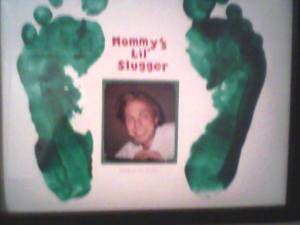 |
Way-too-old child footprintsLuck recipient: mother You remember those cute infant-to-toddler foot print pictures that children often make for their parents. This is kinda like that except instead of ohhh-ing and awwww-ing there was much ewwww-ing and therapist calling. I actually think this was a Mother’s Day gift. Either way, ha! |
Might I recommend you do the same? Creep out your family by gifting one of the items above. Or, better yet, mix in some bookage and give a copy of one of my books. Click below to go to heaven.

I am so incredibly thrilled to announce that my newest book, As a Machine and Parts, is now available for preorder. Simply click over to the Aqueous Books website to order. ALL PREORDERS WILL BE SIGNED. Unfortunately, they will be signed by me. I tried to reanimate Christopher Reeves or get Stephen Hawking here to do the signing–as that would not only be incredible, but would play nicely into the man/machine hybrid themes of the book–but for some reason I couldn’t get their people to connect with my people. Maybe their people are dead and/or paralyzed, too.

There are a few amazing deals going on that make preordering even more worth your time and money.
If you don’t order the book, you are basically calling these people liars:
There was once a Marvel comic book called “What if…” and in it Uatu the Watcher, a bald sage-like character with an enormous head spun speculative tales of alternative versions of the Marvel Universe you thought you knew. With As a Machine & Parts Caleb J. Ross continues to stake his claim as his generation’s Watcher, which should not be construed as a commentary on his beautiful, yet clearly fake head of hair, but instead as an observation about the scope of his imagination and his ongoing vision of what the world can be, might be and just maybe will be if Ross has anything to say about it.
—Ben Tanzer, author of Most Likely You Go Your Way and I’ll Go Mine
As a Machine and Parts is equal parts hilarious, absurd and touching. It’s the kind of book that after reading makes you say, ‘Damn, why didn’t I think of that first?’ only to realize you couldn’t have done it so well. Wildly inventive without collapsing under the weight of its own genius, As a Machine and Parts proves that Caleb J. Ross is one of the most exciting young authors writing today.
—Nik Korpon, author of Stay God and Old Ghosts
(part of my ongoing Unexpected Literary References series)
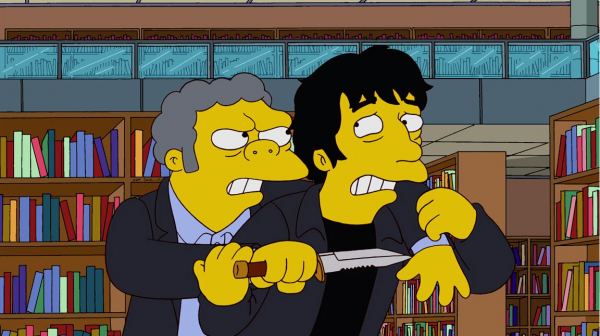
Yesterday (11-20-2011) The Simpsons continued its legacy of literary references with an episode featuring Neil Gaiman, author of American Gods, Anansi Boys, and many others . The episode, “The Book Job” (season 23, episode 6), explores the culture of tween lit, specifically stories featuring vampires and magicians, using an Ocean’s Eleven-style heist as the plot backdrop. Though the episode speaks primarily to the idea that tween lit may be hugely factory produced for market consumption rather than intellectual stimulation, the optimistic take-away is that even in a world where television and the internet dominate as means of entertainment and information distribution, books seem to be making a resurgence. This, my hope anyway, will seed these tween literateurs with a life-long love of reading.
About “The Book Job“:
Lisa becomes disheartened when she learns the shocking truth behind the “tween lit” industry and her beloved fantasy novel characters, but Homer decides to cash in on the craze and forms a team to group-write the next “tween lit” hit, with the king of fantasy, Neil Gaiman, lending his expertise to the effort. After catching the eye of a slick industry publisher at the Springfield Book Fair, the team gets an advanced copy of their work and discovers that the corporate lit business is a bigger operation than they imagined.
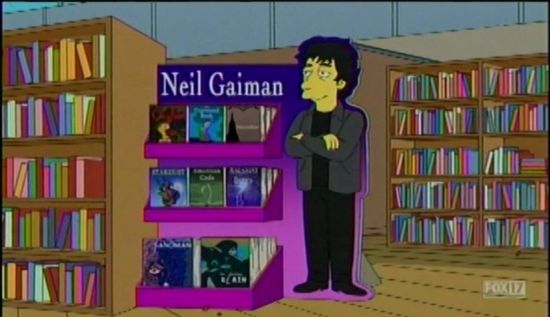
(part of my ongoing Unexpected Literary References series)
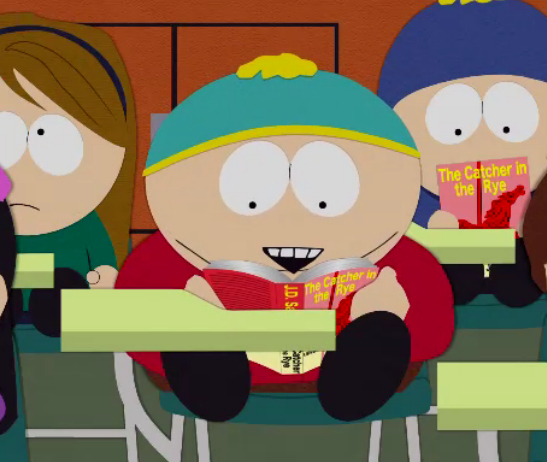
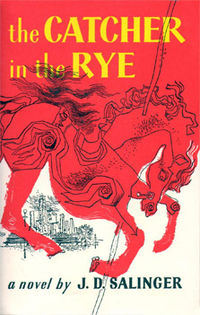
I briefly mentioned this Unexpected Literary Reference way back on the first official post of this series, but this one certainly deserves some special attention. The Tale of Scrotie McBoogerballs (Season 14, Episode 2) is an episode of South Park that speaks directly to the idea that historically banned books, placed in the context of modern media, simply don’t have the power that they once may have. The is called out for being a poor commentary on contemporary teenage angst.
About The Tale of Scrotie McBoogerballs (taken from Wikipedia):
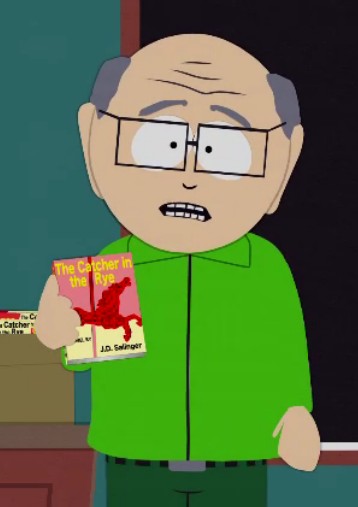
The students at South Park Elementary are assigned to read The Catcher in the Rye, and grow excited when Mr. Garrison tells them that the book has caused so much controversy, it has been banned frompublic schools in the past. However, after reading the book, Stan, Kyle, Cartman, and Kenny are angry to find the content completely inoffensive, and feel the school has “tricked” them into reading. They decide to write their own offensive novel, The Tale of Scrotie McBoogerballs, with the intention of disgusting as many people as possible and getting the book banned…Fearful they will get into trouble for the book’s content, Stan and the boys tell Butters he actually wrote the book.
 |
 |
(part of my ongoing Unexpected Literary References series)
It has been quite a number of years since I woke early to watch Saturday morning cartoons. People of my age (late 20s) will remember that Saturday morning was often reserved for a solid 3-4 hour block of cartoon watching. But since the introduction of all-cartoon networks like Cartoon Network and even Nick Jr. (as a stand-alone network, not as a day-time block on Nickelodeon), the idea that cartoons are something to be packaged and presented only once per week has become a bit of a foreign concept.
So, you can imagine my glee when I brought my son (2 1/2) into the living room this morning, turned on the TV, and found not only cartoons, but the very Looney Tunes cartoons I watched as a child (and as a hungover college student). Looney Tunes always had a reputation for mixing the literary with the cartoon. Back in the 50s and 60s (when the episodes I am most familiar with were originally made) books were still a key form of entertainment. Therefore, including literary references wouldn’t have been such a shocker. Which is why finding two references, back-to-back, wasn’t surprising this morning.
This first one actually comes from a play, not a book, but the writer, Tennessee Williams, is considered by many to be as much a literateur as any author. I am not familiar enough with A Streetcar Named Desire to know if this Looney Tunes’ episode plot of “A Street Cat Named Sylvester” actually reflects the plot of the play.
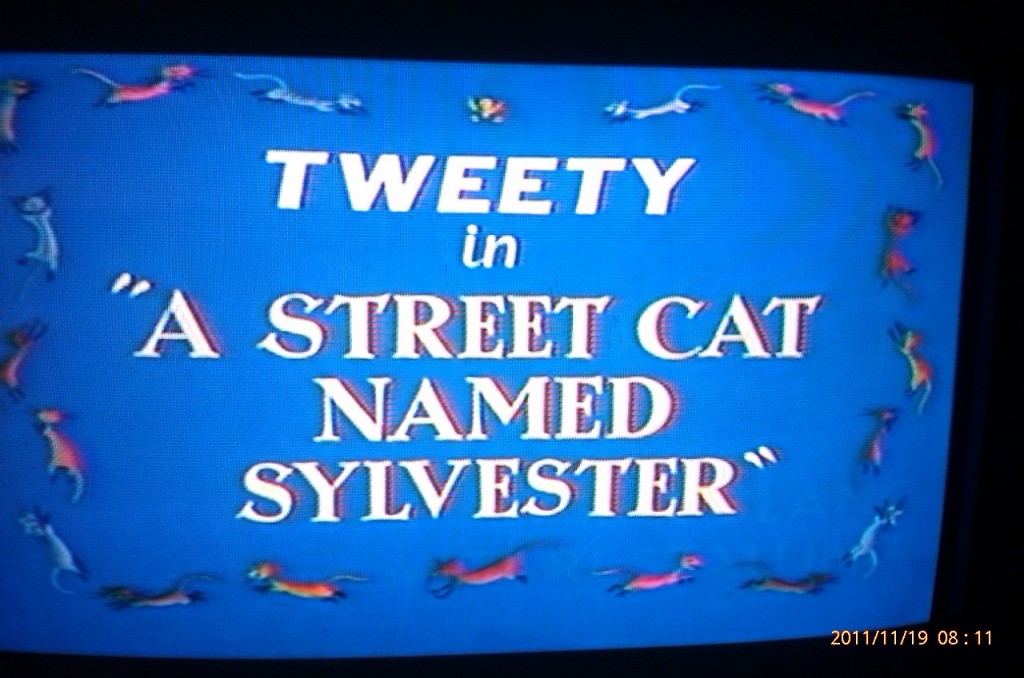
About “A Street Cat Named Sylvester“:
Tweety stumbles into Sylvester’s house looking for shelter and Sylvester hesistates if he saw a tweety bird in the same manner Tweety wonders if he saw a ‘Putty Cat’. Sylvester snatches him inside but has to hide Tweety in a vase covered by books, when Granny appears. While an injured Hector remains bedridden, Sylvester causes whatever diversion he can to stop Granny from spotting Tweety, making Granny give multiple doses of medicine to Hector. When Hector gets in Sylvester’s way from eating Tweety, Sylvester injures himself. Tweety spikes Hector’s medicine resulting in Sylvester ingesting the disgusting stuff.
The second reference of the morning comes from an episode called “Rabbitson Crusoe” which obviously comes from the title of the novel Robinson Crusoe. Like the previous reference, I don’t know enough about the original referent to know how much the Looney Tunes episode plot plays off of the literature plot. I can say that the Looney Tunes episode is pretty good (Bugs Bunny and Yosemite Sam; you can hardly do better)
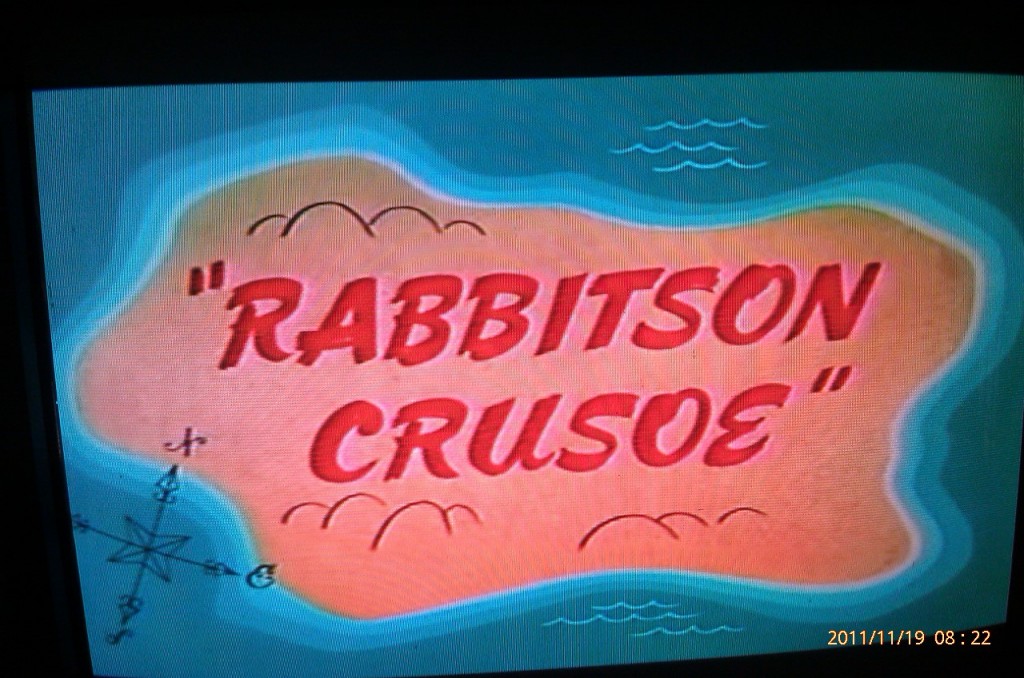
About “Rabbitson Crusoe“:
Yosemite Sam narrates that a low tide and high rocks caused his shipwreck on a small island. After the ship’s remaining food stores have been used up, the only source of food is from a coconut tree on an adjacent island. Crossing between the islands, however, is always difficult because of a man-eating shark called Dopey Dick (another parody, this time based on Moby-Dick). Sam manages to get rid of the shark, who jumps after him on land, only by having a mallet ready on the tree with which to whack the shark back. On his way back to his island, he’s chased again by the shark, but this time has a baseball bat ready to whack the shark. Sam mutters that the shark has tried getting him for 20 years, but misses every time. As a result, one can infer that since the shipwreck, Sam has been marooned on the island for the amount of time described above.
Enter Bugs Bunny and the chase antics we all know and love.
Side-note, the new, updated version of Looney Tunes and Merrie Melodies called The Looney Tunes Show is actually pretty amazing. I recommend for anyone who grew up on the original.