Author: Caleb J. Ross

  • I Didn’t Mean to be Kevin is here!!!

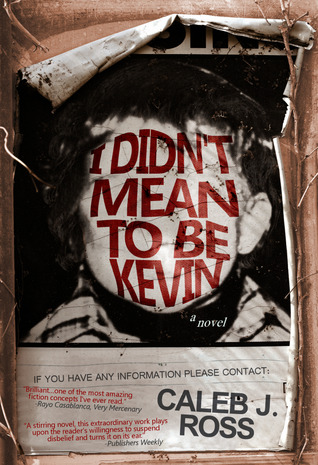
    How the hell did I not post about this already? Things have been busy around here, in all good ways, I assure you. But that’s no excuse. You should have known much earlier than now that I Didn’t Mean to be Kevin is officially here!

    For now, it’s available in the Kindle store and will be going live in other stores, both electronic and print, in the coming days. Get it now.

  • They Know Your Name, but They Aren’t the Ones You Want. Directional Marketing for Authors

    They Know Your Name, but They Aren’t the Ones You Want. Directional Marketing for Authors

    Back in November I wrote a blog post about standardizing your name for search engines. One of the most common responses I received from this post was from authors with unique pen names who cited their unique names as a reason to exempt them from the post’s advice. Basically, their ideas went that a writer with an uncommon name—we’ll use Maximus Pandroistien for this example—should not be worried about being outranked by other websites in a search results page because the likelihood of a similar name existing is nil. While this logic is true, it is narrow-minded. And please, pass along my condolences to Mr. Maxie Pandy and his presumably horrible childhood.

    But here’s the important bit: potential readers who already know your name are not your target demographic. After all, they already know about you. You want to reach those who may be interested in your style of work but have no idea you exist. This is the difference between branding and directional marketing (branding = getting your name out there; directional marketing = being available when/where customers are looking).

    Your Domain Name

    Your initial focus should be your domain name. If you are able to buy your own name (branding) definitely do. Though search engines will try to downplay the power of keywords in a domain name (see this video of Google Matt Cutts dancing around the issue) research consistently speaks to their importance. In fact, in the aforementioned name standardization post, I speak to own troubles with acquiring my own name as a domain.

    So, what if your name isn’t available as a domain name? Then, you are free to focus on directional marketing names, ones that speak to your writing in terms of content, aim, or marketing desire. For example, I currently own the domain names TheSocialMediaAuthor.com and NoirLiterature.com, which contain keywords that speak to the content I create. (note: these two domain names aren’t the best examples, as they currently redirect to CalebJRoss.com; in order for keywords in domains to matter to search engines, the domains generally have to represent unique sites. Search engines are smart enough to know when people are trying to game the system by buying and redirecting keyword-stuffed domains).

    Your Site Content

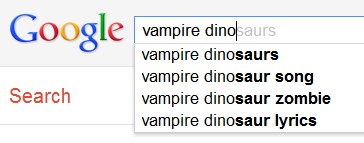
    Now that you’ve taken care of your domain name, the next consideration should be the actual content of your site. When writing content, whether that is pages or blog posts (or meta content, which is a different post entirely), keep your desired keyword targets in mind. If you write about vampire dinosaurs on mars, use phrases that speak to that content as often as possible. Of course, keep readability in mind; don’t stuff your content full of keywords solely for the sake of the search engines.

    The basic idea is to help your website rank for search terms that could lead to more readers. When someone types in “book about vampire dinosaurs” or “I want to read about dinosaurs and vampires” or “are vampire dinosaurs real?” then you want your website (and by extension, your book) to appear in the results.

    When blogging, write about themes in your book, the characters, the plot, and any other interesting element that could be expanded upon in an entertaining way for your blog readers. Pair these ideas with the overall tone you are trying to establish with your content to create something unique that speaks to your personality. For example, if you are a fiction writer, but you also love movies, write about movies that share elements with your books. If you pride yourself on knowing about cutting edge technological advances, writing about how new technology helps you as a writer of vampire dinosaur fiction.

    Of course, all this speaks solely to on-site content. I haven’t even touched off-site elements yet (social networks, inbound links to your site, and offline media). I’ll save those for a future post.


    Subscribe to be immediately notified when new posts go live:

    [subscribe2 hide=”unsubscribe”]
  • “As a Machine and Parts: LOVING IT! So sharp, so sharp…”

    “As a Machine and Parts: LOVING IT! So sharp, so sharp…”


    As a Machine and Parts is getting some love:

    “As a Machine and Parts: LOVING IT! So sharp, so sharp…”

    -Mr. Sean P. Ferguson

    “Fucking insane”

    -Mr. Chester Pane

    “This book is fantastic. I think you guys are going to love it. Very inventive but it doesn’t crumble under its own weight and devolve into merely clever.”

    -Mr. Nik Korpon

    So, if you are easily swayed by the words of people you might not know, then rush out to get your copy of As a Machine and Parts now. While you are at it, this guy I know says that Cheez-Its are good. So, I guess you should buy those.

  • 99 cents, now through January 17th, Charactered Pieces and Murmurs.

    99 cents, now through January 17th, Charactered Pieces and Murmurs.

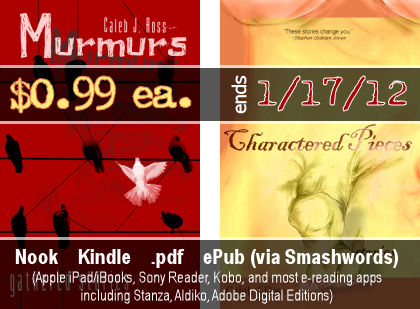
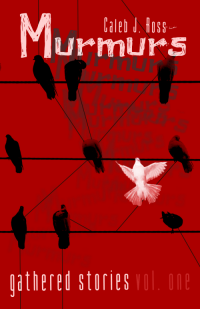
    All eBook versions of either Charactered Pieces or Murmurs: Gathered Stories Vol. One are only $0.99 from now through January 17th. Why January 17th? Because that is the official release date for my newest novel, I Didn’t Mean to be Kevin.

    Just click a link below to go either directly to the Amazon Kindle store or to the Smashwords pages where other formats can be purchased (including NOOK, Sony, Kobo, iBooks, etc.)

    Please, spread the word if you are willing and able. This is a damn fine deal, I must say, and is a great opportunity to whet your appetite for the upcoming I Didn’t Mean to be Kevin.

    [box title=”Charactered Pieces” color=”#000″]

    Amazon Kindle $0.99

    Smashwords $0.99
    [/box]

    [box title=”Murmurs” color=”#000″]

    Amazon Kindle $0.99

    Smashwords $0.99
    [/box]

  • Bookstores can get ebook readers into their stores. Here’s how:

    Bookstores can get ebook readers into their stores. Here’s how:

    The slow eBook adoption of many publishers, and especially of bookstores, is not surprising. For the publishers, monetizing an eBook, with the lack of overhead and reduced production costs, makes justifying print book sticker prices tough. For bookstores, well, it’s pretty obvious why they wouldn’t jump on the eBook wagon.

    But there has to be a way to keep bookstores alive, right? Bookstores aren’t like traditional commerce storefronts, in that they represent a mindset, a way of life, and the best ones promote a sense of community. People don’t just buy books there. People feel at home there. Which makes me believe that book shoppers haven’t stopped shopping in brick and mortar stores because eBooks are so much more convienent and so much cheaper. I think book shoppers have stopped simply because bookstores aren’t offering a “bookstore experience” for shoppers. If bookstores sold eBooks, I think readers who enjoy the bookstore experience would be willing to visit said bookstores to buy eBooks.

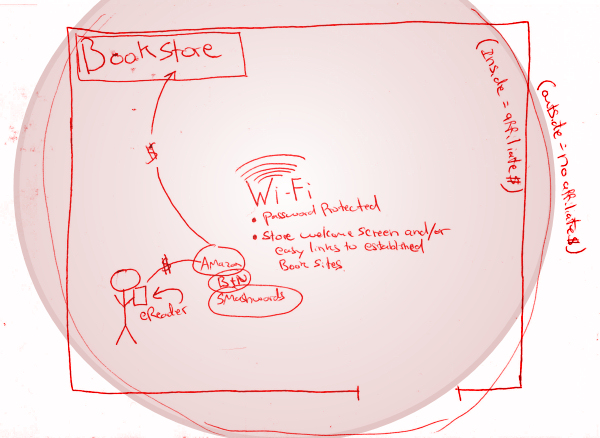
    But how to make it work? Introducing the Wireless Purchase Radius.

    Bookstores should set up a secured wireless network for their shoppers (most of them have these already). Now, instead of simply offering the wireless service as a convenience to coffee drinkers, use the service to entice readers to purchase eBooks at the bookstore.

    Here’s the methodology: a shopper enters the store, logs on to the wireless network, and begins shopping online for eBooks. The store can leverage this shopper’s intent to purchase in one of two ways:

    1. The store has set up it’s own eBook storefront, available only to people logged into their secure network (hotels do this all the time), which offers eBooks either at a discounted rate or with value-added specials. Perhaps, in keeping with the sense of community, a purchase through the store eBook site also offers free copies of local writer’s books. Or maybe every purchase comes with a ticket to some local event or coupons for store coffee.
    2. The other idea is that the bookstore sets up affiliate programs with established sites (Amazon.com, B&N.com, etc.). Affiliate links are already something that anyone can set up; the bookstore would not even have to establish new relationships with the book sites. In this method, the shopper would log onto the bookstore wi-fi network, and would be greeted with a store screen (just like in the above example) only this time there would be links to each of the major book seller sites. Once a user clicks on one of those sites any purchase the user makes would be part of the total affiliate buy, meaning the store would get a percentage of purchases from each of the items that the shopper buys (not even just books).

    This would work, right? Especially, if there is a way to set up affiliate code tagging on a mass level to anyone using the store’s wi-fi network (this would remove the need for a store screen when the shopper first logs on). Of course, I’m not sure if such a thing is possible.

    But the general idea, of using a wi-fi radius to encourage in-store sales is a good one.

    Someone do this now!


    Subscribe to be immediately notified when new posts go live:

    [subscribe2 hide=”unsubscribe”]
  • Why I Write What I Write When I Write it: The Cymbal Analogy

    Picture a drum cymbal, delicately balanced upon a point, say, a pencil tip. This represents my general mental stability. Without any external force, the cymbal remains unmoving. This is me in a vacuum, a sensory deprivation chamber of sorts, without anything to shift my head in any way.

    But of course, I don’t live in a vacuum.

    Instead, I live in a world constantly shifting and changing, and with those shifts, my head shifts. Writing is a way to help maintain equilibrium. Not in a padded room sort of way. Simply, in the way that other people may watch TV or exercise or read a book to maintain that equilibrium.

    But when I write something, despite the intentions to establish a stasis, the writing itself throws the cymbal off balance. Every word, every realized concept and idea, moves the cymbal. The more I write, the more the cymbal teeters further and further from stasis. This is the simple, unavoidable nature of creation. When other people read and comment on my writing, the cymbal moves more. Sometimes, if someone disagrees with what I’ve written (morally, aesthetically, whatever) the cymbal may continue to teeter. But when someone agrees with what I’ve written, finds a shared comfort in it (though, don’t confuse confront with blind dedication; intellectually stimulating topics, even those one may disagree with, can bring comfort) the cymbal may fall back toward equilibrium.

    But remember, the cymbal exists in three dimensions. So, even agreement may bring with it some disagreement, thus shifting the cymbal off balance on another axis entirely.

    You’re starting to see that establishing perfect equilibrium is impossible, right?

    So, when I decide to start a new project, I consider the weight of previous writings, and the wake they may have caused, in hopes for narrowing in on a project that might encourage balance.

    Example: I wrote Stranger Will, a novel about a man who does not want his child to be born. Cue nihilism. Cue concern from friends. Cue some agreement from readers. My cymbal, at this point, would resemble the tilted rings of Saturn, with the low end being weighed down by the general commentary about the book. All of the changes that happened to me, all of the emotions I felt, the attacks I fought against, everything that this book contributed to since its creation brought down the low end. So, I then wrote I Didn’t Mean to be Kevin, thinking that to write from an alternate, and almost opposite, viewpoint—that of a child wanting a parent—the equilibrium may return. Of course, this book, by the very act of its creation and publication, will put new thoughts into the world, which will alter the level of the cymbal in ways I can’t anticipate.

    And on and on and on.

    [subscribe2]
  • UpgradeToEbook.Amazon.com. Exchange Print for eBooks. It could work.

    UpgradeToEbook.Amazon.com. Exchange Print for eBooks. It could work.

    [blackbirdpie url=”http://twitter.com/calebjross/status/152575481391230976″]

    It could work.

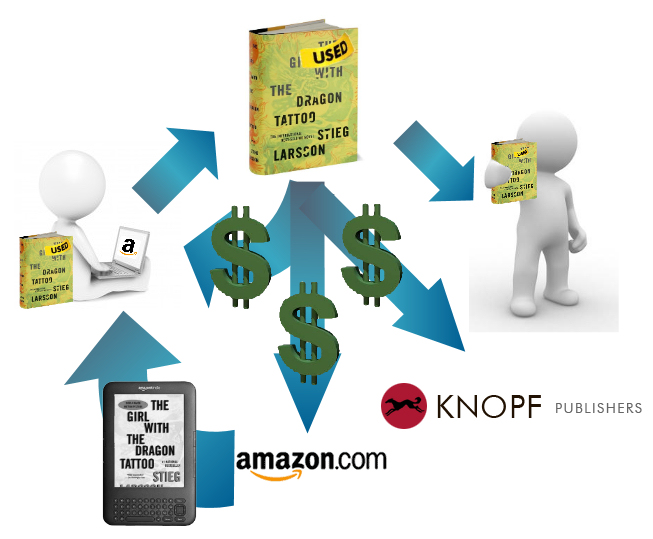
    An online used book selling site, that also manufactures an eReader device, such as Barnes and Noble or the Amazon Marketplace, partners with publishers to provide kickbacks on used book sales in exchange for distribution rights of eBooks. Let’s call it UpgradeToEbook.Amazon.com. It would work like this:

    Here’s an example:

    Let’s say Bookseller_675 has a print copy of Stieg Larsson’s The Girl With the Dragon Tattoo. But he’d like to read it on his Kindle. It’s not in this reader’s best interest to purchase the book again. The publisher gets no new money. The book sales site gets no new money. The reader gets no eBook.

    What do to do?

    Bookseller_675 decides to sell the book on the Amazon Marketplace using the UpgradeToEbook.Amazon.com platform for $6. Amazon takes its cut (15%; $0.90), but for this transaction the seller agreed to kick an extra 35% to Amazon in exchange for an eBook copy. Amazon then gives that $2.10 to the publisher and facilitates distribution of Bookseller_675’s Kindle copy of The Girl With the Dragon Tattoo.

    I know what you are thinking? Why would a publisher sell an eBook for $2.10 when they would normally net around $7.00 (70% of a $10 cover price, as an example)? Consider this: a person selling the print book has already bought a copy of the book. So the publisher, under the current model, makes no money off of Bookseller_675 for the $6 resale. Under the UpgradeToEbook.Amazon.com model, the publisher has the potential of making money multiple times.

    There, a print book is essentially traded for an eBook.

    What’s to keep the buyer of the book from reselling the book the same way? Nothing. The publisher gets money from each transaction, so the publisher, and the book site, would actually encourage resale.

    Where are the holes? What’s to keep this from working?