
Have you ever wanted to know about the most popular bridges from which to commit suicide? Watch this video. (more…)
Author: Caleb J. Ross
-

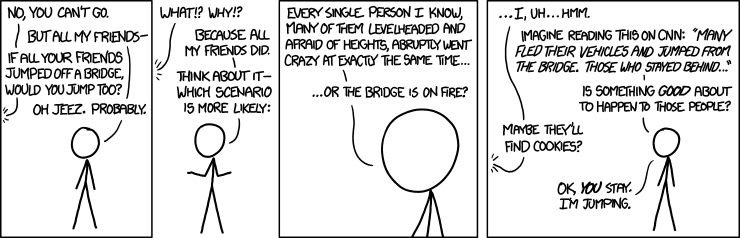
Would you jump off a bridge if all your friends were doing it?
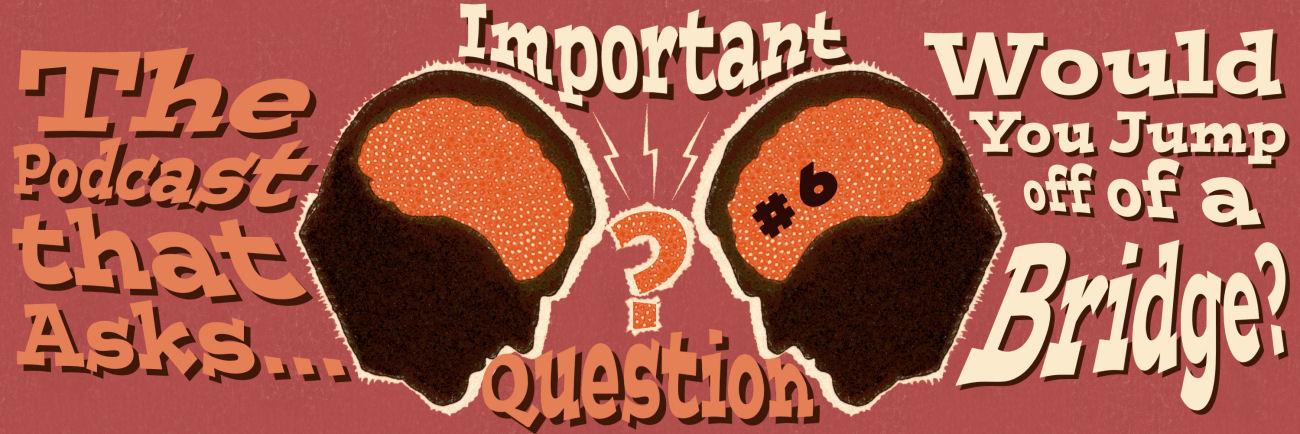
Imagine yourself, alone with a small group of your closest friends, at the center of a suspension bridge looking hundreds of feet down into the ravine below. One by one your friends jump. No parachute. No bungie cord. No apparent reason. But you are there. You did walk to the center. These are your friends. So, after everyone else has jumped, would you?
Today on Important Question? Caleb J. Ross and Gordon Highland ask the stereotypical mother question, if all your friends jumped off a bridge, would you?
What about you? Would you jump off a bridge if all your friends were doing it? Let us know on Twitter. Caleb J. Ross can be found @calebjross and Gordon Highland can be found @gordonhighland.
Subscribe to the podcast by clicking one of the buttons below, or simply add http://feeds.feedburner.com/ImportantQuestion to your favorite (or least favorite) Podcast app.




-
Would you live in a nudist colony?
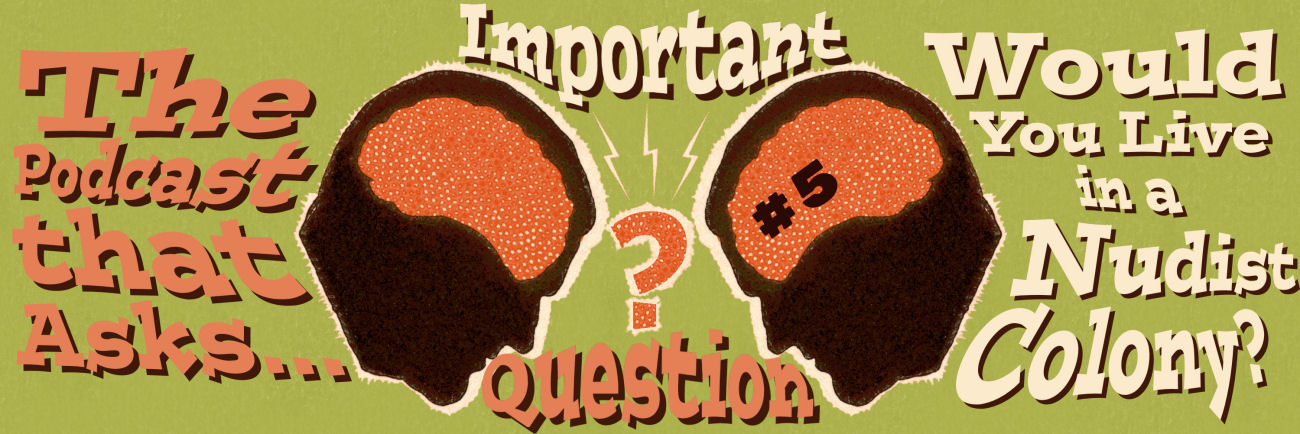
Oh, the allure of flesh, of thick folds of burbling, cellulicious, pocked pockets of wonder. Or so that’s what Gordon may think of when he imagines a nudist colony. Caleb is a bit more open minded, in that to him the preceding sentence would be said without sarcasm. Nudity is a wonderful thing. And that’s what our boys, Caleb J. Ross and Gordon Highland discuss during today’s episode of the Important Question? Podcast.
What about you? Would you live in a nudist colony? Let us know on Twitter. Caleb J. Ross can be found @calebjross and Gordon Highland can be found @gordonhighland.
Be sure to pay close attention to the word from this episode’s sponsor: Hedonism’s all-new, all-nude Kansas resort.
Subscribe to the podcast by clicking one of the buttons below, or simply add http://feeds.feedburner.com/ImportantQuestion to your favorite (or least favorite) Podcast app.
-

3 Things Most Writers Should Stop Doing
 I’ve been a professional writer for zero years, so please pay attention when I tell you this: you probably need to stop doing the following three things.
1. Stop listing your job as author or writer in social profiles unless you truly do make a living as an author or writer
I understand the desire to be perceived as a capital A Author. I also may even understand the fake-it-until-you-become it mentality. There’s a hope of perpetual perceptual motion when you start calling yourself a writer; eventually people around you see you as a writer which may even lead to legitimate writing gigs with legitimate money (not contributor copies).
But what you may be doing–without even realizing it–is an injustice to young writers who themselves want to be professionals one day. If new writers see you claiming to be a professional, they may interpret your likely paltry output (a novel here, a story there) as sufficient to earn a living wage. Eventually, these young writers will realize the near-impossibility of making a living wage as an author, but why unnecessarily perpetuate this false hope? Be honest. And in keeping with that mantra, know this about my writing life: I’ve made just under $3,000 dollars during my entire publishing history (almost 10 years). That’s about $300/year. It’s a good thing I have a real job to help support my family.
“But Caleb, I can still claim to be a professional writer even if I don’t get paid for doing it.” No you can’t. That’s not what “professional” means. But, there is something else about the money side of writing that you should probably stop doing…
2. Stop denouncing the importance of money as a success metric
I am so incredibly guilty of this.
While it’s true that money isn’t the sole metric of success (or even the best metric of success) it is the only metric that is reliable, common, and simple. Neither aesthetic nor literary value have a dependable metric associated with it. The fact is, we can’t universally measure the value of a work based on creative/emotional/artistic parameters. I wish we could. I’ve been trying for years. But until then we have sales figures.
Now, I know what you are thinking. “But marketing budgets often determine how successful–sales-wise–a book will be, so are you saying that we should measure books based on how much marketing they get?” This is a valid retort. So, perhaps more than sales figures we should look at profit to better understand value.
Profit is what is left after all other expenses, including marketing costs (in addition to the amount of the advance which I will use to account for factors like pre-existing platform and celebrity status; generally the more famous the celebrity the higher the advance). This means that, for example, if a book sells a lot but the marketing budget is also a lot then the profit metric indicates weak value. The ratio is not in the book’s favor. The publisher’s hope with marketing is that once people start reading and discussing a book then it will take on a life of it’s own, therefore diminishing the need for long-term marketing. This life of it’s own is what would, theoretically, increase profits thereby allowing profit to be a valid success metric. This life of it’s own is also indicative of word-of-mouth impact, which I think we can agree does have correlations with a book’s value.
Unfortunately, book publishers don’t disclose profit-by-book figures. So, we have to rely on general sales figures.
This is why I am a strong proponent for book award lists (National Book Award, Hugo Awards, Pulitzers,etc). These lists are created based on merit outside of sales figures. If a book makes one of these lists, the publisher basically gets free marketing which means an increase in sales. This puts the aforementioned ratio back in the book’s favor.
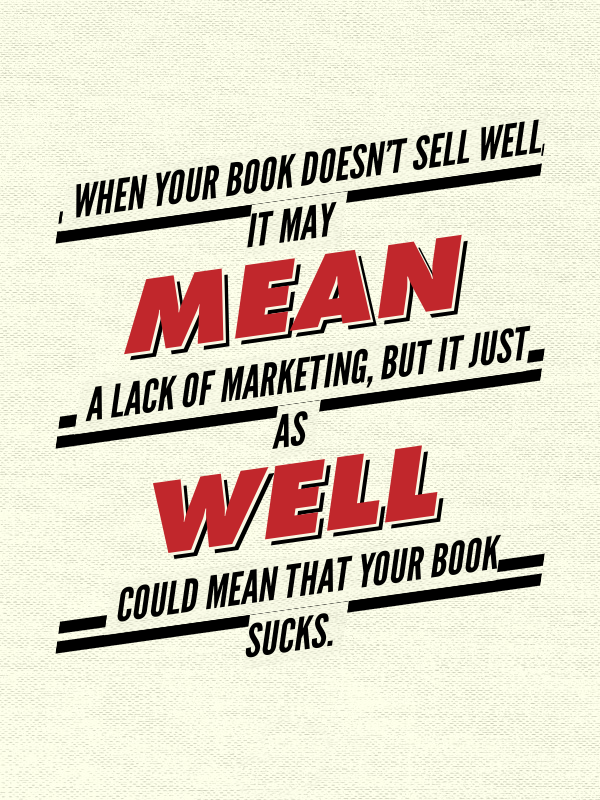
Sales figures don’t always speak to quality, but they sometimes do. It’s important for writers to understand that when your book doesn’t sell well it may mean a lack of marketing, but it just as well could mean that your book sucks.
3. Stop saying you “absolutely love” a magazine, journal, or publication if you don’t read it to the degree that someone who absolutely loves something would
If you do not subscribe to and tell all of your friends about a magazine then you do not absolutely love that magazine.
I’ve been a serial publication editor. I know well the gut-punch feeling of deceit as “readers” claim to love my magazine when I know for certain they don’t (not only can I surmise by the sales figures, but with a small enough publication an editor can verify individual subscribers). I did appreciate the verbal support of course, but that sort of support doesn’t cover a magazine’s overhead.
Often when I see writers comment about how they “absolutely love” a specific serial publication I assume they are simply trying to win points for eventual consideration of their own work to be published. I know a few writers in particular who absolutely love so many journals that 24 hour/day binge reading would be necessary in order to accurately reflect that love in real life.
Yes, it’s great to spread the name of a publication. It’s better to actually read the publication.
Many of my writer friends are guilty of the above. I am guilty as well. So know that my plea to stop doing these things comes only from a place of respect. Let me know if I’m way off here. Do you have other items to add to this list? Are there valid reasons to do any of the things above?
-

Would you have sex with a corpse?
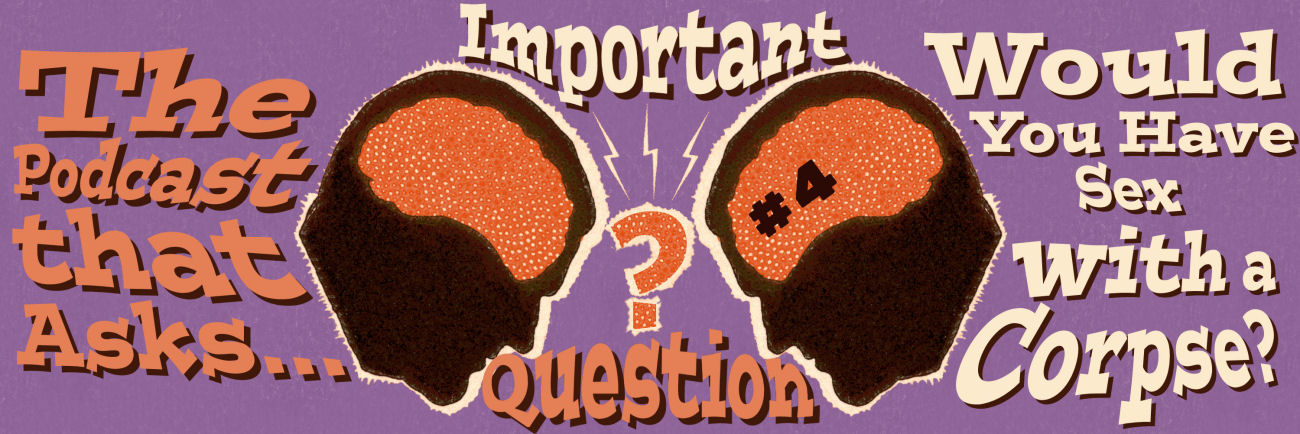
Necrophilia: Of all the philias, is it really the sexiest? Caleb J. Ross and Gordon Highland explore the ethics and physical logistics of having sex with a corpse in this important episode of the Important Question? Podcast.
What about you? Would you have sex with a corpse? Let us know on Twitter. Caleb J. Ross can be found @calebjross and Gordon Highland can be found @gordonhighland.
Subscribe to the podcast by clicking one of the buttons below, or simply add http://feeds.feedburner.com/ImportantQuestion to your favorite (or least favorite) Podcast app.
-

A Man Minus a Necktie: A Very Brief History of Ties and a Longer History of Why I Hate Them
My anti-confrontational nature began at birth. Most kids cry when ripped from the womb. I shrugged. So when, during my first post-college agency job, I was prepping for a face-to-face meeting with a client that, for lack of a more tactful way of stating this, hated my company’s fucking face, I was nervous. My palms were sweaty, my heart was pounding, and I remember feeling as though the entire universe had suddenly snapped back like it had exceeded the limit of its cosmic elasticity and it was now pulling back in on itself with me at the very center, suffering the pressure of billions of years of macrocosmic expansion…you know, normal nerves stuff. But the impending client firing squad paled in comparison to the sudden realization, just before stepping out of my office door, that I had no idea how to tie a tie. And worse, I was in no position to ask for instructions. At that time—a new job, bosses to impress, living on my own—I had committed to a facade of manliness that I had never attempted before. This was new, unnerving territory for me. Failing to tie my own tie would not only chip away at the delicate sports-loving, car-jargon-speaking veneer that I had created, but would likely send me relapsing into a life once again governed by sports-indifference and car-jargon illiteracy. I had worked too hard to risk that. (more…)
-
Would you take a bullet for a stranger?
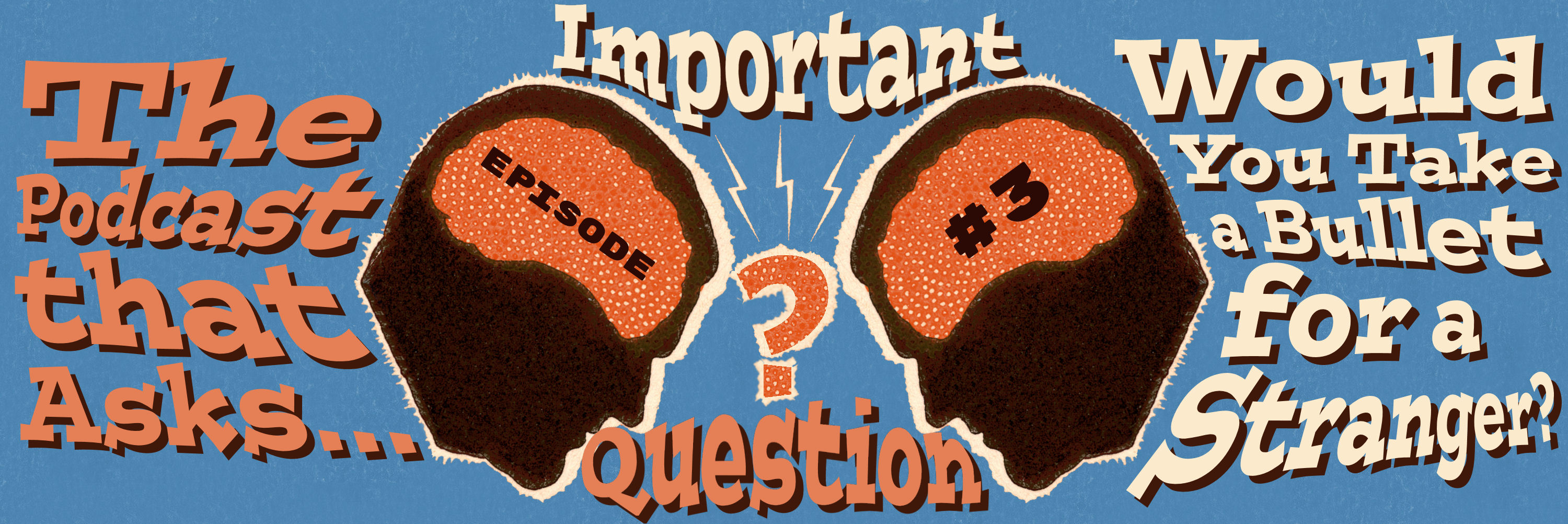
Every image of a noble hero involves some sort of self-sacrifice for the sake of the greater good. But is this really desirable? Caleb J. Ross and Gordon Highland play devil’s advocate and explore the logic of offering your own life to save the life of another human being in this important episode of the Important Question? Podcast.
What about you? Would you take a bullet for a stranger? Let us know on Twitter. Caleb J. Ross can be found @calebjross and Gordon Highland can be found @gordonhighland.
Subscribe to the podcast by clicking one of the buttons below, or simply add http://feeds.feedburner.com/ImportantQuestion to your favorite (or least favorite) Podcast app.