![Is a Videogame Museum Necessary? [VIDEO]](https://calebjross.com/wp-content/uploads/2017/05/VideoGameMuseumThumbnail.jpg)
Last year I visited the National Videogame Museum. I quite enjoyed myself. But despite the fun I had, I kept wondering if a videogame museum is really necessary. Watch the video, and then let me know what you think.
Author: Caleb J. Ross
-
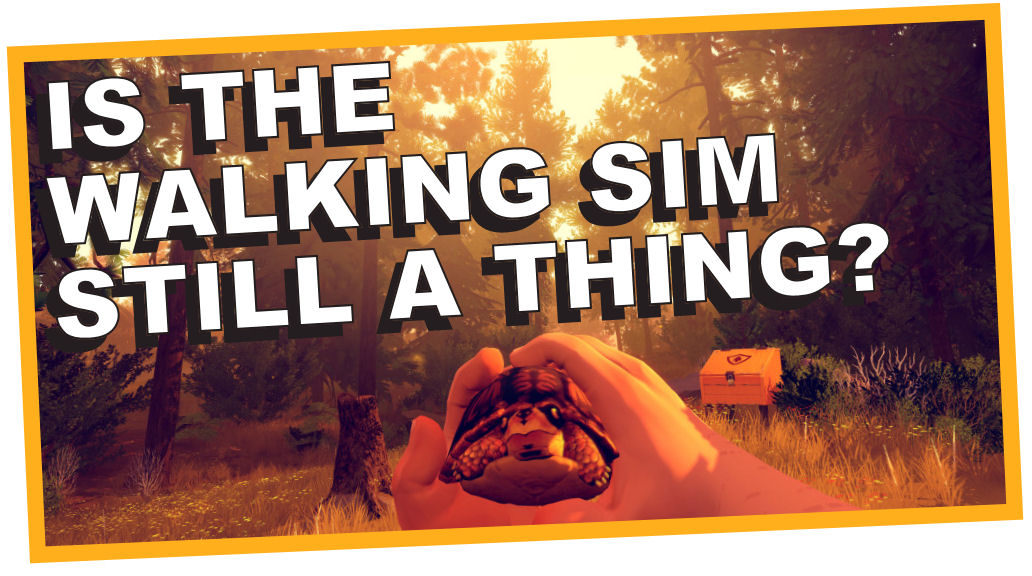
Is the Walking Simulator Still a Thing?
The walking sim has earned a spot in my top 3 gaming genres, and this includes your standard hyphenates, your action-adventure, your puzzle-platformer, your action-rpg, and so on, so I’m considering literally dozens of genres when I make this claim that the walking sim is so, so good.
I’m not a martyr here. Plenty of people are defending the genre and the name. But for the most part, walking sims still represent a very peripheral part of the gaming ecosphere. And I’ve been wondering why that is?
I think, unlike many other genres, walking sims require personal vetting prior to getting praise. You can’t get someone excited by the plot of a walking sim.
Consider these scenarios:
You: “So, what’s this game Firewatch about?”
Me: “You walk around looking for forest fires while talking on a radio.”
You: “So, what’s this game Everybody’s Gone to the Rapture about?”
Me: “You walk around looking for spirits while talking to nobody.”
You: “So, what’s this game Gone Home about?”
Me: “You walk around your home while talking to nobody.”
You: “No thanks.”
Conversely, consider this scenario:
You: “So what’s this game Bloodborne about?”
Me: “You hunt out demon monster things with a variety of badass weapons.”
You: “Is there simulated walking?”
Me: “Only if you want to be scythed by a blood-thirsty farmer.”
You: “Awesome!”
But anyone who has played Firewatch, Everybody’s Gone to the Rapture, Gone Home or even Dear Esther, which most consider to be the first official walking sim, knows that it’s hard to properly explain the experience of a walking sim. And that’s the point of a walking simulator, really: to provide an experience above all else. Above mechanics. Above gameplay. Above even the traditionally inherent sense of victory with a game, a player is subjected to the experience. This reality simply doesn’t make good let’s play fodder or TV commercial fodder. It’s a hard sell.
Walking sims have earned a place in my top 3 genres because, well, because I took the time to play them. And they’ve simply yet to let me down.
But back to that traditionally inherent sense of victory that I mentioned above. Walking sims are often pushed aside, I think, because walking sims defy what it means to be a game.
Let me explain. Developers (and gamers) love a cross breed. Action game + adventure game = action adventure. Puzzle + platformer = puzzle-platformer. Action + RPG = action-RPG.
But walking simulator is the one genre that resists being absorbed into a hyphenate. Its mechanics are defined by exclusion. You wouldn’t have an infinite runner walking sim, for example, because the genre conventions are polar opposites. Endless runner = go fast, avoid objects. Walking Sim = go slow, explore objects. But even less absurd pairings aren’t really possible. You couldn’t have an RPG walking sim or an action adventure walking sim, and this is the case primarily because a defining characteristic of a waking sim is the absence of a lose condition. The only option is completing the game. (though a BitterEmpire article does make a good point that should the player give up when the narrative stops being interesting, that could be considered a sort of lose condition. This is a point that I’m open to exploring, but also a point that I think adheres to all game genres, so I’m not fully inclined to accept it as unique to the walking sim.). All other game genres insist upon a lose condition. That is, by definition, an important component of what it means to be a game. Sure, micro moments within a walking sim can have binary outcomes (open the desk drawer or don’t), but the genre doesn’t have a single global objective that can be failed.
So the obvious question is, are walking sims even games? Well, for the sake of retail placement and consistency within the industry, yes, they will always be shelved and discussed as games. But I don’t believe they actually are games. This may be a personal belief; I tend to align to the side of game formalists, as opposed to game abstractionists, a distinction that is discussed in a great video by Jamin Warren when he explores the definition of a game as outlined by Jesper Juul.
But this refusal by some to accept the walking sim as a proper game is why fans of the genre, as least I speak for me, have this incessant drive to defend it. Walking sims defy what gamers have come to accept as a game. But this is also why the genre has risen so quickly, I think. If a category name is disparaging, defenders will rise.
So, what’s the future of the walking sim? Despite my assertion above that walking sims inherently avoid hyphenation, smart developers will find a way to take what’s great about the walking sim and merge those aspects into other genres.
A great example that I recently played is the 3rd person walking sim platformer Bound (walking platformer?). Bound focuses on the environment. Bound focuses on narrative momentum. Bound lacks a lose condition. Sure you can fall off the edge, but when you do you immediately respawn. But it’s not just the perspective that bucks the walking sim establishment. The game is a platformer. The game even has minor combat elements, but not enough to pull the genre away from walking sim and toward action.
Mentioned:
What is a game? And why it matters! | Game/Show | PBS Digital Studios youtu.be/H0ReU2tvLFo
In Defense of the Walking Simulator, from Bitter Empire http://bitterempire.com/defense-walking-simulator/The following are YouTube videos licensed under CC BY 3.0
youtube.com/watch?v=GqmDXAh_wRg
youtube.com/watch?v=3DPXyCaTMnw
youtube.com/watch?v=W54YRYpLZng -
![One Hour of PREYer: Playing the PREY Demo [VIDEO]](https://calebjross.com/wp-content/uploads/2017/05/Prey-Demo-LetsPlay.jpg)
One Hour of PREYer: Playing the PREY Demo [VIDEO]
I’ve been looking forward to Prey for a while, so when a demo comes along, I must play it. I don’t do very many Let’s Plays on this channel, but I’ve made the decision that should I do any more Let’s Plays on this channel, they will likely only be demos. Why? Implicit brevity.
-
![Remember Yooka-Laylee? [VIDEO]](https://calebjross.com/wp-content/uploads/2017/04/thumbnail-YookaLaylee-FutureCaleb.jpg)
Remember Yooka-Laylee? [VIDEO]
Hey future Caleb, so you found your copy of Yooka-Laylee buried in a box in your attic and you wonder what your past self thought of it. The magic of the internet (with a helpful dollup of camera technology) allows you to relive such opinions.
-
![Will the Nintendo Switch Last? [VIDEO]](https://calebjross.com/wp-content/uploads/2017/04/thumbnail-FutureCalebSwitch.jpg)
Will the Nintendo Switch Last? [VIDEO]
Hey past, current, and future viewers. I take a few minutes to talk with my future self about the longevity and legacy of the Nintendo Switch. Give me your thoughts in the comments below. Does the Switch have lasting power?
-
![Master Blaster vs Master Blaster Zero: How do the Stories Compare? [VIDEO]](https://calebjross.com/wp-content/uploads/2017/04/BlasterMasterThumbnail.jpg)
Master Blaster vs Master Blaster Zero: How do the Stories Compare? [VIDEO]
I compare the intros to Blaster Master (on the NES) to Blaster Master Zero (on the Switch), two games with decades of technological advances between them.
Also, I know that Blaster Master is a localized version of the Japanese Famicom game, Chô Wakusei Senki Metafight. This localization likely explains the problems with the NES story. Still, I’ve got to go with what’s given to me.
-
![Yooka-Laylee to Amanda Palmer in 6 Degress of Pixelation [VIDEO]](https://calebjross.com/wp-content/uploads/2017/01/thumbnail-6degress-yookalaylee-amandapalmer.jpg)
Yooka-Laylee to Amanda Palmer in 6 Degress of Pixelation [VIDEO]
I’m simply too excited to Yooka-Laylee to sit idly by and not direct that excited energy into something. So, I bring you another episode of 6 Degrees of Pixelation. This time I connect Yooka-Laylee with Amanda Palmer (and I never once mention that Amanda Palmer plays the ukulele! I’m either an idiot or a king of self-control).
Like many other episodes in this series, I’m basically taking things I like and trying to find a way to make them exist in the same universe. If you don’t like the things I like, that’s okay. I still love you.
You know that social theory that everyone on earth can be connected to anyone else by no more than 5 intermediaries? They call that 6 Degrees of Separation. I do the same thing here, except I connect video game topics in strange ways using 6 Degrees of Pixelation.
Click here to access the Google Doc with the script and sources.