Author: Caleb J. Ross

  • what happens to us isn’t good

    Flash fiction: feeding a demographic composed of people without much time to read but with plenty of time to think. I used to think of flash fiction as a pompous intellectual commercial; there is something buried in there, but more often than not it doesn’t want you to know what it is. The burden lay with the critic. But then I happened upon a little thing called the internet, where flash fiction has been allow to flourish outside—and even influence—academe. Amy Hempel, an author who writes in a very flash-fiction, minimalist style uses the following lines in her story “The Man in Bogotá,” which textualizes my eventual change nicely:

    “It took months. The man had a heart condition, and the kidnappers had to keep the man alive […] He wondered how we know that what happens to us isn’t good.”

    The internet has without a doubt promoted the art of flash fiction more than any other medium. The internet reader is a predictable type, one with short attention span while simultaneously being offered infinite possible directions. The charge upon the author is to craft something meaningful using as few words as possible (generally about 500 – It’s hard to stay with a story while so much delicious porn lingers just a mouse-click away).


    Fortunately, for all of us, flash fiction isn’t being left to fend for itself. Numerous online and print literary magazines are being produced that cater specifically to the flash fiction genre. Head over to one of the best, Vestal Review, to read my flash fiction piece “5” x 6″ in a Sturdy Frame.” Then read all the other offerings; you’ll have plenty of time left over for porn, I promise.


    Vestal Review Banner Vestal Review is a quarterly print and online literary magazine devoted entirely to flash fiction under 500 words. While you’re perusing the goods spend a few bucks and subscribe: you’ll need to fill what little time you spend away from the internet reading something, right?

  • all about the writing

    Reaching for conversation I once said to Ron Carlson, author of many short story collections including The Hotel Eden and At the Jim Bridger, after his book reading in Emporia, KS (USA) that touring has got to be one of the best things about being a writer.“No,” he said. “It’s all about the writing.” Yeah, I said, but knowing that people actually want to hear you read has got to stroke your ego just a bit. He insisted still that “it’s all about the writing.”

    Okay, so it’s all about the writing, but the occasional piece of fan mail must help push through the days, weeks, months of solitude as the writer writes what he can later claim it was all about. Can I say this from experience? Yes and no.

    Last month I received a couple pieces of fan mail. How, I thought, do I have a single fan, let alone a group whose tensions might provoke one member to single him-or-herself out to make such boisterous claim? I have very few pieces on the public forum and very few people have read what I haven’t yet placed publicly, so how do I have a fan (or two)?

    Turns out I don’t. But Caleb Ross, the star of some show called The Tribe, does. In fact he has at least two fans of which I am aware, both with brief tongues and an annoyingly proud sense of self. Please observe these two emails sent to Caleb Ross the writer, addressed to Caleb Ross the actor:

    Subject: Letter from a big fan
    From: (hidden)
    To: bookrecs@calebjross.com Hi Caleb! I´m a big fan of yours. I have watch you as “Lex” in “the tribe” for almost every part of it. I´m from Sweden in Europe and I hope that you are going to visit my country soon. My name is (hidden) and my e-mail adress is:
    (hidden) So please write to me and I can tell you that I also act in teaters and films in my own country.

    Impassioned? Moderately. Flawless use of broken English? I like is say YES.

    Subject: Tja

    From: (hidden)

    To: (hidden)

    I am Maria. I am 14 years old. I Live in Sweden. You are My Idol! I see Tribe every day
    From Maria


    Darling? A little. Less desperate than the first email? Definitely.

    Do I poke fun out of jealously? Maybe, but to be honest my true beef stems from the fact that these people care almost enough about their “idol” to read a website bearing his name before submitting a fan letter. Look here for the first ever news post on this site. At least two Caleb Ross’s exist on this planet of ours and until “fans” are able to discern one from the other I claim the right to poke all the fun I want.

    But instead of poking fun my time would probably better be spent writing. I’ll go do that now.


  • under the influence

    Any form of expression is arguably one committed “under the influence.” What we eat, what we say, how we walk—hell, human beings simply walking is really just a biological influence. But historically, for writers, one of the most iconic influences of all time is Absinthe—The Green Muse; a devastating liquor. Everyone from Ernest Hemmingway (his short story “Hills Like White Elephants” comes to mind) to Joey Goebel (with his novel Torture the Artist) has capitalized on the image of Absinthe. What better way to weave my own way into this cultural icon than by way of a lit mag called The Green Muse, with “Refill,” a story about a man governed by substance? I suppose a better way would have been for me to actually use the word “Absinthe” somewhere in the story. But I didn’t.


    One of my writing heroes, Denis Johnson, has a few pertinent words on the topic of writing under the influence (of drugs and alcohol):

    “I think it’s silly for anyone to think you could write under the influence, but if they’d like to think that, I’d like to keep the legend alive. Maybe I was under the influence when I wrote Jesus’ Son and I just didn’t know it.”

    Green Muse Review Banner

    The Green Muse is a monthly journal publishing work both online and in print. They are a young journal so be sure to support them (and me) by purchasing a copy of the print journal here.


  • a guilty conscious

    Online literary magazines seemed to me for the longest time some form of blasphemy. Not much compares to the tactile and aesthetic appeal of a printed, bound journal. Maybe that sounds a little creepy, but I’m a creepy guy.

    So when writer and friend Christopher Dwyer posted over at Write Club about this online lit-mag called Dogmatika I wasn’t exactly crushing keys to get over there. But call me a convert.Dogmatika was the eye opener. It stands as not only the first online lit-mag that I read with regularity, but also the first I loved so much that I felt compelled to submit my own fiction. Head over to Dogmatika now to read my short-short, “Petty Injuries.”

    Maybe I was a literary snob. Maybe I yearned too much for the prestige that comes with a printed journal. Maybe I was too focused on the canvas, not the art. I think Albert Camus is correct, that “a guilty conscious needs to confess. A work of art is a confession.”Despite the form, the work needs to get out there.*


    *Though I would say that many theorists, the late Jacques Derrida being one of them, might point out the impossibility of separating message from forum, that they are part of the same end. I agree. But that keeps me from being able to use the Camus quote, and I really like Camus’s work. And yes, I used the quote out of context. What are you going to do, dig up Camus’s corpse and tattle? You are? Can you get me a postcard or something?

    Dogmatika Banner Call it the month of Write Club. Four of us have stories in Dogmatika this month. The aforementioned Christopher Dwyer’s Parabola Jason Kane’s Letter From Point Pleasant and Mark Lazer’s Three Times Dead all share page space in June.


  • when you accept control

    It happened sooner than I expected, sooner than I wanted, and sooner than necessary, to be sure, but it’s here. And to be honest, the idea of a personal homepage still seems a bit arrogant to me. “Who cares?” right? But we all must accept the times, I suppose; must accept our technological evolutionary tendencies. As Mrs. Rose, a character in one of my current projects says, “only when you accept control can you really be free.” I don’t know if I agree with that, but it justifies this ego-trip homepage swimmingly.

    This is the Caleb Ross Official Homepage (call it CROH because the acronym sounds really urban). I’ve held off contributing to the already brackish stagnancy that is the majority of personal online fiction sites, writing instead for me, for lit mags, for friends, but now anyone can be charged as an accomplice.

    For those of you who arrived here by blindly clicking or via an attempt to find this guy I apologize. But you’re life is still worth living. Aside from plenty of blatant arrogance, I’ve got some great reading recommendations and links to other writers (see LINKS at bottom of right sidebar). If anyone asks how you arrived at one of their sites, tell ’em Caleb Ross sent you. Then answer their follow-up question with “no. The other Caleb Ross.”


  • Remember to BLINK by Jason M. Heim (first published at DepravedPress.com)

    Remember to BLINK by Jason M. Heim (first published at DepravedPress.com)

    Note: This review originally appeared in the now defunct DepravedPress.com

    Jason M. Heim. Remember to Blink. Lulu.com, 2003-04. $15.99, paper, ISBN: 1-4116-1121-7.

    The narrator of Jason M. Heim’s debut novel, Remember to Blink, suffers from what might best be described as a chronic case of boredom. Taking a cue from his mundane job in computer software maintenance at one of the world’s largest computer manufacturers, the unnamed narrator creates for himself an autopilot personality which he uses to handle tedious tasks while a separate, conscious part of his brain can ponder deeper ideas: “[…] whatever high concept my mind thinks is the flavor of the month. Things like evolution” (19). And evolution is one of the many trains this mind rides throughout the novel’s stream-of-consciousness styled rant, presented successfully, as a well crafted novel about a struggle for control and the resulting infinite burden this struggle carries.

    What might initially seem like a cheap gimmick, the narrator claims early on in a faux forward that he is not an author, and later (but still very early in the novel) that he has done no research, outlining, or preparation, ultimately proves to be a necessary admission. The narrator claims at the top of page 2:

    Given my mind’s tendency to wander, I can’t promise chronological continuity. And it may seem like it doesn’t make sense. For you, the beloved reader, these disjointed accounts of my life may seem to be rather random. But if you’re going to understand, you need to experience it. For me, this lack of continuity is a way of life.

    This clever device—a therapeutic memoir—allows any inconsistencies and character flaws to be glossed over and forgotten. Fortunately, however, flaws and inconsistencies are few and the story holds together well, presenting itself in such a way that only this straightforward narrative style could justify.

    Obvious comparisons to the contemporary trend of first-person, nihilistic, stream-of-conscious novels will be made. Unfortunately, the popularity of Fight Club by Chuck Palahniuk and its more popular movie adaptation have made it hard to claim the schizophrenic narrator as an original device (RTB’s minimalist style and use of jargon-laden rants doesn’t help to broaden the distinction). But RTB handles the burden well. By subtly—and more importantly, consciously—creating the autopilot personality Heim’s narrator is able to introduce and develop the ulterior personality as an part of himself, rather than attempting to fool the reader into thinking it is a completely separate person.

    Furthering the success of this distinction Heim transitions seamlessly early in the novel from the autopilot as a concept to the autopilot as a believable and effective character trait. Step back and hear of this novel from a friend and you would understandably doubt this sort of effective execution, but read the damn thing and you’ll see that it works.

    RTB is a theme-driven novel, using the characters’ mind-space to explore these themes. Think the way most contemporary literature commentaries tend to do. Any of Palahniuk’s earlier works are arguably platforms to express the author’s social discontent. Bret Easton Ellis’s American Psycho is similar in this regard; sacrificing deep character development for social observation. Heim goes this route, exploring the motif of control as a way to steer evolution. But the novel tends to suffer from its own exploration of tedium as the ultimate destructor. Page after page of cleverly twisted phrases designed to appear deep can wear at a reader’s mind. The rants can be very insightful—especially toward the end of the novel when the narrator’s newly discovered philosophy of Christianity is skillfully incorporated into his already robust set of beliefs—but before the reader really has time to absorb the moments of insight he is shoved into another rant filled with more clever phrases—sometimes logically related; sometimes not. But this is all, as the narrator states early on, a way to “[…] figure out how I got here” (2). And the patient reader willing to accept this will be greatly rewarded by the satisfying climax and unconventional denouement (hint: when you think you’ve found a plot hole in chronology, you haven’t).

    Despite a few jarring choices in narrative style, Remember to Blink succeeds as a probing literary novel with a lot to say and the right mouth to say it. One would hope that Jason M. Heim has more to say and won’t make us wait long to hear it.

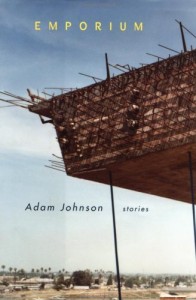
  • Emporium: Stories by Adam Johnson

    Midnight finds us rolling through the waves of the old Double Drive In, the gravel crunching under our tires, the Monte Carlo’s trunk bottoming out like it used to, and all the broken glass, beer caps, and bullet casings now sparkle like stars.

    From “Trauma Plate” as included in Emporium

    Emporium taught me more about short story craft than most textbooks dedicated entirely to the topic. Adam Johnson has what some may call a natural story-telling ability, and I’d agree for the most part, but nature, I suspect, takes a person only so far, and Emporium exists as such a perfect specimen of contemporary fiction that I would hesitate to believe we as human beings have this innate level of ability.

    Yes, he has a flair for language. Yes, he can craft a compelling storyline. But what truly makes Adam Johnson endearing is his obvious knowledge of the craft. He has – and I would say this about very few people – a Richard Russo-ian ability for story.

    I read somewhere that Adam Johnson actually enrolled in his first university level fiction class by accident (he incorrectly transcribed a class number when enrolling, trying to fish for an easy A by taking a poetry class). Proof that accidents are God’s little way of being a hilarious son of a bitch.