Author: Caleb J. Ross

  • CHARACTERED PIECES REFUNDS!?!

    Everyone who preordered Charactered Pieces:

    You likely received a refund notice from PayPal. There was a problem with the ordering system, which is being addressed.

    Please know that Charactered Pieces is still going as promised. Please, though, if your money was refunded by PayPal, re-purchase using the button below. I know this is a hassle. Such is the life of a small operation.


  • Xword causes Yreaction when audience = b and author = a

    Xword causes Yreaction when audience = b and author = a

    Note: I’m picking on poetry here because of all forms, it is the most elusive. But my following comments could be applied to art in general.

    Maybe because I was looking for a reason to give up on what had already proven to be an unfortunate read, but this section of The Book of Lazarus frothed all the ill-will I had toward (most) poetry:

    I have seen that there is no predetermined direction to the birth of a word, that words move across the page like beams of random light moving through immense voids of wandering flares. Poems are built like jewels. (pg 434)

    Really?

    Explaining what poetry is with poetic language is cyclical and confusing. I do appreciate the meta aspect of doing this (truly, I do. See here). But defining an elusive concept with further metaphor doesn’t help to define anything. Yes, the above example is from a fiction text, so the reader should rightfully assume that the definition is more about developing a character than about providing an accurate definition of poetry. However, it seems this flowery style is exactly what demonizes poetry in the mind of the casual (possibly conservative) reader. The common conception of poetry is that it is easy and anyone can do it. There is an “all is right, nothing is wrong, so be yourself” therapeutic hippy aspect associated with poetry. Which is why I don’t count poetry as one of my favorite forms, despite my above understanding of any possible misconception or untruth; the stink is quite potent.

    I’ve reached a point in my writing study where I am tired of intangibles (and I’m not the only one). I want repeatable data. I want the art effect to be measurable. I want to know that word x would elicit reaction y when audience = b and author = a. Can art be scientifically approached? I really want to say yes; we simply haven’t the capacity to do so yet. So, in my dream of measured effect, the above description of poetry elicits one thing well: vomit.

    Xword causes Yreaction when audience = b and author = a

    The first step in a measured effect would be to assign a value to both b and a. This, I understand, is both the first step and the impossible step (impossible, as we currently understand ourselves as a species). The author does not always understand his intentions, and even more-so, does not always know his audience. In a perfect world, an author will come to a story, poem, anything with years of self-awareness along with an understanding of his audience for that specific work. Perhaps this is why most authors get better the more they write, and why most authors don’t peak until middle-age or after.

    Matchbook Lit mag has something good going. They require authors to post critical analyses of their work alongside the work itself. An artist’s statement, so-to-speak. This is important. This is likely necessary to keep writing respected in a world where anyone with an internet connection can post any drivel at any time to potentially hundreds of thousands of readers. In other words: just because someone can type and share words, does not mean he should. The artist’s statement proves that there is at least honest intent behind the writing.

    The bottom line is this: relying on interpretation makes for lazy artists. The burden of art should never be hoisted entirely upon the critic. Doing so creates a false formula, where a and/or b is missing. The more therapeutic hippy drivel out there, the less respected writing becomes. Simple.

    And for all those university professors and doctors out there, who, I know, wrestle with this dilemma daily, think about this: how much easier would it be to acquire arts funding if we were able to rationalize the dollars with measured results?

  • CHARACTERED PIECES preorder open!

    CHARACTERED PIECES preorder open!

    A few of you know how unbelievably happy I am to say this. The rest of you will likely get tired of me saying this: my story chapbook is now officially available for preorder! Books will ship around November 16th.

    All preorders will receive a copy of the book, along with the following:

    • A (very) personal inscription. Note the specific name you would like the inscription made out to in the PayPal comments area. Also, note my use of the word “very;” I warn you: you may be disturbed by what I write. If you would rather a flat-signed, or “clean” copy, note that in the PayPal comments area as well.
    • A picture of me signing the book (so there are no Antiques Roadshow conflicts 90 years from now)
    • As part of the made up LUNGS FOR READERS program, each preorder will smell of delicious ACID cigars. Trust me, even if you don’t like cigars, you’d love the smell of ACIDs. Imagine if cinnamon and Italian food had a veal baby*. Think of this, too: OW Press is mailing these out in the middle of Winter (where I am, anyway), meaning that I have to sit outside, freezing, to bring you the smell of these cigars. My pain, your gain.
    • Whatever other fun stuff I can find to cram between the book’s pages

    That’s all the bulleted aspects above and 63 pages of some quite fantastic writing. How much? you ask. $7. Seriously, OW Press and I don’t make any profit on this (unless hundreds of copies find their way into the world). You are buying love. Money goes back into making more books.

    PREORDER HERE, at the OW Press Charactered Pieces page.

    For more general information on Charactered Pieces, take a look at my info page, here.

    Preorder now. I only get to touch the books once, so I can’t personally inscribe after the initial round of inscriptions. Unless we meet awkwardly in public somewhere. Hint: I’m the guy in the trench-coat…

    Also, don’t forget to subscribe to my RSS Feed. I don’t only whore myself, as you’ve seen here. Check my archives; I post interesting stuff too.

    *Drew Estates (the makers of ACID cigars) don’t endorse me in any way. They goddamn can if they want to, though. This is an official offer: I will become (continue to be?) a Drew Estates whore if I get some free cigars.


  • Reclaim The Bar!

    Reclaim The Bar!

    There still exists a romanticized version of The Bar, one whose sparse patrons restrain rich histories with liquor and silence. But by the aid of free rounds and a free ear, those histories spill. The romanticized bar is a smoky place of bonds melded by story.

    It has been my experience that more often the romantic bar mirage gives way to a sad reality, one of loud, obnoxious chatter with radio-friendly (re: conversationally-unfriendly) music pumped in to dilute any intellectual connection in favor of the visual/physical. Here, women dress as disco balls in hopes of MySpace photo ops. The real bar is a smokeless place of subverted and repressed stories.

    This isn’t a case of Norman Rockwell nostalgia; it cannot be. I am not ready to quit the dream.

    How to make a bar better, while maintaining profit (warning: to make this happen, compromises have been made):

    1. The jukebox

    Perfection: If a song has the words booty, bling, cowboy, ass (in a sexual conquest sense) or is by Nickelback, remove it from the jukebox.

    Compromise: Turn the music down a smidge. The relatively recent introduction of internet-abled jukeboxes satisfies my need for bar-perfect spots like Waits, Cave, Boxcar Saints, and Bauhaus…yes, Bauhaus. So, if the trash is quieter, then maybe the sensible among us can talk over it.

    2. More jukebox

    Perfection: free jukebox! Give out a song token with each drink purchased, thereby rewarding those who buy a lot of the bar’s product.

    Compromise: Lower the prices of the internet-abled jukebox songs. Or at least, allow each purchased song to remain in the jukebox harddrive, so that subsequent purchases are done at the standard song rate. I understand this restriction may be a song rights issue. If so, simply lowering the prices will do just fine.

    3. Books n’ such

    Perfection: Book up the place. There’s a bar in north Kansas City, Mickey’s, I think it is, that has walls filled with books. I suffered a New Year’s Eve there once, and spent the night coveting a bound collection of Camus writings that sat imprisoned behind crepe paper streamers and balloons, slowly deflating, as was I. All I wanted was to silence the crowd and free the book. I would have purchased liters of beer to do so.

    Compromise: Sell the books. Sell more than just beer and shitty food. Sell coffee. Sell cigars.

    4. Smokeable

    Perfection: Let people smoke. I’m not a smoker – aside from a cigar here and there – but I love smokers. There’s an implied social need with smokers, a personality befitting conversation. Now, I understand smoking bans have all but extinguished indoor smoking. But like with most good things, there are loopholes available. A place near me, The Keyhole, has claimed a “club” status, and charges “members” a nominal membership fee ($1 per year, or something amazing like that). Once equipped with the club designation, patrons are free to smoke away. If you don’t want to be around smoke, don’t go/work there. Simple.

    Compromise: Divide the establishment into smoking and non-smoking sections, or have smoking and non-smoking hours/days. I’d be interested to see this happen on a small scale as a test for possible wider adoption. Do the patrons/workers like/dislike the set-up? Are the shifts confusing to patrons? What is the profit difference between times of smoke and times of ban.

    Who’s with me?
  • Writer Help: RSS & Really Sexy Spreadsheet

    Writer Help: RSS & Really Sexy Spreadsheet

    Recently, I mentioned my obsession with RSS to a writer friend, and he was surprised by its capabilities. Maybe I’m too much of a salesman when it comes to nerdy tech things, but nonetheless, I piqued his interest. That got me thinking: what writer tools do I use and unintentionally keep to myself?

    Selfishly-kept secret #1: RSS.

    You’ve likely seen this icon:

    This represents a link to a specific RSS feed.

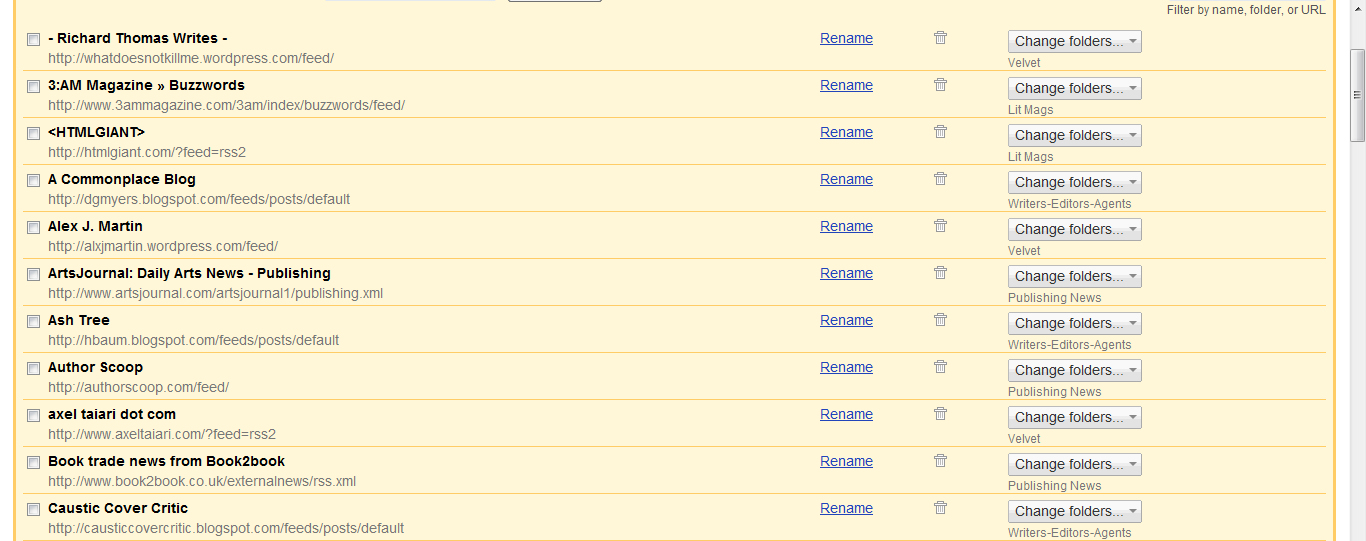
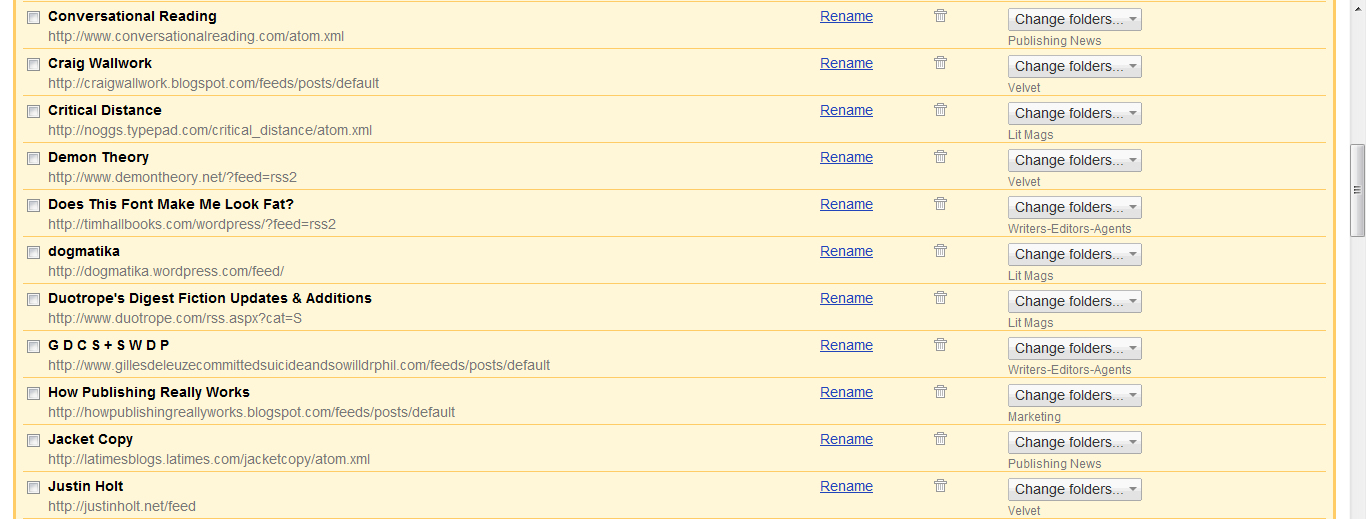
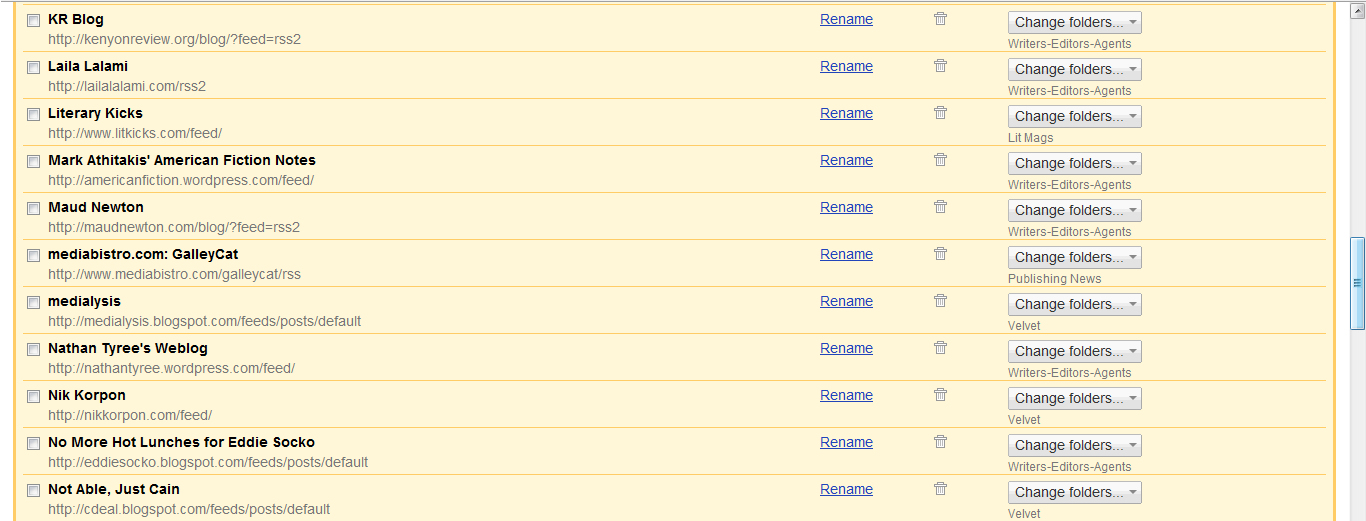
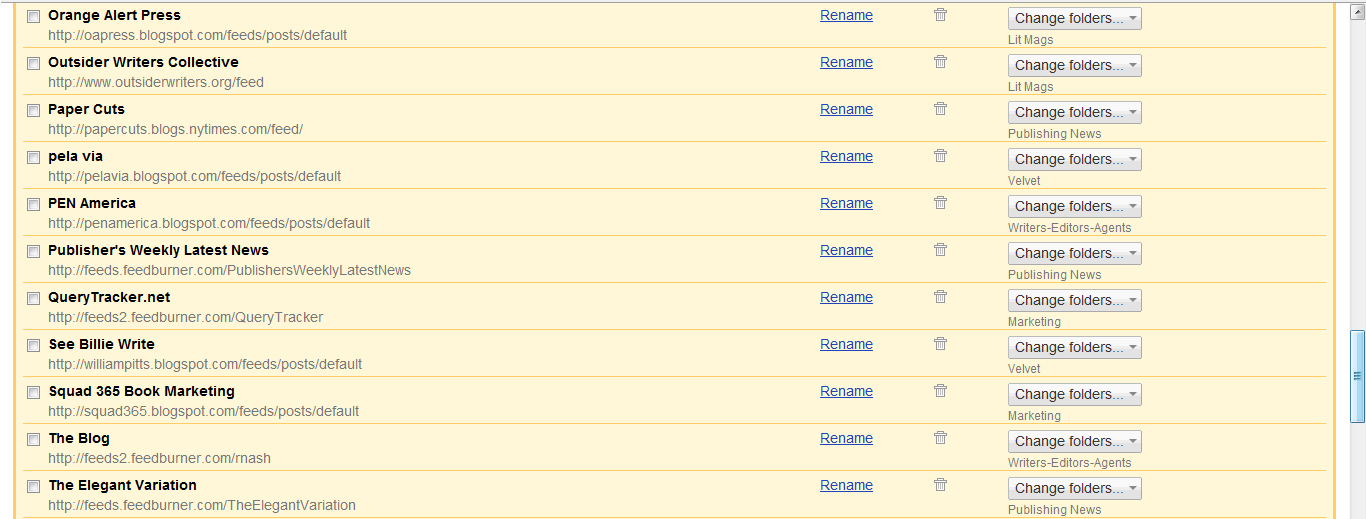
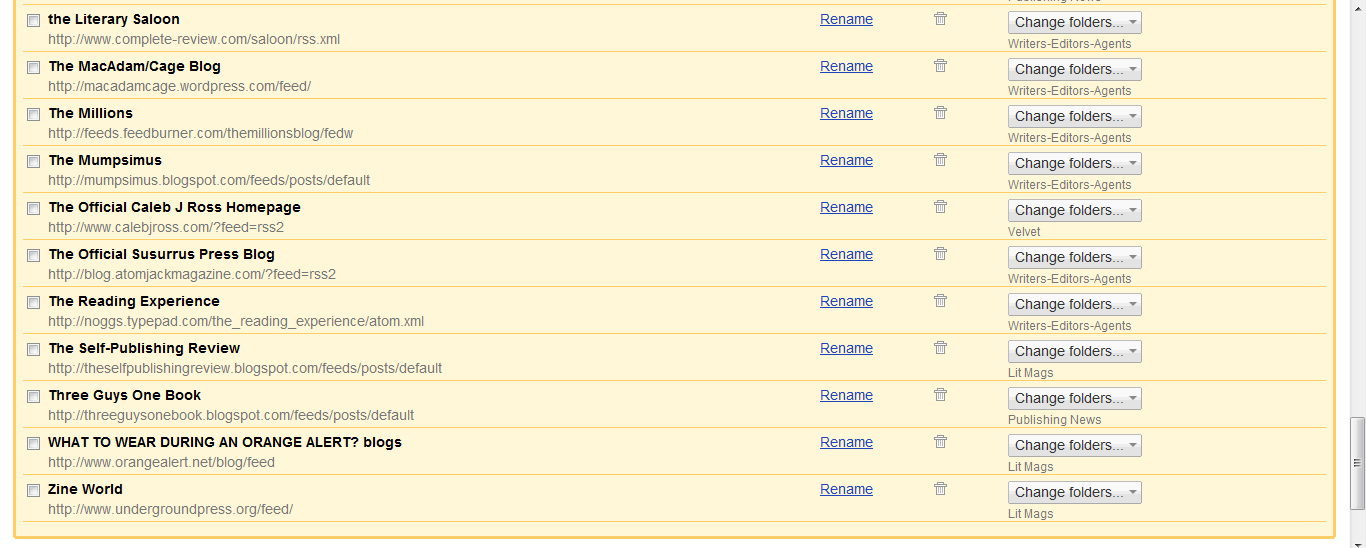
    I won’t go over what RSS is (for that, see here). Instead, how do I use it? Simply put, I use RSS to keep updated with the many, many lit sites whose perusal would otherwise clog my day. Instead of checking each individual site for new posts, I log into one feed aggregator site (I use Google Reader) and see a list of every new post from each of my RSS subscriptions (flip through the screenshots below for a list of my subscriptions – can I play taste-maker and suggest that everyone subscribe to all of them? Better yet, here’s a full .xml file of all my current subscriptions.)

    Think of RSS feeds as organized social site friend contacts, only instead of having to share a common site (MySpace, Facebook, etc) with someone, the format is universally acceptable. Even if a site doesn’t promote that it has an RSS feed, it still has one. RSS feeds are standard fare for all sites. Simply type a website into the feed aggregator and the site is automatically parsed for a feed.

    Google Reader is very intuitive. Not only can the user organize by folder, but the simple act of scrolling through a blog marks it as “read,” meaning that there is no need to click a button or follow a link to take a new post off of your to-read list. This is extremely important when you’ve been away from the internet for an extended period of time and come back to hundreds of new posts.

    Screenshots:

    If you decide to utilize an RSS reader, you should subscribe to me. I am witty and nice and I smell like sex. My feed address is: https://calebjross.com/?feed=rss2

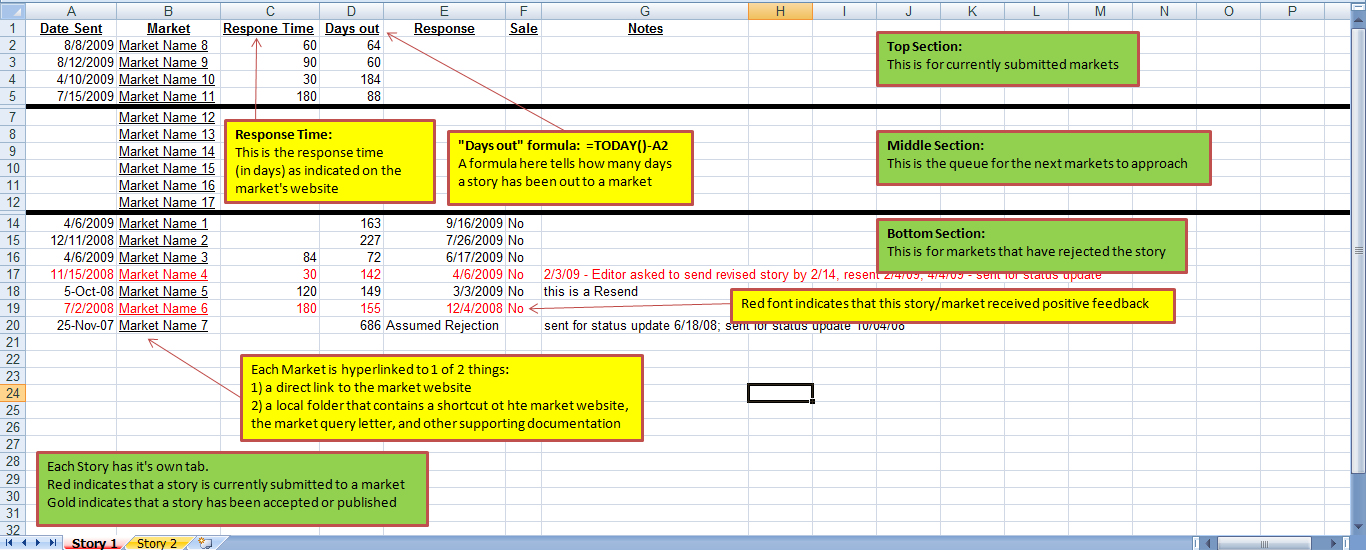
    Selfishly-kept secret #2: my tracking spreadsheet.

    I am an unapologetic spreadsheet geek. I love ‘em. If I could organize my sleep schedule by spreadsheets, I would. So it makes sense that I would create a spreadsheet to make story submission tracking easy. I now share this spreadsheet with you. See the screenshot below for descriptions of all the bells and whistles.

    Basically, the spreadsheet keeps track of everything about a submission, from number of days out, to any query letters associated with a market. Feel free to modify this spreadsheet. If you add something amazing to it, I’d love to hear about it.

    Click here to download the template for yourself.

    I’m always on the lookout for ways to be more lazy. If you’ve got ideas, let me (and vicariously, any RSS subscribers I have, -wink-) know.

  • CHARACTERED PIECES, given the Bosworth treatment

    CHARACTERED PIECES, given the Bosworth treatment

    Mel Bosworth, skullcap connoisseur and Pushcart nominee, has a burgeoning series of youtube videos in which he reads stories by other writers. The short videos (usually less than a minute or so) work well to break down a dull day. And if you are too busy to watch, you can at least listen – Mel’s got a great reading voice.

    His latest, him reading the opening section of CHARACTERED PIECES. I’m thrilled and honored.

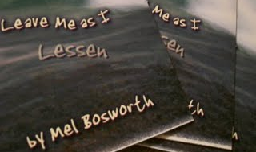
    One of my first intros to Mel’s work was via Folded Word’s single story “mini-mags.” The story: Leave Me as I Lessen. The reaction: floored. I meant to post about this great story before, but my goddamn life got in the way. So, I say, read it now, here. It is only downloadable for free until December 15.

  • CHARACTERED PIECES has a face

    CHARACTERED PIECES has a face

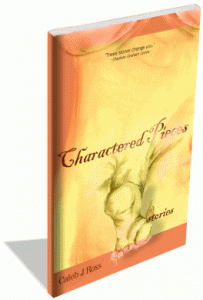
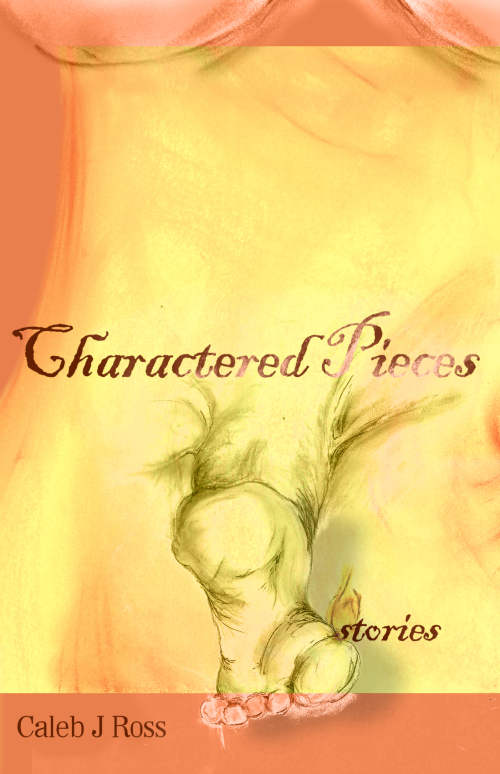
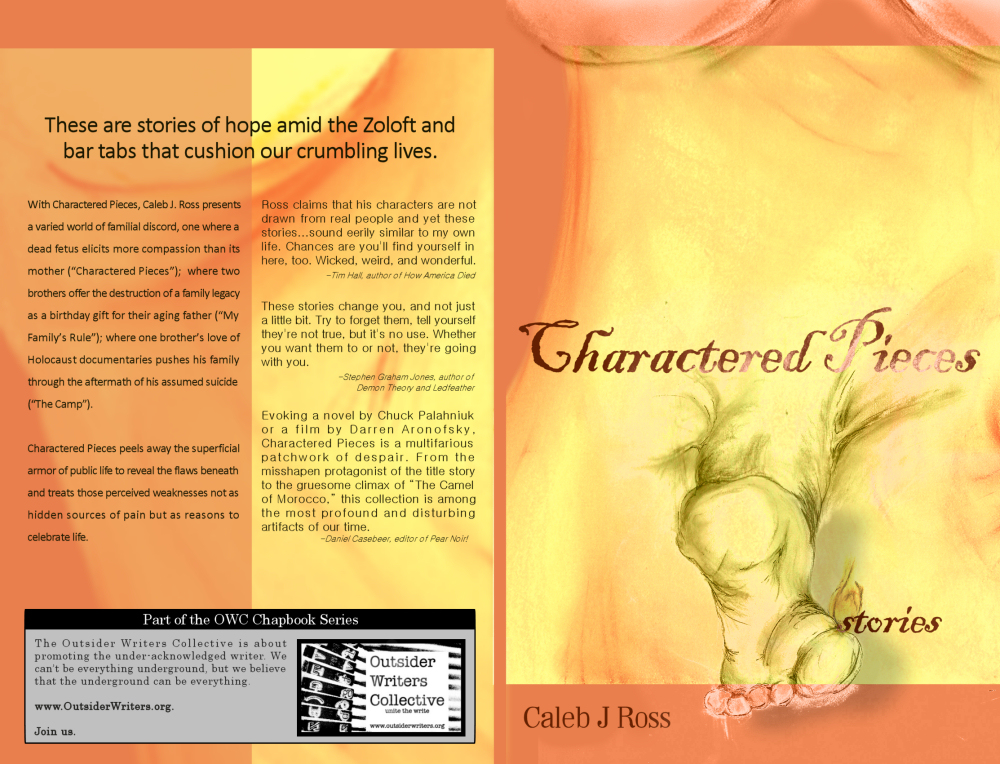
    I’m proud. Click an image to enlarge.