Author: Caleb J. Ross

  • The Turing Test is more Future of Humanity fun. But is it good?

    The Turing Test is more Future of Humanity fun. But is it good?

    Subscribe on YouTube

    The credits are rolling on a really fun first-person puzzle game with a science fiction motif in which advanced AI-turned-fully-sentient machines have caused problems and humans have to use their uniquely capable human brains to save themselves, ultimately encouraging the player to ask “what’s really the difference between people and robots?”

    Though the game traffics in themes, genres, and styles that plenty of other games have trafficked in before (Portal, Portal 2, Q.U.B.E, Q.U.B.E 2, The Talos Principle), I happily jumped into The Turing Test with the same amount of vigor and excitement I will continue to do so for every one of the inevitable forthcoming games that do this exact same thing. I like narrative games. Story in games is often the glue that holds the pieces together and keeps the single-player gamer invested. I like puzzle games. They are slow-paced and they make me feel really smart. But puzzle games with stories are very hard to do right. It’s hard for game designers to give a narrative reason for puzzles to exist in a world. Some games ignore all logic and just lean into the puzzles as part of the game’s charm. The Resident Evil series, for example, does this really well.

    Most games never try for logic and simply never try mixing these two things. Puzzle games are most often hyper-focused on the puzzles themselves. All else is pulled away. Think of a game like Tetris or even World of Goo, where the story is there but it’s limited to essentially text screens between the puzzles.

    Storytelling in a puzzle world is hard. That is, except when that world’s story is specifically about testing a human’s puzzle-solving abilities. And to make the conflict in the story work, the human must be pitted against an entity of intelligence great enough to fool the human: an Artificially, super intelligent, self-learning villain, for example.

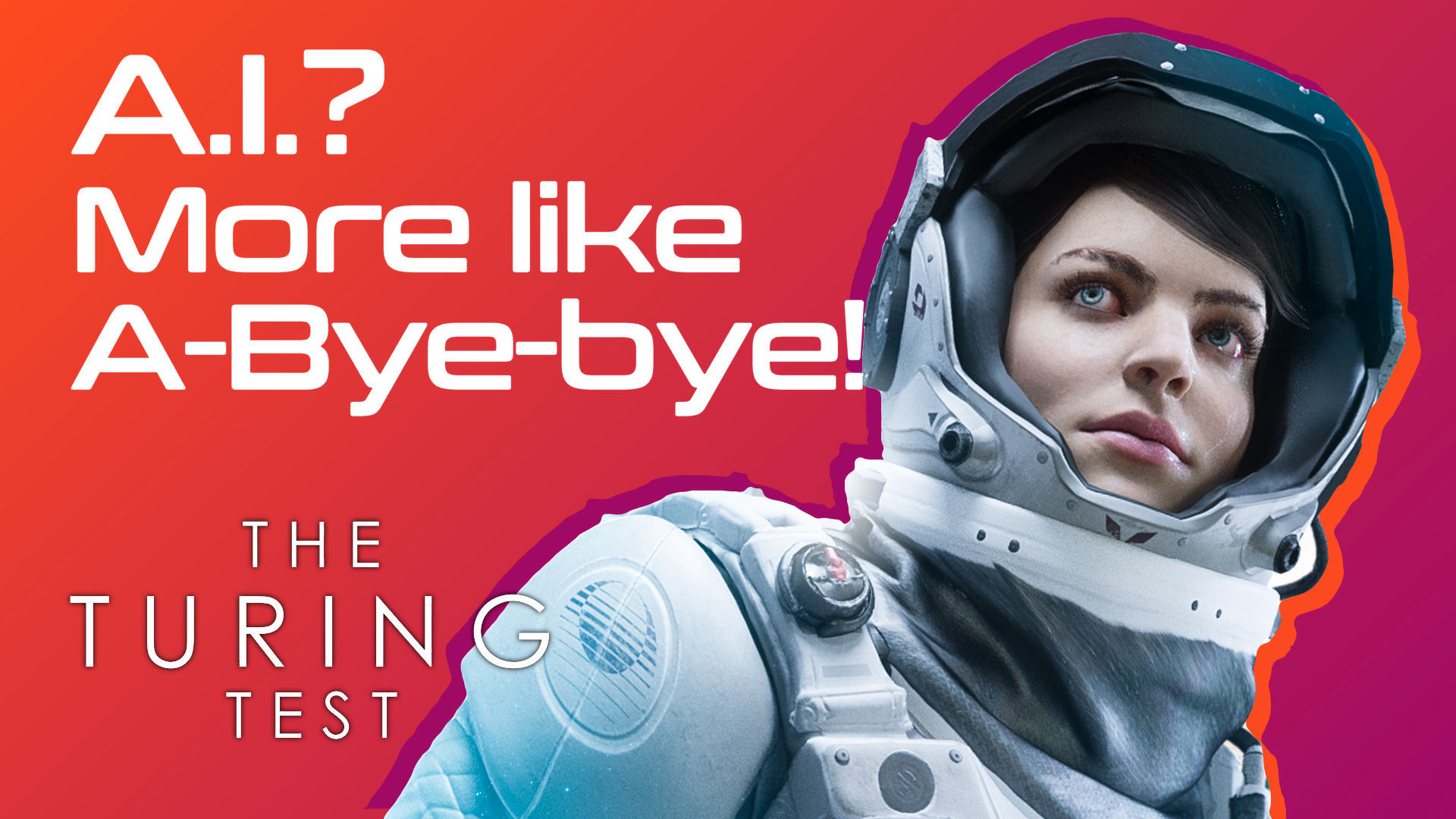
    The villain with The Turing Test is an AI named T.O.M. T.O.M. controls a space station on Europa, one of Jupiter’s moons. You play as Ava, a scientist who has arrived at the space station to rescue the station’s crew who haven’t been heard from in a long time. T.O.M. coaches Ava throughout the space station as she solves puzzles to reach the missing people. T.O.M. also slowly tries to influence Ava’s perception of her mission, insisting that she’s not meant to rescue the crew. Rather, she’s meant to kill the crew to ensure they never return to Earth. See, the crew has become infected with an organism that grants eternal life. Bringing such an organism back to Earth would cause an extinction level event. If people can’t die, the world is doomed to overpopulation, endless cancer, and on and on.

    The tension here, the fuel that keeps the player interested, is when T.O.M.’s logical reasoning is pitted against Ava’s emotional reasoning. T.O.M. tells Ava that the death of her crew is logical, in that it will prevent countless other deaths. Ava, however, is a sappy meat-bag and wants to pull a Joel in order to save all her Ellies.

    But what about the puzzles? This is a puzzle game, right? The Turing Test offers typical switch puzzle mechanics—activating a switch opens a door—but as levels (or Sectors, as they are called here) advance, new mechanics are introduced. You get time activated switches, robot companions, the ability to control cameras, and even for short times, you get to control a turret gun.

    The final 3rd of the game is considerably easier than the first two thirds, which I appreciate. At some point in every puzzle game with a campaign I feel like I’ve proven myself able to overcome challenges. That moment generally happens around the 70-80% mark. But I usually still feel compelled to complete the game. The Turing Test understands this and instead focuses on story for the final third, with the puzzles being only easy to moderately challenging.

    In comparison to other games of this type, specifically those I mentioned at the start of this video, The Turing Test lands right in the middle, not as good as Portal and Portal 2, and the Talos Principle, but a bit better than Q.U.B.E and Q.U.B.E 2, but not by much. All of these games are fantastic if you have an urge to make an AI villain look weak and pathetic fool.


  • Is Playstation Now better than Google Stadia or is Google Stadia better than Playstation Now?

    Is Playstation Now better than Google Stadia or is Google Stadia better than Playstation Now?

    Subscribe on YouTube

    I recently upgraded my internet connection in my game room, so I decided to put the streaming capabilities of Playstation Now against Google Stadia. How did the two streaming platforms perform against each other? Is Playstation Now better than Stadia? Or is Google Stadia better than Playstation Now?

    Mentioned Google Stadia video: “I finished a FULL game on Google Stadia. Am I a believer now?”

  • I finished a FULL game on Google Stadia. Am I a believer now?

    I finished a FULL game on Google Stadia. Am I a believer now?

    Subscribe on YouTube

    I just finished playing through a full 15 hour game on Google Stadia. Did the experience turn me into a Stadia believer?

    This is the longest single-game commitment I’ve made to Stadia. I learned a few things along the way about whether or not Stadia works and if it’s a good option for anyone.

    In this video I give my thoughts on the controller, the impact of a strong internet connection, the Stadia UI (user interface), and more.

  • Are Video Games Good at Comedy?

    Are Video Games Good at Comedy?

    Subscribe on YouTube

    Are video games good at comedy yet?

    More precisely, are video games good at comedy in their own right. Of course video games can make us laugh. Steam has an entire category dedicated to funny video games. But most video games that make us laugh do so in ways that other mediums can also. The writing in video games, or the situational articulation of characters and scenes, these things make us laugh when we watch TV, when we read a book, and so of course they’d offer the same with video games. Nobody is going to argue that the Trashopedia entries in Donut County aren’t worthy of their own mock Mitch Hedberg album. They are. I’ve never laughed so hard when playing a video game.

    But the humor with Donut County’s Trashopedia and Undertale’s incessant puns and Psychonaut’s slapstick gags is humor that’s possible across many different mediums. I want to know if video games have truly carved out their own methods of humor.

    First, let’s start by defining humor and therefore giving us a way we can objectively measure whether or not something is funny, or at least as much as we can given the subjectivity of humor. My favored theory of humor, the Benign Violation theory, itself allows for subjectivity. So, there’s no getting away from the fact that what makes me laugh might not make you laugh, but the Benign Violation theory at least helps us categorize things as funny or not, even if the result of that humor isn’t an outburst of laughter.

    So, the benign violation theory basically states that something is funny when

    1. it violates some norm or expectation
    2. does so without hurting anyone, and
    3. both the perception of the violation and of the non-threatening nature of the violation happen simultaneously

    When it comes to humor by way of writing, the text sets up the expectations and then violates it with a punchline. Or take this poop-shaped coffee mug, for example:

    The coffee mug is generally a banal part of your morning routine. The poop-shape violates this norm. And nobody has been killed. Even if you find this particular joke in bad taste, it’s still easy to understand why it’s funny.

    Video games are unique. We’re connected to a video game by an input device, one that maps our thoughts to the actions we see. As we press buttons the feedback changes our approach, our input changes, and the loop continues until we arrive at a win state. No other entertainment medium offers this level of malleability. No other medium wants us to stretch and shape the product to an end while the product stretches and shapes us to that same end. This reciprocal molding is what makes video games uniquely immersive. And this contract between game and player relies heavily on a firm understanding of the ruleset. Most games literally tutorialize to the player. Books don’t tell you how to read. Movies don’t tell you how to watch. Video games tell you how to play. And this simple fact, I think, is why video games have trouble being humorous in their own right.

    When I press up on the d-pad, I expect the player character to move up. When I press the R2 button, I expect the gun to fire. If that doesn’t happen, and I get shot instead, I don’t laugh about it. Why? The act certainly violates the expectation. But, in the context of the game, it does hurt someone. Me. My progress as the player, the reason I’m playing the game, has ended. Success depends on the game itself following the rules it’s requiring me, as the player, to follow.

    So how do you benignly violate expectations with a video game?

    The most straightforward example I can think of is during the intro tutorial of Portal 2. A robot chauffeur named Wheatley greets you as you wake from a long stasis. Testing for resulting brain damage, Wheatley gives you a simple command. You just need to speak. The game primes you for relief. If you honor the instructions, you’ll discover that your player character is not brain damaged, as was expected, and in fact can follow instructions perfectly, therefore subverting those expectations. However, this happens…

    The punchline is a clever subversion of expectations, even when those expectations already seem to be subverted. This degree of layering and subverting expectations is difficult in any medium, but really shines in this video game example.

    This subversion of the expected control scheme is, as I see it, the primary way video games currently use their unique offerings for comedy. A common flavor of this approach are games that make lack of control a primary feature. Gangbeasts, Octodad, and Human Fall Flat are all examples of this. Limbs are controlled independently, and forward momentum carries the character far beyond what game players have come to expect with most games. These games provide humor by defying the player to play them well. It’s not surprising then that these games are generally pretty forgiving with their lose conditions. If I am punished for the lack of control, then the violation is no longer benign.

    Similar to the ragdoll approach of those games, the recent trend of simulator games manage to use a game’s intrinsic qualities for humor. Goat simulator, for example, promises to allow the player to simulate the life of a goat, which is mundane, and is humorous simply by nature of that juxtaposition. I expect a game to give me interesting experiences. Chewing cud in a petting zoo is not interesting. Therefore, benign violation. However, like Portal, Goat Simulator then subverts that expectation by encouraging the player to do things that are decidedly not goat-like.

    Surgeon Simulator takes the opposite approach by suggesting that the game will let you experience something that requires immense skill. Then it subverts that expectation by limiting the player’s control to absurd levels. That a surgeon cannot control his own fingers is the humor.

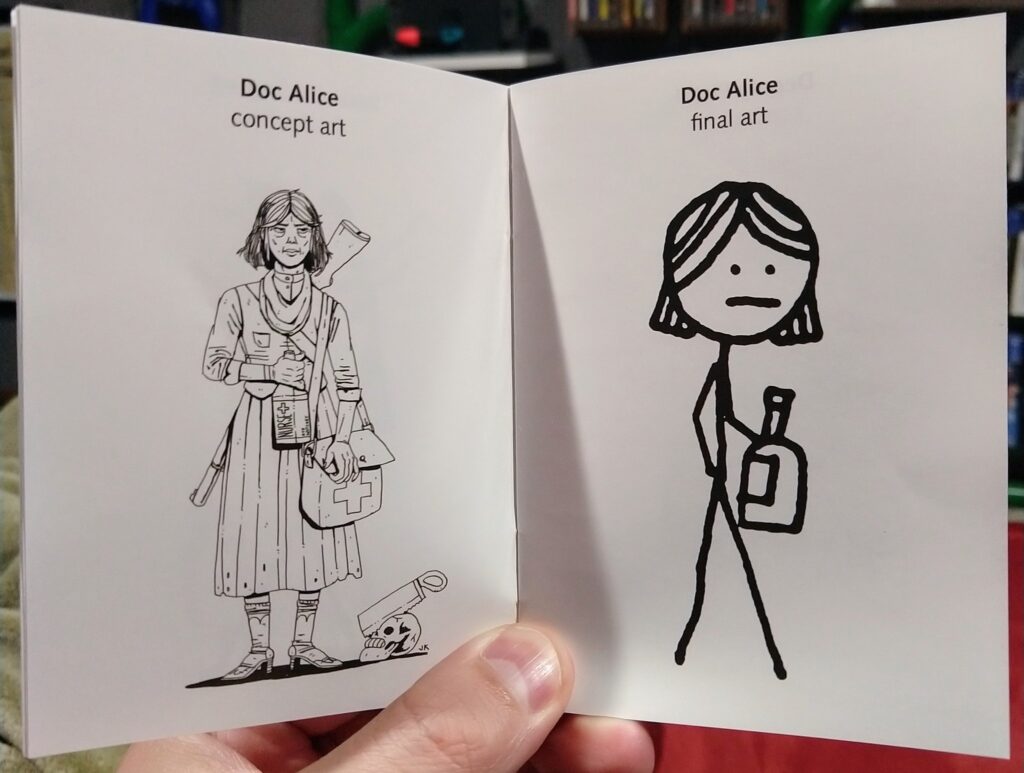
    West of Loathing is an interesting example of video games doing comedy. While most of its comedy is applicable to other genres, one very unique way the game subverts expectations is with its art book. Video games sometimes come packaged with booklets full of concept art for the game with the expectations being that the reader will be guided in a visual chronology from sketch to concept to final rendering. But West of Loathing is a game with a stick figure motif, so the art book instead reduces the fidelity of the art over time rather than increasing it.

    The art book for West of Loathing is hilarious

    When will video games consistently use their own intrinsic properties for comedy? Will it ever happen often enough that awards are given at big award shows for video games that do comedy right? Will class be taught at universities about comedy in video games?

  • Have you ever had a Jill Sandwich?

    Have you ever had a Jill Sandwich?

    In episode 1 of the Tales of the Lesser Medium video game podcast, where we discuss Resident Evil 1 and with it, Barry’s unintentionally funny “Jill Sandwich” quip. Travis suggested that a Jill Sandwich is nothing more an inch thick layer of horseradish between two stale cookies from Subway. So Caleb decides to try one.

    The first season of Tales of the Lesser Medium explores the Resident Evil series, games, 1, 2, 3, and 0.

    Subscribe via your favorite podcast-ery

    Follow @TalesLesser on Twitter if subscribing to the podcast is too much of a commitment for you.


  • How to Play Video Games and Eat Food (and Laugh) at the Same Time

    How to Play Video Games and Eat Food (and Laugh) at the Same Time

    Subscribe on YouTube

    Eating food while playing video games is a problem that’s existed since the very dawn of video games. Way back in the 1900s, a man named William Higginbotham built the first video game machine called Tennis for Two and it required more than one hand to operate. That creation of tennis for two’s two handed control pad seeded an industry trend that continues it’s destructive path still today.

    But not all is lost. Here I present to you a few ways you can play video games while eating.

  • Video game stories + comedy skits = Tales of the Lesser Medium Podcast

    Video game stories + comedy skits = Tales of the Lesser Medium Podcast

    The New Tales of the Lesser Medium Podcast Launches May 26th, 2020! Set a calendar reminder now!

    We (you and me) love video games. But we (you and me and your mom) know they aren’t always concerned with conveying a serious story. Wouldn’t it be fun to poke holes in these stories? That’s where Tales of the Lesser Medium Podcast comes in.

    Each season, Travis (from Polykill, NES Friend, and DrinkFriend) along with Caleb (from his Youtube video game channel, books, and this website you are currently reading) deliver laughs alongside the narratives that hold together (barely) your favorite video game franchises.

    Season one features Resident Evil 1, Resident Evil 2, Resident Evil 3, and Resident Evil 0. Each of the 4 episodes of season one walk the narrative path laid in each game with plenty of semi-improve pee breaks along the way.

    Subscribe via your favorite podcast-ery

    Follow @TalesLesser on Twitter if subscribing to the podcast is too much of a commitment for you.

    Tales of the Lesser Medium podcast twitter profile header