Episode #004 of The Velvet Podcastjust went live a few hours ago. Me, Rob Parker, and Mark Jaskowski talk about:
Please, give it a listen. Subscribe via Feedburner, Podcast Alley, iTunes. |
|
Author: Caleb J. Ross
-

The Master’s Program as a Trade School
 I’ve been accused of being a bit of a literary snob. Mostly by best-seller groupies who smell like trade paperbacks and poverty. Why don’t you go save a few dimes at a used blog store, and leave the shiny new posts to those of us with taste!
/UNDESERVED SENSE OF ENTITLEMENT
My justification for being a literary snob (literob?) always has been that if a book is best-selling and intellectually easily accessible, then it likely isn’t confronting dangerous (i.e., important) topics. I want to believe that fiction should be more than entertainment. For the most part, I still agree with this logic. But a few months ago, at the AWP Conference in Denver, CO, I came to a bit of a realization, with some help from author Tod Goldberg.
I realized that despite any drive to challenge the established format or structure of fiction, it is the story itself that keeps readers reading. I wanted to believe that a unique concept, or beautiful language, or inventive formatting alone could carry a book-length work. But no, it cannot. A book told from the perspective of a cancerous cell? Conceptually unique, but no. A book intimately describing that cancerous cell? Beautiful language, but no. A book giving dialog to every cancerous cell in a body, matching the text color to the cell color? Inventive formatting, but no. A book that imbues a cancerous cell with character traits similar to a human while putting that cell in a morally conflicted position? Sure.
My fault rested not entirely with the assumed intellectual ease of commercial (vs. literary) writing, but also with the ill-conception that plot-driven genre fiction is somehow weaker and easier to write than a high-Art piece of literary fiction. This opinion was birthed in college, where I first began to read and write. Had I read as a child, I may have understood the basal importance of plot long ago. But my literobbery was rooted in college, too late to let aesthetics matter. I was a head case (vs body case) from the beginning.
Now, five years post-graduation, a degree in-hand, and without a writing career that nullifies a day job, I’ve started to wonder about the role a university education plays in a writer’s life. Note: I wouldn’t trade my university experience for anything; I love being a literob. But I do wish that a stronger focus would have been placed on the writer’s career, and less on the writer’s life.
[pullshow]This is where Tod Goldberg comes in. During a panel titled Crime, Horror, Sci‐Fi, and Fantasy… Seriously, Goldberg, almost in passing, mentioned that [pullthis]he teaches his writing classes as though they were part of a trade program, meaning that he trains his students for actual jobs.[/pullthis] This goes against the traditional goal of a university writing program, which places almost no focus on job prospects, instead opting for a focus on intellectual ends (proselytizing [convincing students that their money is well-spent], pedagogy [teaching students to be teachers who in turn put their students in similar job-less positions], and how best to embed asides within parenthesis [I like to use brackets]).If someone loves to weld, they go to a welding school to learn to be a professional welder. If someone loves to write, shouldn’t they go to a writing school to learn to be a professional writer? The key word being “professional,” meaning, to get paid doing so. (more…)
-
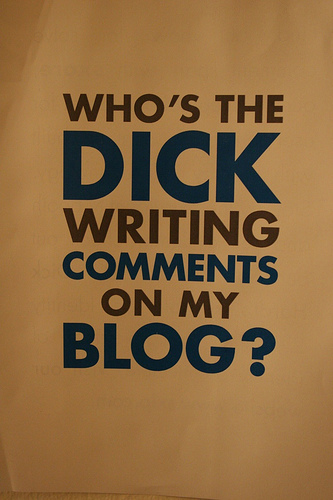
What brings you back?
Things need to change. I need to blog more. I need to have interesting things to say. Yes, that is the correct order for those last two items. Blogs, generally, are dumb. So many of them tend to be self-infatuated messes. The argument that this egotism is their exact purpose stands, true. So perhaps my contempt is like me at an orgy: so many people doing it must mean it’s fun, but every time I try one, I leave with a bad taste in my mouth. Gross.
I read plenty of industry blogs, which I see as more an evolution of the commercial print world (magazines, trades, etc.) than as an evolution of the private world (diaries, journals, bathroom stalls). So, maybe I am meant simply to avoid the diaries and try to make this blog more about the industry.
Problem: I don’t know much about “the industry.” I don’t even know what industry that would be. Publishing? Authoring? Is drinking an industry?
[pullshow]I want to be useful. I want to provide valuable content to my 2.5 readers (I call them nuclear readers; when they comment on my posts, I call them nuclear reactors…get it…anyone…). A Platform is becoming an increasingly important part of a writer’s business arsenal. Think of a platform as a retarded term for group of buyers. Essentially, publishers want writers to have a market before a book is even contracted. Strange, I know. If I already had an audience, I would print and sell the book myself. (Already, I’ve stream-of-conscious-ing this thing; next step: decorate with Lisa Frank stickers and catch my older sister reading it). [pullthis]So my question is, what is useful? What is my unique knowledge?[/pullthis] Or if not that, what is the unique perspective I can offer? Here’s a list of possibilities:- I edit the OWC site, so I know some about small presses and “outsider” authors
- I write fiction, so I know about lying
- I have a lot of concepts for niche products, so I could give away million-dollar product ideas for free
- I’m really good at eating pop-tarts. The trick is to turn them upside-down before eating, so that the icing touches your taste buds directly. Shit, there goes that blog post.
- I know a little about podcasting
- I once helped nurse a bird back to health after nearly hitting it with a lawn mower (yes, “nearly.” The bird was emotionally traumatized)
- I marketed my debut story collection, Charactered Pieces, with a zero-dollar budget, so I know how to spend a lot of time not writing constructive fiction. Related: I blog
Any of these sound good. Why do you, dear reader, come back to a blog? What would bring you back to me? (more…)
-
Caleb’s SNIPPETS OF TOMORROW (04/25/10)
@ UnRonic, Stephen Krauska offers some truly amazing words about Charactered Pieces. There’s so much more than I deserve in the full review, so I urge you to click over the UnRonic to read everything. But here’s a snippet:
Between his spectacular characters, interesting stories, excellent metaphors all held together with great imagery and vivid description, Ross is a must read. He’s young, fresh and down to earth enough to admittedly “steal” lyrics and write an “Acknowledgment” section that sounds more like a bonus story than a Hollywood awards speech. Keep an eye on him, he is bound to turn up more great work in the future.
@Outsider Writers Collective – on the above note, there are only 23 copies of Charactered Pieces left of the entire 150 copy print run. I don’t think there are any plans to go into another print run anytime in the near future. Of course, .pdf and Kindle copies will be available for the foreseeable future. However, if you want a print copy, now would be the time to claim one. Click here to visit the purchase page at Outsider Writers Collective.
-
The Velvet Podcast, Episode 003: INTERVIEW with Brian Evenson
A very special Episode #003 of The Velvet Podcast just went live a few hours ago. I interview one of my very favorite authors, Brian Evenson about his upcoming AWP Conference panel, Crime, Horror, Sci‐Fi, and Fantasy… Seriously.Extract below: (Anthony Smith, Brian Evenson, Stephen Graham Jones, Tod Goldberg, Mark Smith, Seth Harwood) Six writers of genre fiction who also teach and/or have graduated from university creative writing programs discuss how they approach genre fiction as a serious literary pursuit rather than as a lesser form of fiction. In addition, they discuss attitudes towards genre fiction in the university and how those attitudes have changed over the years.
I want to personally thank Mr. Brian Evenson for taking time out of his day to chat with me. He has made this fanboy quite happy. Be sure to visit his website for details about this amazing author.
Please, give it a listen. Subscribe via Feedburner, Podcast Alley, RSS, or iTunes.
