Blog

  • Quotes from Flannery O’Connor’s “Some Aspects of the Grotesque in Southern Fiction”

    Quotes from Flannery O’Connor’s “Some Aspects of the Grotesque in Southern Fiction”

    In the world of grotesque fiction, Flannery O’Connor is the go-to mouth to voice what’s worth our academic time and what’s worth ignoring. Knowing my love of the grotesque and my respect for Flannery O’Connor, Richard Thomas passed along a copy of O’Connor’s important “Some Aspects of the Grotesque in Southern Fiction” (1960) which somehow I had never read before. I’m glad I have now rectified that problem. Below are a few choice quotes, words I’m sure I will cite for the rest of my writing career, especially when citing my own grotesque fiction.

    On mystery as motivation

    …if the writer believes that our life is and will remain essentially mysterious, if he looks upon us as beings existing in a created order to whose laws we freely respond, then what he sees on the surface will be of interest to him only as he can go through it into an experience of mystery itself. His kind of fiction will always be pushing its own limits outward toward the limits of mystery, because for this kind of writer, the meaning of a story does not begin except at a depth where adequate motivation and adequate psychology and the various determinations have been exhausted. Such a writer will be interested in what we don’t understand rather than in what we do.

    On exhausting human knowledge

    Fiction begins where human knowledge begins–with the senses–and every fiction writer is bound by this fundamental aspect of his medium.

    On the path of least resistance

    Henry James said that Conrad in his fiction did things in the way that took the most doing. I think the writer of grotesque fiction does them in the way that takes the least, because in his work distances are so great. He’s looking for one image that will connect or combine or embody two points; one is a point in the concrete, and the other is a point not visible to the naked eye, but believed in by him firmly, just as real to him, really, as the one that everybody sees.

    On sentimentality

    Even though the writer who produces grotesque fiction may not consider his characters any more freakish than ordinary fallen man usually is, his audience is going to; and it is going to ask him–or more often, tell him–why he has chosen to bring such maimed souls alive. Thomas Mann has said that the grotesque is the true anti-bourgeois style, but I believe that in this country, the general reader has managed to connect the grotesque with the sentimental, for whenever he speaks of it favorably, he seems to associate it with the writer’s compassion.

    On being Christ-haunted

    Whenever I’m asked why Southern writers particularly have a penchant for writing about freaks, I say it is because we are still able to recognize one. To be able to recognize a freak, you have to have some conception of the whole man, and in the South the general conception of man is still, in the main, theological. That is a large statement, and it is dangerous to make it, for almost anything you say about Southern belief can be denied in the next breath with equal propriety. But approaching the subject from the standpoint of the writer, I think it is safe to say that while the South is hardly Christ-centered, it is most certainly Christ-haunted. The Southerner, who isn’t convinced of it, is very much afraid that he may have been formed in the image and likeness of God. Ghosts can be very fierce and instructive. They cast strange shadows, particularly in our literature. In any case, it is when the freak can be sensed as a figure for our essential displacement that he attains some depth in literature.

    On audience limitations

    The novelist must be characterized not by his function but by his vision, and we must remember that [the author’s] vision has to be transmitted and that the limitations and blind spots of his audience will very definitely affect the way he is able to show what he sees. This is another thing which in these times increases the tendency toward the grotesque in fiction.

    On novelists and and poetry

    The great novels we get in the future are not going to be those that the public thinks it wants, or those that critics demand. They are going to be the kind of novels that interest the novelist. And the novels that interest the novelist are those that have not already been written. They are those that put the greatest demands on him, that require him to operate at the maximum of his intelligence and his talents, and to be true to the particularities of his own vocation. The direction of many of us will be more toward poetry than toward the traditional novel.

    photo credit: http://marcyankus.com/site/

  • What is the value of a Goodreads.com book Giveaway? 93% of entrants had never heard of me. 88% plan on reading my books.

    What is the value of a Goodreads.com book Giveaway? 93% of entrants had never heard of me. 88% plan on reading my books.

    Does giving away your books lead to more readers, and in turn, more fans?

    I’ve long read of the marketing effectiveness of giving away books using the Giveaways option at Goodreads.com. And though I’ve conducted one giveaway in the past (for Stranger Will) I’ve not yet been able to confidently attribute any gains in readership or sales due to that giveaway. With this attribution gap in mind, I set out to conduct a giveaway for  As a Machine and Parts, that would allow me to more precisely measure the value of a Goodreads.com user. My conclusion: a Goodreads.com user stands a great chance of becoming a reader.
    The setup

    I listed a 2 copy giveaway for As a Machine and Parts to take place between 2/3/2012 and 2/15/2012. During this time the giveaway received a total of 398 entries. After the giveaway was closed for entries, I followed up with all but 46 entrants (because I either knew them personally, which could skew the results, or the user was not accepting personal messages) with a survey of 8 simple yes/no questions that touch on topics such as prior recognition, intent to read/buy my books, intent to connect on social networks, and the desire to connect with me, as an author, in real life. The actual questions asked in the survey include:

    • Had you heard of author Caleb J. Ross before this Goodreads.com giveaway?
    • Had you heard of the book As a Machine and Parts before this Goodreads.com giveaway?
    • Do you intend to purchase As a Machine and Parts in the future?
    • Do you intend to read As a Machine and Parts in the future?
    • Do you intend to read any other books by author Caleb J. Ross?
    • Do you plan to connect with author Caleb J. Ross on social networks such as Twitter, Facebook, and Google+?
    • If Caleb J. Ross were to visit your city/town for a reading, would you consider attending?
    • Would you like to subscribe to the Caleb J. Ross newsletter?

    The results of my Goodreads.com giveaway

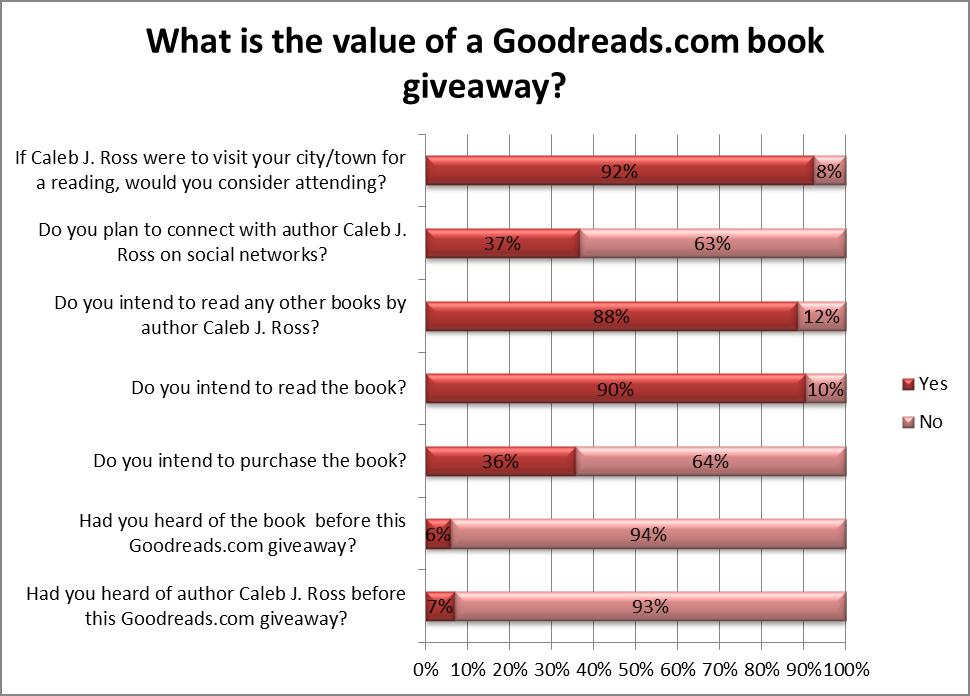
    • 93% of non-winning entrants had never heard of me before this contest. Translation: I’m speaking to an audience who might not otherwise have heard me.
    • 94% of non-winning entrants had never heard of As a Machine and Parts before the contest.
    • 36% of non-winning entrants said they planned on purchasing the book, even though they didn’t win. This is a strange percentage when compared to the 90% of people who intend to read the book. I suppose most readers will look to their library for this book?
    • 88% of non-winning entrants intend to read other books by me. This is an incredibly huge number, especially when compared to the 94% of entrants who had never even heard of me.
    • 37% of non-winning respondents plan to connect with me on social networks
    • 92% of non-winning respondents would come to a reading event if I were to visit their town.
    • 51% of non-winning respondents signed up for my Email is Dead email newsletter. Though I’m convinced that an email newsletter can offer what RSS feeds and social statuses don’t offer more effectively, I do believe that newsletters play a role in summarizing valuable content (which was affirmed with an earlier Facebook poll conducted on this very topic).
    • 38% of non-winning respondents added As a Machine and Parts to one of their Goodreads.com bookshelves
    • 25% of non-winning respondents downloaded Charactered Pieces
    • 25% of non-winning respondents downloaded Murmurs: Gathered Stories Vol. One downloaded

    Additional Goodreads.com giveaway results not included in the chart above

    • 51% of non-winning respondents signed up for my Email is Dead email newsletter. Though I’m convinced that an email newsletter can offer what RSS feeds and social statuses don’t offer more effectively, I do believe that newsletters play a role in summarizing valuable content (which was affirmed with an earlier Facebook poll conducted on this very topic).
    • 38% of non-winning respondents added As a Machine and Parts to one of their Goodreads.com bookshelves

    How many people actually downloaded the free ebooks?

    These percentages are interesting because it means that 75% of people who filled out the survey did not download either of the free ebooks. Either people love filling out surveys or they’ve simply forgotten to download the books.

    • 4% of non-winning respondents added Charactered Pieces (one of the free ebooks given away to survey respondents) to one of their Goodreads.com bookshelves
    • 1% of non-winning respondents added Murmurs: Gathered Stories Vol. One (one of the free ebooks given away to survey respondents) to one of their Goodreads.com bookshelves

    These percentages, when compared to the download percentages above, are interesting as they may elude to a few possibilities: 1) Goodreads.com users may be averse to adding ebooks to reading lists, 2) Goodreads.com users may not always add a book to their lists as soon as they receive the book; perhaps they wait until they actually begin reading it, 3) something else entirely. This seems too big of a discrepancy to ignore, so if anyone has any thoughts, please let me know.

    Why do I think my survey was effective? OR Here Come the Caveats.

    The response-rate for the survey was an amazing 29%. The industry open-rate for Art/Artist newsletters is 17.54% [1]According to Mailchimp. This isn’t exactly a parallel comparison, as open-rate is not the same as response-rate, but it’s a close enough comparison to provide some valuable insight. The response rate is also likely inflated because of the following factors:

    • The entrants were already “in the sales funnel” in that they had already reached out with an interest in my book. In other words, I’m not blindly sending the survey to readers. I’m instead sending the survey to interested readers.
    • I allowed only yes/no answers, leaving out “uncertain” responses. In hindsight, I probably should have provided an “uncertain” response (and perhaps a comments section for each answer).
    • It’s possible that users may have only considered certain actions because the survey included them (connecting on social networks, for example). Would the respondents have connected with me on social networks had they not been introduced to the idea by way of the survey itself? Possibly not.
    • I promised free ebook downloads to all respondents. Obviously, free books must have a lot to do with the high response rate.
    • My communication was very sales averse. I approached giveaway entrants with respect. Truthfully, I am a naturally respectful guy, so I just spoke the way I would normally speak.
    • The survey was incredibly simple. 12 questions with 9 of them being yes/no questions.

    What are your thoughts? Have you conducted a similar survey? What did your results indicate?

    Footnotes

    Footnotes
    1 According to Mailchimp
  • Family Guy does Stephen King, X3

    Family Guy does Stephen King, X3

    (part of my ongoing Unexpected Literary References series)

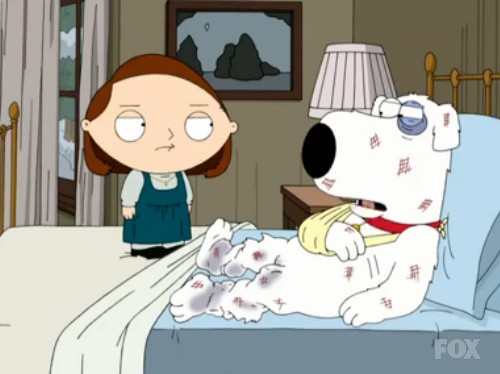
    Yet another Family Guy take on something Stephen King, this time with parodies of three movie adaptations of King works: Stand by Me (based on the novella The Body), Misery (based on the novel of the same name), and The Shawshank Redemption (based on the novella Rita Hayworth and Shawshank Redemption).

    Peter: Hi, it’s me, Peter. Your TV cartoon pal. You know, Lois has been bitching lately that I watch too much TV and don’t read enough books. So I went to the library and picked up three books by the greatest author in the last thousand years: Stephen King, and tonight, I’d like to share them with you.

    Click over the the episode’s IMDB page to see a clip.

  • That great writer, Harry Potter, so says Stan

    That great writer, Harry Potter, so says Stan

    Here’s a quick one for the Unexpected Literary References list.

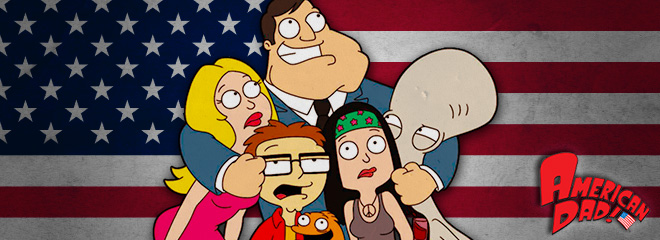
    From American Dad, Season 2  :  Ep. 14: An Apocalypse to Remember

    Hayley: There’s no such thing as mutants because the world didn’t end.

    Steve: You lied to us, Dad?

    Stan: Oh, I tell a great story and I’m a liar, but Harry Potter does it, and he’s your favorite writer.

  • Book Metadata. Let the Algorithm Sell Your Books For You. A Primer.

    Book Metadata. Let the Algorithm Sell Your Books For You. A Primer.

    There’s a rule when it comes to search engine optimization: Content is King. Basically, this means that above everything else—all the link building, code tweaking, and social networking—the most important factor of any well-optimized web presence is the content itself. What good is your website without compelling content? And without compelling content, how can you expect other websites to link back to yours? I would go so far as to suggest the rule should be Content is God, but then we lose out on the lovely alliteration.

    But the Content is King rule governs everything, not just your website or social profiles. Your books themselves actually contain Kingable Content that can be tweaked and optimized for marketing benefits. I’m not suggesting that you to manipulate your book’s words for the sake of search engines; that would be [keyword]ing+<h1>stupid</h1>. Rather, I’m here to clue you in to an area of underutilized content that supports your book even after publication. Metadata.

    What is Metadata?

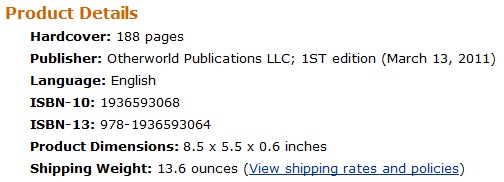
    Metadata, whether it’s book metadata or webpage metadata, is basically the same thing: behind-the-scenes data (subject, genre, theme, etc.) that describes the front-and-center content (the book itself). The categories assigned to help shelve books within the Dewey Decimal system, that’s a form of metadata. Those Product Details on every Amazon.com book page. That’s metadata. When you do a search on a computer for an author or topic, the search results are partially powered by metadata. Those Amazon.com If You Liked ____, You May Also Like ____ recommendations…metadata factors in to those.

    Why Care About Metadata?

    The more information available to search engines and book sites about your book, the more information those search engines and book sties have to use in providing relevant results and recommendations to readers. And while descriptions such as publisher, shipping weight, and product dimensions (pictured above) may be useful for some purposes, they don’t speak to the general concerns of most readers, such as theme, genre, subject, etc. That’s where enhanced metadata comes in.

    Not many people realize just how deep the metadata rabbit hole goes. Which is why, for lack of a better term, I’m using “enhanced metadata” to refer to all those unseen rabbit hole nooks and crannies. Enchanced metadata allows you, the author or the reader, to supply book sites with in-depth information about a book. Such information may include, but is not limited to:

    • fiction or nonfiction categorization
    • genre
    • subjects
    • pace
    • tone
    • writing style
    • perspective of the narration
    • tense (past, present, future)
    • are there strong male or strong female characters
    • errata
    • movie connections
    • books that influenced this book
    • books influenced by this book
    • books that cite this book
    • books cited by this book
    • characters
    • first sentence
    • how many characters does the book follow
    • literary devices used

    Where Can Metadata be Manipulated?

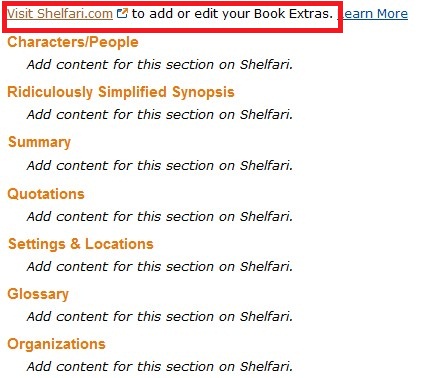
    Shelfari (refers to enhanced metadata as Book Extras)

    Shelfari is a social networking and book cataloging site which powers much of the enhanced metadata provided to Amazon.com. Existing Book Extras data can be seen either by accessing a particular book’s page at Shelfari.com or by accessing the book’s page via your Author Central account at Amazon.com.

    More about Shelfari Book Extras

    Goodreads (refers to enhanced metadata as Book Metadata)

    Goodreads, like Shelfari, is a social networking and book cataloging site. Goodreads feels to me like a much more engaging platform than Shelfari, with far more opportunities for networking with readers.

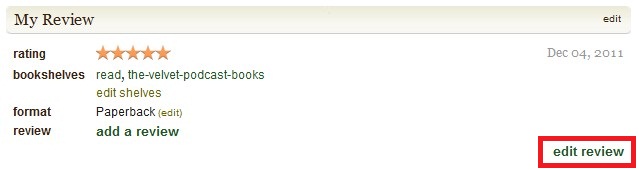
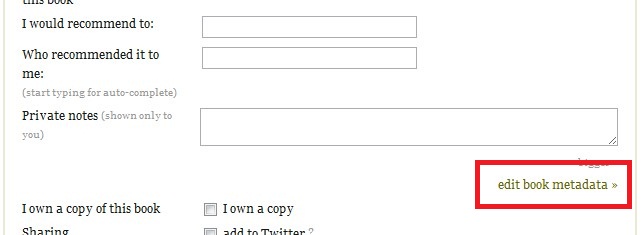
    To access the Book Metadata at Goodreads, first click on the “edit review” link of any book you’ve read. On the next page, toward the bottom, you’ll click on the “edit book metadata” link.  If you have not read a book, Goodreads requires that you become a “librarian” to edit the Book Metadata.

    Goodreads also allows some users to become Librarians, meaning they are able to edit not only book metadata, but also all information about a book including authors, descriptions, publishers, page numbers, and on and on. I highly recommend applying for librarian status. Not only am I an organization nerd, I love being able to more fully control the data with the books I’ve written.

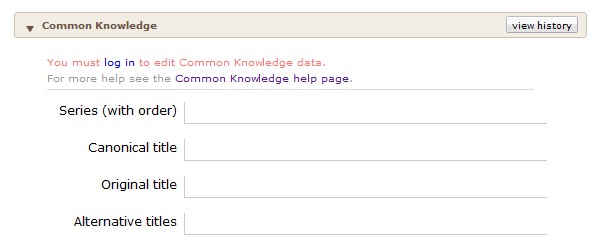
    LibraryThing (refers to enhanced metadata as Common Knowledge)

    LibraryThing is yet another book networking site, and in my opinion is the least user-friendly. But readers use it, so as an author it’s important for me to be there.

    To access the Common Knowledge section, simply open up an existing book page and scroll down to about the middle of the page.

    More information about the LibraryThing Common Knowledge metadata can be found here.

    Additional information on metadata (as well as general SEO information for authors) can be found in this amazing PBS.org article, “A Self-Publisher’s Guide to Metadata for Books.”

    top photo credit: http://www.flickr.com/photos/leprecon/

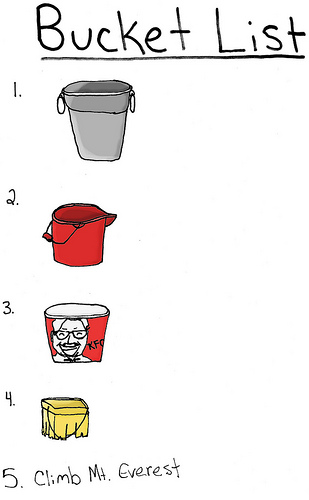
  • How can a happenstance bucket list lead to compelling characters?

    How can a happenstance bucket list lead to compelling characters?

    Bucket lists are generally grandiose compilations of big events with universal appear. So, you want to swim with the dolphins and go cave spelunking in Chile? Well, who the hell doesn’t want to do those things? Big events do not a compelling character make.

    I believe I’ve taken the bucket list concept to a much more satisfying place, one that celebrates happenstance and relative minutiae rather than expensive plane tickets and vacation photo fodder.

    For a long time, I’ve been paying attention to the unique moments of my life, ones that more often than not seem to materialize without any provocation, but that are nonetheless sources of pride. Here are a few examples of the accomplishments on my bucket list:

    What is the impact of these items in terms of character development?

    The way a character reacts to each of the events above says a great deal about the mental state and lifestyle of the character. Does a character routinely get free drinks on an airplane? If so, how? If not, how would this character react to such a unique gesture? Would a character witnessing a light bulb burn out assume he caused the light to burn out? Was there a big event happening when the light went out, such as a wedding, award ceremony, or something smaller like a criminal interrogation? Who is the day-stranger friend? How did this friend meet your story’s character? Perhaps the meeting was planned without one of the parties knowing. Who was in the car wreck? How was it that our character was in the right place at the right time to witness this car wreck? Why did the character call 911? Was it a prank call? And on and on and on…

    By contrast, a character connected to a big event from a traditional bucket list item (such as skydiving or swimming with dolphins) may simply be the product of a plot rather than a rounded character in his own right.

    Traits implied by a happenstance bucket list puts the focus on the character rather than on the plot. What are some items on your happenstance bucket list?

    Photo credit: http://www.flickr.com/photos/ratatatratsy/

  • A Taste of Philosophies to Come. Further Thoughts on Writing and Publishing.

    A Taste of Philosophies to Come. Further Thoughts on Writing and Publishing.

    Earlier this afternoon Pablo D’Stair, as he is apt to do, asked some questions that made me evaluate my writing in way that I haven’t before. Not deeper, necessarily. Just different.

    I won’t copy the questions and answers verbatim here—as I believe Pablo has something planned for the full discussion—but I don’t think he’ll mind if I mull over a few of the topics for a bit.

    Literary and Genre

    Do you think of what you do as “genre” writing and if so or if not, do you see a difference (and what is it) between writing termed genre and writing termed literary?

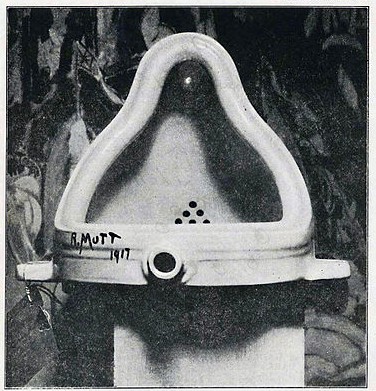
    In common use “genre” equates fiction created to entertain while “literary” refers to fiction created to enlighten. Here’s where the dispute originates, in that the differences are with intent rather than the end product. When something cannot be judged 100% objectively, there’s going to be disagreement. Hell, that’s why conceptual art, you know, Duchamp’s R. Mutt urinal and such, is so polarizing. Some people would call The Fountain trash. Others would call it art. The fact is, it’s both. Genre and literary are not mutually exclusive.

    Genre refers to tangible measures like content, setting, plot, etc. Literary refers to the way in which those tangibles are executed.  For example, a novel that people of the first distinction might call literary, Freedom by Jonathan Franzen, is most definitely literary. But, like everything, it has a genre as well: domestic fiction or environmental fiction (or any number of other categories). Following that logic, two books could share genre, but not necessarily both be literary. Stephen King’s It is horror and so is Mark Z. Danielwski’s House of Leaves, but only the latter could be called literary.

    Expression and Intention

    Are you a writer who seeks to express yourself, personally and primarily or a writer who seeks to kind of “set down something for other people” pulled from a personal place or not?

    I’m never one to simply express myself. Rather, I use writing to mull over my own philosophies, to textualize them so that I may have a physical referent for any future questions regarding those philosophies, an artifact of sorts to say, “This is what I believe about this subject.” Also, I love to hearing the way great word-combinations sound, especially when used to describe grotesque situations. So, it’s a mix of giving permanence to my own philosophies and seeing beautiful words. Oddly enough, though, I don’t care for poetry, which would logically seem to satisfy both of those goals.

    Legacy Publication and Self-Publication

    Considering the landscape of “writing” and “publishing” these days, and considering the micro-press level, do you see any specific reason for “publishers” to exist?

    The way I see it, there are three components of success—what most people would define as success—when it comes to being an author: readership, sales, and prolificacy. I think the lure of the publisher is the potential to grow all three areas with perceived ease. But what a new generation of writers is beginning to understand is that the writers themselves can, with equal ease (though not to imply that either way is truly easy) accomplish the readership and prolificacy aims without the aid of a publisher. Sales, too, but that one is still difficult, at least to the level that it takes to be a full-time author. I think it’s up to the publisher to adapt. A publisher needs to understand that authors can gain readership and can write plenty. A publisher needs to then reallocate resources away from these two areas and bring more attention to sales. Meaning, promotion, PR, events, etc.

    Ultimately, the tendency for an author to favor legacy publishers over self-publishing implies a certain degree of ego. Readers, for the most part, don’t care how a book gets published. In fact, most readers probably don’t know the publishers of even their favorite books. Among writers, for one to claim one of the Big Six legacy publishers as their own means that the writer had navigated a difficult series of desks and wallets to have the book published. The end physical product is the same as a self-published author, but the implied journey is much different. And I think the perception is valid. It’s about winning something more than readers.

    Getting a book published with a legacy publisher is more difficult than self-publishing or publishing with a small independent publisher. It’s that simple. But again, as far as the general reader is concerned, the publisher is irrelevant. Though, I would love to live in time when readers were passionate about publishers the way, say, music lovers tend to be about independent record labels.

    Did Crime Come to You or Did You Go to Crime?

    You write what could be considered crime fiction, noir fiction.  Do you approach it with crime fiction tropes in mind are you drawn to an extremely general idea?

    Drawn to a general idea, for sure. In fact, only recently did I sit down to consciously write a crime story (for a forthcoming collection of novellas). I think the allure of crime for me—whether as a defined genre, or as a mashup of thematically similar tropes—is its inherent proximity to morality, which in turn speaks to the importance of characters. For me, writing is all about exploring my own philosophies through the lens of grotesque characters and situations. Crime lets me do that without compromise.

    I’m not against trying to “force” myself into a genre, though. I like the artificial construct of hard genre. I like a challenge. Hell, that’s what my writing philosophy is built around; challenging myself to confront personal philosophies.

    Risks and Risk Aversion

    Do you feel that the authors you admire take risks, and if so what do you mean by “risks”? In my experience, crime/noir (and horror) writers tend to spend a lot of time going on about “getting in touch with their dark side” or “going to places where they are uncomfortable” but I never really get the feeling they do that.

    I don’t buy the risks thing. Or, said better, I don’t care if a writer is taking risks—whether consciously or sub-. To me, a risk is when a writer does something that could potentially cripple something they’ve, until the moment of the risk, spent their writing lives building. So, for Stephen King to write a bodice ripper would be risky. For Pynchon to do a reality TV show would be risky. Neither of these would impress me. I love that Stephen King writes horror (though, for the record, I’m not a fan). I love that Pynchon is a recluse. These traits are important to the general perception of these authors and their work. A risk would be compromising those things.

    I think authors themselves don’t generally see themselves as risk-takers. They write what interests them. However, talking about being a risk taker adds to the sexiness of being an author that readers want (in the way that any public persona tends to dramatize their role for the sake of success). Those writers who say they are “getting in touch with their dark side” or “going to places where they are uncomfortable” aren’t describing truth; they are describing fiction. And isn’t fiction what they do best? Or, perhaps, they are simply using grandiose terminology for the act of mulling over personal philosophies, as a familiar author once said (me, above).