Blog

  • Why don’t I use guns in fiction?

    Why don’t I use guns in fiction?

    GetInTheFuckingBoat

    (This post isn’t so much a cohesive argument but more of a textualized exploration. I welcome contributions to the topic)

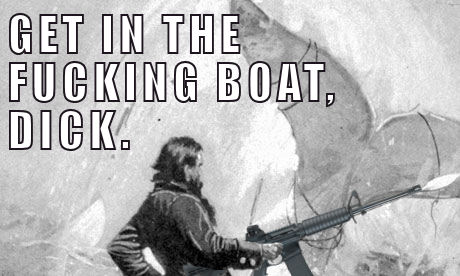
    I rarely incorporate guns into my fiction. To me, the (sudden) presence of a gun shifts the trajectory of a story much too easily. No matter how a character has been established during the preceding pages, a gun suddenly—and more importantly, unfairly—gives ultimate power to that character. When given a gun, either 1) a lackluster character becomes the fulcrum of a scene (or story) or 2) a well-developed character gets robbed of all the reader investment by artificially becoming the fulcrum of a scene (or story)[1]Of course there are exceptions. If the gun itself is important to the character’s makeup, or if the context of a story supports guns (a war story, for example), or, as in the case of one of my … Continue reading. Either way, a gun generally says to the reader “I’m a lazy author, and I don’t respect your time, reader.”
    LazyAuthorBut I do incorporate what I would consider valid character traits/histories. Some of the more common traits I use being difficult childhoods, physical deformities, and general familial strife.

    However, this morning, I asked myself what’s the difference between a physical deformity and a gun? Aren’t they both, in some way, just crutches used to advance plot. Some perhaps more nuanced than a gun, but still, aren’t they all simply elements designed to steer the plot’s trajectory?

    Is there a universal hierarchy of character traits, ranging perhaps from the most subtle (re: most acceptable and vetted) to the most obnoxious (re: the most potential to artificially steer a plot; re: gun)? Of course the answer is no; nothing is universal and there are plenty of examples of guns in quality fiction. But the question is worth exploring.

    Perhaps a better way to approach this topic is by asking, is it possible for a story to work without containing any narrative crutches at all? When asked this way, the same response, no, means so much more.

    Now that we can accept that a story MUST contain character traits (crutches), especially when we acknowledge that the very purpose of a character trait is to advance (re: steer) plot. The original concern then returns: are guns simply an especially lazy character trait. Yes. Yes they are.
    [references/]

    Footnotes

    Footnotes
    1 Of course there are exceptions. If the gun itself is important to the character’s makeup, or if the context of a story supports guns (a war story, for example), or, as in the case of one of my novels, the very power of something like a gun to quickly change a story’s trajectory is exactly one of the points of the novel.
  • Short Story Every Day: “That Lombardi Thing” from Phil Jourdan’s What Precision, Such Restraint

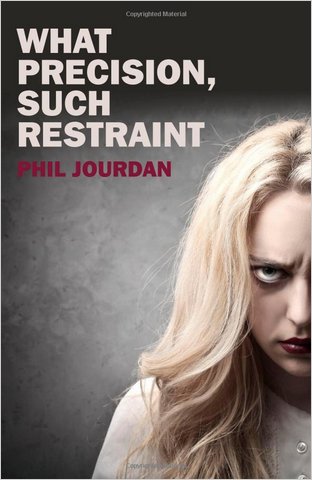
    Short Story Every Day: “That Lombardi Thing” from Phil Jourdan’s What Precision, Such Restraint

    Click to buy
    Click to buy

    I read an early version of this collection, What Precision, Such Restraint, a few years ago, during which time I must have been drunk, since though I recall enjoying the collection I don’t remember it being so front-loaded with genius.

    I read two stories today, the first and second, chronologically. Both are amazing, but it’s the second I want to mention here, “That Lombardi Thing” which encapsulates what I consider to be the absolutely best kind of story: voice-driven, thought-provoking, and never too full of itself. This is why I love Saramago. This is why I love Brian Evenson (though his characters do tend to be a bit full of themselves, the stories aren’t). This is what I try to write.

    “That Lombardi Thing” explores the made-up (I think made-up) concept of Freudhacking, which is the practice of switching a person’s conscious with their subconscious. Thought-provoking: check. The narrator is a one-time practitioner of Freudhacking who wants nothing more than to be left alone, never to practice again. Voice-driven: check. The occasion for the story is that this old man practitioner is approached by a man who wants to know what it’s like to live without language. The old man thinks he’s nuts. Never too full of itself: check.

    The author, Phil Jourdan, tries to pawn this collection off as just a literary experiment without any merit beyond its own pages. He even calls the book a bunch of terrible names during a live reading in Boston a few months ago. It’s just proof of his genius that by telling the world of the book’s insufficient origins Phil can then be free to write whatever he wants, and the reader, having been briefed of the rubbish, can’t complain. Well, the reader won’t want to complain, so you failed, Phil.

    Rules for Short Story Every Day posts, designed to make me have to work as little as possible

    1. I’m not allowed to take notes as I read
    2. My commentary on each story should involve as little research as possible. I’m reacting to the story on a visceral level, not an intellectual level (though I reserve the right for overlap should my visceral mix with my intellectual)
    3. “Every Day” should be taken as the headline grabber it’s intended to be. I probably won’t
  • FREE Caleb J. Ross novel. Read today. Change life tomorrow.

    FREE Caleb J. Ross novel. Read today. Change life tomorrow.

    GrumpyCat-FreeKevin

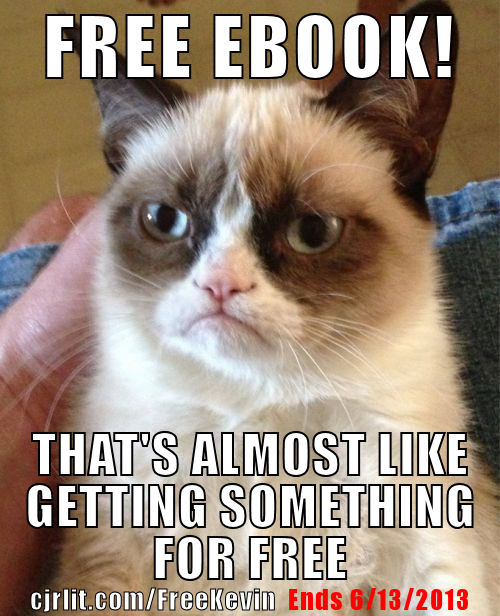
    Every once-in-a-while one of my novels gets promoted as a FREE Kindle eBook for about a week. That every-once-in-a-while has come again, now. Head over to Amazon.com to get your absolutely FREE copy of I Didn’t Mean to be Kevin. No fine print (except for the super fine ass print that is I Didn’t Mean to be Kevin).

    Click to start reading now: http://www.amazon.com/exec/obidos/ASIN/B0088QLPFM/thecalebrosso-20

    FREE not enough to convince you? Check out some of the wonderful things some wonderful people have said about this wonderful novel:

    Publishers Weekly

    “A stirring novel, this extraordinary work plays upon the reader’s willingness to suspend disbelief and turns it on its ear…The novel casts a similar spell on its readers…Covering ground similar to the works of Sherman Alexie and Chuck Palahniuk, this is an author worth keeping an eye on.”

    Rayo Casablanca, author of 6 Sick Hipsters and Very Mercenary (Kensington)

    “Brilliant…one of the most amazing fiction concepts I’ve ever read.”

    Joey Goebel, author of Torture the Artist and Commonwealth (MacAdam/Cage)

    “In I Didn’t Mean to Be Kevin, Caleb J. Ross writes fearlessly, never shying away from the wild, insane places where his fertile imagination leads him. The first half a twisted take on small-town aimlessness, the second half the American road novel from hell, the book is ultimately a darkly comedic evaluation of a generation of motherless men.”

    Paul Tremblay, author of  The Little Sleep and No Sleep til Wonderland

    You read this for the truly memorable cast of characters and Caleb’s smart, funny, and imaginative spin on a Palahniukian conceit…Here’s hoping some of that mainstream audience can pull their heads out of their asses long enough to read Ross, and then be gloriously horrified.

    Ready to spend your hard earned nothing on this book? Go here now: http://www.amazon.com/exec/obidos/ASIN/B0088QLPFM/thecalebrosso-20

  • Short Story Every Day: “Sugarbaby” from William Gay’s I Hate to See that Evening Son Go Down

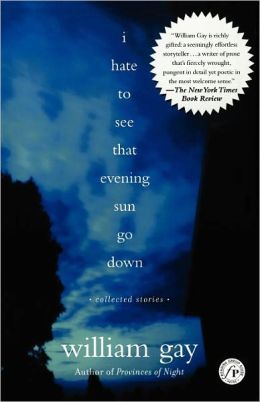
    Short Story Every Day: “Sugarbaby” from William Gay’s I Hate to See that Evening Son Go Down

    Click to buy
    Click to buy

    “Sugarbaby” from William Gay’s collected stories, I Hate to See that Evening Son Go Down captures slow, unaffected degradation of a marriage in ways I’ve never read before. The main couple, Beasley, and let’s say, Martha (as part of the rules, I’m not allowed to go back to the story at all, and I can’t remember the wife’s name) are seen within their small community as a pillar of marital perfection. They’ve en-joyed/-dured marriage longer than any other couple. One day, Beasley buys his wife a dog, a small, yap-yap-yap kind of dog, who doesn’t seem to appreciate the fine home Beasley has brought him into. Eventually, Beasley shoots the dog with a gun far larger than would be necessary to kill such a tiny animal. This fact, though not directly addressed, is mentioned only enough to be allowed to simmer in the reader’s head. This is what makes a Gay story so perfect: small actions and tiny mannerisms imply tremendous consequences.

    After a lifelong perfect marriage, Margaret suddenly abandons her husband. Beasley doesn’t react. This non-reaction is the impetus for an eventual divorce lawyer sent to Beasley’s house, a court supenona, and on and on the list goes, when really, Mildred never even tried to contact her husband after her split. This is where the reader is asked to pick a side. We choose Beasley because, yeah yap-yap dogs are terrible, and yeah, Megan should have given Beasley a phone call before sending in the law. What the fuck, Marge!

    So the reader roots for Beasley, yeah, perhaps by default, as we aren’t allowed to see Melissa’s side of the story. And sure, eventually Beasley kills a cop and “escapes” to live on his own in the wilderness, primarily to avoid paying 50% cash to his wife in lieu of 50% of his property (the property deal having long been decided by Melody’s lawyer as no longer enough), but despite all of this, we actually still feel for Beasley. It makes me wonder if my loyalty would be different if Beasley shot a real dog like a Golden Retriever.

    Rules for Short Story Every Day posts, designed to make me have to work as little as possible

    1. I’m not allowed to take notes as I read
    2. My commentary on each story should involve as little research as possible. I’m reacting to the story on a visceral level, not an intellectual level (though I reserve the right for overlap should my visceral mix with my intellectual)
    3. “Every Day” should be taken as the headline grabber it’s intended to be. I probably won’t
  • HeavyShelves asks writing questions. You learn something. Everybody wins.

    HeavyShelves asks writing questions. You learn something. Everybody wins.

    Andrew, known as HeavyShelves in BookTube land, was kind enough to invite me to a Google Hangout a few nights ago where he treated me like a rockstar for almost 3 hours. That’s a long time, especially when you consider the time frame was 12am – 3am his time (he’s in the UK).

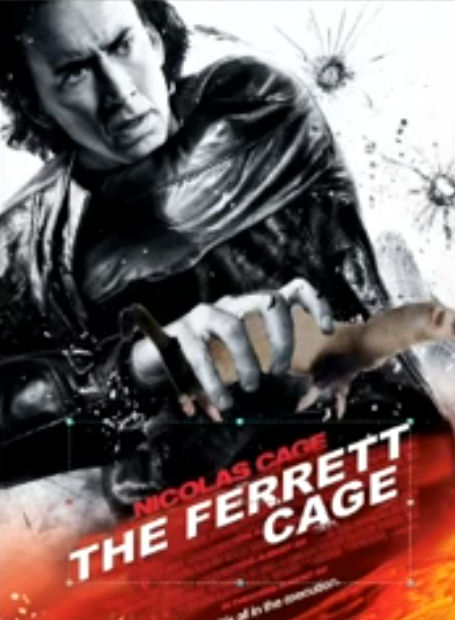
    I definitely encourage you to take a watch. Or, just listen, as you would a podcast (visually, it’s pretty much just webcam style cuts between his face and mine…except for one truly amazing appearance by Nicholas Cage…see image below).

    Andrew asked some great questions, and we had some great discussions. List for these gems:

    • My publishing history (and the importance of knowing people, starting here)
    • Writers need to know their productivity limitations (more about why I can’t be allowed to write 8 hours/day, starting here)
    • The importance of caring about what you write (the real “write what you know” advice, starting here)
    • What book am I working on now? (Southern Gothic set on an island, starting here)
    • And much, much, much more (starting everywhere)

    Nicholas Cage stops by:

    FerrettCage


  • Guest Post from Author Kevin Haworth: Fiction vs. Non-Fiction

    Guest Post from Author Kevin Haworth: Fiction vs. Non-Fiction

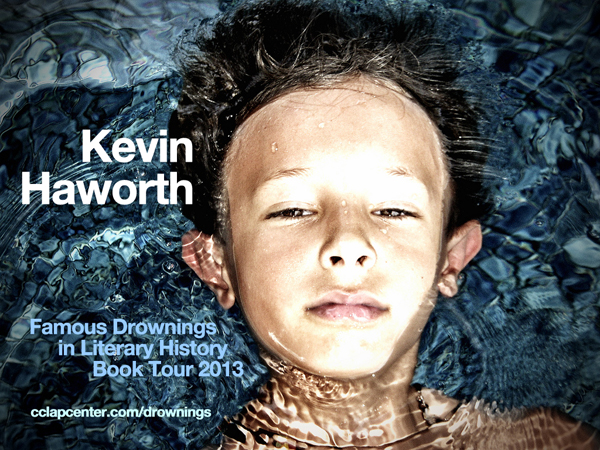
    Kevin Haworth

    The post below was written by author Kevin Haworth as part of his Famous Drownings in Literary History – Book Blog Tour. Learn more about Famous Drownings in Literary History at the publisher website.

    For a long time, I saw myself as a fiction writer.  But for me, fiction was always as much about the “real world” as it was about my own imagination.  For a future fiction writer, I was a very fact-oriented child; my most-read books were Zander Hollander’s Complete Handbook of Baseball series, a team-by-team listing of statistics, trivia, and odd personal info for every single major leaguer.  I read my share of fiction, too—everything from comic books to Jack London—but my shelves of sports encyclopedias, WWII histories, and pocket biographies always felt just as important in sparking my imagination.

    So it’s no surprise that writing my first novel involved a lot of reckoning with the facts.  The Discontinuity of Small Things is based on the German occupation of Denmark that began in 1940.  I spent eight years writing that book, not just developing the characters, but also immersing myself in the facts of that world—everything from European fashions of the 1930s to the market price for fish along the north Zealand coast.

    When I began writing the essays that would become Famous Drownings in Literary History, the process wasn’t all that different.  This time, the overall narrative wasn’t the events of the summer of 1943 in Copenhagen but rather my own life, or pieces of it, anyway—life on kibbutz in Northern Israel when I was twenty-one, my son’s circumcision just over ten years later, my daughter’s near drowning in a hotel pool in Columbus a few years after that.  But those essays are back-stopped, to use a baseball term, by other stories, discovered through an intensive research process, and all of them just as real: the deaths of hundreds of West Virginia miners in an industrial accident, the forced evacuation of Israeli settlers from the Sinai desert, a bus explosion in Bulgaria.  For me, fiction and non-fiction share an impulse and a process: to be comprehensive, encyclopedic.  I’m the Zander Hollander of my own mind.


    About Kevin Haworth

    haworthbiggest

    Kevin Haworth’s first novel, The Discontinuity of Small Things, was awarded the Samuel Goldberg Prize for best Jewish fiction by a writer under 40. It was also recognized as runner-up for the 2006 Dayton Literary Peace Prize. His collection of non-fiction essays, Famous Drownings in Literary History, was released by CCLaP in 2012, and won Kevin a pre-publication grant from the Ohio Arts Council. A two-time resident of the Vermont Studio Center, he is also a winner of the David Dornstein Prize for Young Jewish Writers and the Permafrost Fiction Prize. His fiction and nonfiction appear in Sentence, ACM, Poetica, Permafrost, and others. He lives in Athens, Ohio with his wife, Rabbi Danielle Leshaw, and their two children, Zev and Ruthie. He teaches writing and literature at Ohio University.

  • Week Five of Reading Harry Potter for Babies – THANK YOU!

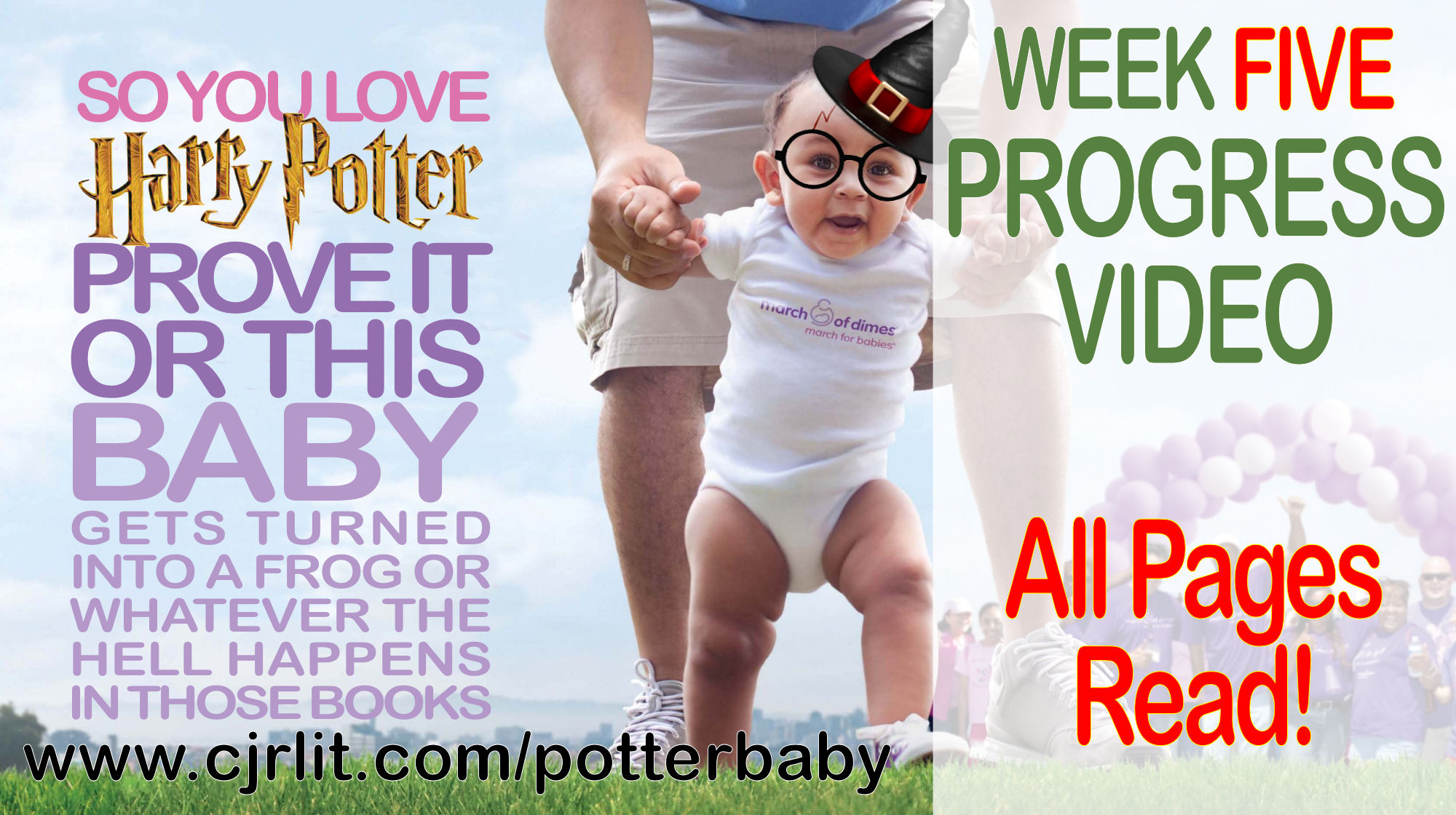
    Week Five of Reading Harry Potter for Babies – THANK YOU!


    This is it, the last video in my Reading Harry Potter for Babies series.

    Every year I raise money for March of Dimes, which is a foundation established to study the causes and develop cures for premature birth. This year, rather than simply beg friends and family for donations, I’m taking donations to read Harry Potter. More about this strange donation tactic at the full intro video here:http://www.youtube.com/watch?v=cCVBPVLXJAU

    I want to thank every single person who donated money to this great cause. In total, we raised over $600, which meant I had enough money to completely finish reading the first Harry Potter book, but more importantly that’s $600 more dollars going toward the March of Dimes effort.

    Apologies if I mispronounce names

    Special Thanks to

    • Simon West-Bulford (http://www.simonwb.com/)

    ManArchy Magazine (http://www.manarchymag.com)

    • Jesse Wichterman
    • Misty Bennett
    • Gordon Highland (http://www.gordonhighland.com)

    Books and Booze podcast

    • Renee Pickup (http://www.books-booze.com/ and http://www.youtube.com/user/BooksnBooze)

    Booktubers/Readers

    • Chenoa Shannon (http://www.youtube.com/chenoash)
    • Martine Svanevik (http://nascentnovelist.wordpress.com/)
    • Rincey Abraham (http://www.youtube.com/user/rinceyreads)

    Books, Beer, and Bullshit podcast

    • Frank Edler (http://booksbeerbullshit.podbean.com/)

    Others

    • Cassandra Chu
    • Warren Mueller 
    • Sean Nickerson
    • Roxy, Ryan, Kyler and Kailey Marcotte
    • Adonna and Christian Thompson
    • Karsten Weseth
    • Erin Pettit